Faculty Accomplishments
Page 16 of 61
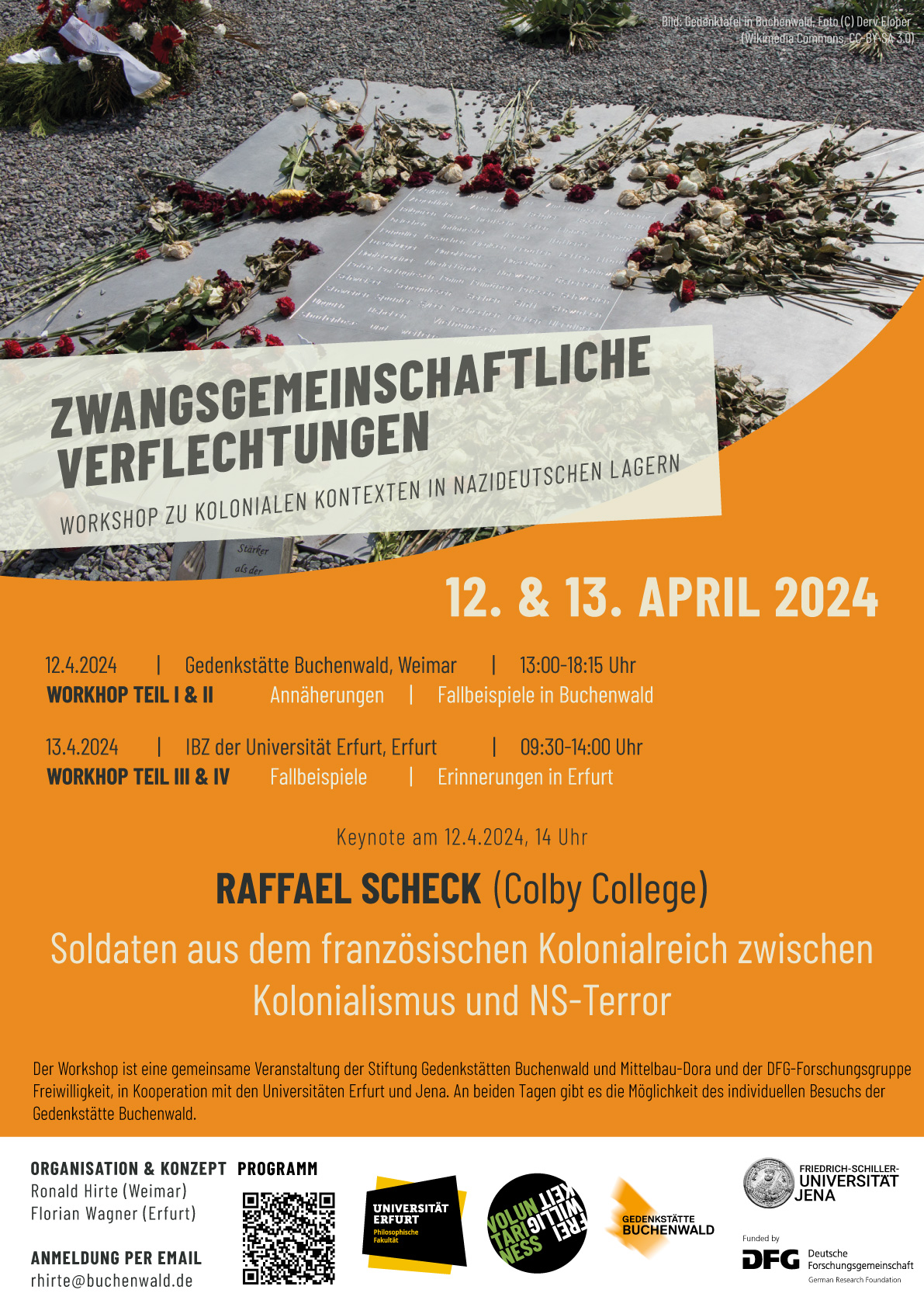
Raffael Scheck, the John J. and Cornelia V. Gibson Chair in History, delivered a keynote address at a conference in Germany marking the anniversary of the liberation of the Nazi concentration camp of Buchenwald on April 11, 1945. His talk was titled "French Colonial Soldiers between Nazi Terror and Colonialism."
Associate Professor of Environmental Studies Stacy-ann Robinson has been selected to be part of the 2024 cohort of the Wrigley Institute Storymakers Fellows. Launched in 2022, Storymakers is a first-of-its-kind program that trains mid-career environmental and sustainability researchers in the art of storytelling so they can reach the public with creative and compelling narratives that inspire positive change. Fellows must show an established, influential body of work on environmental or sustainability topics and a demonstrated commitment to public outreach. They come from leading academic institutions, national and independent laboratories, and environmental organizations across North America.
Associate Professor of Environmental Studies Stacy-ann Robinson was an invited speaker at the Jamaica Hotel and Tourist Association's Climate Resilience Symposium. She spoke about the ways in which the local tourism sector can balance economic growth with environmental sustainability, and she shared transformative ideas that can significantly elevate the sector's resilience to coastal vulnerabilities. The symposium was a gathering of political leaders, national-level tourism and disaster decision-makers, hoteliers, community stakeholders, and students.
For the spring issue of the Maine Arts Journal, Professor of Art Véronique Plesch wrote the introduction to the issue as well as an essay for her "Art Historical Musings" column titled "Dark Dreams." In the essay, she discusses publications that affirm the fundamental role of dreams for the Surrealist ethos and works by visual artists who had “the courage to dream” and thus face the dark recesses of the unconscious mind.
Assistant Professor of Philosophy Ben Baker was the lead author in the paper "Computational Kinematics of Dance: Distinguishing Hip Hop Genres," published in the journal Frontiers in Robotics and AI. Noting that the field of dance "would benefit from a general, quantitative and human-understandable method of characterizing meaningful differences between aspects of any dance style; a computational kinematics of dance," Baker and his team introduced and applied "a novel system for encoding bodily movement as 17 macroscopic, interpretable features, such as expandedness of the body or the frequency of sharp movements. We use this encoding to analyze Hip Hop Dance genres, in part by building a low-cost machine-learning classifier that distinguishes genre with high accuracy," according to the paper's abstract.
Assistant Professor of Chemistry Greg Drozd published a paper in the journal Environmental Science: Atmospheres about his research on wildfire emissions. The paper, titled "Wavelength-resolved quantum yields for vanillin photochemistry: self-reaction and ionic-strength implications for wildfire brown carbon lifetime," is part of the journal's themed collection on wildfire impacts on atmospheric composition. This is Drozd's first work on wildfire emissions, and the paper will be featured on the cover of the journal's May edition.
Associate Professor of Psychology Jen Coane has won the 2023-24 Psychology Mid-Career Mentor Award from the Council on Undergraduate Research's Psychology Division. Coane, who studies cognitive psychology, memory, and cognitive aging, was selected for her success in incorporating research in both classroom and laboratory settings. She has authored 18 peer-reviewed articles and 41 poster presentations with undergraduate coauthors. As the awardee, Coane will deliver a virtual presentation through the council at 2 p.m. on March 25.
Sheets Publishes Paper on Outcomes in BIPOC and First-Gen Students in Clinical Psychological Science
Associate Professor of Psychology Erin Sheets published a paper in the journal Clinical Psychological Science titled "A Brief Group Social-Belonging Intervention to Improve Mental-Health and Academic Outcomes in BIPOC and First-Generation-to-College Students." The paper reported on a brief social-belonging intervention that significantly reduced risk for depression over the first two years of college and specifically reduced risk for participants experiencing more discrimination. The research was conducted at Colby, with the brief intervention led by Colby student research assistants.
Jennifer Yoder, the Robert E. Diamond Professor of Government and Global Studies, has published a new book, World War II Memory and Contested Commemorations in Europe and Russia (Oxford University Press, 2024). "Using a comparative, conceptually original approach, the book identifies the actors who manipulate memory surrounding wartime anniversaries, such as the bombing of Dresden and ceremonies to honor fallen soldiers and fascist collaborators," said Yoder, who has special interests in German politics, remembrance and reckoning after communism, and borderlands in Europe. This is her third book.
In January 2024, Professor of Art Véronique Plesch led a group of 20 Colby-connected people to Sicily for a type of "Alumni Jan Plan." Titled "Sicily, Crossroads of Cultures: Art, Architecture & Cuisine," the 13-day trip "entailed a near-circumnavigation of the island of Sicily to explore its many treasures and extraordinary range of cultures," according to Bruce Drouin '74, who instigated the trip. Plesch lined up an itinerary with sites (a staggering number of which are on the UNESCO World Heritage List) that retraced the many cultures and artistic styles that left their mark on the island: Phoenician, ancient Greek and Roman, Jewish, Byzantine, Muslim, Norman, Gothic, Romanesque, Mannerist, and Baroque—all the way to 20th- and 21st-century contemporary art. Plesch also took the group to a winery, an artisanal chocolate maker, and a hillside olive oil maker.