External Posts
Page 144 of 178
Cartoonist Lincoln Peirce '85 was listed as one of the 10 most intriguing people in Maine in Portland Monthly magazine. As the creator of the popular comic series Big Nate, Peirce has also drawn eight Big Nate books. "These hybrids of text and pictures held down a top ten slot on the New York Times bestseller list for over 140 weeks. Sales of the series plus compilations have topped 18 million books," Portland Monthly reports.
Marine toxicologist Riki Ott '76, director of the nonprofit ALERT, discussed the lasting effects of the BP oil spill in the Gulf of Mexico on an NBC News feature. "ALERT and its allies filed a lawsuit on Jan. 30, 2020, to force the Environmental Protection Agency to finalize its rules on the use of chemical dispersants in oil spill response. ALERT has since launched a campaign to further update the entire plan to protect workers and families from toxic exposures during oil-chemical disasters," according to the organization.
Marine toxicologist Riki Ott '76, director of the nonprofit ALERT, discussed the lasting effects of the BP oil spill in the Gulf of Mexico on an NBC News feature. "ALERT and its allies filed a lawsuit on Jan. 30, 2020, to force the Environmental Protection Agency to finalize its rules on the use of chemical dispersants in oil spill response. ALERT has since launched a campaign to further update the entire plan to protect workers and families from toxic exposures during oil-chemical disasters," according to the organization.
Following the announcement of Colby's bold initiative, Pay in Northward, President Greene was interviewed on NPR's Marketplace Morning Report program to discuss the College's plan to find postgraduate opportunities for members of the Class of 2020. The show's host, David Brancaccio, asked about what types of jobs Colby hopes to secure for its graduates. "It’s important that they end up with a great job," President Greene responded. "I’ll tell you, really interesting studies that have been done on what happens to graduates and recessionary jobs, and their wages are often depressed for 15 years or more when they come out in a substandard job. One of the ways that they often catch up is by job-hopping. So if we can avoid that for this graduating class, and I think we can, then it’ll make a huge difference for them."
Two poems by Professor of English and Creative Writing Adrian Blevins are included in the Spring 2020 issue of Washington Square Review. The poems, "Northern Status Anxiety" and "Overall Status" are from Blevins's manuscript-in-progress, Status Pending.
Assistant Professor of Spanish Bretton White has a new book out: Staging Discomfort: Performance and Queerness in Contemporary Cuba (University Press Florida, June 2020). "Following the 1959 revolution, nonconformists were monitored and reported by local committees and punished or reformed by the government. Censorship was rampant, and Cuban art suffered as the state tried to control the national message. Through the lens of queer theory, White explores how the body has been central to the state’s fear-based marginalization of gay life and looks at the ways these theatrical performances defuse that fear," according to UPF's website.
Professor of History Paul Josephson has a new book out titled Chicken: A History from Farmyard to Factory (Polity, June 2020) that looks at the history of the "most plentifully eaten and popular animal protein in the world." The book tells the story of "the chicken's rise [that] involves a whole host of factors; from art, to nineteenth-century migration patterns to cold-war geopolitics" and how the chicken transformed from a "backyard scratcher to hyper-efficient industrial meat-product." Josephson also discusses the endearing qualities of chickens and shows that "the chicken’s relationship to humanity runs deep; by treating these animals as mere food products, we become less than human."
Neil Gross, the Charles A. Dana Professor of Sociology, was a guest on New Hampshire Public Radio's show Lifelines discussing collective trauma in the time of the COVID-19 pandemic. When asked what can help heal collective trauma, Gross responded, "I think a big part of it has to do with leadership and what people, from politicians, to faith leaders, to writers and others, what kinds of stories they can tell, what kinds of things they can say to help people put things in perspective and get a better sense on what's happened and how they can move forward and find meaning in moving forward."
On the eve of the 50th anniversary of the shootings at Kent State, Down East magazine released the article "The Moment That Presaged a Maine Senator’s Downfall," which recalls a May 10, 1970, event with the senator at Colby, six days after Kent State. "Shocked by the horror of it all, Colby junior and student government president Stephen Orlov had spent the previous week contacting his fellow student representatives at colleges across Maine, convincing 16 of them to endorse a telegram inviting the state’s two senators to an all-Maine student event. Its wording was more command than invitation: 'Return home and address yourself to the people whom you represent.'”
Associate Professor of Biology Dave Angelini has been named to the executive committee of the Society for Integrative and Comparative Biology (SICB), the largest and most prestigious professional association of its kind. Angelini will serve as chair of the Division of Evolutionary Developmental Biology starting in January 2021.
An expert in evolutionary developmental biology (EvoDevo), Angelini said he was honored to be asked to join the society. His appointment comes on the heels of a four-year position as secretary of the Pan-American Society for Evolutionary Developmental Biology.
The SICB, founded in 1902, encourages interdisciplinary cooperative research that integrates across various aspects of biology, promoting new models and methodologies to enhance research and education, Angelini said.
As chair, Angelini will advocate for other EvoDevo professionals, especially students and early-career researchers and professors.
“I’m going to be very interested in undergraduate involvement with the society,” Angelini said. He would like to invite the SICB to provide recommendations around the undergraduate curriculum in the field of evolutionary developmental biology, a subject not often included in the undergraduate curriculum. “But I teach it at Colby,” Angelini said, “and I’d just love to give some serious thought to how the field can be represented and ways to make that happen and resources to provide to support people who want to do it.”
[caption id="attachment_43617" align="aligncenter" width="580"]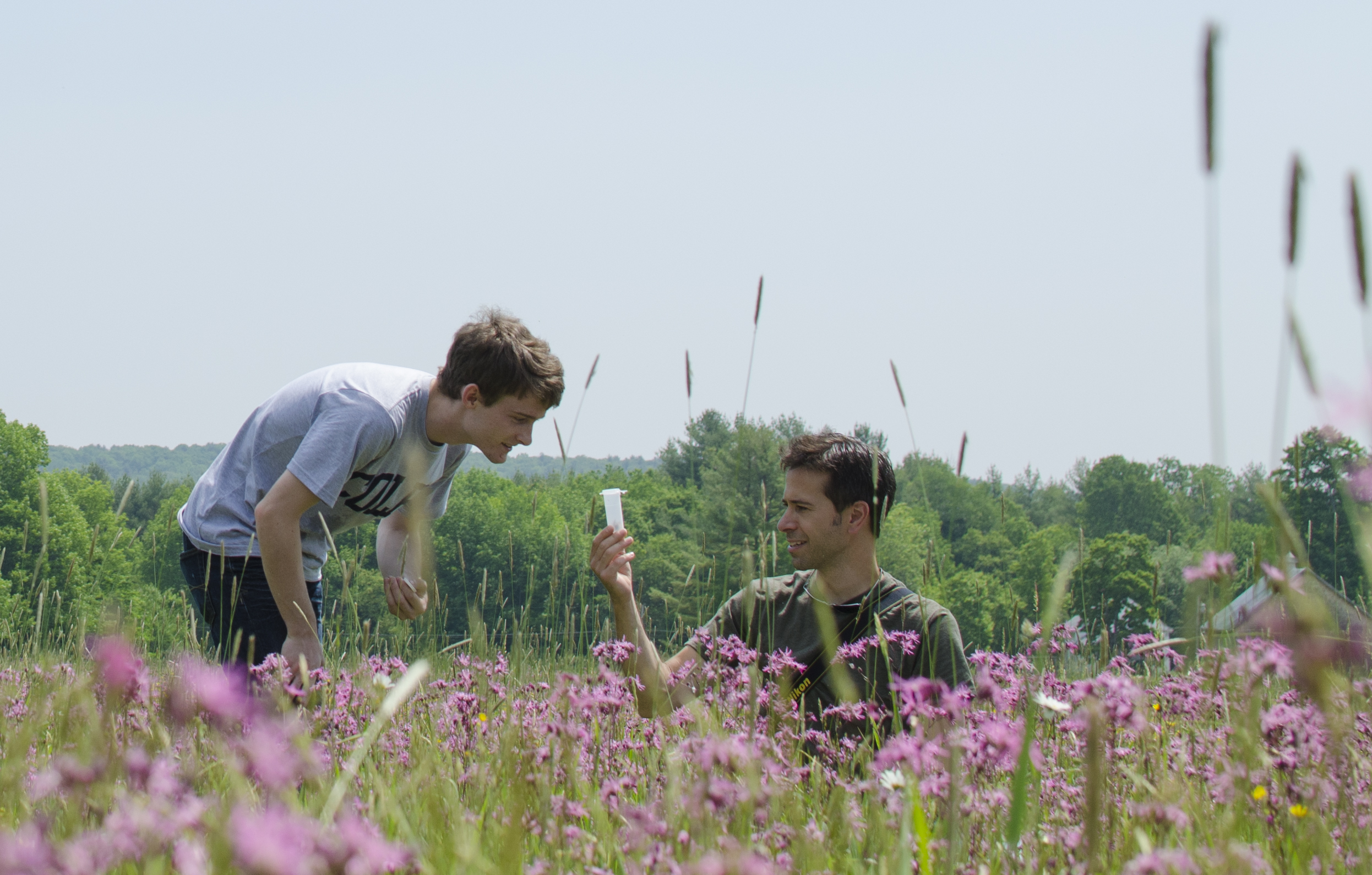 Associate Professor of Biology Dave Angelini, right, in the field conducting research on bumblebees. Angelini has been elected to the executive committee of the Society for Integrative and Comparative Biology.[/caption]
Supporting students and junior members of the field is key to the society’s mission. “A lot of what we do revolves around trying to provide opportunities for people, especially from underrepresented parts of the world, Latin America, especially, to have a forum where they can present their work and get the kind of recognition amidst the larger scientific community that they deserve,” he said.
Angelini should know. As a student, he attended SICB meetings himself and found them important. ”They were very formative, very important experiences,” he said. ”So to the extent that I can provide that for other new people in the field, that's what I want to do.”
These opportunities include speaking at conferences, serving within the society, and attending society meetings, especially critical for students to present their work and expand their networks. Other opportunities exist through the society’s professional journals and with its robust online presence.
Among Angelini’s goals when he becomes chair is to expand the geographic inclusivity and education of the division, to make global connections and learn more broadly about what’s happening in the field. He also hopes to increase the society’s educational outreach to the general public and K-12 schools, using as a model his own citizen science project, Bugs in our Backyard.
Angelini believes strongly in the importance of having an understanding of the natural world, especially during this pandemic with so many people experiencing nature deprivation. “The natural world has impacts on our way of life, whether we choose to recognize that or not,” he said. “And I think as citizens it's really important for people to understand the role that biology plays in their lives, the impact that it can have on their lives.”
Associate Professor of Biology Dave Angelini, right, in the field conducting research on bumblebees. Angelini has been elected to the executive committee of the Society for Integrative and Comparative Biology.[/caption]
Supporting students and junior members of the field is key to the society’s mission. “A lot of what we do revolves around trying to provide opportunities for people, especially from underrepresented parts of the world, Latin America, especially, to have a forum where they can present their work and get the kind of recognition amidst the larger scientific community that they deserve,” he said.
Angelini should know. As a student, he attended SICB meetings himself and found them important. ”They were very formative, very important experiences,” he said. ”So to the extent that I can provide that for other new people in the field, that's what I want to do.”
These opportunities include speaking at conferences, serving within the society, and attending society meetings, especially critical for students to present their work and expand their networks. Other opportunities exist through the society’s professional journals and with its robust online presence.
Among Angelini’s goals when he becomes chair is to expand the geographic inclusivity and education of the division, to make global connections and learn more broadly about what’s happening in the field. He also hopes to increase the society’s educational outreach to the general public and K-12 schools, using as a model his own citizen science project, Bugs in our Backyard.
Angelini believes strongly in the importance of having an understanding of the natural world, especially during this pandemic with so many people experiencing nature deprivation. “The natural world has impacts on our way of life, whether we choose to recognize that or not,” he said. “And I think as citizens it's really important for people to understand the role that biology plays in their lives, the impact that it can have on their lives.”
Associate Professor of Biology Dave Angelini, right, in the field conducting research on bumblebees. Angelini has been elected to the executive committee of the Society for Integrative and Comparative Biology.[/caption]
Supporting students and junior members of the field is key to the society’s mission. “A lot of what we do revolves around trying to provide opportunities for people, especially from underrepresented parts of the world, Latin America, especially, to have a forum where they can present their work and get the kind of recognition amidst the larger scientific community that they deserve,” he said.
Angelini should know. As a student, he attended SICB meetings himself and found them important. ”They were very formative, very important experiences,” he said. ”So to the extent that I can provide that for other new people in the field, that's what I want to do.”
These opportunities include speaking at conferences, serving within the society, and attending society meetings, especially critical for students to present their work and expand their networks. Other opportunities exist through the society’s professional journals and with its robust online presence.
Among Angelini’s goals when he becomes chair is to expand the geographic inclusivity and education of the division, to make global connections and learn more broadly about what’s happening in the field. He also hopes to increase the society’s educational outreach to the general public and K-12 schools, using as a model his own citizen science project, Bugs in our Backyard.
Angelini believes strongly in the importance of having an understanding of the natural world, especially during this pandemic with so many people experiencing nature deprivation. “The natural world has impacts on our way of life, whether we choose to recognize that or not,” he said. “And I think as citizens it's really important for people to understand the role that biology plays in their lives, the impact that it can have on their lives.”