External Posts
Page 151 of 178
Current Ocean Crisis Indicates Land May Be Experiencing Even More Stress
New research from an international team of scientists led by Colby College Professor of Geology Robert Gastaldo appears this week in Nature Communications, the world's leading multidisciplinary science journal. Titled “The base of the Lystrosaurus Assemblage Zone, Karoo Basin, predates the end-Permian marine extinction,” the publication of the paper in this prestigious journal once again highlights Colby’s deep expertise and excellence in the sciences.
[caption id="attachment_43434" align="alignright" width="300"]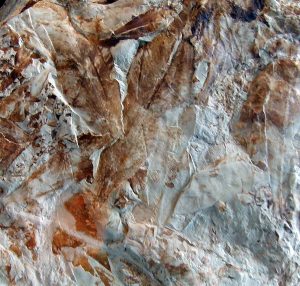 Leaf of Glossopteris, the most common and dominant southern hemisphere tree before ecosystem disturbance in the late Permian. Photo courtesy of M. Grey, Joggins UNESCO World Heritage site, Nova Scotia.[/caption]
The research, which was funded by the National Science Foundation, reveals that at the time when planet Earth experienced the greatest loss of biodiversity, during what is known as the end-Permian mass extinction about 251.9 million years ago, biodiversity on land suffered several hundreds of thousands of years before biodiversity crashed in the ocean.
“If changes in biodiversity on land preceded the biodiversity changes in the ocean during the Great Dying, which is what our paper shows, the current changes that we’re now seeing in the ocean may mean we’re close to reaching a major tipping point and crisis on land,” said Gastaldo, the Whipple-Coddington Professor of Geology at Colby. “In other words, not only are the plants and animals on land the canary in the coal mine, but the canary may already be threatened or, at the very least, quickly approaching an imbalance. The bottom line is that, while we’ve largely focused on the crisis in the ocean and how it will, or could, affect organisms on land, there is now solid evidence that land may be the first to respond.”
Gastaldo added that the timing of the turnover seems to be coincident with the beginning of massive volcanic activity that occurred in what is now Siberia. Over the course of less than one million years, this volcanic episode emplaced a volume of lava and other igneous rocks approaching 720,000 cubic miles. Those rocks now cover 80 percent of Siberia. This activity significantly increased atmospheric gas concentrations, including carbon dioxide, methane, sulfur, and mercury. “Essentially what was happening then is what we’re seeing now—a massive release of damaging gases that alter the way in which Earth systems operate,” he said.
With the publication of this paper, the turnover in vegetation across the landscape in the Southern Hemisphere during the end-Permian mass extinction—including the loss of a major group of seed plants that formed extensive forests—has now been documented in both Australia and South Africa at the same time.
[caption id="attachment_43435" align="alignleft" width="300"]
Leaf of Glossopteris, the most common and dominant southern hemisphere tree before ecosystem disturbance in the late Permian. Photo courtesy of M. Grey, Joggins UNESCO World Heritage site, Nova Scotia.[/caption]
The research, which was funded by the National Science Foundation, reveals that at the time when planet Earth experienced the greatest loss of biodiversity, during what is known as the end-Permian mass extinction about 251.9 million years ago, biodiversity on land suffered several hundreds of thousands of years before biodiversity crashed in the ocean.
“If changes in biodiversity on land preceded the biodiversity changes in the ocean during the Great Dying, which is what our paper shows, the current changes that we’re now seeing in the ocean may mean we’re close to reaching a major tipping point and crisis on land,” said Gastaldo, the Whipple-Coddington Professor of Geology at Colby. “In other words, not only are the plants and animals on land the canary in the coal mine, but the canary may already be threatened or, at the very least, quickly approaching an imbalance. The bottom line is that, while we’ve largely focused on the crisis in the ocean and how it will, or could, affect organisms on land, there is now solid evidence that land may be the first to respond.”
Gastaldo added that the timing of the turnover seems to be coincident with the beginning of massive volcanic activity that occurred in what is now Siberia. Over the course of less than one million years, this volcanic episode emplaced a volume of lava and other igneous rocks approaching 720,000 cubic miles. Those rocks now cover 80 percent of Siberia. This activity significantly increased atmospheric gas concentrations, including carbon dioxide, methane, sulfur, and mercury. “Essentially what was happening then is what we’re seeing now—a massive release of damaging gases that alter the way in which Earth systems operate,” he said.
With the publication of this paper, the turnover in vegetation across the landscape in the Southern Hemisphere during the end-Permian mass extinction—including the loss of a major group of seed plants that formed extensive forests—has now been documented in both Australia and South Africa at the same time.
[caption id="attachment_43435" align="alignleft" width="300"]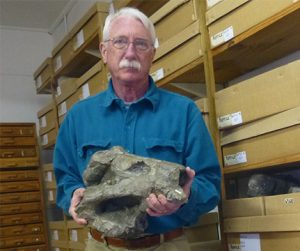 Skull of Lystrosaurus maccagi, a common Late Permian synapsid tetrapod in the Karoo Basin, South Africa, held by Robert Gastaldo for scale. Specimen in the collections of the Albany Museum, Grahamstown, South Africa. Photo courtesy of R.A. Gastaldo.[/caption]
“We are incredibly proud of Bob’s ongoing accomplishments and congratulate him on having his research published once again in such a prestigious publication,” said Margaret McFadden, provost and dean of faculty at Colby College. “His work is reflective of science programs that are unparalleled for a small liberal arts school and that are truly having an impact by addressing the major issues and challenges affecting our world.”
This is the third time that Professor Gastaldo has been published in Nature. His most recent article in the journal, “Ancient plants escaped the end-Permian mass extinction,” discussed what happened to terrestrial plants during the end-Permian crisis.
Skull of Lystrosaurus maccagi, a common Late Permian synapsid tetrapod in the Karoo Basin, South Africa, held by Robert Gastaldo for scale. Specimen in the collections of the Albany Museum, Grahamstown, South Africa. Photo courtesy of R.A. Gastaldo.[/caption]
“We are incredibly proud of Bob’s ongoing accomplishments and congratulate him on having his research published once again in such a prestigious publication,” said Margaret McFadden, provost and dean of faculty at Colby College. “His work is reflective of science programs that are unparalleled for a small liberal arts school and that are truly having an impact by addressing the major issues and challenges affecting our world.”
This is the third time that Professor Gastaldo has been published in Nature. His most recent article in the journal, “Ancient plants escaped the end-Permian mass extinction,” discussed what happened to terrestrial plants during the end-Permian crisis.
Leaf of Glossopteris, the most common and dominant southern hemisphere tree before ecosystem disturbance in the late Permian. Photo courtesy of M. Grey, Joggins UNESCO World Heritage site, Nova Scotia.[/caption]
The research, which was funded by the National Science Foundation, reveals that at the time when planet Earth experienced the greatest loss of biodiversity, during what is known as the end-Permian mass extinction about 251.9 million years ago, biodiversity on land suffered several hundreds of thousands of years before biodiversity crashed in the ocean.
“If changes in biodiversity on land preceded the biodiversity changes in the ocean during the Great Dying, which is what our paper shows, the current changes that we’re now seeing in the ocean may mean we’re close to reaching a major tipping point and crisis on land,” said Gastaldo, the Whipple-Coddington Professor of Geology at Colby. “In other words, not only are the plants and animals on land the canary in the coal mine, but the canary may already be threatened or, at the very least, quickly approaching an imbalance. The bottom line is that, while we’ve largely focused on the crisis in the ocean and how it will, or could, affect organisms on land, there is now solid evidence that land may be the first to respond.”
Gastaldo added that the timing of the turnover seems to be coincident with the beginning of massive volcanic activity that occurred in what is now Siberia. Over the course of less than one million years, this volcanic episode emplaced a volume of lava and other igneous rocks approaching 720,000 cubic miles. Those rocks now cover 80 percent of Siberia. This activity significantly increased atmospheric gas concentrations, including carbon dioxide, methane, sulfur, and mercury. “Essentially what was happening then is what we’re seeing now—a massive release of damaging gases that alter the way in which Earth systems operate,” he said.
With the publication of this paper, the turnover in vegetation across the landscape in the Southern Hemisphere during the end-Permian mass extinction—including the loss of a major group of seed plants that formed extensive forests—has now been documented in both Australia and South Africa at the same time.
[caption id="attachment_43435" align="alignleft" width="300"] Skull of Lystrosaurus maccagi, a common Late Permian synapsid tetrapod in the Karoo Basin, South Africa, held by Robert Gastaldo for scale. Specimen in the collections of the Albany Museum, Grahamstown, South Africa. Photo courtesy of R.A. Gastaldo.[/caption]
“We are incredibly proud of Bob’s ongoing accomplishments and congratulate him on having his research published once again in such a prestigious publication,” said Margaret McFadden, provost and dean of faculty at Colby College. “His work is reflective of science programs that are unparalleled for a small liberal arts school and that are truly having an impact by addressing the major issues and challenges affecting our world.”
This is the third time that Professor Gastaldo has been published in Nature. His most recent article in the journal, “Ancient plants escaped the end-Permian mass extinction,” discussed what happened to terrestrial plants during the end-Permian crisis.Writer and outdoor adventurer Blair Braverman '11 was a contestant on the reality show "Naked and Afraid," and she wrote about her experience for Outdoor magazine. Titled "Everything on 'Naked and Afraid' Is Real—and I Lived It," the piece is rich with Braverman's descriptions about her experience in South Africa. "When the Discovery Channel invited me to audition for its popular survival-challenge reality show, I knew it was going to be rough," she wrote. "What followed was one of the most intense experiences of my life."
Writer and outdoor adventurer Blair Braverman '11 was a contestant on the reality show "Naked and Afraid," and she wrote about her experience for Outdoor magazine. Titled "Everything on 'Naked and Afraid' Is Real—and I Lived It," the piece is rich with Braverman's descriptions about her experience in South Africa. "When the Discovery Channel invited me to audition for its popular survival-challenge reality show, I knew it was going to be rough," she wrote. "What followed was one of the most intense experiences of my life."
Associate Professor of Government Walter Hatch wrote an op-ed titled "With the coronavirus surging, compassion is more important than ever" that appeared in the Seattle Times March 20. The piece recounts the moment when students in Hatch's class learned the College would be moving to remote learning and sending students home three days hence.
In the midst of the emotions in the classroom, a student inquired about Hatch's plans, knowing Hatch splits his time between Seattle and Maine. Hatch was deeply touched by the student's concern. "It was an emotional reminder that, especially in this moment of 'social distancing,' we cannot live without compassion," Hatch wrote. "Sure, we can stock up on food, toilet paper, hand sanitizer, and face masks. But what we really need is community, a thick web of connections to one another across the social distance."
Associate Professor of Government Walter Hatch wrote an op-ed titled "With the coronavirus surging, compassion is more important than ever" that appeared in the Seattle Times March 20. The piece recounts the moment when students in Hatch's class learned the College would be moving to remote learning and sending students home three days hence.
In the midst of the emotions in the classroom, a student inquired about Hatch's plans, knowing Hatch splits his time between Seattle and Maine. Hatch was deeply touched by the student's concern. "It was an emotional reminder that, especially in this moment of 'social distancing,' we cannot live without compassion," Hatch wrote. "Sure, we can stock up on food, toilet paper, hand sanitizer, and face masks. But what we really need is community, a thick web of connections to one another across the social distance."
Professor of Economics Michael Donihue was tapped to comment on a March 20 Bangor Daily News article titled "Restaurant staff divvy up food, help each other file for unemployment, as they enter ‘panic mode’" that reported on the importance of seasonal business to Maine's economy. “We have a really vulnerable population, not just because we’re the oldest state but because we don’t have that much disposable income and people depend a lot on seasonal work,” Donihue told the BDN. “If we don’t have the season, it’s hard for them to make it.”
Professor of Economics Michael Donihue was tapped to comment on a March 20 Bangor Daily News article titled "Restaurant staff divvy up food, help each other file for unemployment, as they enter ‘panic mode’" that reported on the importance of seasonal business to Maine's economy. “We have a really vulnerable population, not just because we’re the oldest state but because we don’t have that much disposable income and people depend a lot on seasonal work,” Donihue told the BDN. “If we don’t have the season, it’s hard for them to make it.”
The Boston Globe ran a Q&A with senior basketball guard Sam Jefferson '20 in their "College Angle" series. Jefferson, who averaged 18.7 points per game this year and earned first-team all-NESCAC honors, talks about his academics at Colby, scoring 1,000 college points, and the possibility of going pro. "Right now I expect it to be just a couple years," Jefferson said about going pro, "and hopefully come back and maybe go to grad school, find out what I really want to do for a long-term career."
The Boston Globe ran a Q&A with senior basketball guard Sam Jefferson '20 in their "College Angle" series. Jefferson, who averaged 18.7 points per game this year and earned first-team all-NESCAC honors, talks about his academics at Colby, scoring 1,000 college points, and the possibility of going pro. "Right now I expect it to be just a couple years," Jefferson said about going pro, "and hopefully come back and maybe go to grad school, find out what I really want to do for a long-term career."
Dominick Leskiw '21, an English and environmental studies double major, wrote and illustrated an article titled "Holding Fast, or Failing?" that was printed in Earth Island Journal about his experiences on a "600-mile road trip up the California coast from La Jolla to just north of Bolinas, tracking down abalone devotees from all walks of life." Leskiw took the trip with Assistant Professor of Environmental Studies Ben Neal to trace the history of the marine snail and to chart recovery efforts.
"Every long-vacant, ear-shaped abalone shell rings with an opalescent plea, begging us to listen to, and learn from, the plight of these shellfish," Leskiw writes at the end of his article. "Abalone will almost certainly fail to see any significant recovery without human intervention. What ends up happening to these sea snails will reveal our capacity to reinstate and nurture the ecological and cultural complexity of our world that we continue to destroy."