Faculty Accomplishments
Page 51 of 61
Assistant Professor of Environmental Studies Stacy-ann Robinson has published a paper in the well-respected journal Wiley Interdisciplinary Reviews (WIREs): Climate Change. In reviewing 28 years of literature on climate change adaptation in small islands, Robinson finds that most island research has been published by scholars in the developed world. She calls for more island research from island scholars, and for such studies to be published in top-tier, high impact-factor journals as a way of legitimizing "island studies." This, she argues, would help legitimize islands as early indicators of common global challenges.
Colby students in the Humanities Lab AR393 Museum Practicum – The L.C. Bates Museum: History and Collections, taught by Professor Véronique Plesch, have created a new website for the L.C. Bates Museum in Hinckley, Maine. Click here to learn about the history of the museum, take a virtual tour, access informative learning materials, and read research papers on different aspects of the museum and its collections.
The L.C. Bates Summer Exhibition 2020, Maine Waters and its Inhabitants, curated by Colby students Lola Collins ’20 and Sabina Garibovic ’22 under the supervision of Plesch, is also available on the website, accessed here. Discover 37 works by 21 artists who depict Maine’s aquatic world and its denizens, whether they live in the water, on it, or near it.
A book published in 1985 by Tom Tietenberg, Colby's Mitchell Family Professor of Economics, Emeritus, was given the Publication of Enduring Quality Award by the Association of Environmental Economists. Tietemnberg's book, Emissions Trading: An Exercise in Reforming Pollution Policy, "was the first comprehensive review of large-scale attempts to replace command and control regulation with incentive-based environmental regulation under the Clean Air Act," according to a citation from the association.
Two poems by Professor of English and Creative Writing Adrian Blevins are included in the Spring 2020 issue of Washington Square Review. The poems, "Northern Status Anxiety" and "Overall Status" are from Blevins's manuscript-in-progress, Status Pending.
Assistant Professor of Spanish Bretton White has a new book out: Staging Discomfort: Performance and Queerness in Contemporary Cuba (University Press Florida, June 2020). "Following the 1959 revolution, nonconformists were monitored and reported by local committees and punished or reformed by the government. Censorship was rampant, and Cuban art suffered as the state tried to control the national message. Through the lens of queer theory, White explores how the body has been central to the state’s fear-based marginalization of gay life and looks at the ways these theatrical performances defuse that fear," according to UPF's website.
Professor of History Paul Josephson has a new book out titled Chicken: A History from Farmyard to Factory (Polity, June 2020) that looks at the history of the "most plentifully eaten and popular animal protein in the world." The book tells the story of "the chicken's rise [that] involves a whole host of factors; from art, to nineteenth-century migration patterns to cold-war geopolitics" and how the chicken transformed from a "backyard scratcher to hyper-efficient industrial meat-product." Josephson also discusses the endearing qualities of chickens and shows that "the chicken’s relationship to humanity runs deep; by treating these animals as mere food products, we become less than human."
Associate Professor of Biology Dave Angelini has been named to the executive committee of the Society for Integrative and Comparative Biology (SICB), the largest and most prestigious professional association of its kind. Angelini will serve as chair of the Division of Evolutionary Developmental Biology starting in January 2021.
An expert in evolutionary developmental biology (EvoDevo), Angelini said he was honored to be asked to join the society. His appointment comes on the heels of a four-year position as secretary of the Pan-American Society for Evolutionary Developmental Biology.
The SICB, founded in 1902, encourages interdisciplinary cooperative research that integrates across various aspects of biology, promoting new models and methodologies to enhance research and education, Angelini said.
As chair, Angelini will advocate for other EvoDevo professionals, especially students and early-career researchers and professors.
“I’m going to be very interested in undergraduate involvement with the society,” Angelini said. He would like to invite the SICB to provide recommendations around the undergraduate curriculum in the field of evolutionary developmental biology, a subject not often included in the undergraduate curriculum. “But I teach it at Colby,” Angelini said, “and I’d just love to give some serious thought to how the field can be represented and ways to make that happen and resources to provide to support people who want to do it.”
[caption id="attachment_43617" align="aligncenter" width="580"]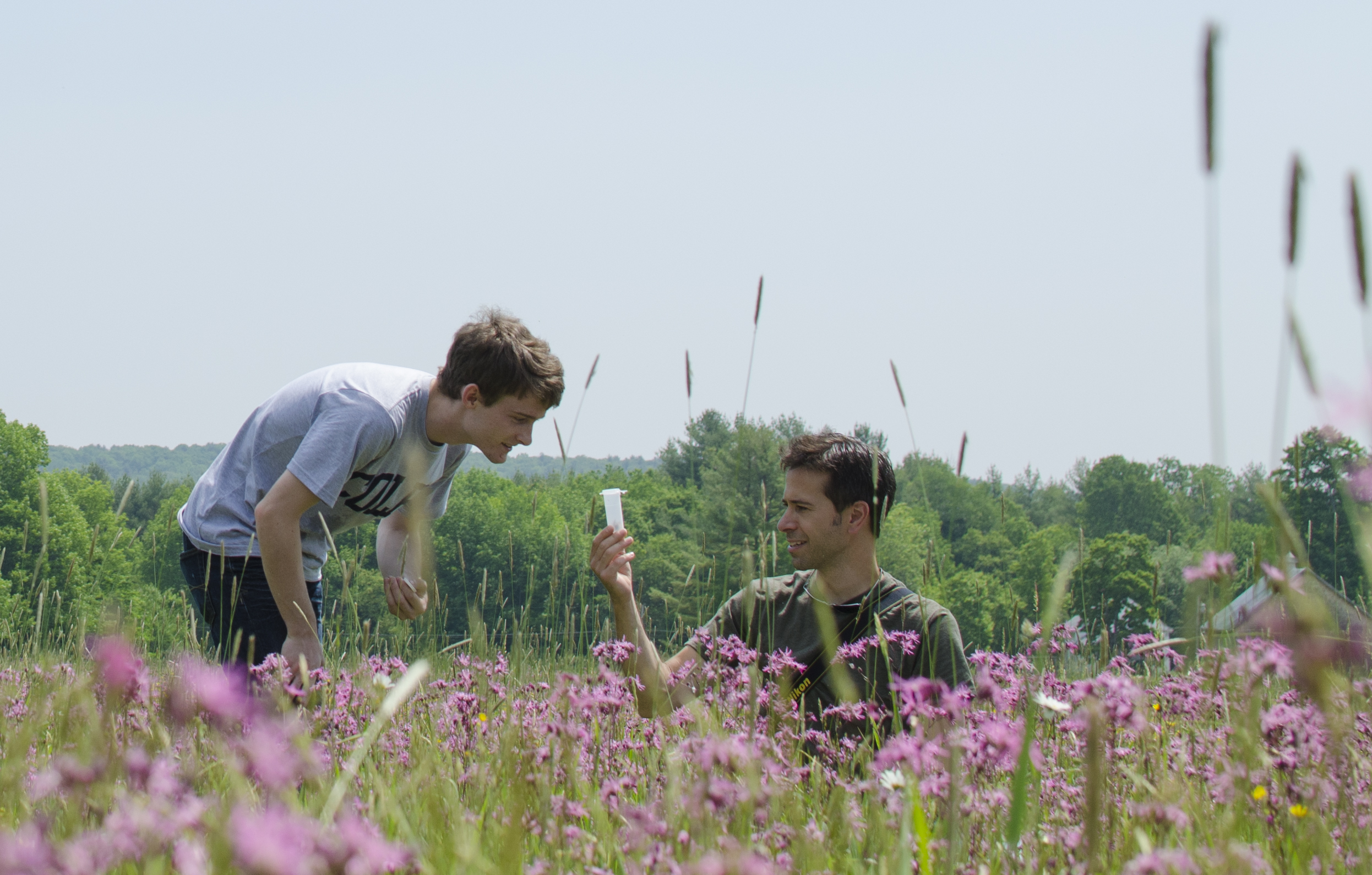 Associate Professor of Biology Dave Angelini, right, in the field conducting research on bumblebees. Angelini has been elected to the executive committee of the Society for Integrative and Comparative Biology.[/caption]
Supporting students and junior members of the field is key to the society’s mission. “A lot of what we do revolves around trying to provide opportunities for people, especially from underrepresented parts of the world, Latin America, especially, to have a forum where they can present their work and get the kind of recognition amidst the larger scientific community that they deserve,” he said.
Angelini should know. As a student, he attended SICB meetings himself and found them important. ”They were very formative, very important experiences,” he said. ”So to the extent that I can provide that for other new people in the field, that's what I want to do.”
These opportunities include speaking at conferences, serving within the society, and attending society meetings, especially critical for students to present their work and expand their networks. Other opportunities exist through the society’s professional journals and with its robust online presence.
Among Angelini’s goals when he becomes chair is to expand the geographic inclusivity and education of the division, to make global connections and learn more broadly about what’s happening in the field. He also hopes to increase the society’s educational outreach to the general public and K-12 schools, using as a model his own citizen science project, Bugs in our Backyard.
Angelini believes strongly in the importance of having an understanding of the natural world, especially during this pandemic with so many people experiencing nature deprivation. “The natural world has impacts on our way of life, whether we choose to recognize that or not,” he said. “And I think as citizens it's really important for people to understand the role that biology plays in their lives, the impact that it can have on their lives.”
Associate Professor of Biology Dave Angelini, right, in the field conducting research on bumblebees. Angelini has been elected to the executive committee of the Society for Integrative and Comparative Biology.[/caption]
Supporting students and junior members of the field is key to the society’s mission. “A lot of what we do revolves around trying to provide opportunities for people, especially from underrepresented parts of the world, Latin America, especially, to have a forum where they can present their work and get the kind of recognition amidst the larger scientific community that they deserve,” he said.
Angelini should know. As a student, he attended SICB meetings himself and found them important. ”They were very formative, very important experiences,” he said. ”So to the extent that I can provide that for other new people in the field, that's what I want to do.”
These opportunities include speaking at conferences, serving within the society, and attending society meetings, especially critical for students to present their work and expand their networks. Other opportunities exist through the society’s professional journals and with its robust online presence.
Among Angelini’s goals when he becomes chair is to expand the geographic inclusivity and education of the division, to make global connections and learn more broadly about what’s happening in the field. He also hopes to increase the society’s educational outreach to the general public and K-12 schools, using as a model his own citizen science project, Bugs in our Backyard.
Angelini believes strongly in the importance of having an understanding of the natural world, especially during this pandemic with so many people experiencing nature deprivation. “The natural world has impacts on our way of life, whether we choose to recognize that or not,” he said. “And I think as citizens it's really important for people to understand the role that biology plays in their lives, the impact that it can have on their lives.”
Associate Professor of Biology Dave Angelini, right, in the field conducting research on bumblebees. Angelini has been elected to the executive committee of the Society for Integrative and Comparative Biology.[/caption]
Supporting students and junior members of the field is key to the society’s mission. “A lot of what we do revolves around trying to provide opportunities for people, especially from underrepresented parts of the world, Latin America, especially, to have a forum where they can present their work and get the kind of recognition amidst the larger scientific community that they deserve,” he said.
Angelini should know. As a student, he attended SICB meetings himself and found them important. ”They were very formative, very important experiences,” he said. ”So to the extent that I can provide that for other new people in the field, that's what I want to do.”
These opportunities include speaking at conferences, serving within the society, and attending society meetings, especially critical for students to present their work and expand their networks. Other opportunities exist through the society’s professional journals and with its robust online presence.
Among Angelini’s goals when he becomes chair is to expand the geographic inclusivity and education of the division, to make global connections and learn more broadly about what’s happening in the field. He also hopes to increase the society’s educational outreach to the general public and K-12 schools, using as a model his own citizen science project, Bugs in our Backyard.
Angelini believes strongly in the importance of having an understanding of the natural world, especially during this pandemic with so many people experiencing nature deprivation. “The natural world has impacts on our way of life, whether we choose to recognize that or not,” he said. “And I think as citizens it's really important for people to understand the role that biology plays in their lives, the impact that it can have on their lives.”Professor of Art Véronique Plesch and Pulver Family Associate Professor of Jewish Studies David Freidenreich have coauthored a paper recently published in the journal Studies in Iconography. Titled “’What is That to Us?’: The Eucharistic Liturgy and the Enemies of Christ in the Beam of the Passion," the paper addresses the so-called Beam of the Passion, an early 13th-century painted pine beam "created in Iberia for display above the eucharistic altar, which unexpectedly depicts Judas’s second encounter with the priests in its central Crucifixion scene," according to the paper's abstract.
"Even more surprisingly, the priests and elders of first-century Jerusalem look like stereotypical African Muslims. Prior scholarship emphasizes the Beam’s depictions of Muslims as Christ’s enemies, but this work is not ultimately about Muslims. Rather, “Moorish” figures—like the Jewish figures they displace—play an instrumental role in an effort to bolster faith in Christ and the eucharist. In this respect, the Beam’s anomalous iconography illustrates a common dynamic within medieval anti-Jewish and anti-Muslim rhetoric, whose true focus is often a fellow Christian. The full significance of the Crucifixion’s Moorish figures and their dismissive quid ad nos becomes apparent through analysis of the Beam in its entirety within its architectural, liturgical, and political contexts."
Plesch frequently lectures on art in Freidenreich’s classes (in particular on depictions of Jews in medieval art) and this is how this research first started. Over the course of years, different Colby students were involved in the project, in particular, Anna Spencer ’16 and more recently, Plesch’s research assistants Sarah Rossien ’19 and Annie Muller ’22.
James Fleming, the Charles A. Dana Professor of Science, Technology, and Society, contributed an item to Smithsonian Magazine's article "50 Things We've Learned About The Earth Since the First Earth Day." Fleming's contribution: That the Air Has Gotten Better."Since 1970 smoking (at least of tobacco) is way down, sick building syndrome is far less common, acid deposition from sulfur dioxide is lower, lead additives have been removed from gasoline, and stratospheric ozone levels are on the mend. Let’s work to see these trends continue and accelerate in years to come," wrote Fleming, who is also a research associate at the National Museum of American History.
Professor of Art Véronique Plesch was in conversation with artist Abby Shahn on the occasion of her retrospective, Abby Shahn—50 Years, at SPEEDWELL projects in Portland, Maine. More than 80 people attended the April 19 Zoom event, which was hosted by SPEEDWELL's founder/director Jocelyn Lee (aunt of Austin Lee '20), who was in situ at the gallery, making a virtual tour of the show possible.