Faculty Accomplishments
Page 53 of 61
Robinson and Nguyen ’20 Coauthor Paper on Climate Change Adaptation in the Caribbean Lesser Antilles
Assistant Professor of Environmental Studies Stacy-ann Robinson and Cindy Nguyen '20 coauthored the paper "Differential climate change impacts and adaptation responses in the Caribbean Lesser Antilles" to be published in Caribbean Geography. In reviewing the recent literature, the paper finds that climate change impacts and adaptation responses in the Lesser Antilles vary widely, with islands mainly coping with climate effects on coastal ecosystems and sectors. In discussing its results, the paper presents three potential drivers of differential impacts and responses across the sub-region and highlights the need to address uneven adaptation research.
Assistant Professor of Environmental Studies Stacy-ann Robinson has been elected vice chair of the Caribbean Geography Specialty Group of the American Association of Geographers. In her role, Robinson will assist the chair and conduct and supervise elections. She will become chair for 2021/2022 when the association holds its general meeting in New York.
In the Spring 2020 issue of the Maine Arts Journal, Professor of Art Véronique Plesch has a piece on Amanda Lilleston, visiting assistant professor of art, who teaches printmaking at Colby. Plesch also wrote the introduction to this special issue on Macro/Micro, and, with the assistance of editorial interns Sabina Garibovic ‘22 and Andrew MacDonald ‘21, edited the issue.
Current Ocean Crisis Indicates Land May Be Experiencing Even More Stress
New research from an international team of scientists led by Colby College Professor of Geology Robert Gastaldo appears this week in Nature Communications, the world's leading multidisciplinary science journal. Titled “The base of the Lystrosaurus Assemblage Zone, Karoo Basin, predates the end-Permian marine extinction,” the publication of the paper in this prestigious journal once again highlights Colby’s deep expertise and excellence in the sciences.
[caption id="attachment_43434" align="alignright" width="300"]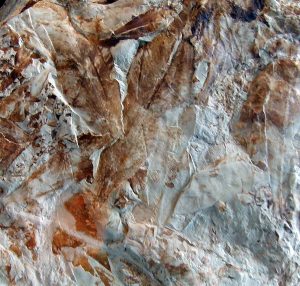 Leaf of Glossopteris, the most common and dominant southern hemisphere tree before ecosystem disturbance in the late Permian. Photo courtesy of M. Grey, Joggins UNESCO World Heritage site, Nova Scotia.[/caption]
The research, which was funded by the National Science Foundation, reveals that at the time when planet Earth experienced the greatest loss of biodiversity, during what is known as the end-Permian mass extinction about 251.9 million years ago, biodiversity on land suffered several hundreds of thousands of years before biodiversity crashed in the ocean.
“If changes in biodiversity on land preceded the biodiversity changes in the ocean during the Great Dying, which is what our paper shows, the current changes that we’re now seeing in the ocean may mean we’re close to reaching a major tipping point and crisis on land,” said Gastaldo, the Whipple-Coddington Professor of Geology at Colby. “In other words, not only are the plants and animals on land the canary in the coal mine, but the canary may already be threatened or, at the very least, quickly approaching an imbalance. The bottom line is that, while we’ve largely focused on the crisis in the ocean and how it will, or could, affect organisms on land, there is now solid evidence that land may be the first to respond.”
Gastaldo added that the timing of the turnover seems to be coincident with the beginning of massive volcanic activity that occurred in what is now Siberia. Over the course of less than one million years, this volcanic episode emplaced a volume of lava and other igneous rocks approaching 720,000 cubic miles. Those rocks now cover 80 percent of Siberia. This activity significantly increased atmospheric gas concentrations, including carbon dioxide, methane, sulfur, and mercury. “Essentially what was happening then is what we’re seeing now—a massive release of damaging gases that alter the way in which Earth systems operate,” he said.
With the publication of this paper, the turnover in vegetation across the landscape in the Southern Hemisphere during the end-Permian mass extinction—including the loss of a major group of seed plants that formed extensive forests—has now been documented in both Australia and South Africa at the same time.
[caption id="attachment_43435" align="alignleft" width="300"]
Leaf of Glossopteris, the most common and dominant southern hemisphere tree before ecosystem disturbance in the late Permian. Photo courtesy of M. Grey, Joggins UNESCO World Heritage site, Nova Scotia.[/caption]
The research, which was funded by the National Science Foundation, reveals that at the time when planet Earth experienced the greatest loss of biodiversity, during what is known as the end-Permian mass extinction about 251.9 million years ago, biodiversity on land suffered several hundreds of thousands of years before biodiversity crashed in the ocean.
“If changes in biodiversity on land preceded the biodiversity changes in the ocean during the Great Dying, which is what our paper shows, the current changes that we’re now seeing in the ocean may mean we’re close to reaching a major tipping point and crisis on land,” said Gastaldo, the Whipple-Coddington Professor of Geology at Colby. “In other words, not only are the plants and animals on land the canary in the coal mine, but the canary may already be threatened or, at the very least, quickly approaching an imbalance. The bottom line is that, while we’ve largely focused on the crisis in the ocean and how it will, or could, affect organisms on land, there is now solid evidence that land may be the first to respond.”
Gastaldo added that the timing of the turnover seems to be coincident with the beginning of massive volcanic activity that occurred in what is now Siberia. Over the course of less than one million years, this volcanic episode emplaced a volume of lava and other igneous rocks approaching 720,000 cubic miles. Those rocks now cover 80 percent of Siberia. This activity significantly increased atmospheric gas concentrations, including carbon dioxide, methane, sulfur, and mercury. “Essentially what was happening then is what we’re seeing now—a massive release of damaging gases that alter the way in which Earth systems operate,” he said.
With the publication of this paper, the turnover in vegetation across the landscape in the Southern Hemisphere during the end-Permian mass extinction—including the loss of a major group of seed plants that formed extensive forests—has now been documented in both Australia and South Africa at the same time.
[caption id="attachment_43435" align="alignleft" width="300"]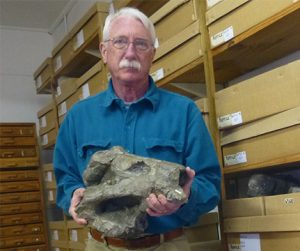 Skull of Lystrosaurus maccagi, a common Late Permian synapsid tetrapod in the Karoo Basin, South Africa, held by Robert Gastaldo for scale. Specimen in the collections of the Albany Museum, Grahamstown, South Africa. Photo courtesy of R.A. Gastaldo.[/caption]
“We are incredibly proud of Bob’s ongoing accomplishments and congratulate him on having his research published once again in such a prestigious publication,” said Margaret McFadden, provost and dean of faculty at Colby College. “His work is reflective of science programs that are unparalleled for a small liberal arts school and that are truly having an impact by addressing the major issues and challenges affecting our world.”
This is the third time that Professor Gastaldo has been published in Nature. His most recent article in the journal, “Ancient plants escaped the end-Permian mass extinction,” discussed what happened to terrestrial plants during the end-Permian crisis.
Skull of Lystrosaurus maccagi, a common Late Permian synapsid tetrapod in the Karoo Basin, South Africa, held by Robert Gastaldo for scale. Specimen in the collections of the Albany Museum, Grahamstown, South Africa. Photo courtesy of R.A. Gastaldo.[/caption]
“We are incredibly proud of Bob’s ongoing accomplishments and congratulate him on having his research published once again in such a prestigious publication,” said Margaret McFadden, provost and dean of faculty at Colby College. “His work is reflective of science programs that are unparalleled for a small liberal arts school and that are truly having an impact by addressing the major issues and challenges affecting our world.”
This is the third time that Professor Gastaldo has been published in Nature. His most recent article in the journal, “Ancient plants escaped the end-Permian mass extinction,” discussed what happened to terrestrial plants during the end-Permian crisis.
Leaf of Glossopteris, the most common and dominant southern hemisphere tree before ecosystem disturbance in the late Permian. Photo courtesy of M. Grey, Joggins UNESCO World Heritage site, Nova Scotia.[/caption]
The research, which was funded by the National Science Foundation, reveals that at the time when planet Earth experienced the greatest loss of biodiversity, during what is known as the end-Permian mass extinction about 251.9 million years ago, biodiversity on land suffered several hundreds of thousands of years before biodiversity crashed in the ocean.
“If changes in biodiversity on land preceded the biodiversity changes in the ocean during the Great Dying, which is what our paper shows, the current changes that we’re now seeing in the ocean may mean we’re close to reaching a major tipping point and crisis on land,” said Gastaldo, the Whipple-Coddington Professor of Geology at Colby. “In other words, not only are the plants and animals on land the canary in the coal mine, but the canary may already be threatened or, at the very least, quickly approaching an imbalance. The bottom line is that, while we’ve largely focused on the crisis in the ocean and how it will, or could, affect organisms on land, there is now solid evidence that land may be the first to respond.”
Gastaldo added that the timing of the turnover seems to be coincident with the beginning of massive volcanic activity that occurred in what is now Siberia. Over the course of less than one million years, this volcanic episode emplaced a volume of lava and other igneous rocks approaching 720,000 cubic miles. Those rocks now cover 80 percent of Siberia. This activity significantly increased atmospheric gas concentrations, including carbon dioxide, methane, sulfur, and mercury. “Essentially what was happening then is what we’re seeing now—a massive release of damaging gases that alter the way in which Earth systems operate,” he said.
With the publication of this paper, the turnover in vegetation across the landscape in the Southern Hemisphere during the end-Permian mass extinction—including the loss of a major group of seed plants that formed extensive forests—has now been documented in both Australia and South Africa at the same time.
[caption id="attachment_43435" align="alignleft" width="300"] Skull of Lystrosaurus maccagi, a common Late Permian synapsid tetrapod in the Karoo Basin, South Africa, held by Robert Gastaldo for scale. Specimen in the collections of the Albany Museum, Grahamstown, South Africa. Photo courtesy of R.A. Gastaldo.[/caption]
“We are incredibly proud of Bob’s ongoing accomplishments and congratulate him on having his research published once again in such a prestigious publication,” said Margaret McFadden, provost and dean of faculty at Colby College. “His work is reflective of science programs that are unparalleled for a small liberal arts school and that are truly having an impact by addressing the major issues and challenges affecting our world.”
This is the third time that Professor Gastaldo has been published in Nature. His most recent article in the journal, “Ancient plants escaped the end-Permian mass extinction,” discussed what happened to terrestrial plants during the end-Permian crisis.Associate Professor of Government Walter Hatch wrote an op-ed titled "With the coronavirus surging, compassion is more important than ever" that appeared in the Seattle Times March 20. The piece recounts the moment when students in Hatch's class learned the College would be moving to remote learning and sending students home three days hence.
In the midst of the emotions in the classroom, a student inquired about Hatch's plans, knowing Hatch splits his time between Seattle and Maine. Hatch was deeply touched by the student's concern. "It was an emotional reminder that, especially in this moment of 'social distancing,' we cannot live without compassion," Hatch wrote. "Sure, we can stock up on food, toilet paper, hand sanitizer, and face masks. But what we really need is community, a thick web of connections to one another across the social distance."
Milan Babík '01, visiting assistant professor of government, was a guest on the Czech Radio podcast series Vinohradská 12 on March 6. The interview, hosted by Lenka Kabrhelová (a highly decorated Czech TV/radio reporter and foreign correspondent), covered the results of Super Tuesday, reflected on the Democratic Party primaries, and zeroed in on what the fight between Sanders and Biden indicates about the soul of the Democratic Party and its future shape.
Babík, a native Czech, speaks frequently to the Czech media about American politics. Two other recent appearances include a radio interview and a television interview, both covering Trump's impeachment.
Jessamine Batario, the Mellon Postdoctoral Fellowship for Artistic and Scholarly Engagement and Programs, was guest critic for the Brooklyn Rail in March, and on the publication's "Critics Page," Batario included writings by AB Brown, assistant professor of contemporary performance and dance, and Arisa White, assistant professor of English (creative writing).
Sandy Maisel, the Goldfarb Family Distinguished Professor of American Government, wrote an op-ed for the Portland Press Herald's section "Maine Voices" titled "Ranked-choice presidential primaries would give boost to moderates," which ran March 2, the day before Super Tuesday. Even if Maine were to use ranked-choice voting in the primary, "interpreting voter true preferences when many candidates are running is more complex than simply declaring whoever gains a plurality of the votes as the winner," Maisel wrote. "The party is split," he concludes, "and when we look at the results in Maine, we should appreciate that a plurality for one candidate does not imply support from all party voters."
Sandy Maisel, the Goldfarb Family Distinguished Professor of American Government, wrote an op-ed for the Portland Press Herald's section "Maine Voices" titled "Ranked-choice presidential primaries would give boost to moderates," which ran March 2, the day before Super Tuesday. Even if Maine were to use ranked-choice voting in the primary, "interpreting voter true preferences when many candidates are running is more complex than simply declaring whoever gains a plurality of the votes as the winner," Maisel wrote. "The party is split," he concludes, "and when we look at the results in Maine, we should appreciate that a plurality for one candidate does not imply support from all party voters."
Assistant Professor of Environmental Studies Stacy-ann Robinson and Caroline Wren '20 coauthored the paper "Geographies of vulnerability: a research note on human system adaptations to climate change in the Caribbean" recently published in Geografisk Tidsskrift-Danish Journal of Geography. In reviewing the recent literature, the paper calls for more effective adaptation strategies that centre climate justice, primarily in the Caribbean.