Back to the Blue (and Green) Book
How the rise of ChatGPT brought a hundred-year-old exam book back to Colby's classrooms.
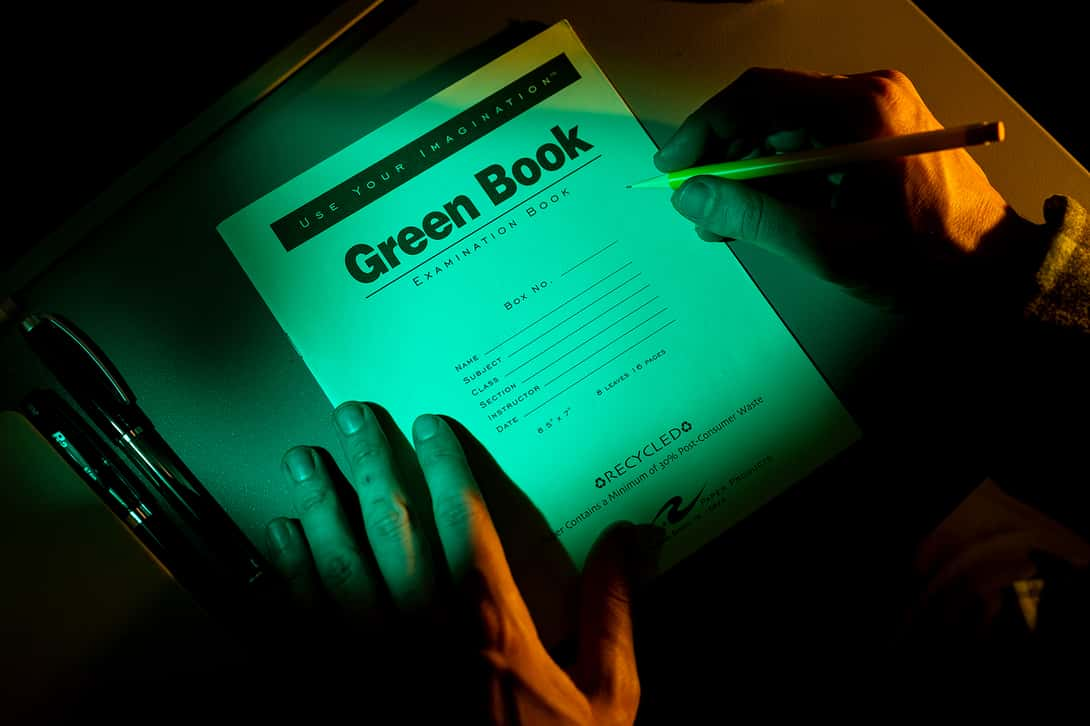
For generations of college students, midterms and finals meant one thing: agonizing hours spent hunched over a desk, frantically scribbling a semester’s worth of learning into a blue exam book.
It’s a core memory so vivid that many former students can still feel their hands cramp after the test.
With the advent of the digital age and open-book, take-home tests, blue books seemed relegated to history. But when generative AI hit higher education like a tornado, it forced professors to reconsider how they teach and evaluate learning, and beginning just a few years ago, blue books began to return.
The blue books are making a comeback at Colby, as they are in college classrooms everywhere, though at the College, the books are printed on green recycled paper. Gen Z students who have never even heard of this artifact have had to quickly familiarize themselves with the small lined books.
But physical booklets are just part of the story. Across disciplines, faculty are revamping assignments and exam formats to ensure students do the learning themselves, even as they live in a world that constantly pushes AI’s help with everything from Google searches to drafting emails.
For Associate Professor of History Sarah Duff, who used blue books as a student, returning to handwritten exams is a deliberate response to AI.
“Everything is a circle. Using the blue books is part of a broader strategy of making the classroom screen-free, or going analog, as best we can,” she said. “Students tend to reach for AI when they are anxious, when they are overwhelmed, when they think that they’re not going to do well in an assignment. They use it almost unthinkingly because it’s right there and easy to access. It’s forced many of us to think not just about beating AI, but about how we teach in this moment.”

A coast-to-coast comeback
The history of blue exam books is a little murky, but they are thought to have originated at Butler University in Indianapolis in the late 1920s as a standardized tool for essay-based exams. The books caught on and were widely used in college and university classrooms around the country until the late 1990s and early 2000s, when the growth of the internet, the ubiquity of laptops, and the adoption of digital learning management tools like Moodle pushed teachers to abandon their use. One company, Roaring Spring Paper Products in Pennsylvania, makes most of the nation’s blue books, and sales had been dropping for years before the COVID pandemic tanked them further.
But when OpenAI released ChatGPT in late 2022, it triggered a seismic disruption in higher education, and one result was the resurgence of blue books. Across the country, professors are reaching for the humble exam books for all kinds of courses. College bookstore managers from coast to coast report sharp sales increases from pre-2022 levels.
At Colby, departmental administrative assistants order green books in bulk from the Colby Bookstore, where Bookstore Director Barb Shutt said the numbers are trending upwards. So far this year, the store has ordered 84 packets of 50 green books for academic departments, compared with 47 packets last year and just 31 in 2021. Even accounting for enrollment growth, demand for the booklets is rising.
Many departments use them, including American Studies, Anthropology, Art, Classics, Economics, Environmental Studies, Government, History, languages, Philosophy, and Women’s, Gender, and Sexuality Studies.
A throwback to a previous time
In a Diamond Building classroom this fall, students waited nervously as Assistant Professor of Economics Ben Scharadin handed out graded green books from a recent test. In previous years, Scharadin assigned complex problem sets for students to complete outside of class but decided to take a different approach this semester to ensure that there was both “learning and struggle.”
He gave them clear guidelines on how they could and couldn’t use AI for at-home coding problems, then included an in-class test to assess their understanding of economic theories.
“To me, it was like a throwback to a few years ago, where you did actually have to have recall right in front of you,” Scharadin said. “It’s a lot of grading. It’s really time-consuming this way. But I think it was good.”
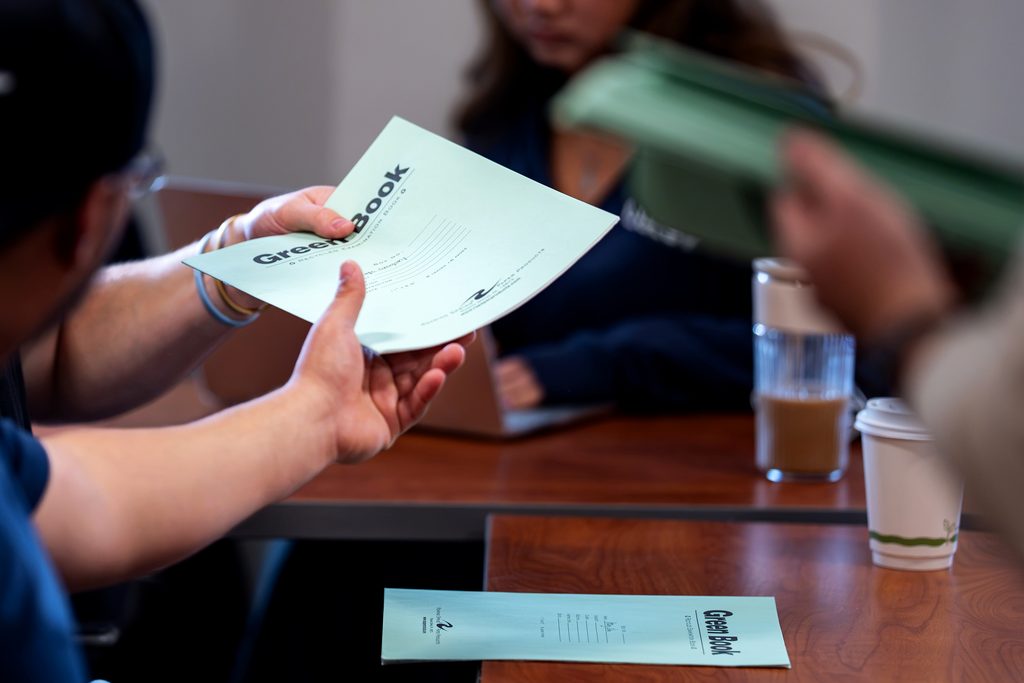
Jack Lockner ’28, an economics and history double major, said that in-class exams can be hard, but they also have benefits.
“It can definitely be a little stressful, but I think overall it’s worth it,” he said. “I think it’s worth having the opportunity to express how much you’ve learned.”
Kat McManus ’27, a history and economics double major, appreciates that Colby professors want students to sharpen their critical thinking skills while still acknowledging AI’s role in our lives today.
“I think at the core of Colby, we are a very honest community, and a community that really does want to learn,” she said. “I feel that students actually do use AI very responsibly here.”
As she has applied for jobs after graduation, prospective employers have asked her about her fluency with AI, and she credits courses she’s taken with the Davis Institute of AI with helping her answer their questions confidently. At the same time, she has appreciated professors like Duff for classes that stress reading, discussion, and learning over screens and AI. Some of her friends have been in courses where professors assign essays, and part of the grade comes from meeting with them for a 15-minute defense of the paper.
“I think it’s fantastic,” McManus said. “Because if you wrote the essay with AI, you’re not going to be able to defend your essay. You’re not going to be able to answer these questions. But you do have the opportunity to engage with the material in a much more interesting way.”
As for the blue or green books, they have been a part of her academic life since her first year on campus. She knows well what it feels like to write until her hand gets tired.
“And you shake out your hand and then you’re like, gotta keep going, gotta keep going,” she said.
But she also knows what it feels like to be fully engaged and focused in a class that values discussion over AI prompts—really good.
“I love being in community, and I love that we have this emphasis on communal learning. We all learn together,” McManus said. “And I think the nice part about it is that we all come out of class and we’re still continuing the conversation as we walk out and head our separate ways.”
Finding ways to adapt
Stacy Doore, the Clare Booth Luce Associate Professor of Computer Science, doesn’t use the blue books. Instead, she uses a printer to make her own exam materials, including question sets and blank paper.
In-class exams have been a shift for a scientist whose research has focused on emerging assistive technologies, such as non-visual navigation solutions for people who are blind and visually impaired. Because of her interest in accessibility and disability issues, she previously gave open-book take-home exams.
“I really felt like I expected more because they had as much time as they needed, and they had all their resources,” she said. “When ChatGPT came out in 2022, it was like, ‘That’s not going to work anymore.’”
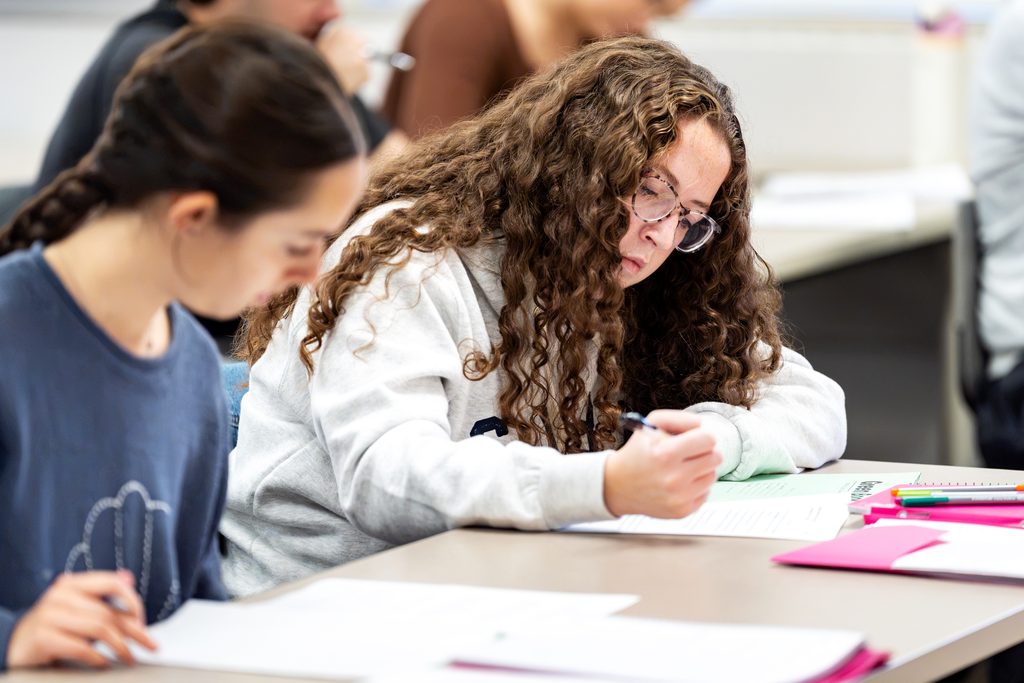
Since then, she has worked with every class at the beginning of the semester to create a community policy for using generative AI tools, including ethical issues, cheating, and more. She aims to assess learning thoughtfully so the playing field is level for all students, and she has added more quizzes on reading assignments and other in-class assessments to ensure students demonstrate they can do the work themselves.
It’s been an adjustment for both her and her students, but they have risen to the challenge. As soon as they knew they were responsible for “sitting and delivering,” Doore said, most of them studied and did well. They must show they understand core concepts of how computers work, how systems are designed, and the ethical implications of new approaches to computing.
That’s important because, no matter what shortcuts AI offers, students still need to think for themselves to prepare for both the world right now and the world of the future.
“Computer science has always taught new languages, or new hardware, or new networks. You could look at it as a cycle. We might be in an ‘AI summer’ right now,” she said, before adding that seasons inevitably change. “We want to teach them how to think critically and demonstrate what they have learned. These are valuable skills no matter what new advanced computing innovation is happening.”
From medieval monks to the digital age
For some professors, the blue and green books offer room for creativity. Zach Peckham, a visiting assistant professor of English, uses the green books in a structured creative-writing workshop process that he developed while teaching at an art school in the Midwest.
“We needed something to record the notes in, and I didn’t want to have devices. I want to just have a physical object. And no joke, I found a closet full of blue books at the art school that no one was using, that had just been sitting there for years.”
As he incorporated the blue books into the workshop, he realized that the cheap, widely available booklets were perfect for the task.
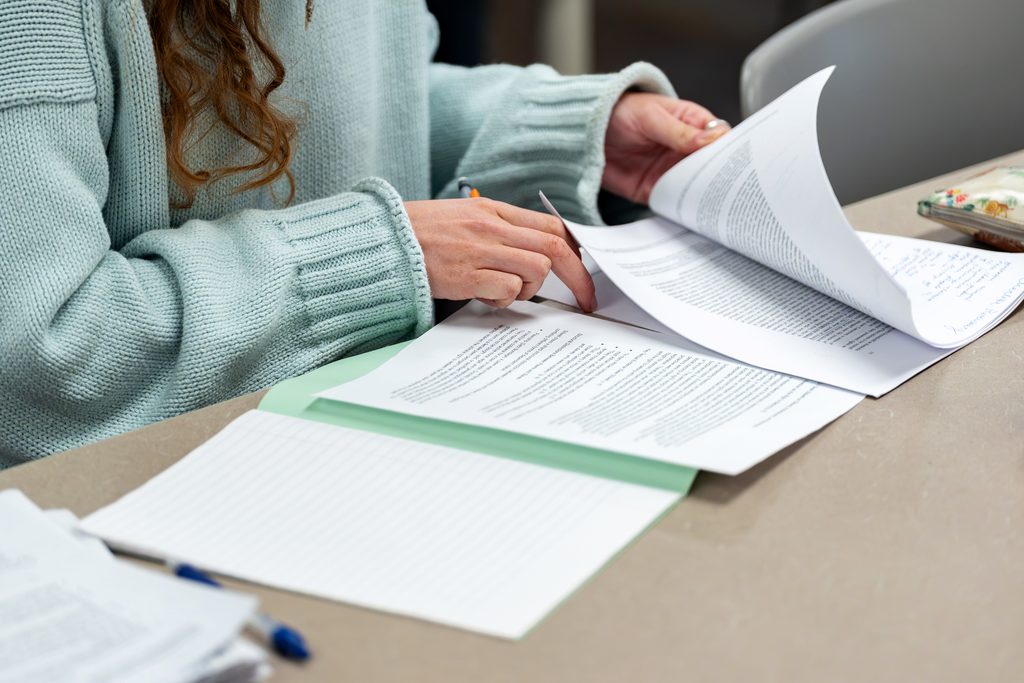
“They are like a scholastic amulet, or a totem. We’re in school, and I think it’s so appropriate,” he said. “And I have found that students do seem to enjoy taking a familiar object and doing something different with it.”
In Megan Cook’s literature classes, students use green books and other notebooks to write in reading journals and to take exams. Cook, the Arthur Jeremiah Roberts Professor of Literature, is a medieval specialist, and knowing how to read the ornate, complicated cursive of long-ago monks has given her an edge in deciphering difficult student handwriting today.
“It’s helpful here that I am a trained paleographer,” Cook said. “I’ve probably at this point graded upwards of 100 blue books. Only once have I had to go back to a student and be like, ‘Can you come to my office and tell me about your answers to this, because I cannot read them.'”
For her and other Colby faculty members, blue books (and green books) are a tool, a throwback, and a way to make sure students get what they need from their college experience. Duff, the history professor, is glad the College is meeting the challenge.
“When we’re in that classroom, we’re all there together with our brains thinking about the topics for today. I want students to be fully present,” she said. “And it seems to me to be something that students seem to be very happy with. I have noticed that when I teach like this, students are properly tired by the end of class. Their brains are wrung out. They have been present. They have focused and thought, and now they are tired. That’s a good feeling.”


