When the Ghost in the Machine is a Poet
Ross Goodwin’s ‘gonzo data science’ inspires new ways to experience writing
People often think about AI in terms of what the technology can do for them, or how it might change our world in ways that range from helpful to intrusive to downright alarming.
Words that don’t come up much in relation to AI are creativity and inspiration. But for Ross Goodwin, an artist, hacker, writer, technologist, former White House ghostwriter under President Obama—and self-described “gonzo data scientist”—AI is a bubbling cauldron of possibilities.
He finds ways to use machine learning and natural language processing to push the understood boundaries of the written language, including through poetry, the world’s first film created with an AI-written screenplay, SUNSPRING, and other creative works.
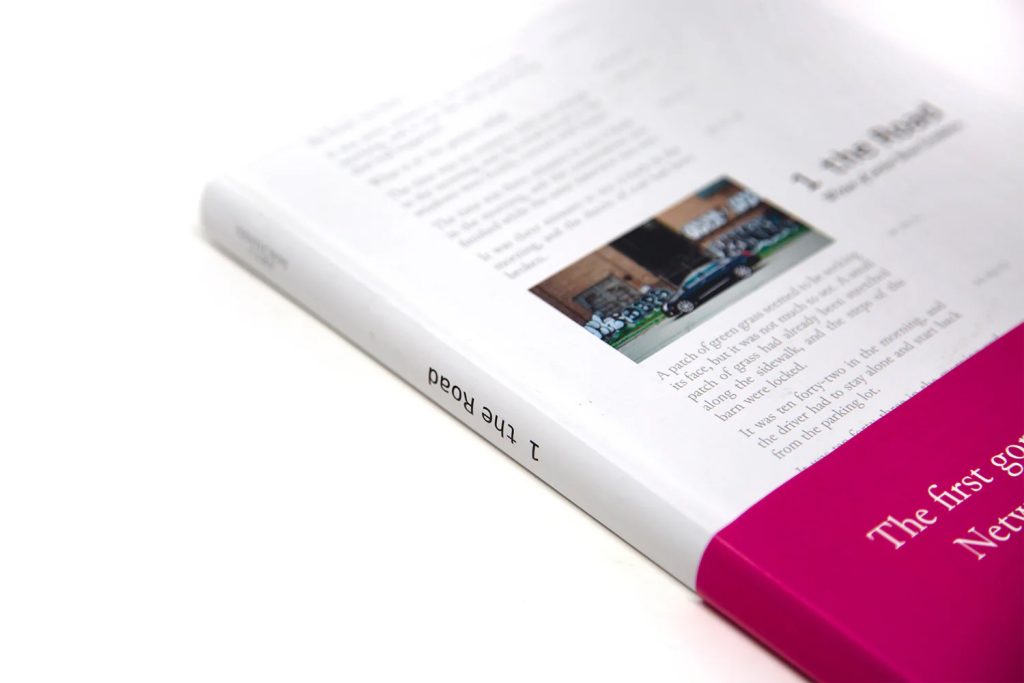
He even drove from New York to New Orleans in a car equipped with sensors, microphones, cameras, and a machine that turned the collected data into a road-trip story that became the first novel to be written with AI. The ensuing book, 2018’s 1 The Road, was an experimental work published years before ChatGPT made AI a household concept.
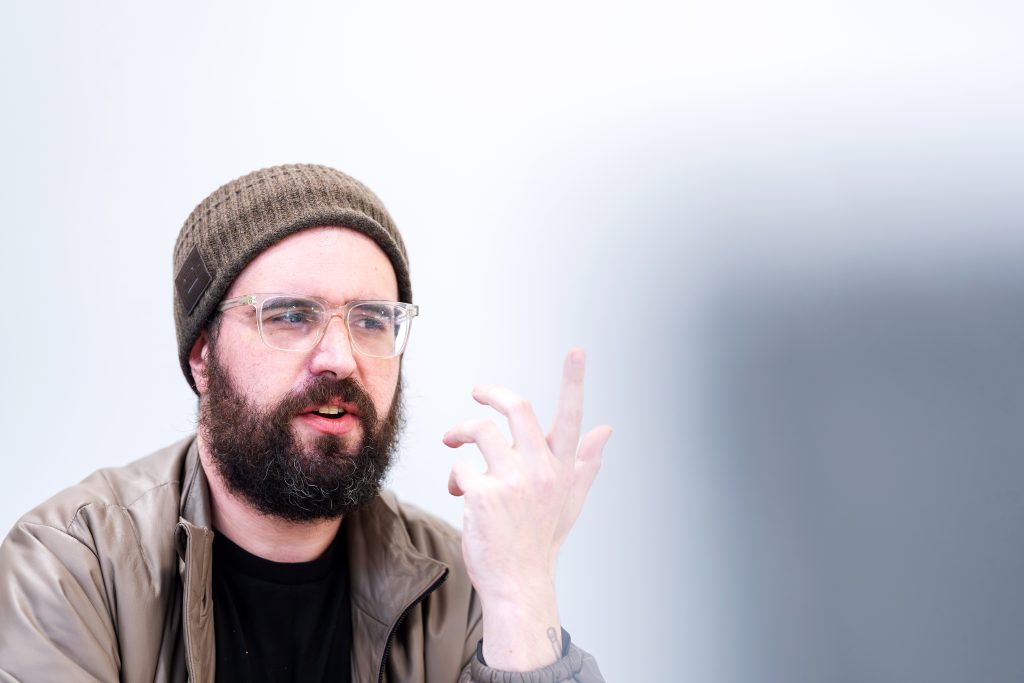
Goodwin came to the College last week through the Davis Institute for Artificial Intelligence’s Distinguished AI Speaker Series to give a public presentation called “Narrated Reality” and lead a Bagels & Bots discussion for faculty. He described his personal journey with language, writing, and large language models, including a moment of discovery that occurred when he was a graduate student in New York University’s Interactive Telecommunications Program about a decade ago.
Back then, he got access to the university’s high-performance computing facility and trained his own large language models to write poetry that turned out to be both weird and interesting.
“It conjured imagery in a way that I had not seen generative text do before, and that, to me, was sort of the mark of something that would be an obsession for me over the next few years,” Goodwin said. “Because it had, I think, the potential to augment human creativity in a real way.”
An old, new way to think about poetry
In her introduction to the lecture, Ryan Bloom, the artificial intelligence application specialist at the Davis Institute for Artificial Intelligence, said that Goodwin’s work lives at the intersection of technology and art.
“We often think of poetry purely as an emotional expression, but the root of the [Greek] word poiesis actually means to make or bring something into being,” she said. “In the ancient sense, a poet is a maker, someone who gives form to their imagination, and that etymology has never felt more relevant than it does tonight.”
After all, she said, some are quick to jump to criticism when thinking about creative writing and AI. If one of the points of reading is to connect with another human being, why would someone bother reading something that was written by a machine? But what if it were possible to think about poetry and writing in a new way, inspired by the ancient definition of poiesis?
“What happens when a machine is not replacing an artist, but is being conducted by one or even collaborating with one?” Bloom asked. “What new outlooks or epiphanies might we unlock by getting creative with the purpose and process of writing itself? … Our speaker tonight, Ross Goodwin, has been exploring these questions and building out answers for more than a decade.”
His visit to the College was cosponsored by the Center for the Arts and Humanities and the departments of Writing, Computer Science, Art, and Science, Technology, and Society.
Pushing storytelling further
One of the major arguments against AI is that it increases human isolation by replacing human interaction with simulated companionship, but Goodwin’s work shows that it doesn’t have to be that way. In one of his experiments as a graduate student at NYU’s ITP, described as an art school for engineers and an engineering school for artists, he put a large language model inside an antique camera and instructed it to narrate an image, location, and time.
“You could take a picture with it, and it would print out a receipt of a poem based on the photo you captured in real time. It was like a text Polaroid,” Goodwin said.
He’d tuck the contraption into a backpack he’d wear with a printer on his waist and walk around the city, just pressing the button to take snapshots and print poetry.
“It definitely invited a lot of interesting conversations and just interesting moments in time that I have captured on these receipts,” he said.
Another project was “Please Feed the Lions,” an interactive sculpture in London’s Trafalgar Square created for the 2018 London Design Festival, which Goodwin believes to have been one of the largest artistic displays involving AI at the time. Visitors were invited to use tablets to “feed” words to an immense, bright-red lion, ultimately writing a collective poem with the help of a dedicated machine inside the sculpture.
“People could walk up to a kiosk in front of the sculpture, feed the lion a word, and the lion would roar back a line of poetry, which at night would be projected all over the lion’s body and up Nelson’s Column behind it,” Goodwin said, referencing a nearby monument. “It was an incredible experience seeing this thing come to life.”
Part of the goal of all his creative efforts has been to push storytelling further.
“I feel like in the space of human storytelling and human literature, we’ve only just scratched the surface of what’s possible. And that’s because we like hearing the same stories over and over and over again, and that’s OK,” he said. “But that also means there are a lot of stories we’ve neglected to tell, a lot of stories that might lie outside the boundaries of what we define traditionally as a story.”
Through creating art that seems to defy the rules of how things are supposed to work, including collaborating creatively with AI, Goodwin is able to bring some of those stories to life.