Bridging the AI Gap
Interdisciplinary Summer Bridges Program challenges students to collaborate on responsible AI startups and address real-world problems
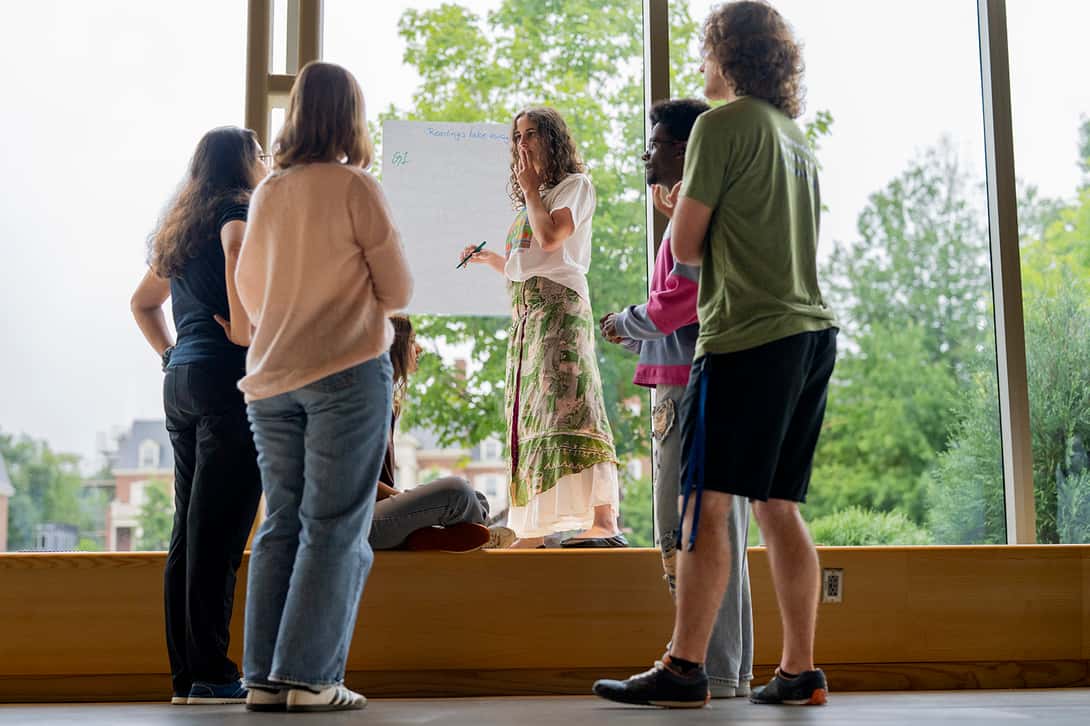
At Colby this summer, students from across the country and Germany are participating in an innovative eight-week AI program designed to bridge the gap between technical expertise and interdisciplinary innovation.
The first-of-a-kind Interdisciplinary Summer Bridges Program was created to demonstrate the core mission of Davis Institute for Artificial Intelligence, to harness the value of interdisciplinary collaboration and build meaningful AI solutions for society, said David Watts, director of Davis AI. The program is co-hosted by Davis AI in collaboration with the Halloran Lab for Entrepreneurship.
As the program nears its July 31 finale, these students are investigating both the revolutionary potential and fundamental hazards of AI, while fostering innovation through a unique interdisciplinary lens. Based on their two months of work, students conceived AI startup concepts, refined their ideas, and will pitch their concepts as capstone presentations to a panel of experts between 9:30 a.m and noon on Thursday, July 30, in the Gordon Center for Creative and Performing Arts.

“Beyond being a first, perhaps what makes this program unique is that it isn’t just about learning AI technology. It makes AI literacy about the interdisciplinary ecosystem of students from a wide variety of backgrounds interacting with each other and with world-renowned experts in AI, ethics, and real-world applications, collaborating toward solutions to actual societal challenges,” Watts said.
In addition to the diversity of disciplines, there is also diversity of experiences. Students were accepted from all undergraduate years, and graduate students from Brown University and the Max Planck Institute in Germany were included. In all, 32 students are participating—representing 23 majors and six partner institutions—to learn about AI and apply what they learn by developing AI products and ventures. In addition to Colby, Brown, and Max Planck, students represent the University of New Mexico, Connecticut College, and Thomas College.
The graduate students benefited from this unique approach to AI literacy and served as mentors for the undergraduates. They gave presentations on their own research and assisted instructors throughout the program.
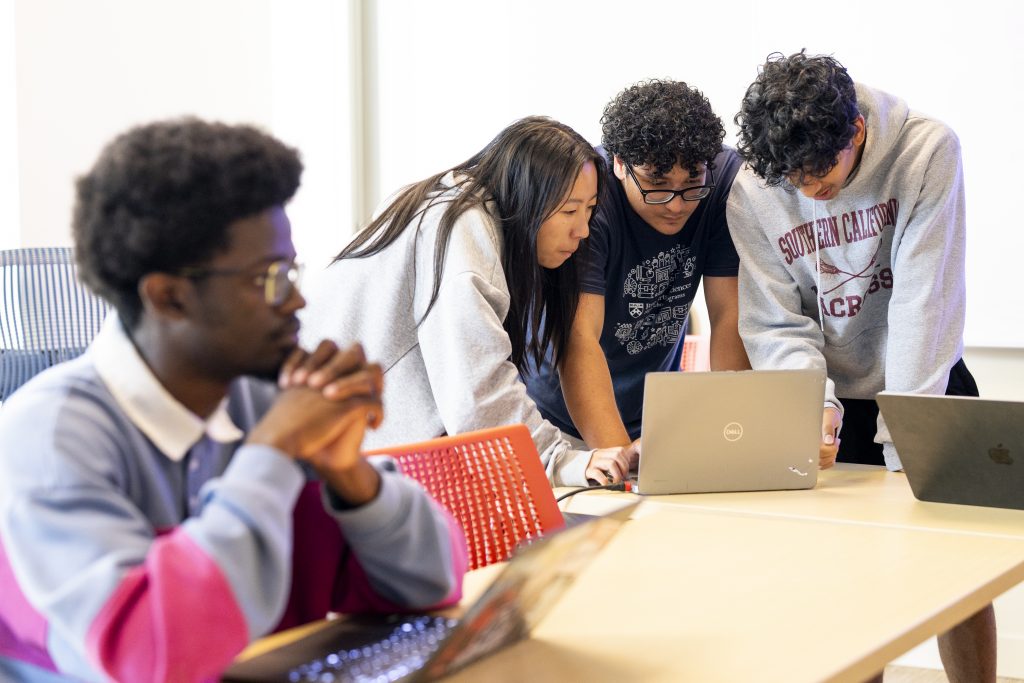
Ryan Szczepkowski ’28, an economics: financial markets major and anthropology minor, signed up for the program to distinguish himself in what is becoming an increasingly competitive job market for young people because of the impact of artificial intelligence.
“One of the things that is differentiating people now is their ability to use AI on the job,” said Szczepkowski, who is interested in pursuing a career as a consultant after graduating. “I was just talking to a partner at a firm the other day, and he said the hiring process has completely changed. They are asking all candidates lots of questions about AI—do you understand AI models? Can you use AI? So this Summer Bridges program is giving me what I feel that I need.”
Nabeela Ali ’29 concurred. She is double majoring in computer science, with a concentration in AI, and mathematical sciences. Her motive for enrolling in the summer session was to harness her AI skills working with open-source materials and large language models.
Among her takeaways is the importance of factoring AI ethics into her work to help ensure that AI is developed and used in ways that benefit society. It encompasses a broad range of considerations, including fairness, transparency, accountability, privacy, security, and the potential societal impacts.
“When I am developing any technology myself,” she said, “I’ll always be thinking of an ethical approach.”
Two four-week sessions
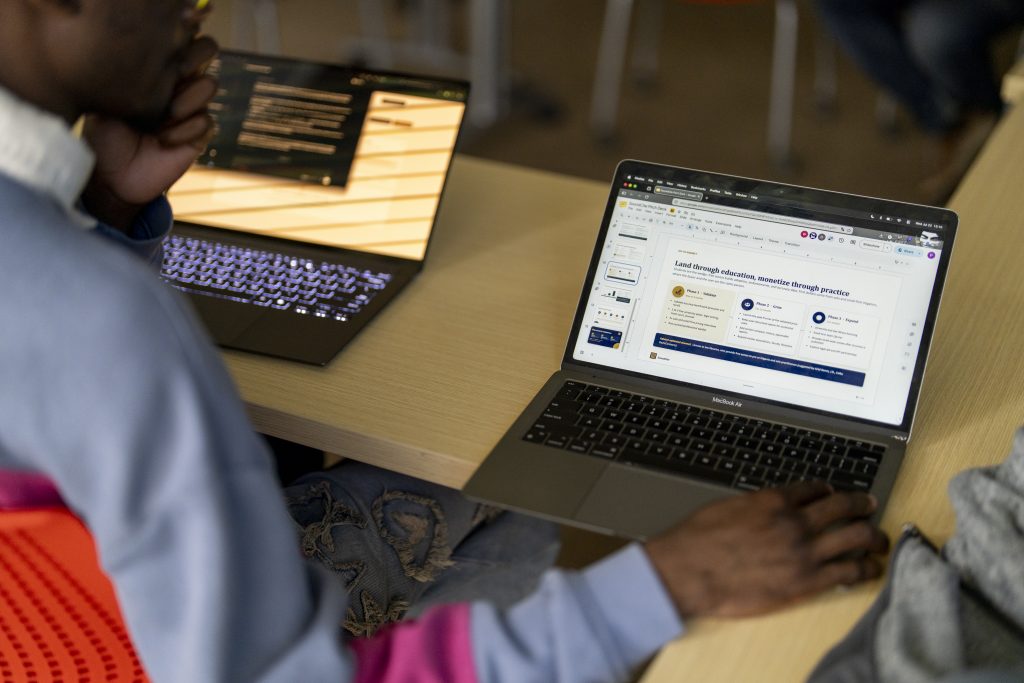
Summer Bridges is split into two four-week sessions. During the first phase, students learned AI fundamentals and core technical concepts. Instructors, including Associate Professor and Associate Chair of Computer Science Oliver Layton, Associate Professor of Computer Science Stacy Doore, and Assistant Professor of Statistics Annie Tang, engaged students through lectures and hands-on workshops to introduce the fundamentals of responsible AI systems and applications. Students learned about the core components, including machine learning, neural networks, and large language models.
The program’s curriculum emphasizes key pillars such as supervised and unsupervised learning—supervised learning is a machine learning technique that uses labeled datasets to train AI models to identify underlying patterns and relationships—prompt engineering, and integrating current AI tools into creative and analytical workflows.
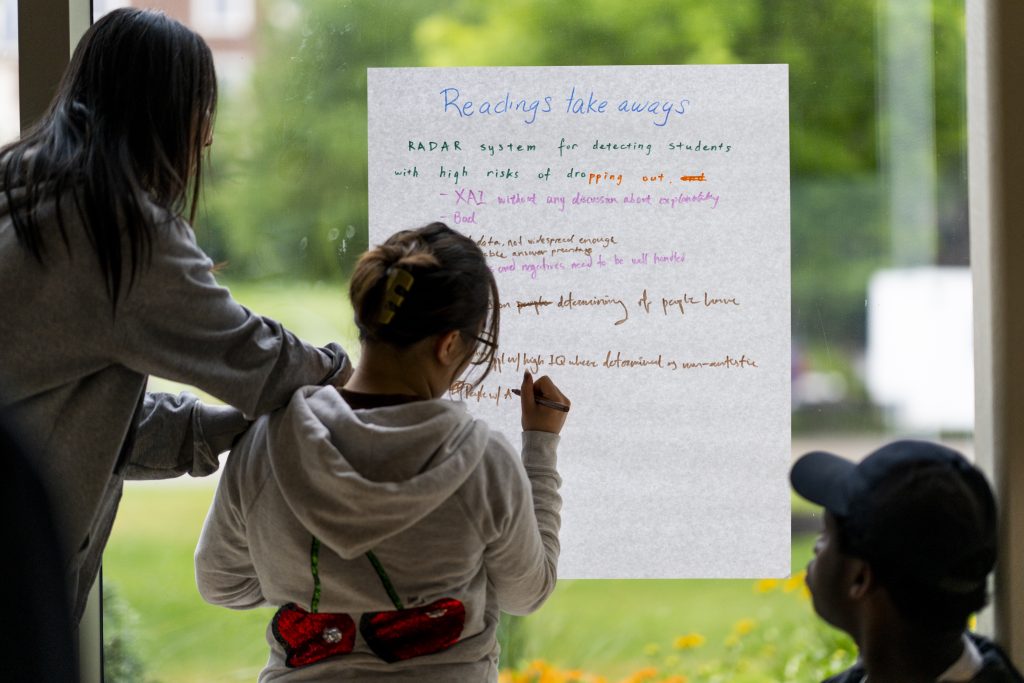
When developing their pitch ideas, students connected with stakeholders, pinpointing algorithmic weaknesses and evaluating potential hazards using a blend of technical expertise and sociological insight. As a bridge to launching original AI startups, the students participated in seminars centered on business and entrepreneurial strategy.
The second month-long session focused on collaboration. Throughout this period, doctoral candidates from Brown and the Max Planck Institute served as mentors to their undergraduate counterparts. Drawing on the technical foundations established during the initial four weeks, students developed original AI venture models and prepared to present their final concepts to a jury, including former IBM CIO Kathryn Guarini.
‘Building something meaningful’
Jonathan Godbout ’08, deputy director of the Halloran Lab for Entrepreneurship, said a distinguishing feature of the program is its emphasis on ethics and using AI to design or develop products or processes that have lasting value and staying power.
“We are instructing students on how to use these tools and how to build ethically, but also to build in a way so that whatever you create is going to last. It is not just about building software and creating presentations, but building something that is meaningful,” Godbout said.
Godbout worked closely with students on their pitches, along with Mike McQuillan, founder of BEcamp, a business education startup that partners with colleges and universities to help non-business majors prepare for work and life.
Among the experts who addressed students was Melanie Moses, professor of computer science and associate professor of biology at the University of New Mexico. Moses addressed the topic of scale during her address, titled “Can We Trust Intelligence at Scale?”
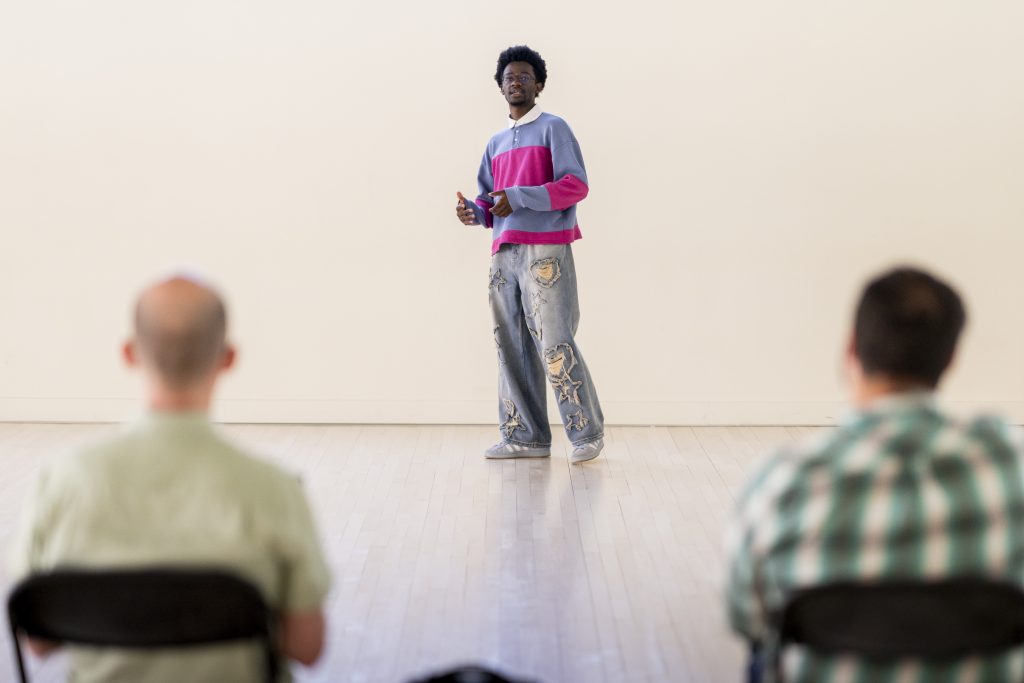
She spoke about trustworthiness as a central challenge for AI, particularly for AI applied in mental and behavioral healthcare. While many AI capabilities improve as data, neural network size, and energy scale up, alignment with scientific and societal goals is not necessarily generated by scaling up, she said. She explained AI scaling trends in the context of scaling in computation more broadly, and contrasted areas where AI has made enormous advances— for example, writing code—with areas where large-language model hallucinations, inaccuracies, biases, and disregard for truth pose significant risks, as in mental and behavioral health.
Assistant Professor of Psychology and former Davis AI Fellow Veronica Romero ’09 and Assistant Professor of Computer Science Isaac Lage spent several days with the students talking about mental and behavioral health in the age of AI. The two Colby professors are participating in a major National Science Foundation grant establishing the AI Research Institute on Interaction for AI Assistants, which will accelerate the development of next-generation AI assistants in the mental health field.
Many in the psychology field are concerned that the use of AI in mental health introduces severe ethical risks regarding data privacy, deceptive empathy, and inadequate crisis protocols during psychiatric emergencies.
Romero and Lage explained their work and offered an overview of how AI has been used in mental and behavioral health settings, what has worked well, and what has not.
Romero praised the program for its emphasis on ethics and the inclusion of graduate students among the undergraduates. “I think that aspect has been a really positive experience, and I hope the students appreciate the kind of experience they are getting here, because it sets them up to think about AI in a much more well-rounded way,” she said. “A lot of students use AI, but they don’t quite understand how it works. This program gives them the chance to not only peek inside, but actually play around and see what the strengths and weaknesses are. It’s going to give them a leg up in everything they do at Colby and at their own institutions.”
A summer internship
One of the unique aspects of Summer Bridges is that students are paid to study, so it serves as both a learning opportunity and a paid internship.
“It’s really hard for first-year students to get a good summer internship, so this program is a perfect opportunity for me to get some hands-on experience that helps me in my field,” said Kylee Kong ’29, a computer science and economics double major.
Watts said the feedback has been positive, but the real value of the program is yet to be realized. “We should get a taste of it during the student pitches in the final week, but will know more after they complete the program when we see the value they create toward solving some of the most problematic challenges in the AI era,” he said.
Watts thanked Colby’s partners for making the program possible, including the Davis family through the Shelby Cullom Davis Charitable Fund, the National Science Foundation, Bank of America, and the Bill and Joan Alfond Family Foundation.