Overcoming Adversity, Colby Students Earn Honors at Hackathon
These three friends turned a bad day into a winning project
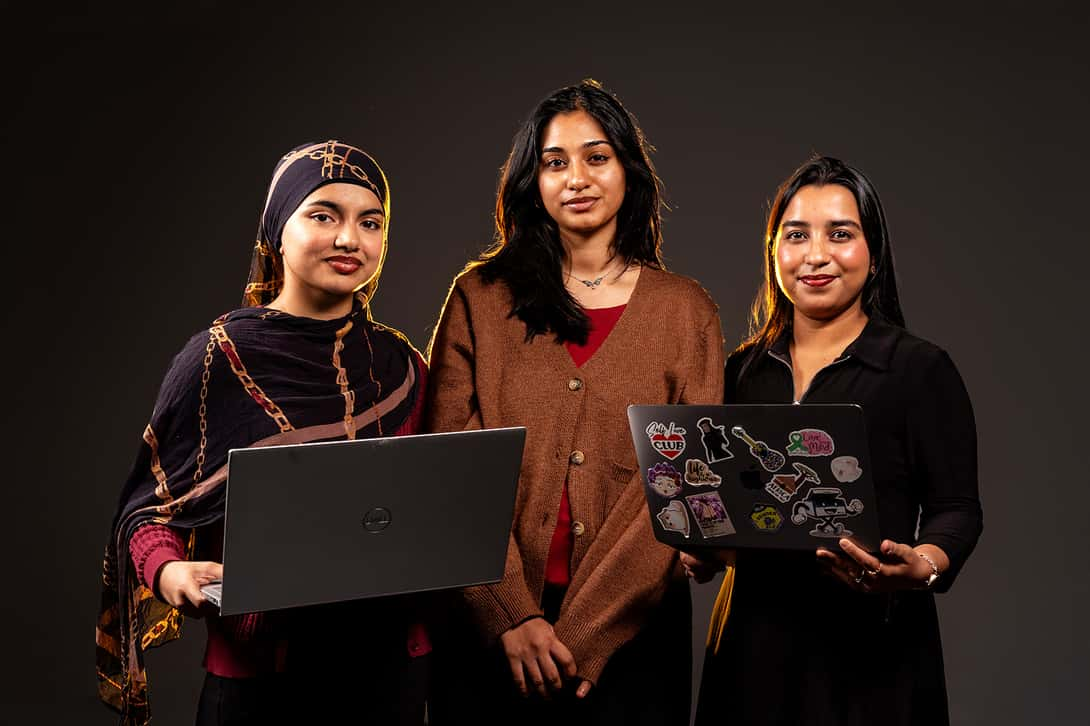
One Saturday morning in September, everything went wrong for three Colby students who hoped to compete in the Bowdoin College Hackathon.
Aaminah Ali ’29, Nur Anika ’28, and Anjumanara Chowdhury ’30 thought they had transportation to Brunswick arranged, but that morning they learned their friend couldn’t give them a ride. They looked for public transportation, then an Uber, but nothing worked out.
“It was terrible,” said Ali. “We were so upset. We were so defeated in the morning when we didn’t think we were going to go.”
But then, their bad day turned around. Half an hour before the hackathon was scheduled to start, they emailed Associate Professor of Computer Science Naser al Madi to say they couldn’t make it to Bowdoin after all, and he arranged a last-minute taxi.
Ali, Anika, and Chowdhury arrived late, after the other student teams had started their projects, but the challenges they overcame that morning galvanized them.
They called their team the “Spice Girls” in honor of their South Asian heritage, and their project turned heads—and won one of the two top Bowdoin Hackathon awards.
A digital journal meant for self-care
Ali, Anika, and Chowdhury created a digital journal inspired by kintsugi, the traditional Japanese art of repairing broken pottery with lacquer mixed with precious metals such as gold.
The journal they designed and built over the day-long hackathon features an image of a ceramic bowl. Prompts ask users to describe challenges they’ve faced, and as they write, a crack spreads across the bowl. They are then asked to reflect on what helped them through, or on a positive moment, no matter how small. With a click, the crack fills with gold, a visual reminder that finding the positive matters, even in times of adversity.
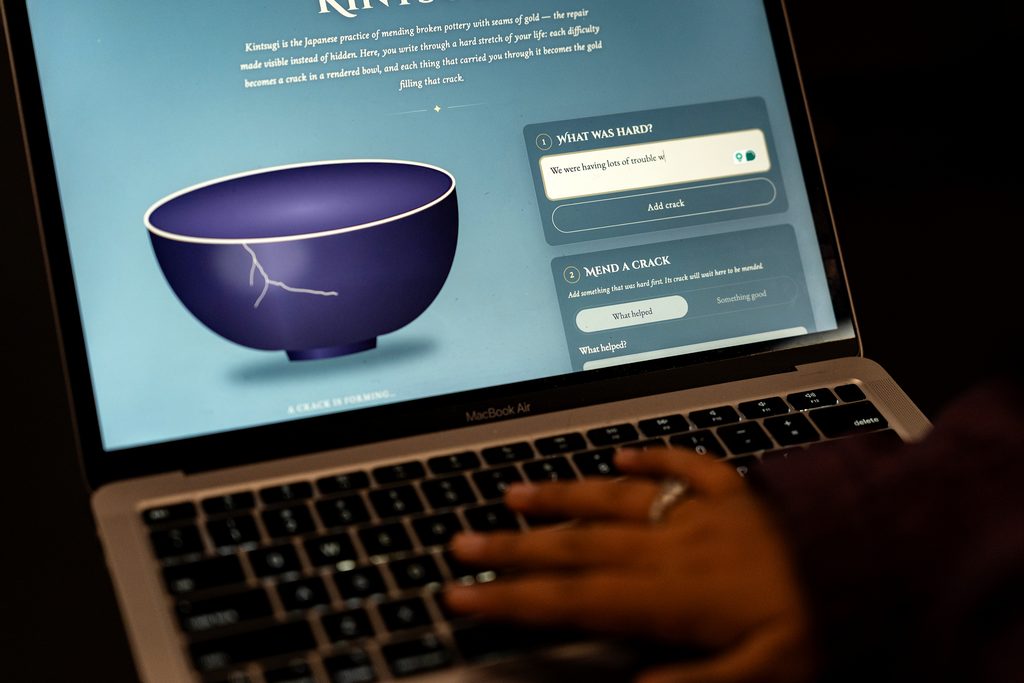
Hovering over any crack or gold seam highlights the words behind it, so each bowl holds the story of its own repair. When a bowl feels finished, users can name it, save it as a keepsake in their personal collection, and reopen it anytime to replay its story crack by crack.
“In our journal, you’re able to talk about the negatives of your day, and then try to mend those broken pieces with positive outcomes and solutions,” Chowdhury said. “It was honestly inspired by our day.”
Bridging the gap between art and code
College hackathons serve multiple purposes. Participants aim to solve a specific problem or test a creative idea by rapidly building a working software or hardware prototype. In the process, students bridge the gap between classroom theory and real-world application.
This year, the hackathon’s theme was art, creativity, and technology, and it was open to students from Colby, Bates, and Bowdoin. Seventy students registered for the event, which encourages scholars from all academic disciplines to explore the intersection of art and technology with the help of artificial intelligence. Students brainstorm ideas and are expected to bring one to fruition by the end of the day by creating an app or web platform, with mentors on hand to offer guidance and advice.
“There was always someone to help you,” Anika said, adding that students came up with a wide range of projects. “As long as it had art, creativity, and technology, you could do anything in the intersection of these.”
For Ali, a computer science and physics double major; Anika, a computer science and neuroscience double major; and Chowdhury, a first-year student considering declaring computer science as her major, working together was a powerful, positive experience. Tech is a male-dominated industry, with women making up from a quarter to just over a third of the overall tech and STEM workforce both in the U.S. and globally.
For women in tech and STEM, it can be hard to make sure their voices are heard. But for the Spice Girls team, that wasn’t an issue. Communication and collaboration were among their strengths.
‘It’s one thing to just crack jokes with your friends, and it’s another thing to have to build something with your friends, to produce a deliverable and go through the highs and lows of everything we did throughout the day.’
Anjumanara Chowdhury ’30
“In fields that are very male-dominated, it comes with the idea that because men are what dominate, their voices are more heard, so their ideas must be better,” Chowdhury said. “But having an all-girls team was incredible, because anything you say will not be shut down.”
After brainstorming, they decided to run with the kintsugi idea, but developing the journal wasn’t easy. An hour before the deadline, parts of the journal didn’t work, and they weren’t sure they could bring their vision to life.
“There were so many highs and lows,” Chowdhury said.
Coding under pressure
Each member of the Spice Girls team brought their own strengths to the hackathon. Anika, who had previously participated in hackathons and worked under pressure, did most of the coding work. Chowdhury connected with the computer science mentors and delivered a strong final presentation to the larger group and judges. Ali was “the glue,” her teammates said, helping with each part of the process, from coding to writing jokes for the presentation.
While creating their digital journal, they used JavaScript, Python, HTML, and CSS, along with AI tools.
The hackathon was stressful but exhilarating, and at the end of the day, they were shocked and thrilled to hear their team name called out as one of the two winners. The students were friends before the hackathon, but the experience brought them closer.
“It’s one thing to just crack jokes with your friends, and it’s another thing to have to build something with your friends, to produce a deliverable and go through the highs and lows of everything we did throughout the day,” Chowdhury said. “It really is such a bonding experience.”


