Protecting an Ancient Forest
Colby’s tree-dating research was instrumental in conserving a 172-acre parcel of old-growth forest on Long Pond in Maine
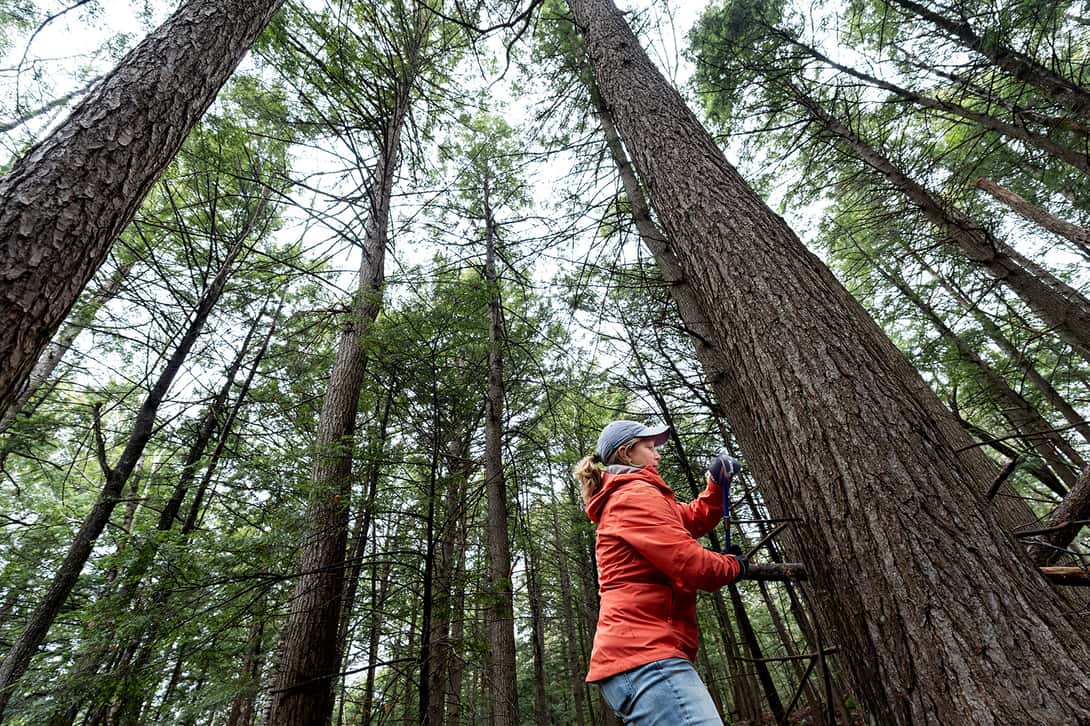
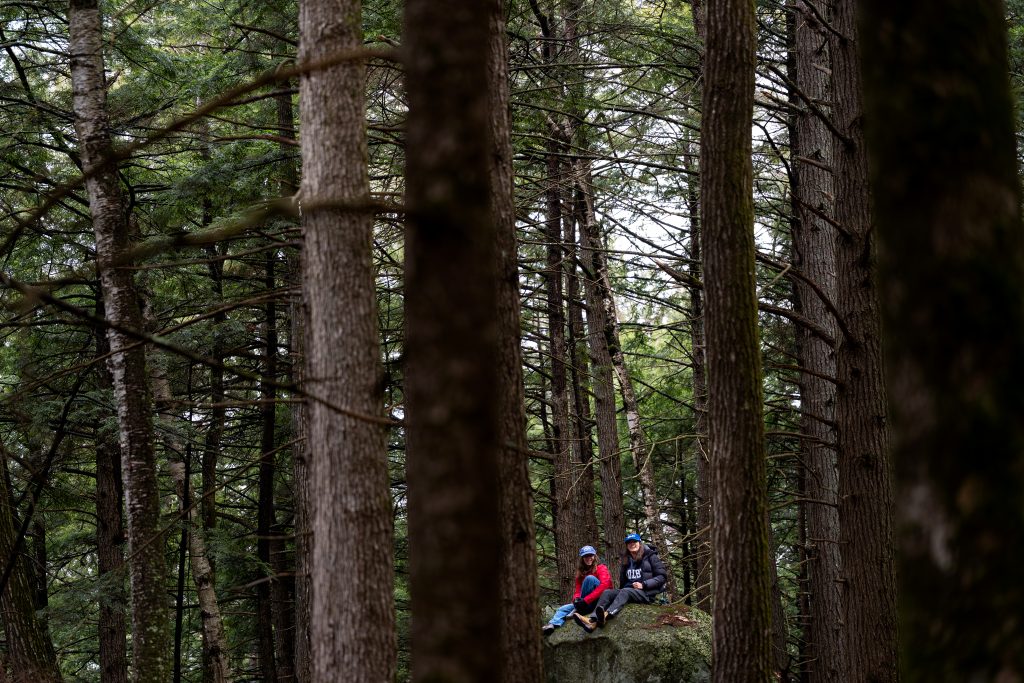
The hemlock forest on the eastern shore of Belgrade’s Long Pond seems both beautiful and mysterious on a chilly late March afternoon, the dark green tree crowns steepled like a wilderness cathedral into the misty, slate-gray sky.
The landscape where these trees are growing is rugged and wild, too, with a soft carpet of moss and leaf duff that’s almost obscured by a labyrinth of roots, rocks, and steeply sloping terrain.
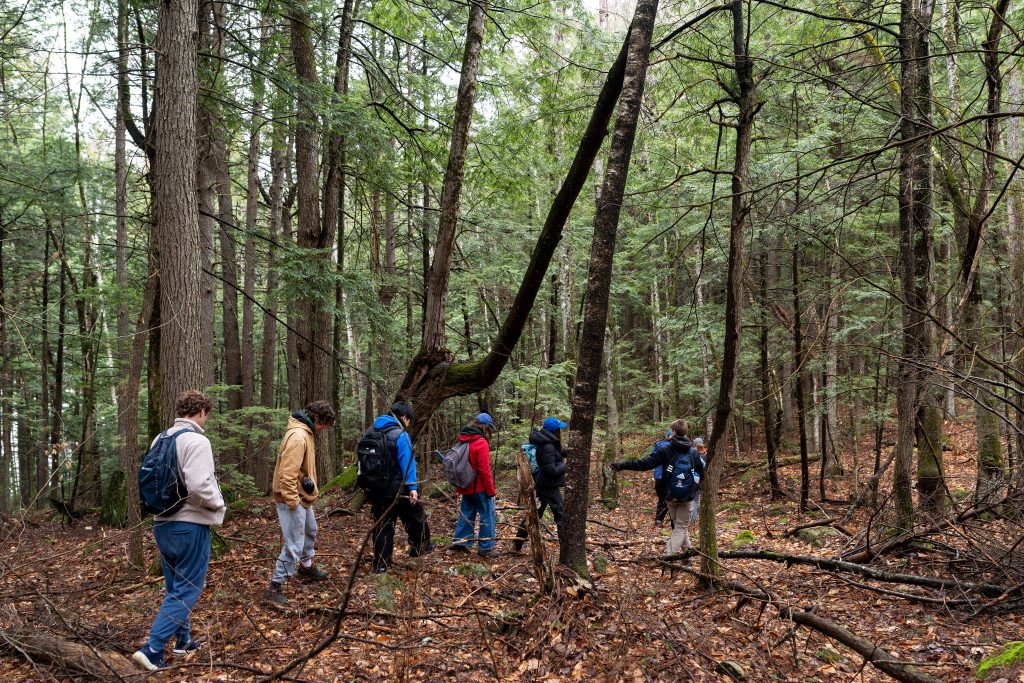
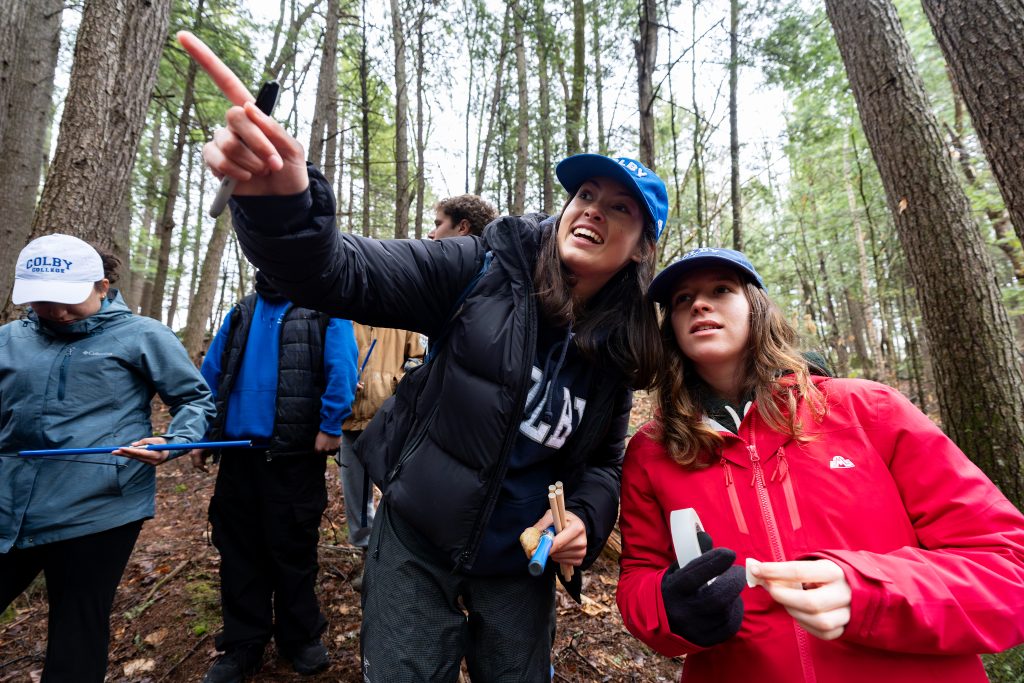
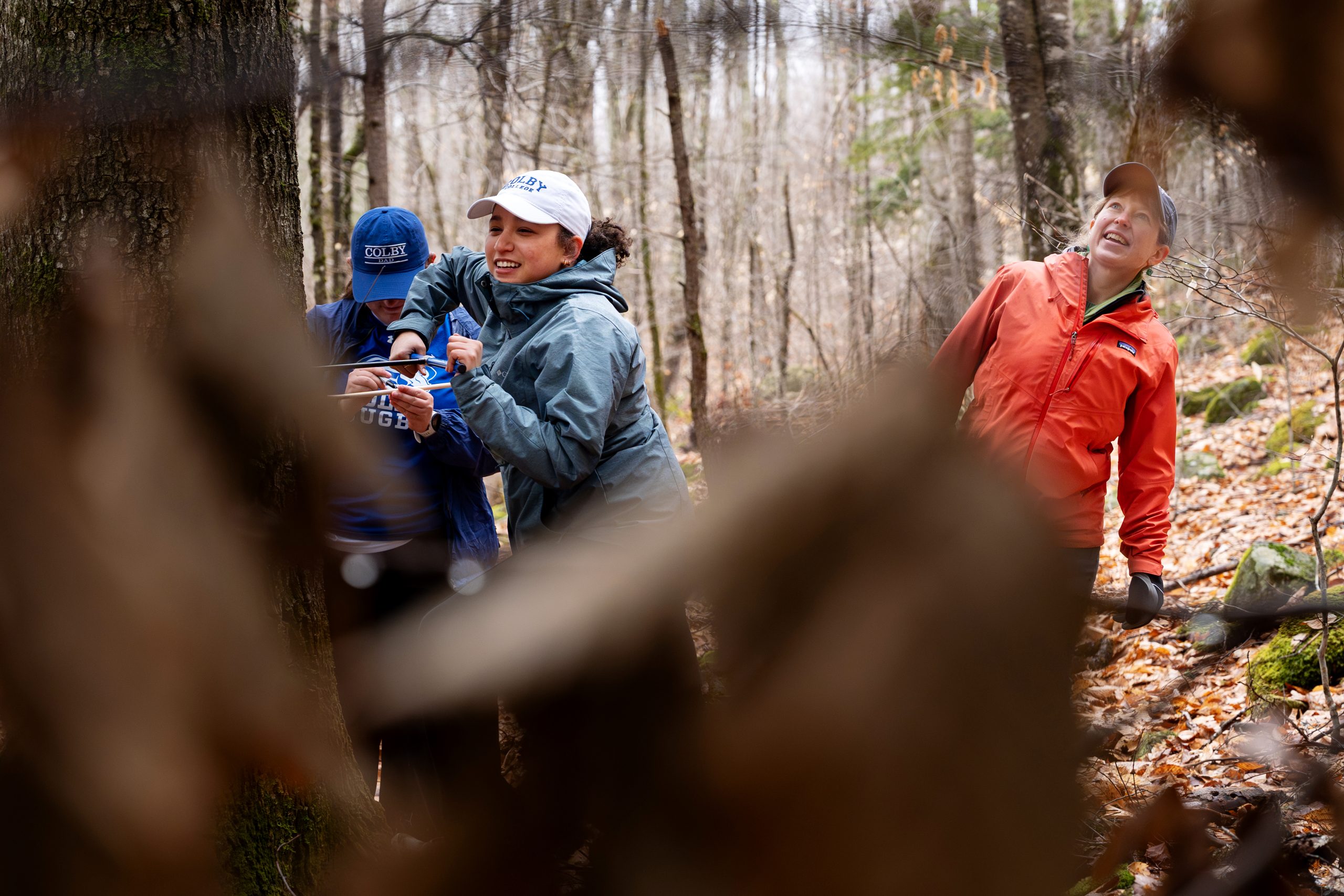
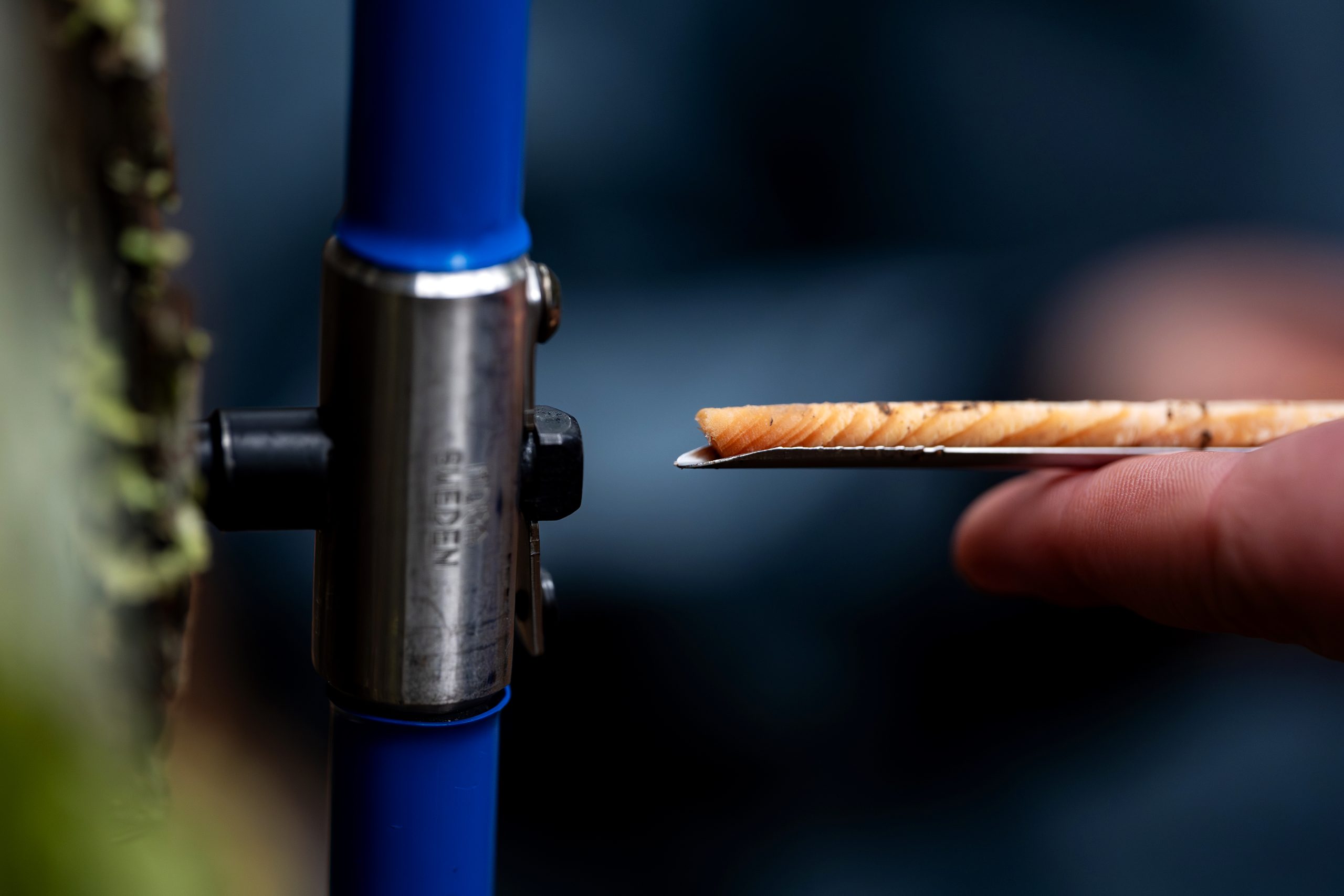
Associate Professor of Earth Sciences Bess Koffman and students in her Earth’s Climate: Past, Present, and Future course move carefully among these hazards as they fan out through the forest in search of the largest hemlocks, which they’ll core with increment borers and then count the annual growth rings to determine the age of the trees.
This research project, which Koffman began with her students in the spring of 2024, has already proved something extraordinary about the forest: it hasn’t been cut down before. The trees here are old-growth, and students have found that the trees they’ve sampled had an average age of 188 years. One red pine turned out to be 250 years old, meaning it was a sapling during the Revolutionary War.
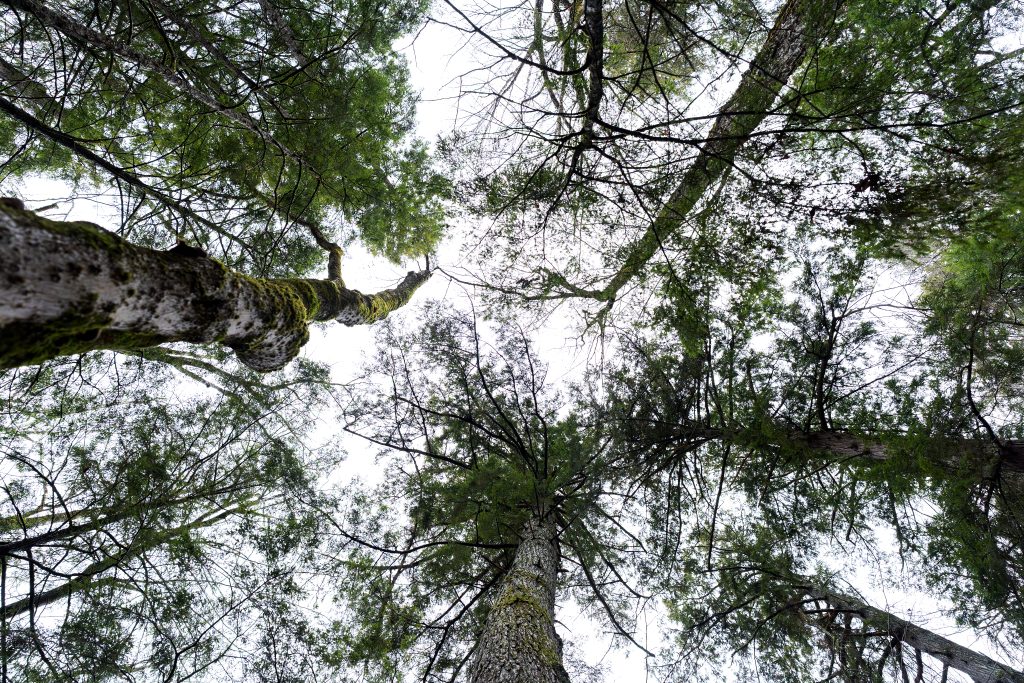
“The amazing thing is that this area didn’t get logged. It’s super rocky. It’s steep. There’s a big wetland over there,” Koffman said as she looked around the landscape. “We’re really lucky that this forest is here.”
What she and her students learned about the age of the trees was instrumental in helping the 7 Lakes Alliance, a nonprofit land trust and conservation organization that works in the Belgrade Lakes region, secure funding from the state’s Land for Maine Future program to help purchase the Long Pond property.
A unique forest on a special piece of land
Last year, the land trust was able to conserve the 172-acre parcel, which includes almost a quarter-mile of undisturbed shoreland, a property that Noah Pollock, the land conservation director for the 7 Lakes Alliance, described as special.
“This particular part of the lake is pretty remarkable in its wild nature. And the more we explored the property, the more we learned of its value, including a really exemplary string of vernal pools along a wetland, and then a patch of fairly old trees that had not been logged, and just these beautiful pines and hemlocks,” Pollock said. “We had seen that they were big and looked old, but we weren’t sure if we could call them old growth or not.”
Maine is generally considered the nation’s most heavily forested state, with trees covering nearly 90 percent of the total land area. But old-growth forests, which have not been harvested and are critical to biodiversity, make up a tiny amount of that acreage—less than half a percent in total.
Pollock and the 7 Lakes Alliance didn’t want to make that claim about the Long Pond property without evidence, so they invited Koffman and her class to see what they could find out about the forest. Colby and the 7 Lakes Alliance have long worked together to understand the ecology of the Belgrade Lakes and to develop exceptional research, education, and guidance to partners and neighbors throughout the watershed.
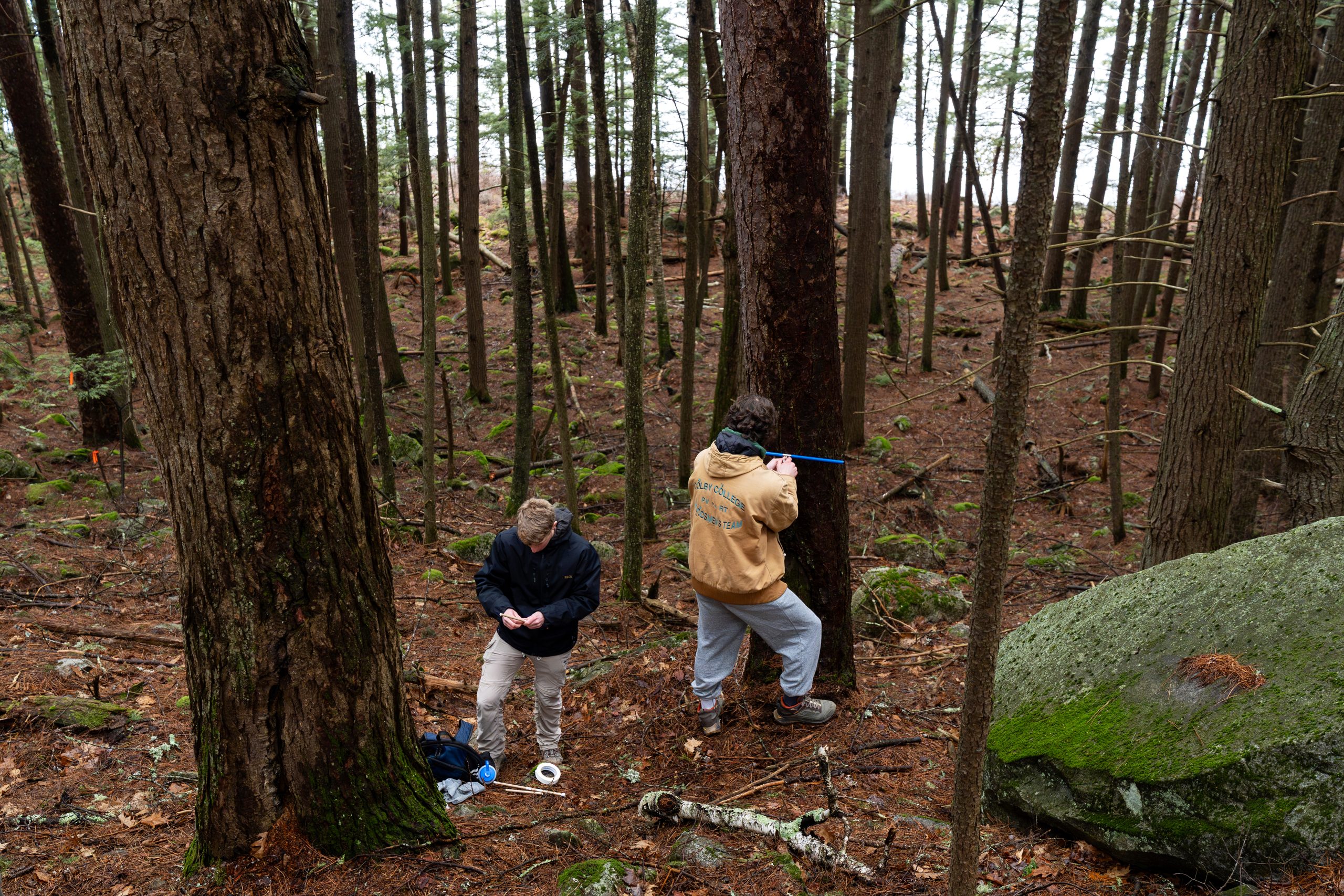
On Long Pond, the dendrochronology, or tree-dating research, done by the Colby students helped the land trust make a persuasive case when applying to Land for Maine’s Future, the state’s primary funding vehicle for conserving land for its natural and recreational value.
“We were able to really highlight that old-growth forest,” Pollock said. “Not only was it a good experience for the students, but it also helped us tell the story in a scientific way.”
Ultimately, Land for Maine’s Future funded roughly half of the purchase price from the timber company that owned the land, with contributions from individual donors making up the rest.
“It is among our favorite projects,” Laura Graham, the Land for Maine’s Future director, said of the Long Pond parcel. “The most exciting thing about this project was the combination of water access with this old-growth forest coupled with gorgeous views across the water. It was a wonderful combination. Being able to walk in an old-growth forest was such a treat, and not something we get to do that much.”
Stories told by the trees
After Colby students take cores from the trees, they return to the lab to use digital calipers and microscopes to count the annual growth rings and measure the ring widths. According to Koffman, there’s an abundance of information to be learned from tree coring.
“It’s a great hands-on way for students to learn about past climate,” she said.


For instance, in the Long Pond forest, it’s possible to see how trees in Maine were affected by the 1815 eruption of Mount Tambora in Indonesia. It was a catastrophic event considered to be the most powerful volcanic eruption in human history, and it cast a shadow across the globe, including the 1816 climate event known as the Year Without a Summer.
“We only have a few trees that we’ve cored that date back to the early 1800s, but there is a low period of growth in that time when it was cold in Maine, and there were frosts on the ground in July,” Koffman said. “That’s pretty tangible, and a really cool thing for students to see.”



They’ve also found evidence of a big jump in tree growth in the mid-1950s, which may be related to hurricanes Carol and Edna that blew through central Maine in 1954, knocking down trees. This allowed other trees to grow faster because more light sifted down through the forest.
“That isn’t really a climate reason, but it’s certainly weather-impacting ecology,” Koffman said. “These are all questions and stories that we can start to tell with these trees.”
The Colby connection
The partnership between Colby and the 7 Lakes Alliance means that students will continue to learn from the Long Pond forest, and the land trust will benefit from their interest and enthusiasm. The College is part of a long-term monitoring project on the land, and Cam Rogers ’28, a biology and environmental science double major, will spend his summer working with Koffman and the land trust to do coring research and trail work on the property. Also, Associate Professor of Environmental Studies Justin Becknell plans to bring his students to the land to study ecology here.
Colby students have left their mark here already, and not just on the trees.
“It’s not every day that you get to do science that helps to inform what happens on the landscape,” Pollock said. “I think that they really like knowing that their work helped lead to the conservation of this special spot.”
Meredith McKeever ’29, a history and earth sciences double major, and De’Naiza Watson ’29, an earth sciences and global studies double major, scanned the landscape in search of the tallest, broadest trees to core and investigate. They and the other students in the class soon learned that using the increment borers demands time and elbow grease, but all were happy to be out in the woods.
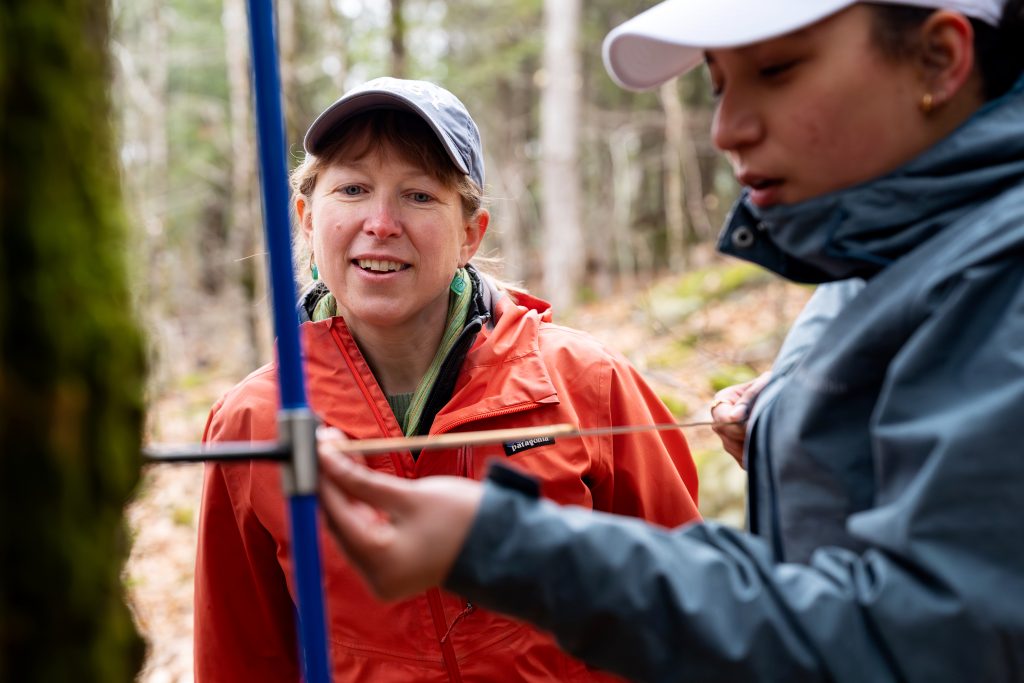
“It’s awesome to be able to do actual fieldwork that real geologists are doing,” McKeever said. “Even though I’m just a freshman, I get to make observations about what I want to do when I graduate from Colby.”
That’s exactly the point of bringing her students to places like the Long Pond forest, Koffman said.
“We want to get them familiar with the tools that we use to learn about climate in the past so that it’s not just theoretical, and not just working with data,” she said, “but actually doing it themselves, and learning the techniques that they can use in the future.”