A Major Math Breakthrough
Pedro Alves Silva Dos Santos ’26 teamed up with Associate Professor Evan Randles to crack a complex problem in numerical stability
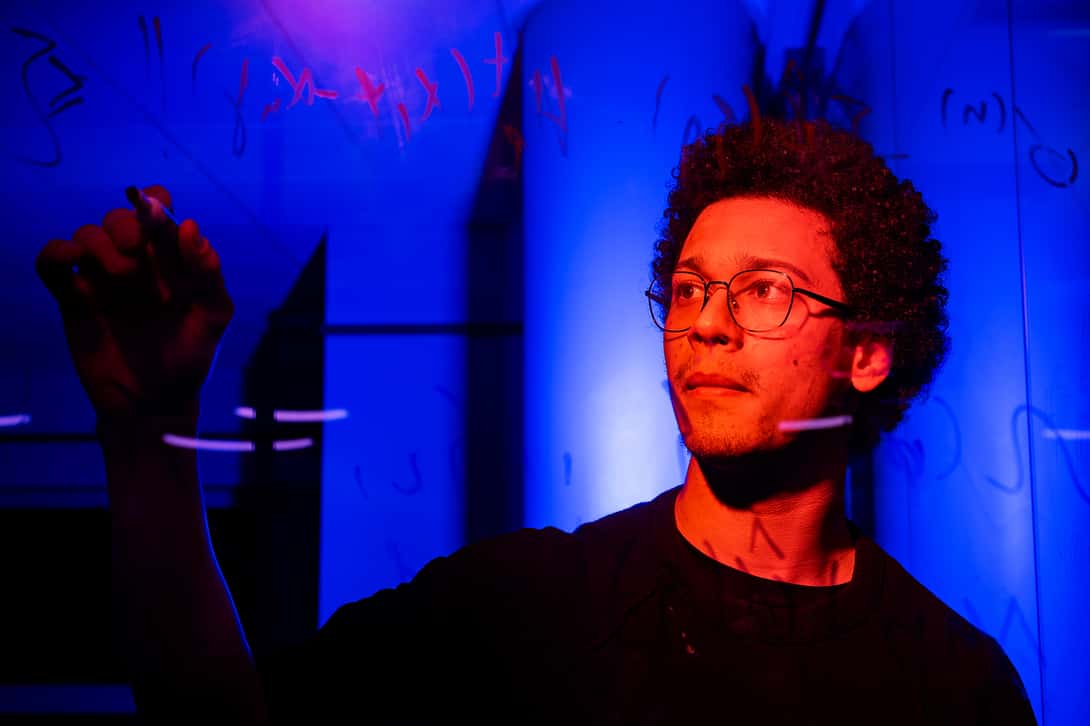
As a child, Pedro Alves Silva Dos Santos ’26 wasn’t especially interested in math. But when he was in middle school, he signed up to participate in Brazil’s national math and physics Olympiads, reasoning that there was no downside, and maybe it would even be fun.
He was right on both counts.
Alves, a double major in physics and mathematics, found the problem-solving process to be irresistible. “The goal is more like, can you learn this new thing through the process of solving this problem?” he asked.
Years later, he still loves figuring things out. It’s a passion that recently helped lead to a breakthrough in a math problem that Associate Professor of Mathematics Evan Randles has worked on for more than a decade.
Sitting squarely in the not-so-simple-to-define area of the numerical analysis of partial differential equations, the problem wasn’t an easy one to solve.
“I’m one of a handful of people working on this problem, and I’ve been wondering about this for 12 years,” the professor said. “The problem basically is to provide precise estimates for certain numerical approximations. And they are very hard to do.”
Last year, he began working with Alves, whom he knew to be a gifted student. He suggested they try their hand at solving the problem.
“I told him that I don’t have great hope that we’ll be able to do it,” Randles said, “But we should try.”
They did try—and they succeeded. Randles and Alves have written a paper about their solution and are preparing to submit it to academic journals.
Randles is thrilled with the outcome and said that Alves’s intelligence, ability, and work ethic are major reasons for the breakthrough.
“He is a very, very clear thinker, and he is detailed, thorough, and creative in a way that is really required for a budding mathematician,” the professor said. “He can clearly state questions and get to the heart of how to answer the question in a way that is really unmatched.”
The evolution of stability theory
Because solving differential equations is very hard, and often impossible to do exactly, it’s of great interest to numerically approximate solutions to understand the physical phenomena they describe. When scientific computing came of age around the early 1960s, this area of mathematics “sort of exploded,” Randles said, because with the advent of computers, it was suddenly possible to approximate solutions to high degrees of accuracy.
“Unfortunately, the numerical approximations—called schemes—can sometimes blow up and yield only garbage from the computer,” Randles said. “It is therefore of great interest to identify when schemes do not blow up and have the potential to give good approximations. Mathematicians call this stability.”
About 10 years ago, he was able to prove that there was a collection of these numerical difference schemes that were “nice and stable,” he said. But there was still room to learn more about them.
A group of mathematicians in France recently made substantial progress on the problem. Their work focuses on numerical schemes posed in one dimension, which help solve differential equations in one variable. Randles read their paper and realized that it might be possible to extend their methods to obtain good results for schemes posed in any spatial dimension.
“These higher-dimensional results are of interest in a larger class of physical problems,” Randles said.
He asked Alves to see how far he could get, and the student followed through with alacrity. They worked together through the fall semester and into the winter to prove several results that originally seemed very hard to get. In early February, they submitted their paper to arXiv, an open-access repository for scholarly papers. When they did, they learned that a post-doctoral researcher in France had also been working on the problem and had obtained complementary results.
“We’ve decided we’re going to make it a collaborative effort,” Randles said, adding that he, Alves, and the group in France had their first Zoom meeting last week.
Collaborating in the Fishbowl
Alves, from the tropical coastal city of Salvador, Brazil, with a population of roughly 2.4 million, has enjoyed his years in the very different environment of Maine and Colby.
“I wanted to come to Colby so that I could really try different things and learn different perspectives on thinking,” he said.
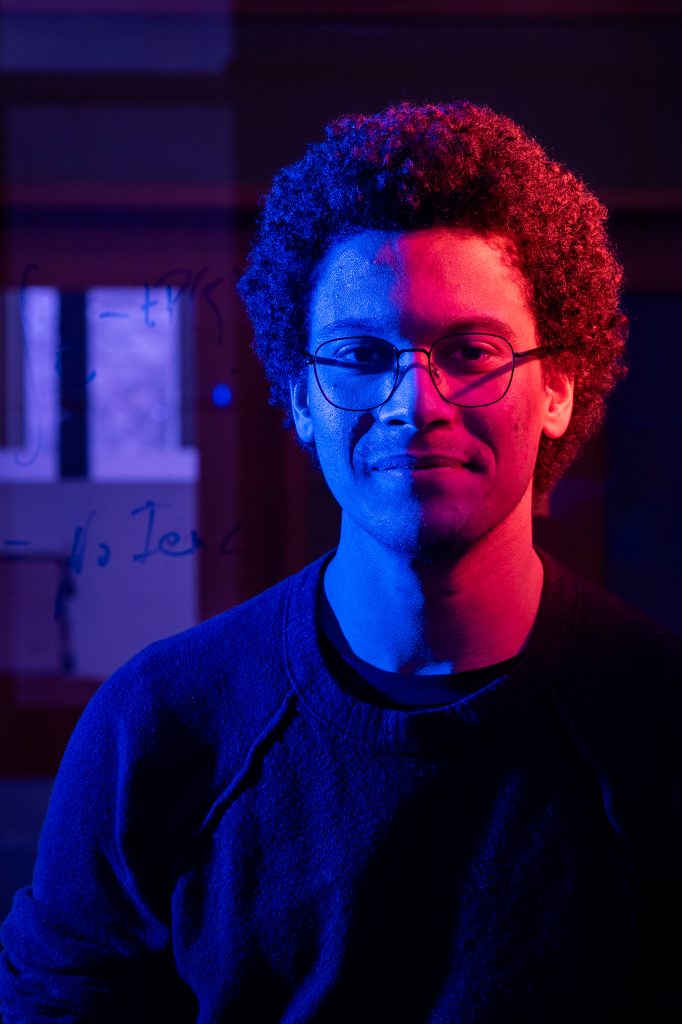
At the College, he spends much of his time in the Davis Science Center, where he works on problems and collaborates with other mathematicians. Although there’s a common stereotype that math is a solitary pursuit, Alves, who still talks to friends from middle and high school about the Olympiad problems they worked on all those years ago, believes that math is really a social enterprise.
That’s especially true in what students call the “Fishbowl,” a space in the Davis Science Center that is dominated by computers and chalkboards.
“It’s the place where a lot of the math students congregate. Sometimes, everybody will be studying quietly, and then someone will go, ‘I found this nice problem, look at this,’ and they’ll write it on the board, and we’ll discuss things,” Alves said. “You’ll be spending a few hours thinking to yourself about something, and then you try to explain what you’re working on to someone. They ask you a question, and it just clicks. I think the Math Department does a good job of bringing people together.”
It’s been exciting for him to work as a research assistant for Randles, who specializes in probability theory and analysis along with partial differential equations.
“He didn’t necessarily need a student to do things, but he brought me on, and he was really helpful. I had lots of questions,” Alves said. “He made sure that you learned things, that you contributed, and that you made progress. He was really supportive.”
A desire to understand new things
This semester, Alves is working to complete honors theses in both math and physics, where he is also a standout student, according to Charles Conover, the William A. Rogers Professor of Physics.
“Pedro is, without a doubt, one of the strongest three or four students I have taught and advised in my 35 years at Colby. I have rarely (and maybe only once) had another student with his level of academic talent, diligence, and ambition,” Conover said in an email. “While working on an experimental project in my lab to measure lifetimes and hyperfine intervals, Pedro has done excellent work on the data analysis. He has also been independently working through challenging papers describing the theory of details of the time-dependence of fluorescence we are measuring in the lab.”
After graduation, Alves is looking forward to graduate school, although he has not yet decided which program to choose. He’s also looking forward to continuing to solve problems and advance the greater understanding of mathematics.
“If you just had the end result, but nothing else, it would be so small,” he said of solving math problems. “What you’re trying to do is understand new things and try to contribute in some ways to help other people understand them, too.”