How One Colby Student Is Reimagining Science Education
David Tettey Tawiah ’27 is taking what he learned at Colby and the MDI Biological Laboratory to inspire a new generation of West African scientists
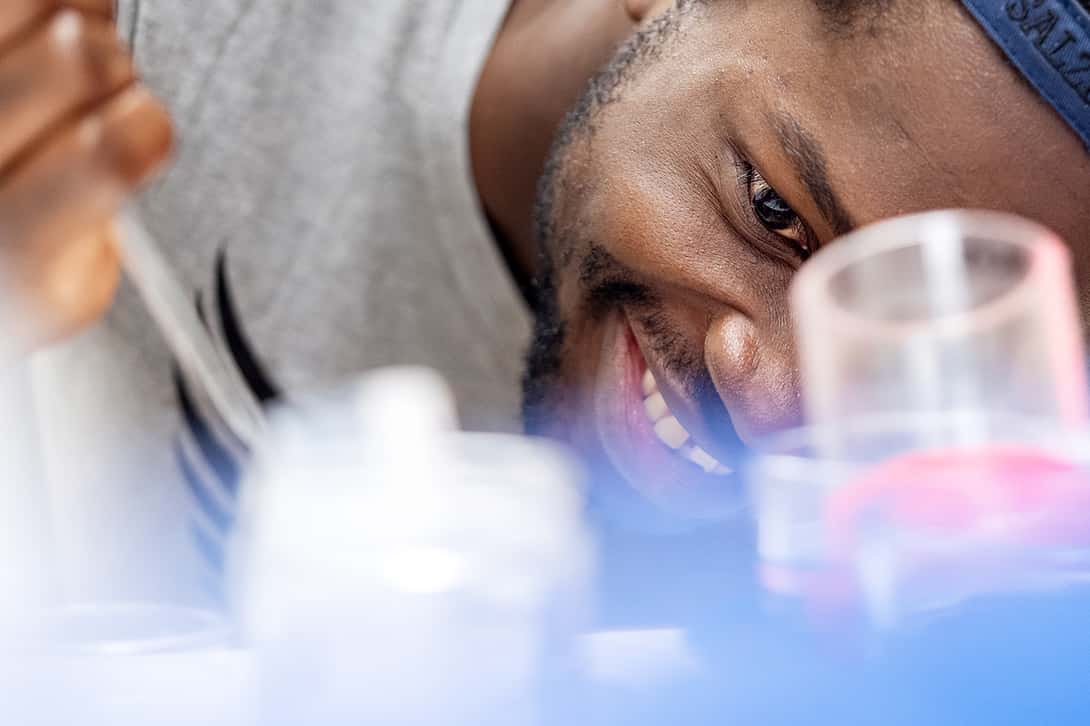
When David Tettey Tawiah ’27 was in high school in Ghana, he learned that being a good student meant memorizing facts from the textbook and listening quietly and respectfully to his teachers and other experts.
Tawiah was a very good student. He navigated the educational culture there with grades high enough and aspirations broad enough to earn admission to Colby.
Once here, though, it didn’t take him long to realize that being a good student at Colby would require a very different set of skills than the ones he had learned in Ghana. Instead of rote memorization, professors here prized the ability to think critically, ask questions, and challenge conventional wisdom. They saw making mistakes as essential rather than embarrassing.
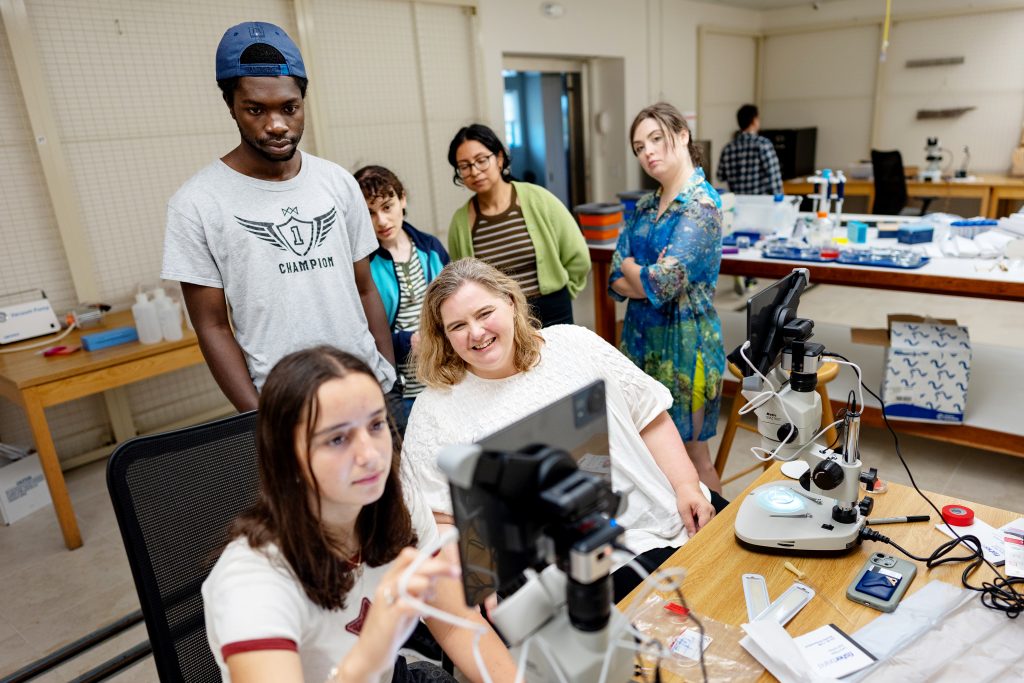
For Tawiah, a biochemistry and music double major, the transition was challenging but rewarding—and it sparked an idea. Now, he’s taking what he learned at Colby back to Ghana through a startup he is calling the Sankofa Lab for Learning and Discovery. Its goal is ambitious: to make learning accessible, practical, and fun for pre-college-age students in Africa, with a broad vision to inspire and equip young people there to reach their full potential.
In the Akan language of Ghana, sankofa translates to “go back and take something,” a phrase that embodies using valuable lessons of the past to shape a better future. For Tawiah, it means employing the hands-on, inquiry-driven research opportunities he discovered in Maine as a pathway for Ghanaian students to follow.
A transformational summer
On campus, Tawiah can often be found in the Arey Life Sciences Building, where he works as a research assistant for Dave Angelini, professor of biology and associate chair of that department. If he’s not there, it’s likely he’s at the Gordon Center for Creative and Performing Arts, practicing jazz piano, singing, or studying with José Martinez, assistant professor of music.
But one of Tawiah’s most meaningful experiences in Maine happened off campus when he was accepted as a Summer Undergraduate Research Fellow at the Mount Desert Island Biological Laboratory in Bar Harbor after his first year at Colby. The venerable research organization is focused on regeneration and aging. There, he and the other student interns got a comprehensive introduction to research. They also learned what it is like to work in a collegial, collaborative environment where everyone is passionate about science.
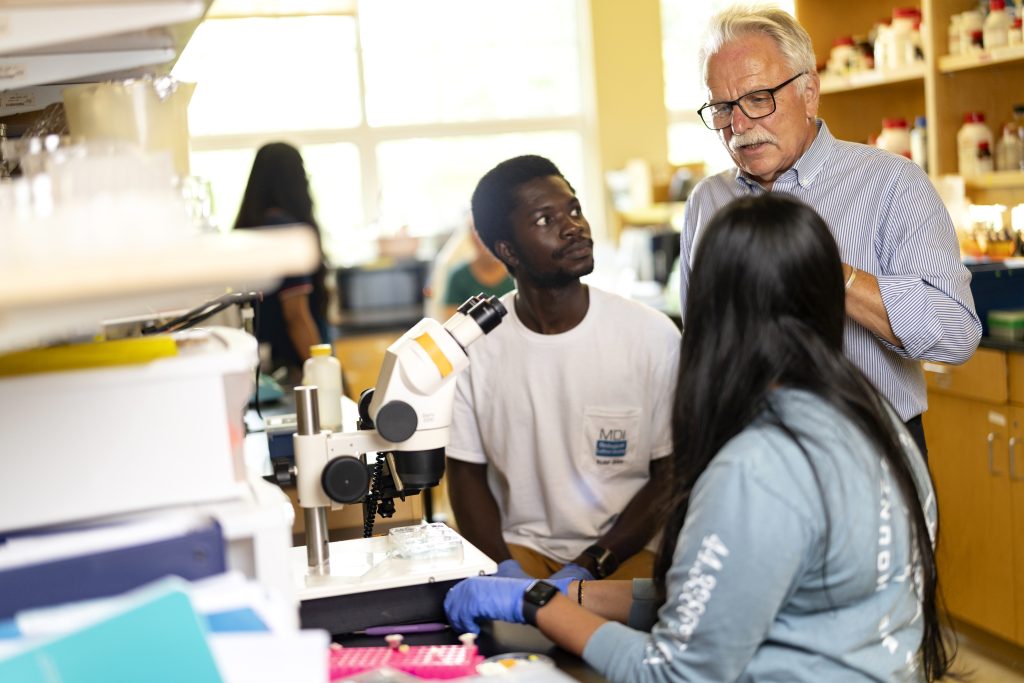
“It’s a really strong and kind community,” Tawiah said. “It was a really enriching experience for me.”
Every morning, he would sit on a wooden bench overlooking the ocean, soaking in the beauty of the Maine coast, before going to work in Dr. Hermann Haller’s lab. Haller, the president of MDIBL, is interested in zebrafish, which can do something that humans can’t: regenerate their organs. He is studying the cellular mechanisms of kidney regeneration in zebrafish, with the goal of one day figuring out how humans can regenerate their own kidneys.
In the lab, Haller’s team worked to model a rare human immune disease in zebrafish by inactivating specific genes. Tawiah helped create a stabilized model of the disease, methodical work that he found deeply satisfying. It was a transformational summer that shifted his career aspirations from clinical medicine to research.
“I find it more exciting and more fulfilling to go out and ask questions and find answers,” Tawiah said.
‘The best ambassador’
It’s clear that the Mount Desert Island Biological Laboratory made a big impression on Tawiah, who makes a small financial contribution to the lab every month out of concern about federal funding cuts.
“I can attest first-hand to the impact its educational programs have on participating students,” Tawiah wrote in support of the lab. “Indeed, I am grateful for the opportunity to contribute in my own small way to sustaining the SURF program for the next generation of biomedical scientists.”
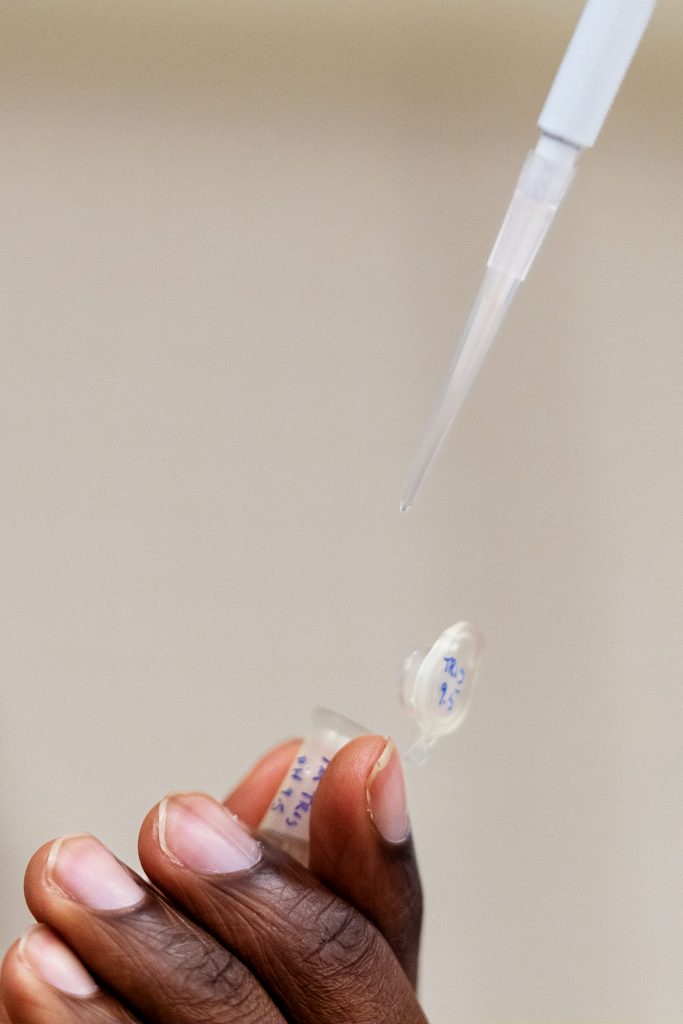
The student made an impression in the lab, too, Haller said. Researchers there want students to understand not just where science is going, but where it comes from, and to make sure they see science as something fundamental to humanity.
When Haller found out that Tawiah had a special gift for music, he connected the student with a retired MDIBL research scientist who also plays piano. Tawiah performed a concert at her house, one at the lab, and also joined a local choir, balancing his musical and scientific responsibilities with aplomb.
“He was enthusiastic, and he worked hard, and he was lovely to work with,” Haller said. “To be honest, most of the students would have had a full summer just doing science. He did a great job with the science, and then he was doing all the other things on the side.”
Haller is now talking to Tawiah about supporting the Sankofa Lab.
“I’m happy to help him with his aspirations because he makes the world better,” the scientist said. “He is the best ambassador of his country you could think of.”
Starting Sankofa
After his summer at the Mount Desert Island Biological Laboratory, Tawiah spoke with Andrea Tilden, the Leslie Brainerd Arey Associate Professor of Biosciences, about how to replicate the lab magic elsewhere.
“We had lots of conversations about how to set up a summer program,” said Tilden, who is also the director of the Linde Packman Lab for Biosciences Innovation. “And David just got really excited about this idea that it doesn’t take major resources to get a foot in the door.”
He started communicating with organizations in Ghana, designing educational programming for Sankofa’s pilot program, and learning how to present science to different audiences.
“He pulled together lots of ideas, and basically came up with a version of the MDIBL summer program that could be transported to Ghana,” Tilden said. “I thought it was really a wonderful idea. He wanted to give high school students the experience of hands-on science that, for him, was so instrumental in sparking his interest in research. He just really had this dream of making science research accessible.”
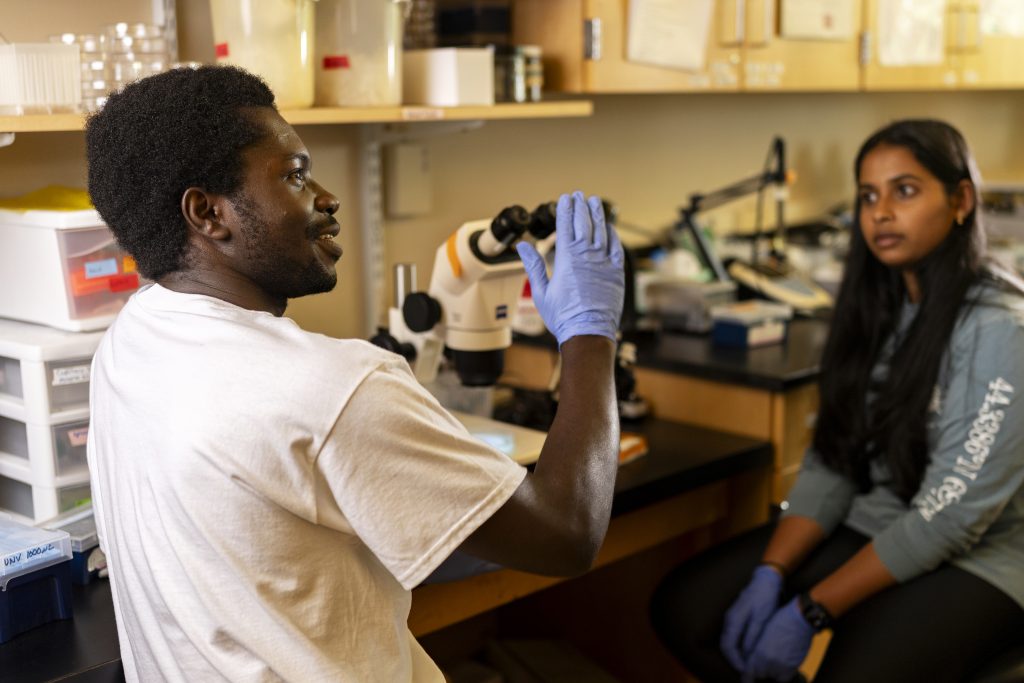
As executive director of the Sankofa Lab, Tawiah leads a 13-person founding team with members at Colby and in Ghana. Last summer, they ran a remote lab science program for high school students in Ghana.
“I tried to make science and scientific research seem fun. I think I at least got them to rethink old, bad perceptions about science,” he said.
That initial Sankofa STEM Fellowship was a success, and this year he and his team are scaling up. This month, with help from Colby’s Linde Packman Lab, they’re holding a 10-day program in Ghana for 20 students focused on bacteriology, entomology, and parasitology.
“The idea of a lab is a place where things get done, problems are solved, discoveries are made, and camaraderie is built,” Tawiah said, noting they are deliberately targeting high school students. “We think that sector has very, very little attention. But it’s precisely where we should be putting our attention, because they are the people who are going to grow up to do things.”
Following the threads of research
Over his years at Colby, Tawiah has continued saying yes to research opportunities. He participated in the College’s inaugural Tunicate Research Consortium on Allen Island and assists Angelini with his soapberry bug research, which aims to prevent age-related muscle atrophy in humans.
“He lets the students figure things out, make mistakes, and take responsibility for what they are doing,” Tawiah said of Angelini’s research style. “I appreciate that, because especially as an aspiring leader, it’s great practice for me to learn how to make mistakes and be comfortable with the unknown.”
Last December, Tawiah won third place in the Journal of the American Physiological Society’s prestigious national essay competition. He wrote about how studying diverse creatures from all over the world helps humans unlock fundamental secrets about human life and health.
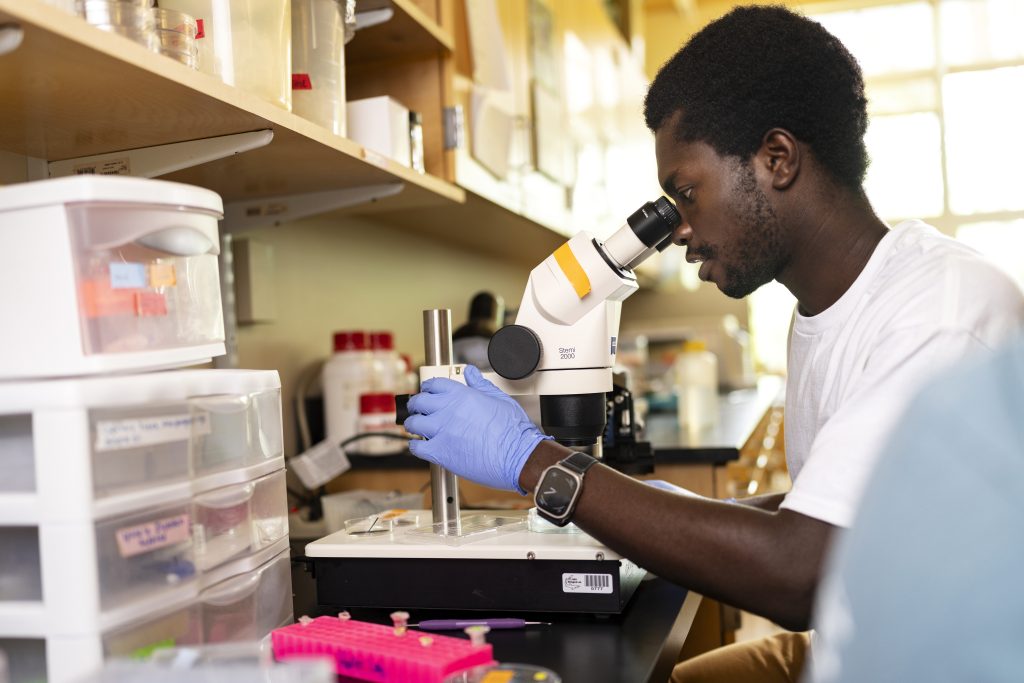
“The future will depend on keeping our nets cast wide, across species, disciplines, and continents, so that curiosity can continue to surprise us,” he wrote. “That is the big open question that excites me most: not just what we will discover, but how we will choose to pursue it.”
Tawiah and Sankofa’s other founding members have big dreams for the startup. They would like it to become a comprehensive pipeline for students of all ages and demographics to learn about science before they start college or university. They also envision it expanding beyond Ghana into other African countries.
It’s ambitious, but Tilden and others who know Tawiah believe that he is capable of bringing ambitious dreams to fruition.
“He definitely goes the extra mile,” she said. “I am blown away by the depth and maturity of his thinking about how to create a solid program, with thoughtful pedagogy and inspiring activities. It’s exactly the kind of thing that the whole world needs.”