The Science of Sea Squirts
A gathering of scientists and students on Allen Island allows for the close study of a distant human relative, the tunicate

Blobby, squishy, and even alien, sometimes loosely resembling a cluster of eggs or jelly-filled sacks, the sea creatures called tunicates are about as far from charismatic megafauna as you can get.
But their unprepossessing appearance did not quell the excitement this summer on Colby’s Island Campus as a group of tunicate aficionados from around the country came together to study them. The scientists and their students were invited by Assistant Professor of Biology Christina Cota, who said there’s a lot more to tunicates than meets the eye.
For starters, they’re our closest invertebrate relatives. Tunicates and humans may be only distant cousins, but we are fellow members of the phylum Chordata, which includes animals with backbones. This means that scientists can use them to study genes and major biological structures such as the heart and the brain.


In vertebrate species, such big, important organ systems are so complex that they can be hard to understand, but that’s not the case with tunicates.
“In tunicate systems, they’re much simplified, but the core, essential components of the system are there, and much easier for us to see,” Cota said. “And they’re also transparent, which is really useful if you want to do fluorescent or light imaging of them and watch what’s happening, not just on the surface of the animal, but actually inside the cells.”
About tunicates
Tunicates are abundant, with about 3,000 species found in the world’s oceans. Their name was inspired by their firm outer covering that helps protect them from predators such as sea stars and fish. It made an 18th-century observer think of a tunic, and the name has stuck.
In their larval stage, tunicates have a notochord: a flexible, backbone-like structure that makes them part of the phylum Chordata. Tunicates are all filter feeders, and as larvae, or tadpoles, they use their notochord to swim around. Although some live their lives as planktonic drifters, many tunicates spend their tadpole stage searching for a good place to spend the rest of their lives, like rocks, or the undersides of docks or boats. Once they do, they attach with a suction-like structure and metamorphosize into an adult.
The most commonly known class of tunicates, the ascidians, are commonly known as sea squirts, so called because when they are startled, they contract their muscles and shoot out water.
Many tunicate species are native to the Gulf of Maine, but the fast-warming waters there seem to have turbo-charged their ability to thrive off the Maine coast. As well as the native tunicates, plenty of invasive species of the animal have migrated to the state’s shallow coastal waters. It’s a turn of events that is concerning to the fishing and aquaculture industries but is an opportunity for Cota and other scientists to collect them for research.
“We can get them easily, because the species we are interested in are considered invasive,” Cota said. “They can cause problems for people like lobstermen because they attach onto their lobstertraps, and they’re what we call a ‘fouling organism.’ They just multiply in such unbelievable quantities that they block water flow and use up nutrients and resources, so people are at least theoretically happy for us to be taking them out of the water in these spaces.”
‘A pivotal moment’
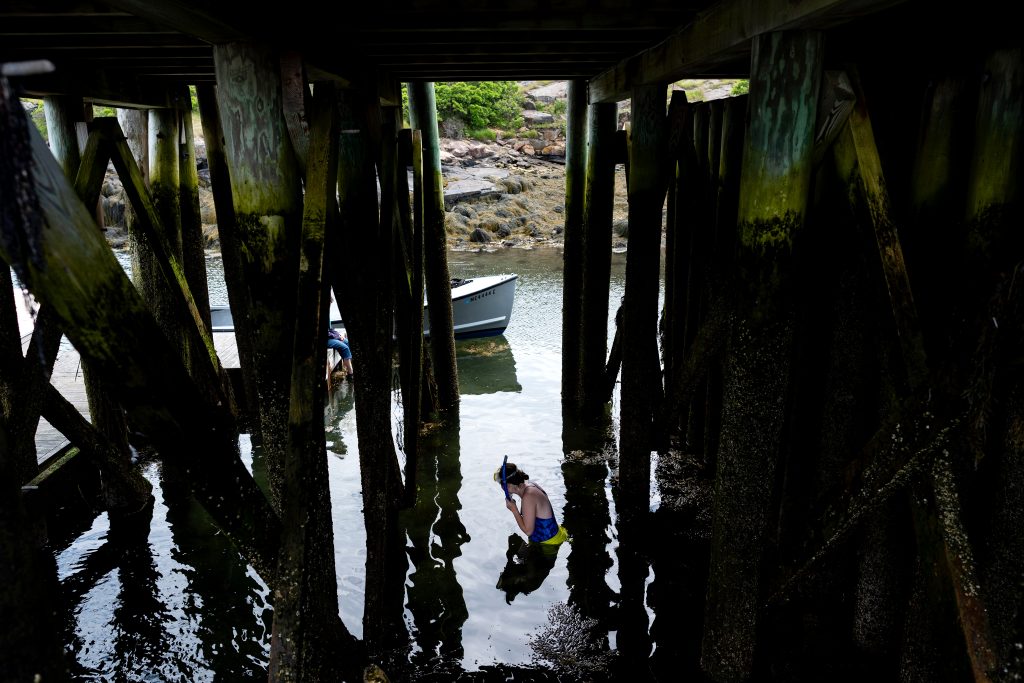
On a bright summer day on Allen Island, the weeklong gathering that Cota dubbed Colby’s inaugural Tunicate Research Consortium hummed on all cylinders. Sydney Popsuj, a post-doctoral student from Swarthmore College whose focus is evolutionary developmental biology, donned a swimsuit and snorkel gear to gather tunicates from underneath the island dock.
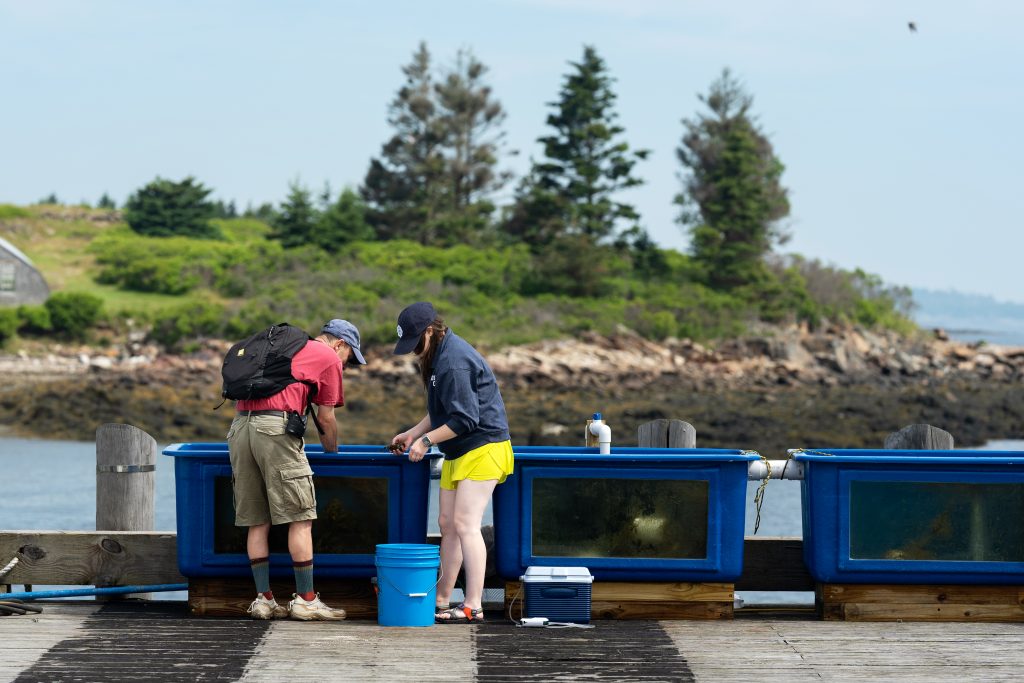
Meanwhile, on dry land, Cota and Alberto Stolfi, an associate professor at Georgia Tech’s School of Biological Sciences, talked with other members of the group about why the consortium mattered.
“I think this is a pivotal moment in the tunicate community for us to come together and do some incredible research out in the field where these guys are living,” said Chris Johnson, who recently received his doctorate in biology from Georgia Tech. “We are normally in school labs, which is nice, and you get a lot of work done, but it’s also good to be outside, getting your hands dirty and working with these organisms firsthand with collaborators from all across the country.”
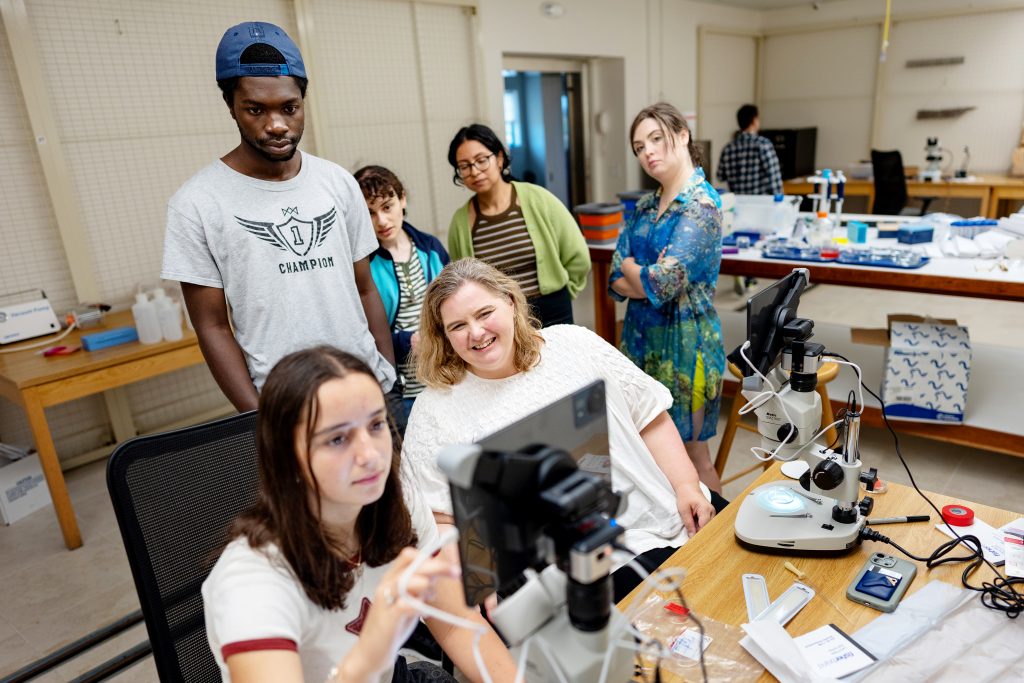
Later that day, everyone moved indoors, to an ad hoc biology lab set up in the basement of the bunkhouse, to get to work on the tunicates.
Jacqueline Cahaly ’27, a biology major, concentrated on an array of petri dishes as she practiced a new skill: performing in vitro fertilization of tunicate eggs.
“You pull out their tough surrounding, or tunic, if you will, and then you can see they’re pretty transparent creatures, so there’s going to be a stripe of red, and that’s the eggs. You would do a small incision with scissors, and then you push that out into the water,” Cahaly said. “And then their sperm ducts are also very easy to see. And so in a different petri dish, we cut those out. You activate it just by changing the pH a little bit with some buffer, and then you mix it together.”

Then, she waited, but not for long. It only takes a couple of minutes for fertilization to happen, and on the previous day, her first attempt ever at fertilizing the eggs was successful.
“I think it’s really cool research. It’s definitely the biology I’m interested in, personally,” Cahaly said. “I’m pre-med, and was looking at jobs in between college and med school. Ironically enough, I just discovered embryology. So I kind of want to do that, and I feel like I’m getting exposed to embryos. I feel like I want to call my friends and say, ‘You’ll never believe what I did today.’”
Cahaly and David Tawiah ’27, a biology and music double major, normally would be found in Associate Professor of Biology Dave Angelini’s lab this summer. But both were glad to be part of Cota’s tunicate research.
“It’s an opportunity to see scientists at work,” Tawiah said. “I believe we learn as much from actually observing for ourselves and seeing how things go as from being told stuff. And the scientists are also really accessible, so we get to ask them questions, and that’s really useful.”


A small organism with big potential
The world of tunicate researchers is a small one. But, they say, it has the potential to be mighty. That became clear in the early 2000s, when genome sequencing showed that tunicates and humans were fairly closely related, and that the tunicate genome is relatively small.
“Tunicates had very small, compact genomes, and so they were among the first animals to be sequenced,” Stolfi said. “And then they exploded in popularity together with the development of techniques that allow us to directly manipulate the cells and the genes.”
It’s not clear right now exactly what kind of breakthroughs this work at Allen Island could lead to, but scientists say they could be important. Researchers are already using these animals to gain insight into how vertebrate genomes and immune systems have evolved and as a potential source of novel antiviral and anti-cancer compounds.

One unique feature of colonial tunicates, the ones that live in colonies, sounds more like science fiction than science. That is, all the individual organisms in the colony are genetically identical because they are clones of one another. If you peer into a single tunicate, you can spot a small, identical tunicate sprouting out of its gut. Inside that one is another tunicate that is even smaller, and every seven days, the mature individual dies and is replaced by a clone of itself that comes out of its gut.
“They undergo a whole body regeneration,” Stolfi said. “That’s something that would be interesting because they can make a whole new brain. If you remove their brain, they will grow a new brain right back. And that’s kind of incredible since they are very similar to us. How can we unlock this? Right now, when people get a traumatic brain injury, you can’t fix it. We cannot do that regeneration.”
The scientists on Allen Island were hopeful for the future of their field.
“This is just the seed, I believe, and it’s only going to grow into something incredible,” Johnson said. “Because I think maybe in five years, or 10 years, people are going to know what tunicates are and have a deep appreciation for them.”