McVey Center and Computing Innovation Take Flight
Colby accelerates its mission to integrate high-performance computing and data science across the liberal arts
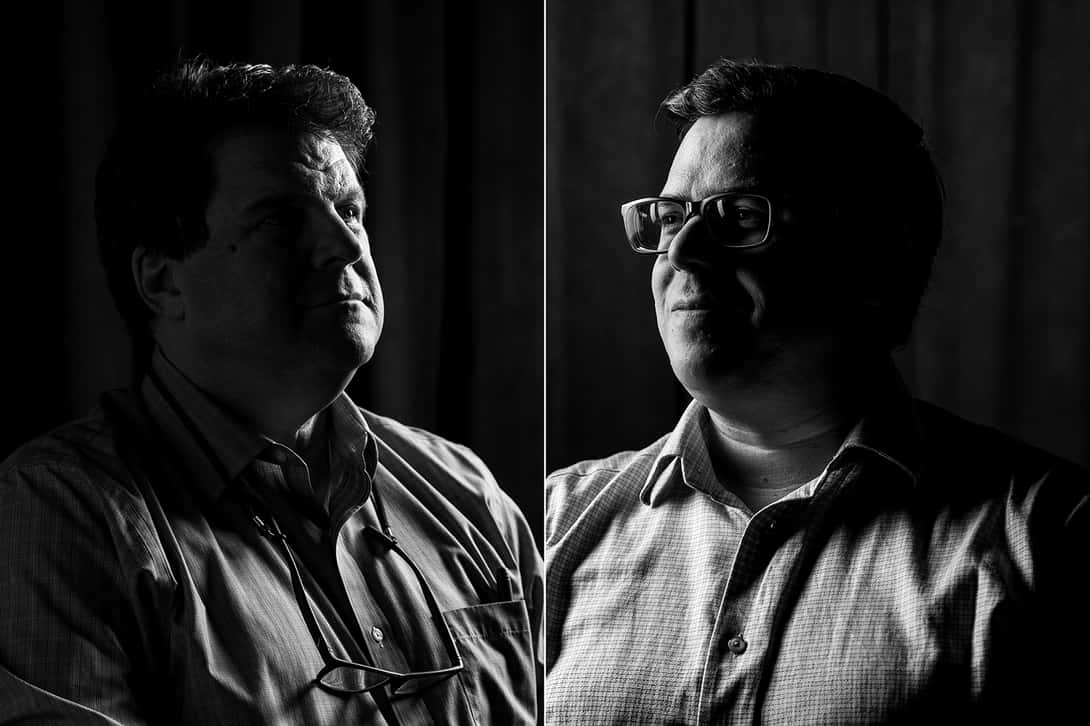
With the fall semester close at hand, Colby’s McVey Center for Computational and Data Sciences is moving from vision to reality with the appointment of Andrew Tupper, a specialist in high-performance computing with a background in biochemistry and AI, as its inaugural director of computing innovation.
“This is an amazing opportunity for the College to advance high-performance computing and data science. We have the hardware in place, and now we have the staffing to make it happen,” said Whitney King, the center’s director and Dr. Frank and Theodora Miselis Professor of Chemistry.
Established through a $10-million gift from trustee Richard M. McVey, the center is designed to embed computational power and data science across the liberal arts curriculum. Tupper’s arrival jumpstarts its academic and technical initiatives to speed scientific discovery, support faculty research, and provide students with practical expertise, King said.

With a centralized location on campus and leadership in place, the McVey Center for Computational and Data Sciences will begin working with faculty proficient in high-performance computing and with others interested in learning more. In addition, the center will equip students with critical computational skills, ensuring Colby graduates are prepared to address the world’s most complex challenges in an increasingly data-driven economy.
The McVey Center joins Colby’s sector-leading Davis Institute for Artificial Intelligence, positioning the College as a national leader in frontier computing. The two fields are increasingly interdependent. Machine learning—a primary branch of AI—extracts patterns from data to automate decision-making, while high-performance computing leverages supercomputers and parallel architectures to execute massive calculations at extreme speeds.
Together, they form an interdisciplinary applied science that enables breakthroughs in climate modeling, genomics, physics, and other fields such as economics.
Tupper also works closely with the on-campus high-performance computing center. The HPC team will handle the backend, while the McVey Center will tackle the user-facing side, focusing on education and faculty research.
The core mission
The center’s core mission is to integrate computational methods across disciplines, said Tupper, who most recently managed high-performance computing environments at the University of North Carolina at Wilmington’s Center for Marine Science.
“One of the things the McVey Center can bring is the combination of HPC expertise, AI experience, and data science expertise all together,” he said. “And then we will use that to innovate across campus. I plan to work with faculty across all departments to rethink what can be done in their courses.”
It will also enable Colby to launch new applied fields of study, such as public health, biomedical engineering, and environmental engineering. While the McVey Center will eventually be located in the College’s future sciences complex, scheduled to open in 2030, it is currently based in the F.W. Olin Science Center. Tupper has offices in Olin and the Eustis Administration Building.
David Watts, director of the Davis Institute for Artificial Intelligence, is eager to begin collaborating.
“With data science as a core and critical component of enabling AI systems, there is absolutely a lot of opportunity for McVey and Davis AI to collaborate on interdisciplinary access points for faculty and students. McVey can drive data literacy, for example, in areas like data hygiene, statistical reasoning, or data visualization, and Davis AI can focus on AI literacy across things like genAI tools, model and algorithm evaluation, or computational infrastructure.”
Tupper joins Colby with a pedigree that aligns with the center’s cross-curricular vision. He earned his B.S. in interdisciplinary science from Rensselaer Polytechnic Institute and completed his Ph.D. in biochemistry at McMaster University.

Tupper’s scholarly work focuses on complex computational modeling, including simulating prebiotic chemical kinetics and the origins of life. He has worked with the U.S. Department of Agriculture as a research associate and as a bioinformatics software engineer for a startup, and at UNC-Wilmington as a research computing and data professional.
“I see my past work as a way of unifying multiple core areas at Colby,” he said, noting his background in sciences, his entrepreneurial work at a startup, and his experience in AI and high-performance computing.
His background will allow Colby researchers to scale their analyses and implement advanced modeling techniques, King said.
Denise Bruesewitz, provost and the Clara C. Piper Professor of Environmental Studies, said that Tupper’s interdisciplinary approach aligns well with the center’s work. “The impact of the McVey Center is evident across all four divisions of the College. Our faculty are asking fascinating questions, and there is an ever-increasing amount of data to explore those questions from new angles,” Bruesewitz said. “What the McVey Center does so well is start with the faculty’s own expertise and curiosity, and then helps them learn new tools and approaches to use that data, strengthening both their research and their work in the classroom.”
A new chapter at Colby
For Assistant Professor of Economics Ben Scharadin, the value of the McVey Center for Computational and Data Sciences is its potential for flexible, faculty-driven collaboration. Scharadin, who serves on the center’s faculty advisory committee, described a partnership where the center asks faculty, “What do you need? Let’s see if we can accomplish that.”
As data collection explodes, the challenge is not finding information, but understanding how to use it effectively, he said. “You can look at the ocean and see a massive amount of data,” Scharadin said, “but if you can’t read the tides or understand the currents, then working with that data is very difficult.”
The center, he believes, will help faculty and students “wrangle” that data, turning overwhelming quantities of information into usable insights.
In practice, Scharadin is putting this partnership into action through his course Economics of Poverty and Food Insecurity (EC257). He and Tupper are working on a project where students will map food resources, such as farm stands and grocery stores, across Waterville. The goal is to provide students with a “complete project with tangible output” rather than a prolonged, high-stakes research endeavor, he said.
Assistant Professor of Biology Andrea Wegrzynowicz teaches immunology, and her lab investigates the role of the immune system in female infertility. She studies hundreds of thousands of cells, each with thousands of genes.
“That’s a big-data problem,” said Wegrzynowicz, who is new to Colby this semester. “My field, like so many others, is dealing with more and more data. The processes you used to be able to run on a relatively standard desktop don’t work anymore.”
She will collaborate with Tupper in her introductory Immunology course (BI225) to expose students to sample gene-expression data from immune cells and teach them to access high-performance computing clusters, which link individual computers to solve complex mathematical problems and run massive simulations.
One reason she chose Colby as the next step in her career was its commitment to data science. “There is a focus on innovation and supporting data science here at Colby, and that is not something that every liberal arts college is doing. It gives our students more applicable experiences,” she said.


