AI Doesn’t Have To Be an Empire. It Can Be a Bicycle.
Author and journalist Karen Hao brings a message of community-driven AI resistance and hope
It’s hard to argue that AI’s rapid adoption and ubiquity are changing how people live, work, learn, and interact with the world.
The technology’s trajectory feels unstoppable—at least by ordinary humans. What, after all, can a single person do against tech titans like OpenAI, Anthropic, Meta, Google, and Microsoft? Their CEOs hold key cards: money, clout, and power. If they believe they know best, that they hold the key to benefiting all humanity, how can we show them otherwise?
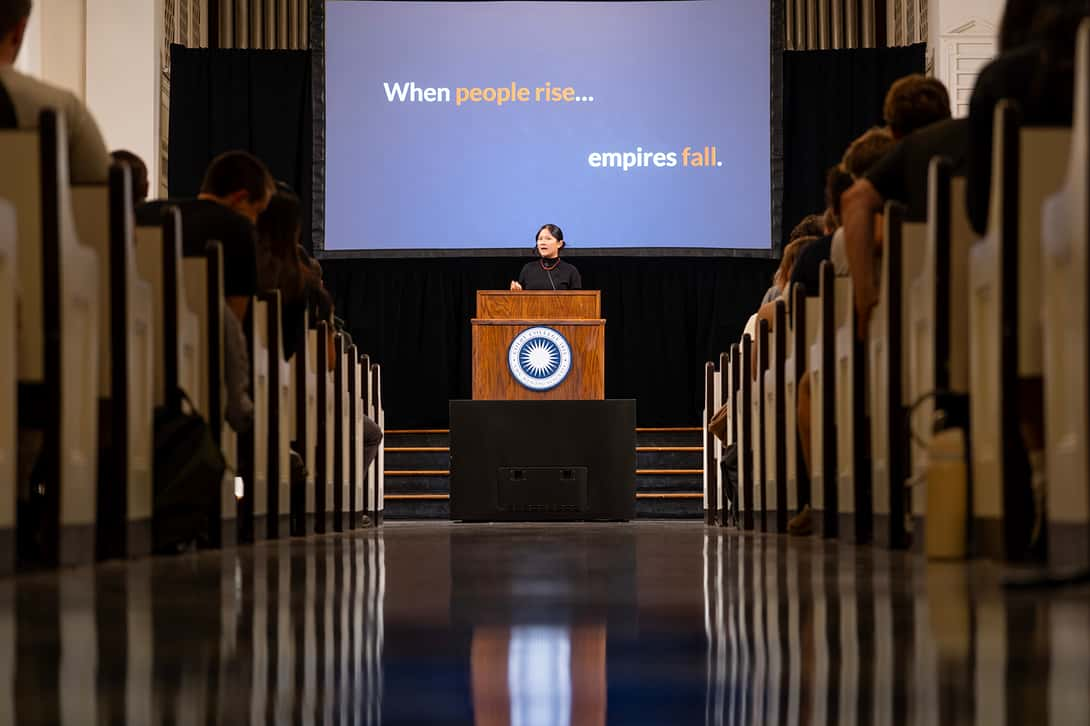
But Karen Hao, an award-winning journalist and author of Empire of AI: Dreams and Nightmares in Sam Altman’s OpenAI, offered something different in a talk at Lorimer Chapel that was part of the Distinguished Lecture Series of the Davis Institute for Artificial Intelligence.
Hope.
Hao drew parallels between history’s rapacious empires and today’s AI giants, detailing how the rush to scale up threatens communities, the environment, and intellectual property.
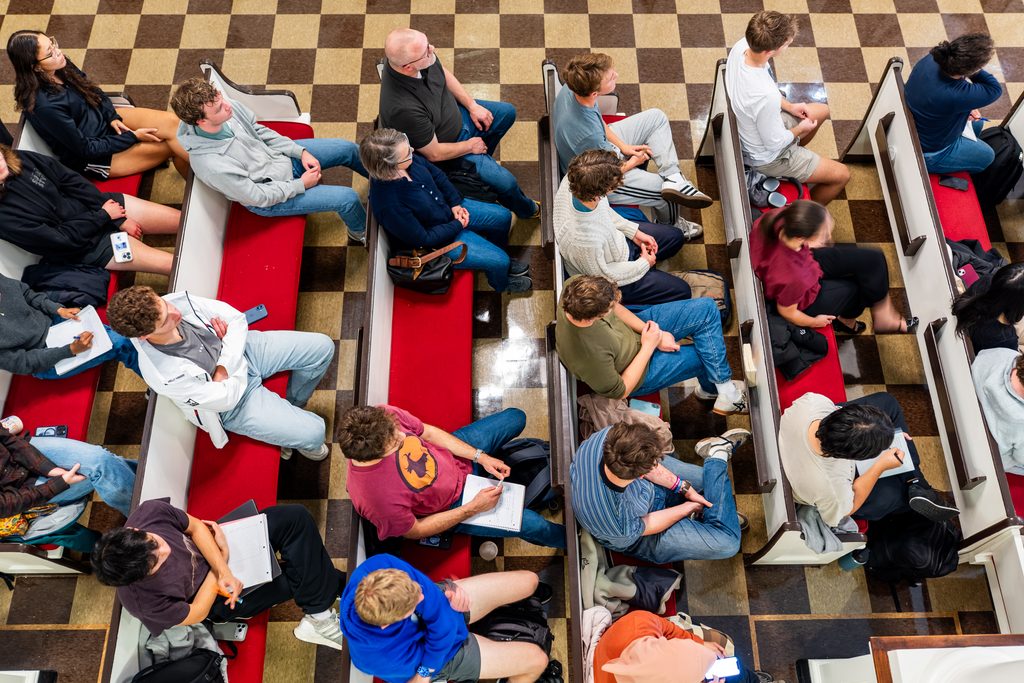
But she also told the crowd that ordinary people can do a lot to right-size AI technology and create a new, better vision of what it can be.
“This is the vision of AI that we are fighting for,” Hao told the students, faculty, and community members. “A vision that is community-driven, consentful, respectful of local contexts and history, a vision that uplifts and strengthens marginalized communities, a vision that is inclusive and democratic.”
A highlight of the semester
The crowd, including a group of students from Bowdoin College, listened attentively, and when Hao finished, they rose to give her a standing ovation.
“This was the highlight of my semester,” one attendee said after the talk.
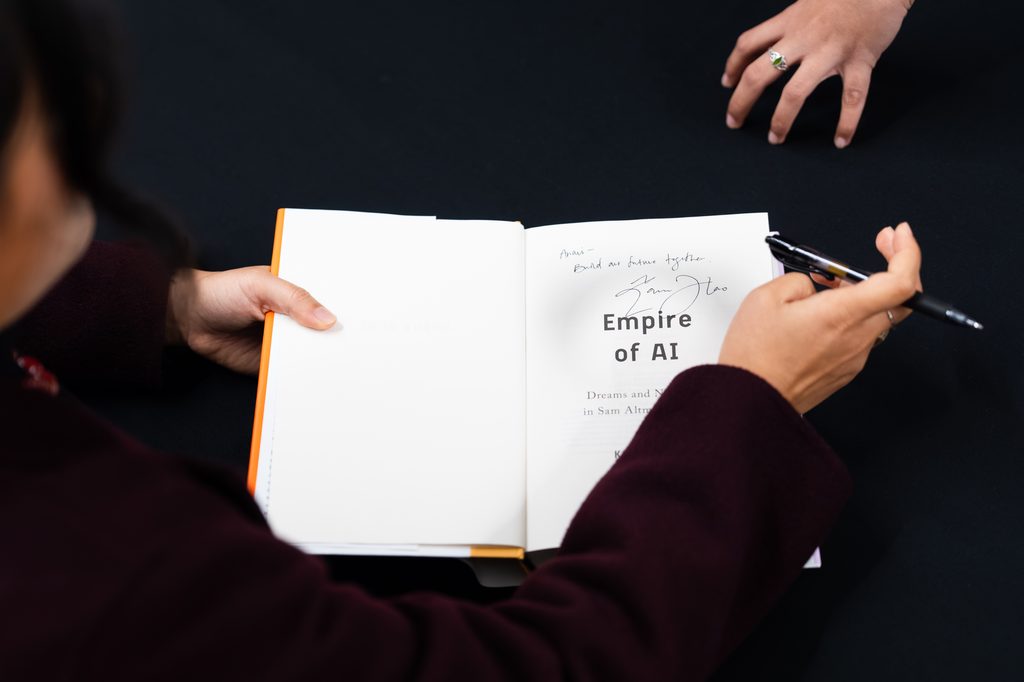
Stacy Doore, Clare Booth Luce Associate Professor of Computer Science, introduced Hao, whose book received the 2025 National Book Critics Circle Award for Nonfiction and the 2026 New York Public Library’s Helen Bernstein Book Award for Excellence in Journalism. To advocates of ethical AI, the professor said, Hao is a powerful ally.

“I am a huge fan girl of Karen Hao and have been pretty much since I started teaching responsible computing,” Doore said. “Not only was I reading Karen and all her amazing journalism about the tech industry, but I was also assigning her to all of my classes to make sure that they knew about what was really going on, counteracting a lot of the narratives that they were hearing in popular press or from the tech companies.”
Reconsidering empire building
To Silicon Valley, size and speed are critical to AI development, which Hao describes as a “scale-at-all-costs approach.” The scale is so huge that, to grasp its magnitude and downstream consequences, we need to stop thinking of AI giants as merely businesses providing products and services.
“OpenAI and other companies of its form are new forms of empire, consolidating a historic amount of economic and political power, terraforming our Earth, upending our education systems, your future careers, and our physical and mental health,” Hao said.
Among the parallels she drew between AI empires and historic empires are: claiming resources that aren’t their own, exploiting an extraordinary amount of labor, monopolizing knowledge production, and justifying their actions with a moral and existential imperative.
A question of scale
At giant AI companies like OpenAI, the answer to most problems is to throw more computational resources at them, driving the rapid scaling of AI systems. But training models on ever-larger amounts of data carries risks, including eroding intellectual property and building data centers that consume vast amounts of energy, freshwater, and the minerals needed to make computer chips.
Right-sizing AI, however, can deliver the technology’s benefits without the destructive costs, she said, comparing large-scale generative AI models to rocket ships.
“Generally speaking, there’s actually a very small number of transportation needs that we actually want to use rockets for. We would not want everyone to have a rocket. Commuting from Portland to Colby by rocket would make absolutely no sense,” Hao said. “It’s simply not fit for purpose. And this is how we should think about AI.”

Rather than rockets, we should build more bicycles, she said—small, task-specific AI systems that bring benefits without the extraordinary costs. Those include AlphaFold by DeepMind, which predicts the 3D structures of proteins and won the Nobel Prize in Chemistry in 2024. AlphaFold isn’t trained on the whole internet, but on a highly curated dataset that doesn’t require supercomputers to run.
“We need to break up the empire as we simultaneously build more bicycles,” she said.
The power of grassroots movements
Grassroots movements are growing worldwide to resist data centers, AI taking intellectual property, and AI-enabled labor exploitation. Hao described what’s happening in Tucson, Ariz., where Amazon wants to build a $3.6-billion data center called Project Blue. Community members there formed the No Desert Data Center Coalition to fight against its construction.

“Never once did they say, ‘Well, this is inevitable.’ Never once did they say, ‘There’s nothing we can do,’” Hao said. “They mobilized, and on a day pushing 114 degrees Fahrenheit, the coalition packed into city hall in a show of force and burst into cheers and tears when the council voted 7-0 to stop the project in its current form.”
That kind of energy can be contagious and lead to hope, she said, adding that individuals can do much to resist the narrative that giant AI companies are all-powerful.
“We do not need empires, nor the one-size-fits-all model that they try to peddle to us. It is up to us to resist the empire and fortify our collective futures,” Hao said. “Empires are made to feel inevitable, but history has shown us that when people rise, empires fall.”


