A Lively Conversation About AI
Kathryn Guarini, a technology and business leader, explores how technology is changing teaching and learning

Artificial intelligence seemed to be more the realm of science fiction than real life until very recently—but what a difference a few years can make.
Everyone is now living in the midst of the AI revolution, a time of breakneck technological developments on a vast scale that is reshaping entire industries and many aspects of daily life, including higher education. Such fast-paced change can be disorienting, and it calls for thoughtful discussion about what’s technologically possible and the ethical issues that arise from those possibilities.
Last week, Colby’s Davis Institute for Artificial Intelligence welcomed Kathryn Guarini to campus to facilitate some of that discussion. Guarini, a technology and business leader who helped spearhead IBM’s digital transformation as the company’s former global chief information officer, was the first participant in Davis AI’s Distinguished AI Speaker Series. She gave a public presentation and talk called “Responsible Innovation in the Age of AI: Building What Lasts for a World That Moves Fast” and held other sessions with faculty and students.

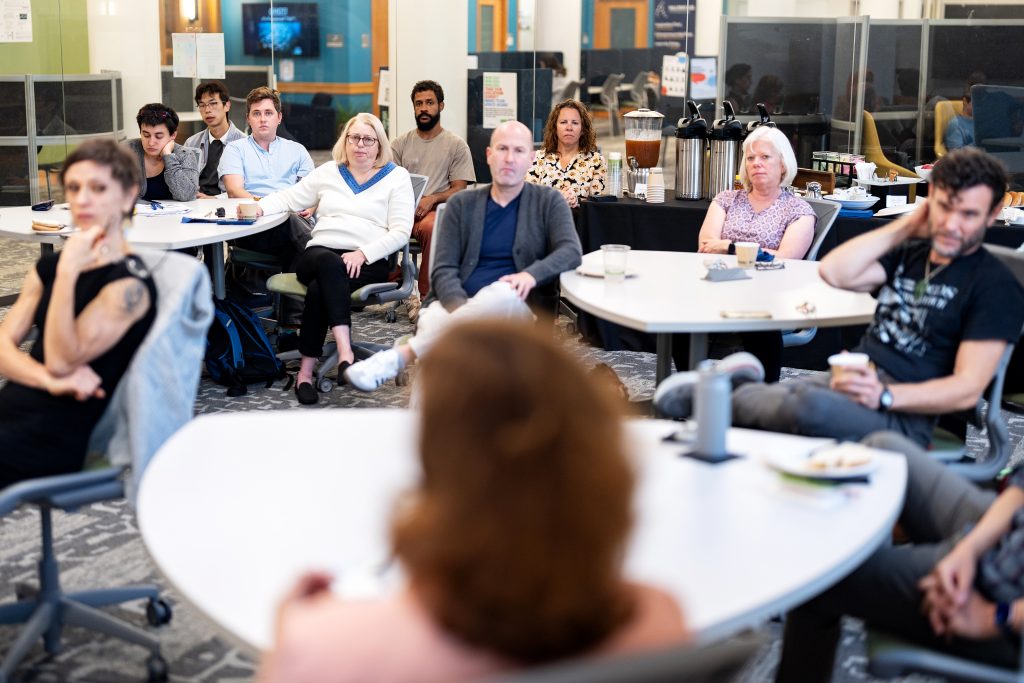
All the events involved lively conversations as the community came together to grapple with and explore how AI is changing teaching, learning, and higher education institutions in general.
“People were engaged. They were asking interesting follow-up questions. They were challenging me on some of the topics. That’s exactly what I was hoping for, that we raise awareness for some or both the opportunities and challenges,” Guarini said at the end of her visit to the College. “This is something that is affecting everyone. And the fact that this college is out there saying, ‘We recognize that, and we’re willing to grapple with it, and we want to have these conversations so we can surface issues and figure out how best to position the school,’ I think is great.”
A robust conversation
David Watts, the new director of the Davis Institute for Artificial Intelligence at Colby, said that inviting speakers like Guarini and holding robust conversations about AI is crucial right now.
“We want to connect with what’s happening in the world, and bring our liberal arts values to it,” he said.
Despite the torrential deluge the night of Guarini’s public presentation and discussion, more than 100 people streamed into Ostrove Auditorium to listen—a number that emphasized to Watts the hunger for this kind of conversation.
“It shows this topic is on people’s minds all across the campus,” he said. “I think a lot of the people there were from different majors, and the students were really engaged. You could hear that in all of the questions. They had some phenomenal questions for her, challenging questions that she had to think about and answer.”
Among the points Guarini made is the astonishing speed of adoption of AI technology. It took 46 years for electricity to be used by a quarter of the American population. Then, 31 years for the telephone to be adopted as widely, 26 years for television, 16 years for personal computers, 13 years for mobile phones, and seven for the internet. ChatGPT, on the other hand, took just two months to attract one million users.
“With this speed, there are magnified benefits and risks,” she said. “The good news is, I am optimistic and excited by what technology offers. We can do good things for the world. At the same time, if we are not careful, there are downsides.”
Listening to students and faculty
Maddie Puzon ’26, a computer science and philosophy double major, said that her professors are actively working to figure out how, or whether, to incorporate AI into their classrooms. It’s not always a question with a clear answer.
“Do you go at every problem with the mindset that technology can improve this?” she asked during the lunchtime meeting with Guarini. “Or are there some problems, or even spaces within certain classes and curriculums, where AI just might not fit?”
In a separate conversation with faculty, topics included concerns about the lack of guardrails around the use of data by for-profit companies, questions about holding those companies accountable, and discussions about the tension between the ethics of using data and the desire to make money as fast as possible. They also touched on the current use of AI on campus.

One faculty member, Assistant Professor of Environmental Studies Aleja Ortiz, described a moment that caught her attention last spring during her intro to coding class for non-computer science majors. In the course, there were students who ranged from first years to seniors.
“I was interested in asking how they were using AI,” she said. “There was a really stark difference between how juniors and seniors used and talked about it versus the first years and sophomores.”
The older students talked about having some experience of college without AI, and that they saw it as a tool, but not something they relied on.

“They used it to this very limited extent, versus the first years and sophomores. For them, it was anything and everything,” Ortiz said. “And it was clear that it just was replacing huge swaths of ways that had been done before for trying to learn, or ingest material, or study. It was very stark.”
AI may have arrived in a hurry, but it’s clear that it’s not going anywhere fast. Last week’s campus conversations showed that the Colby community wants to use it thoughtfully and to keep on talking about the full spectrum of what AI can do and mean.