The Doctor is Always In: AI in Medicine
Sara Hoffman ’18 is director of AI initiatives at Harvard Medical School
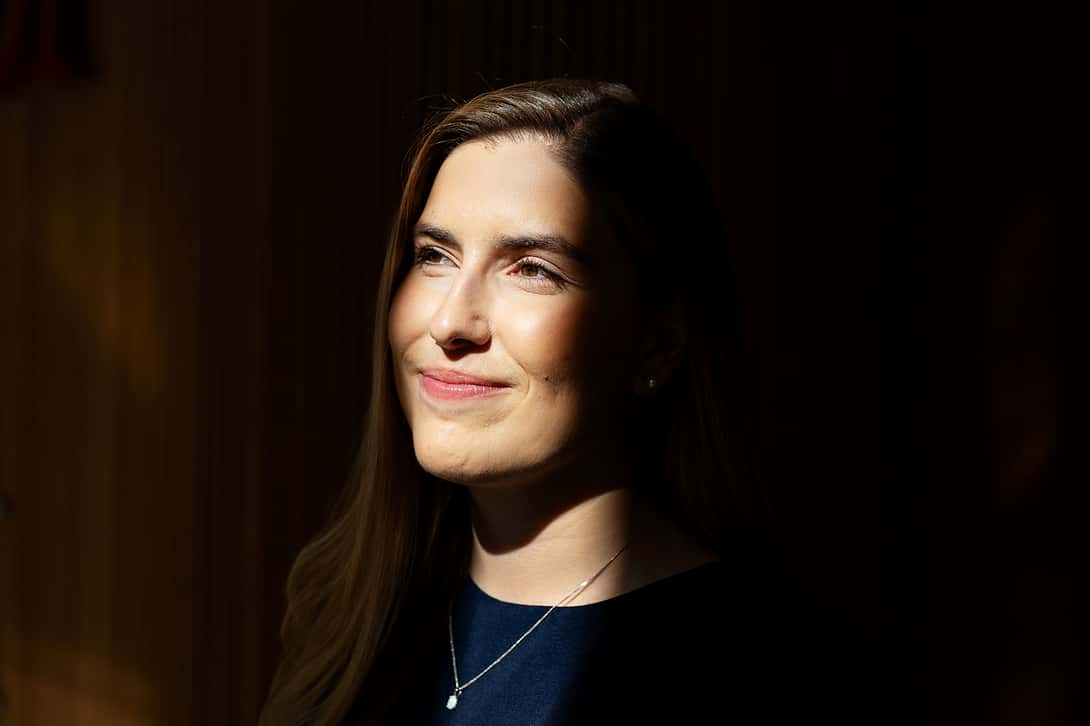
Artificial intelligence can’t hold a scalpel or conduct an ultrasound. But in a medical system designed to squeeze as many patients into a given period as possible, doctors, nurses, and PAs turn to AI.
Sara Hoffman ’18 is part of a team at Harvard Medical School trying to figure out how AI fits into modern medicine. Will it “do no harm?” New technology doesn’t take the Hippocratic Oath.
Take the pulse oximeter, for instance, which measures oxygen levels through your fingertip. The device consistently rates people of color with an incorrect oxygen saturation, which causes doctors to downplay their symptoms or dismiss them altogether. And it’s done so for decades.
With AI, Hoffman hopes to guide physicians through the technology’s potential pitfalls. “Day-to-day, there are quite a few issues with AI, so you have to be careful,” warned Hoffman. “Bias is a big one, but also hallucinations, where you can ask a question and get a completely wrong answer. But I’m optimistic because we’re having these conversations up front about how to build AI models as safely and responsibly as possible.”
From Colby to Dana-Farber
Hoffman came to Colby knowing she wanted to study medicine, and ended up adding computer science to her pre-med requirements. “I always thought I wanted to go to medical school. I spent a lot of time with my grandparents growing up, who had a bunch of health issues, and I saw all the ways the medical system repeatedly failed them,” she said. “When I got to Colby, I stuck with the pre-med track, but I found myself really interested in technology, and ended up falling in love with computer science. I loved all the work I was doing, and was fueled by it, and that drove me to want to combine technology with clinical experience into the role I have today.”

After graduation, Hoffman joined Dana-Farber Cancer Institute as a clinical research coordinator. “I was interested in sort of getting into patient care as quickly as possible, rather than spending seven or eight years in additional schooling,” she said. “While I was there, I really missed that technical side of things. I wanted to find a way to blend the two fields so I could have more of an impact on patients using my skillset.”
She spent several years at a biomedical startup called PathAI, working to deliver machine learning-powered pharmaceutical research. “We were building AI models to help with clinical trial processes to standardize the patient assessments,” said Hoffman. “I started on the data engineering team and then moved into a partnership role, where I worked directly with pharmaceutical companies to figure out what kind of AI model they needed.”
It was while Hoffman was at PathAI that generative AI exploded into the mainstream in 2022. Suddenly, AI was everywhere—including in the exam room. Hoffman wanted to be part of the broader conversations about AI policy, which led her to her current role as director of AI initiatives at Harvard Medical School.
Ethical considerations
Said Hoffman, “Now, these AI models like ChatGPT or Claude are out there, and it’s publicly available. Patients, doctors, and clinicians are using it every single day. If you’re in the ER and you see three patients come in, but you can only see one patient at a time, how do you decide who to see first? When AI models are asked questions like that, do the values in the model match the human value sets to prioritize care? How can we refine those models? That’s just one example of the types of public policy, human-centered questions I’m dealing with in my role at Harvard Medical.”
‘I think that having the experience across different departments prepared me really well for this broad, overarching role. My technical background allows me to understand these models and communicate how they work, but the sociological perspective Colby allowed me to embrace helps me think more from the patient perspective, and to focus on building equity and ethics into our approach to AI. Colby really prepared me to see those big-picture issues.’
Sara Hoffman ’18
Hoffman works with professors, engineers, and members of the public to infuse ethical considerations into different models, draft AI literacy curricula for clinical programs, and influence legislative conversations to better protect patients.
She’s now pairing her pre-med and computer science degree from Colby with an M.B.A. from MIT’s Sloan School of Management. “One thing I noticed working in this field is there’s a real gap between academics and business,” she said. “There’s so much incredible research happening, uncovering these incredible scientific insights, but no plan to distribute or translate the research into protocols that impact patients.”
It takes an average of 17 years to implement changes from new research into medical practice, according to the NIH. That can be the difference between life and death for some patients. “If we build an AI model that can detect cancer earlier, how can we distribute that model as a nonprofit institution? What relationships and skills do we need to build? There’s so much potential positive impact AI can have on healthcare, but we need to facilitate that,” said Hoffman.
“AI director” isn’t a job that existed when Hoffman was a student. But Hoffman cites her liberal arts education as the foundation for her work blending science, ethics, and technology.
“I think that having the experience across different departments prepared me really well for this broad, overarching role,” said Hoffman. “My technical background allows me to understand these models and communicate how they work, but the sociological perspective Colby allowed me to embrace helps me think more from the patient perspective, and to focus on building equity and ethics into our approach to AI. Colby really prepared me to see those big-picture issues.”


