‘Guiding Her Own Path’
Class Marshal Sophie Shanae Gould Dulabaum followed her curiosity across disciplines all the way to the top of her class
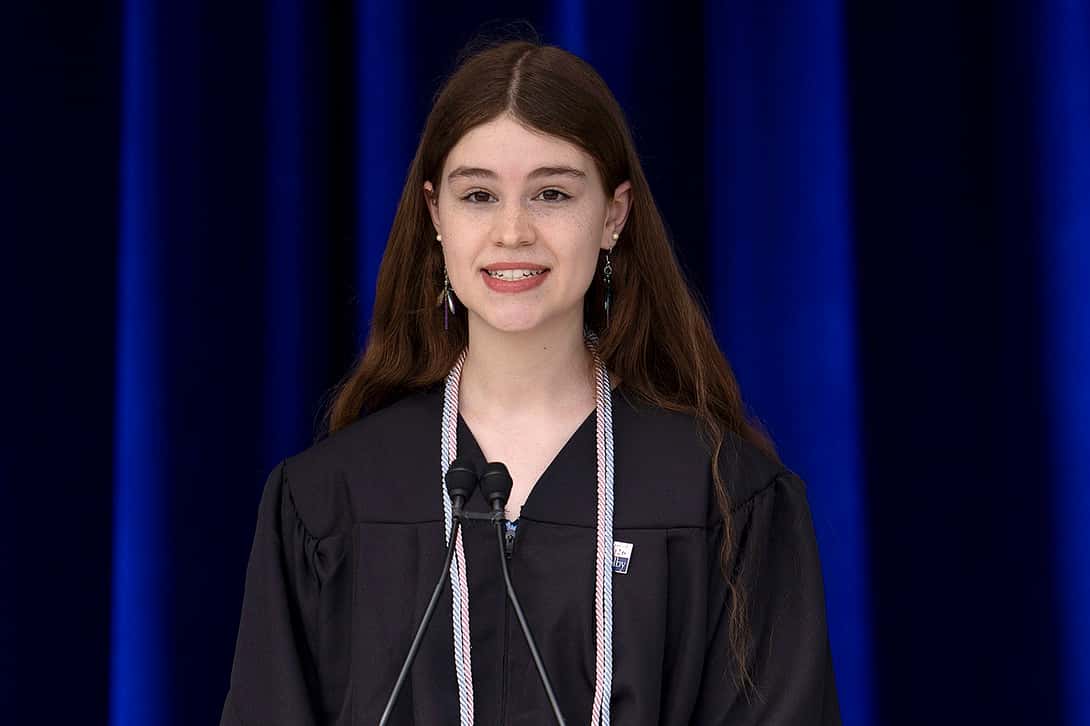
For Sophie Shanae Gould Dulabaum ’26, a Colby education meant the chance to explore all her interests without having to stick to a narrow path.
And explore she did.
Gould Dulabaum, a biology and music double major from Elgin, Ill., spent the last four years following her curiosity and talents, which led her in myriad directions. She explored the genes of two wild blueberry species, created original music, learned complex classical guitar songs, and studied in Denmark. She also sang with the a cappella group Mayflower Chill, traveled to Washington, D.C., to talk to legislators about the importance of the arts and humanities, worked at the L.C. Bates Museum, helped organize the Freecycle clothing donation and exchange, was part of the Colby College Running Club, and so much more.
Along the way, she excelled academically and was named class marshal for the Class of 2026, an honor given to the graduating senior with the highest grade point average.
Gould Dulabaum led her classmates last weekend as they filed into the baccalaureate and commencement ceremonies. The Bixler Scholar and Presidential Scholar has embraced the breadth of a liberal arts education, and said that following a couple of basic principles kept her grounded in her years on Mayflower Hill.
“Those are always staying true to my interests, and not thinking, ‘Oh, I should learn this because,’ but rather thinking, ‘Oh, this sounds super interesting to me, and I might not know how it’s going to serve me in the future, but if I keep following my interests, then eventually I’ll figure out how.’ Just stay true to what you chose to come here for,” she said. “And I always enjoy doing my best. I know that if I do my best, no matter what the outcome is, I feel satisfied.”
‘I feel like she’s one of these people who embraces a wandering journey, but with incredible reflection and intention. I feel like she’s guiding her own path, and I love that about her. She’s going to have just a huge impact on the world.’
Assistant Professor of Biology Kristen Nolting
Now, her path of discovery will take her to Germany, where she will pursue a master’s degree in environmental humanities at the Rachel Carson Center for Environment and Society, part of the University of Munich. Gould Dulabaum has won a scholarship through the German Academic Exchange Service that will cover living and travel expenses, among other costs, throughout her two-year program.
She’s keeping an open mind about what will happen after her time in Germany, but she loves museums, which she sees as a way to join her interests in the creative arts and science.
“I love how museums are a sort of bridge between the public, researchers, communication specialists, artists, and scientists,” she said. “They bring everyone in dialogue with each other under one roof.”
No matter what direction she chooses, it is certain that her curiosity will remain a guiding star.
“I just like knowing how the world works, pretty broadly,” Gould Dulabaum said. “And I always like seeing how different corners of it overlap in ways you may not expect.”
A talented musician
Gould Dulabaum shone in her music courses, too, according to Assistant Professor of Music José Martinez, who taught her in music theory, audio sampling, senior seminar, and an independent study. He described her as both methodical and sensitive—a good combination of qualities for a musician.
‘She’s the kind of student that it’s so easy to work with because she just brings, and brings, and brings. She always has something to say.’
Assistant Professor of Music José Martinez
“You have people who are full of emotions, but don’t have the skills to say what they want. Or sometimes you have general artists with a lot of skills, but they don’t have anything to say that is very interesting,” Martinez said. “But in Sophie Shanae’s case, she’s a very dedicated student who is also curious about the world.”
It means she has a lot to say, and the means with which to say it, as well as a bubbling creativity that leads her to see things a little differently than most people. In her independent study, she composed a breakup song, which is a standard topic for many songwriters. But Gould Dulabaum wrote her song about breaking up with her car, a whimsical idea that firmly connected her interests in music and the environment.
“Who does that, right?” Martinez asked, marveling.
The song, “Forget Your Name,” is a witty and unexpectedly moving criticism of the transportation system in the United States. Gould Dulabaum played guitar and bass, while Martinez played the cajón. She sang sweetly about trading her first love, the car, for a high-speed train, and with it the freedom to look out at the beauty of the world without needing to sit behind a steering wheel.
“She’s the kind of student that it’s so easy to work with because she just brings, and brings, and brings,” Martinez said. “She always has something to say.”
But there’s more to it. Many people are born with natural musical skills, but the important part is what they do with those skills. Martinez remembers listening to her play classical guitar as a first-year student. At that time, he wasn’t blown away by her talent, but he was astounded by the change he heard during her senior guitar recital.
“That only happened because she’s dedicated, she practices and practices,” Martinez said. “That’s how you get better. And because of who she is, she took it on herself to improve.”
As she practiced, worked, and got better, she polished her skills to a high sheen.
“She’s an artist,” the professor said, adding that he believes she will keep having music in her life. “A person like that is difficult to stop. She’s very skilled. She has the tools, and she took it seriously.”
Guiding her own path
Assistant Professor of Biology Kristen Nolting, who came to Colby in fall 2024, had Gould Dulabaum in the very first course she taught at the College—a plant taxonomy class.
“She was very thoughtful in all of her work,” Nolting said. “She was clearly a very good student, but it was her thought and intention on some of the reflection pieces I had them do that made her stick out in my mind.”
The next summer, Gould Dulabaum applied to work for Nolting as a research assistant in her lab. It was an easy hiring decision, Nolting said.
“The work that we were doing last summer was largely getting a blueberry project off the ground,” she said. “So I needed students who were OK with figuring things out.”
Gould Dulabaum jumped right in, pulling trait data and other information from digitized herbarium specimens, and doing her own research project on the hybridization of two species of Maine lowbush blueberries. She worked with environmental data and computer code, and developed map-making skills in the process.
“She did all these things she’d never done before,” Nolting said. “Sophie Shanae just took every single challenge and ran with it, and came out with a really solid, cool, cohesive project at the end of the summer.”
She brings the same kind of focus and intention to her other classes and projects, too, the professor said, adding that the diversity of her interests does not dilute her ability to reach her goals.
“I feel like she’s one of these people who embraces a wandering journey, but with incredible reflection and intention. I feel like she’s guiding her own path, and I love that about her,” Nolting said. “She’s going to have just a huge impact on the world. And in the world that we live in right now, I’m so thankful that Sophie Shanae is going to be a kind of ambassador for the U.S. in Germany. She’s just the type of person that you want to represent us, to show who we are when we’re at our best.”


