Colby Athletes Earn Olympic Berths
Cross-country skiers Jack Young ’25 and Maddie Hooker ’27 will compete in the Olympic Winter Games in Italy
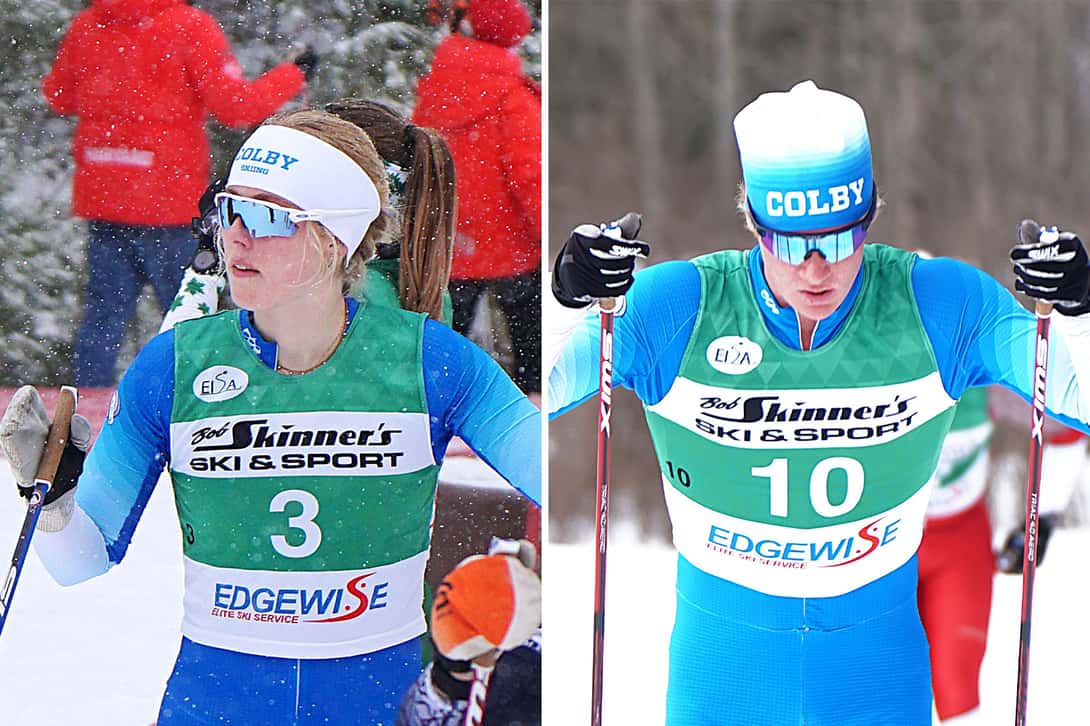
When the Milano Cortina Winter Olympics begin on Feb. 6 in Italy, Colby sports fans will have two standout Mule cross-country skiers to cheer on: Jack Young ’25, who is competing for the United States, and Maddie Hooker ’27, who will be skiing for Australia.
It’s a heady moment for the Colby community as a whole, and especially for a ski program that consistently produces NCAA Championship qualifiers and All-Americans.
Tracey Cote, the head coach of men’s and women’s Nordic skiing, said that the fact that Young and Hooker will compete in the Olympics reflects on the athletes’ commitment and skill, as well as on the Nordic program at Colby.
“They have worked so hard and prioritized skiing at the highest level in their lives,” she said. “Both their stories are so inspirational, and I just can’t wait to keep watching them, as they are both so young to be competing at this level.”
It has also been exhilarating for other Colby skiers to see friends they train with every day reach this elite level.
“When you know your teammates can get there, it becomes more realistic for you to [imagine] that you could also be there someday,” Cote said. “It also shows that Colby has the resources and the program to develop skiers at the highest level, which is a confidence-builder for our whole team.”
The College is a Division III school, but the Alpine and Nordic teams compete in Division I. They race against other Eastern Collegiate Ski Association schools, such as the University of Vermont, Harvard University, and Dartmouth College.
“We are smaller, and I think it is cool to show that we’re punching our weight at the highest level, and competing with the very best schools out there,” Cote said.
Realizing a dream
Hooker, an economics and math double major from Melbourne, Australia, was in Europe competing for the Australian World Cup team when she learned she was selected for the Olympics.
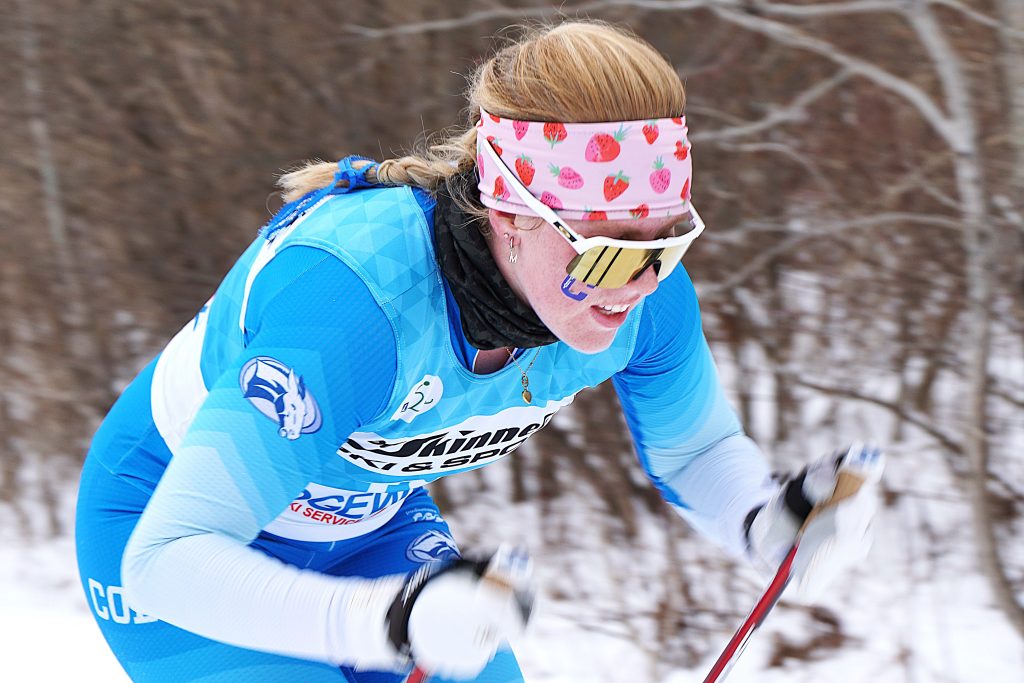
“This opportunity is truly a dream come true. It still doesn’t feel real, but I’m so excited to soak in every moment,” said Hooker, who has withdrawn from Colby this semester to compete on the world stage. “I’m incredibly grateful to the entire Colby community for their support in helping make this dream possible. I can’t wait for what’s ahead.”
Young, a sprint skier from Jay, Vt., spoke from Austria, where the American World Cup team is training.
“I’m happy, and excited for the games, for sure,” he said. “I want to be as good of a teammate as possible, and just be a part of it, because it could be a really special year for U.S. men’s cross-country skiing.”
‘I love having my big Colby team’
Cote said that Hooker is one of the hardest-working athletes she has coached. When Hooker came to Colby, her high school results were not spectacular, but the coach saw potential. As a first-year student, Hooker watched the seniors and learned from them. Her first race went much better than Cote had expected, and Hooker just kept improving.
“She’s a very good student and is going to be very successful in whatever she does,” Cote said. “But right now, she has tunnel vision for skiing.”
Hooker races everything from three-minute sprints to 20-kilometer races, and does both skate skiing and classic. She appreciates her teammates, Cote, her professors, the opportunities she’s had at Colby, and the facilities she gets to use, including the Harold Alfond Athletics and Recreation Center, which she described as better than the Australian Olympic training center.
“I love having my big Colby team. Just the atmosphere they bring, they’re so chatty, and always laughing and joking, and our ski waxing room’s so nice that everyone always wants to hang out there,” she said. “I definitely could not have gotten here without the Mules and without Colby’s support. It really is an amazing community.”
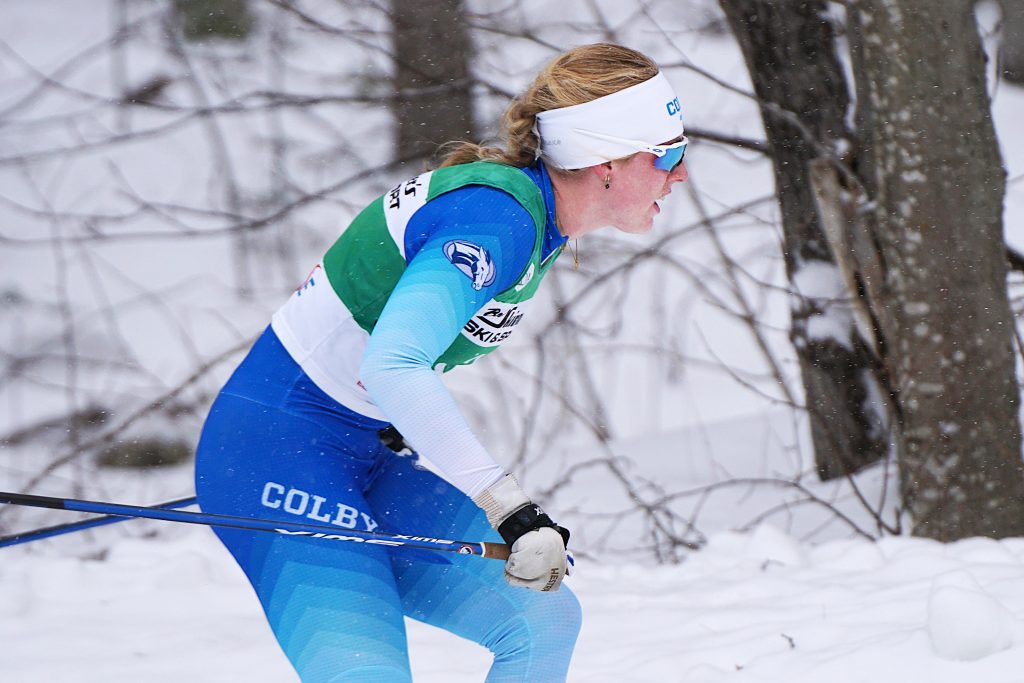
Hooker grew up in a country known for its surfers and swimmers. She spent weekends at the beach learning life-saving skills and many, many hours “staring at a black line” at the bottom of the pool as a competitive swimmer.
But something sparked when she and her family began spending Christmas in the United States. They went to Colorado, where Hooker learned downhill skiing and loved the way it felt to fly over the snow in the mountains. Back in Australia, she started competing in Alpine ski racing for her primary school. When her team needed competitors for cross-country events, she was eager to try.
She got serious about the sport as a teenager, when the Covid pandemic essentially paused downhill skiing for two years. When her mom asked her if she wanted to finish high school at an American boarding school for skiing, she said yes—enthusiastically. “That sounds awesome,” she recalled thinking.
Hooker went to Stratton Mountain School in Vermont, whose alumni include 14 Olympians. There, she quickly learned that being a good cross-country skier in Australia did not necessarily translate into being a good skier in the U.S.
“I definitely say I was thrown into the deep end,” she said. “I really had to quickly learn and get faster. I was at the back, barely keeping up, exhausted. I was nowhere near as good as the other kids. But I loved it. I was really lucky. I made a lot of amazing friends, and the families of all the kids were super welcoming, and they brought me in as one of their own.”
When she returned to Australia after a year at Stratton Mountain, Hooker made the junior national team and qualified for the junior world championships. She kept working to improve, including after arriving at Colby.
“She’s just moved up,” Cote said. “She’s clearly established herself as the top skier on our team. It is really hard, I think, for us to lose her this year. We’re so excited for her to go to the Olympics, but there definitely have been a million times where I’ve been thinking, ‘I wish Maddie was here.’ Not even from a result standpoint, but from a leadership standpoint, just because she’s set such a good example.”
A sprint specialist
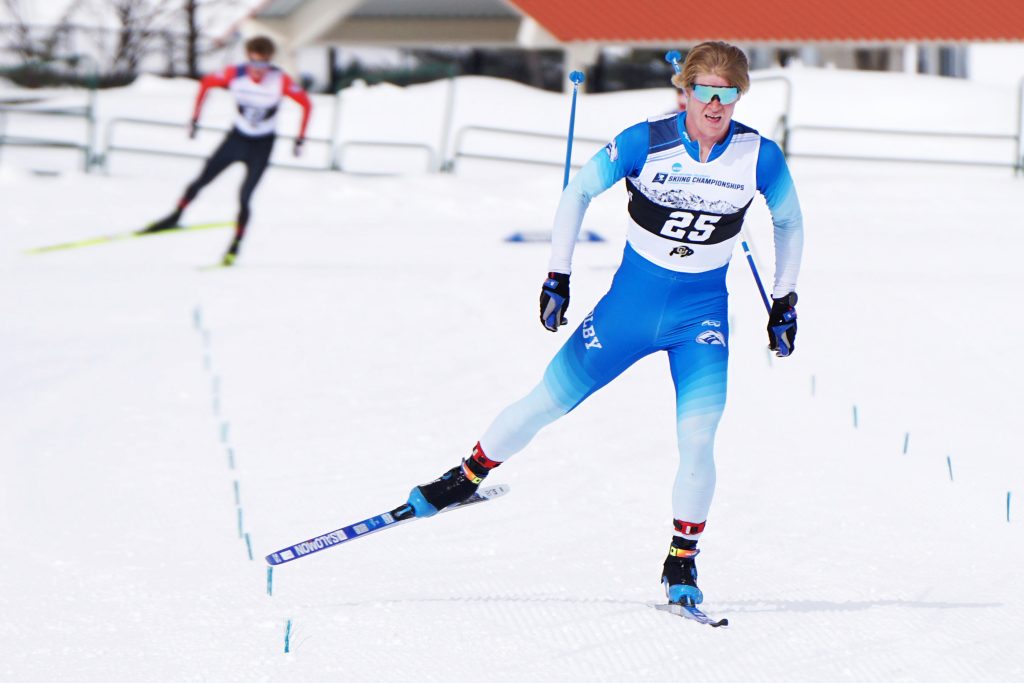
Young graduated last spring with a double major in history and educational studies. He came to competitive skiing relatively late, and was a high school quarterback and baseball player in addition to being a good skier. It wasn’t until college that he decided to focus on skiing. And although he didn’t have a typical resumé, Cote was thrilled to have him join the team, where he excelled as a sprinter.
“From the minute I met him, I thought, ‘This kid’s going to be good,’” Cote said. “He’s just very athletic, strong, and agile.”
When Young was a first-year student, he and one of his teammates, Victor Sparks ’25, committed themselves to figuring out just how good they could become. “I wanted to take this seriously, really see how far I could go, and what I was best at was sprinting,” Young said.
Cote backed his efforts, even though collegiate skiers compete in 7.5-kilometer or 20-kilometer races. In World Cup and Olympic sprinting, the distances are much shorter, ranging between one and two kilometers. As well, sprint skiers have two techniques to choose from—classic or skate. In classic skiing, the skiers stay parallel in their tracks, using a movement akin to running. In skate skiing, skiers push off their edges in a V-motion, which is more akin to ice skating.
“My junior year, when I set a goal of qualifying for a World Cup in North America, Tracey was very supportive of me focusing more on sprinting, and taking my focus away a little bit from the NCAA events,” Young said. “I have a lot to thank her for, letting me be a little bit more individual and focused on the things I was best at for my career.”
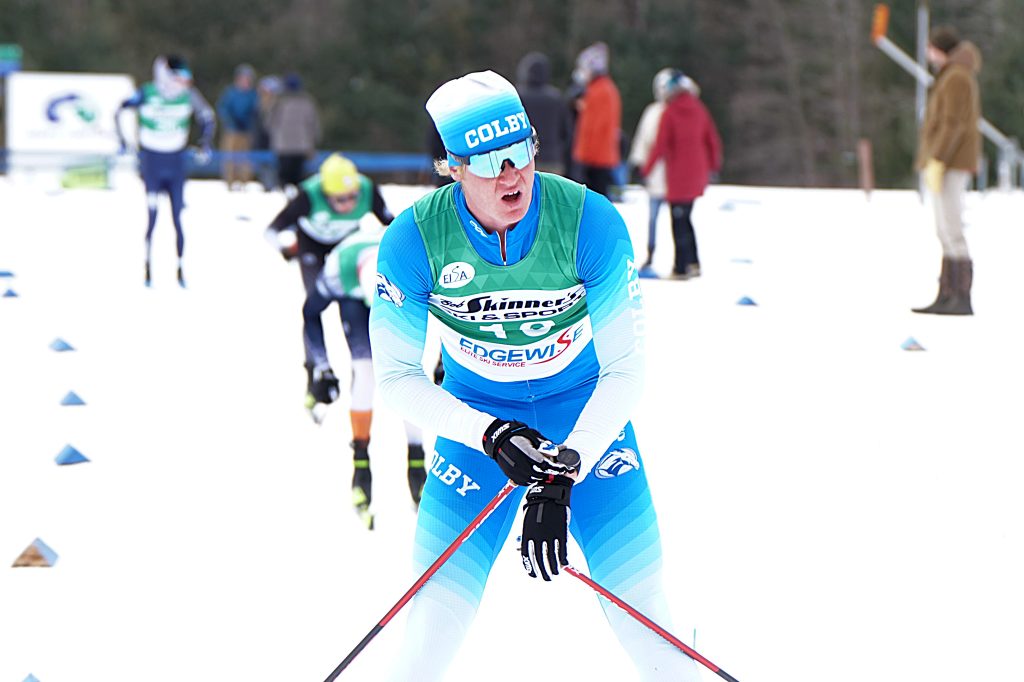
According to his coach, Young is both a standout skier and a stand-up person.
“He was awesome from the minute he showed up to the minute he left,” Cote said.
For his part, Young feels lucky to have skied with Cote and studied at the College.
“I am so happy I ended up at Colby,” he said.
Young joined the World Cup Nordic ski circuit his junior year and held his own against much more experienced athletes. In his first race in Canmore, Alberta, he raced against Olympic medalists and became the second-fastest American in the qualifying round of the sprint race. The publication FasterSkier described his first-ever finish in a World Cup race as “smoking fast.”
This December, Young had the best race of his career during a night sprint in Davos, Switzerland. He finished fourth in the World Cup event and got the result needed to qualify for the Olympics.
“It was that result that unlocked me and let me set championship medal goals,” he said.
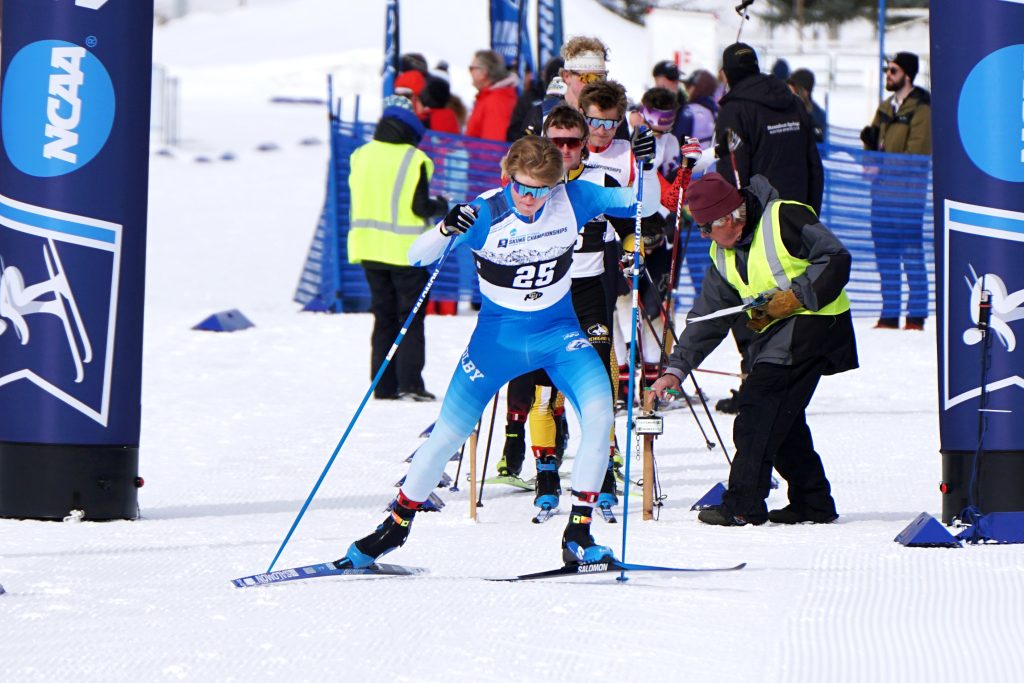
Every Winter Olympics, the sprint event alternates between classic and skate skiing, and this year the skiers will race using the classic technique. The U.S. men’s team has five sprinters vying for four starts, so it’s not a foregone conclusion that Young, who is stronger and faster at skate skiing, will be able to race.
Even so, he is committed to doing his best and supporting the team as much as he can. After the Olympics, he will return to the World Cup circuit and work toward finding a spot on the medal podium there.
“My long-term goal is getting an Olympic medal in 2030,” Young said. “If I’ve learned anything, it’s that it’s not bad to have big goals, especially in the long term. I think I’m capable of it if everything goes right in the next four years.”


