The Nation’s Most Ambitious Undergraduate Research Symposium Returns
CLAS26 solidifies Colby's place as a leader in student scholarship, with nearly 700 students presenting 550 unique projects on April 30

Lauren Slingluff learned about the Colby Liberal Arts Symposium when she came to campus last spring to interview for the director of the Colby Libraries position.
“The symposium was presented as a signature program that Colby offers when I was interviewing,” said Slingluff, who goes by “L.”
“It was used as a recruitment tool.”
The pitch worked. Slingluff became the Michael and Eugenia Wormser Director of the Colby Libraries, and this year she has joined the organizing committee for CLAS26 to help ensure its continued success and that Colby librarians are involved in its planning, execution, and archiving. She and her staff are working closely with Senior Associate Provost Jim Sloat, principal organizer of the event, and Jennifer Phillips, academic administrative assistant for the Office of the Provost.
“CLAS holds a lot of warmth in librarians’ hearts. The concept of celebrating research, scholarship, and academic achievement at Colby is really exciting,” Slingluff said. “It takes all the work that students are doing in the classroom and makes it more visible. Librarians are perpetually curious. We love learning. So this is an opportunity to hear what people are learning and what they are interested in. That’s the lifeblood of the College. That’s why we are all here.”
The symposium is an annual day-long celebration of student success, during which students stand before their peers, professors, and others to explain and discuss their research. Now in its 10th year in its current iteration, CLAS has evolved into the largest undergraduate research symposium of any liberal arts college in the United States, with student poster sessions, presentations, and demonstrations.
CLAS26 will be Thursday, April 30, at locations across campus. Colby cancels classes to encourage wide participation. This year, 680 students will present 550 unique projects across 72 sessions that are scheduled throughout the day, starting at 9 a.m. and continuing until 4 p.m.
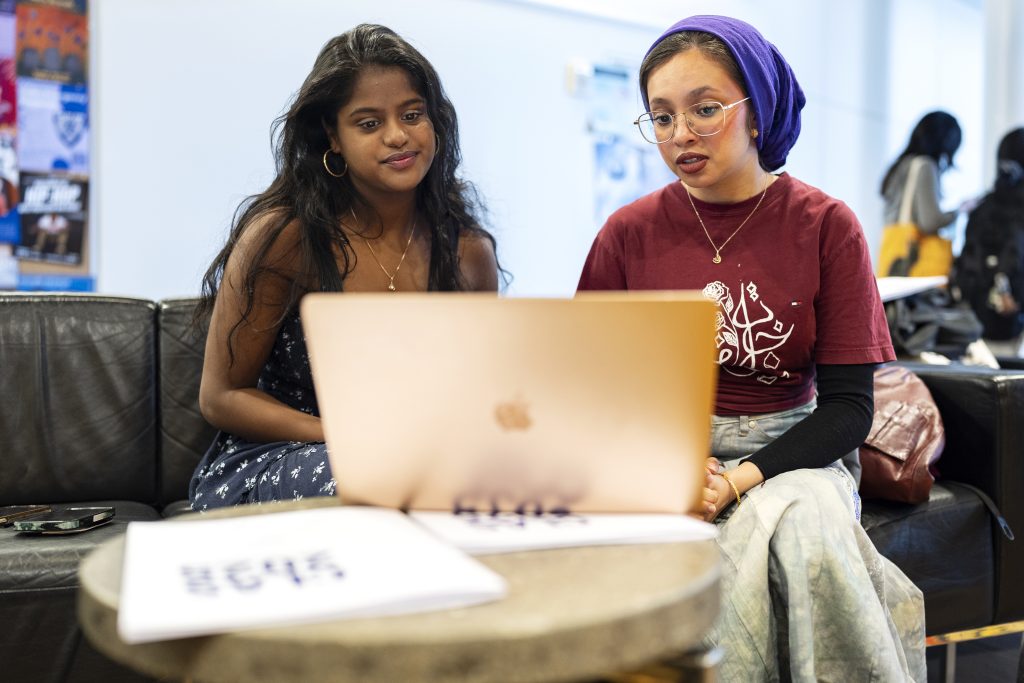
Those numbers, which will fluctuate in the days leading up to the event, are significant to Sloat, who has championed CLAS and helped it become an informal Colby holiday. He’s proud that Colby hosts a research symposium for undergraduates that rivals those of the country’s largest research universities. Based on research conducted by Colby Libraries, only the University of Washington Undergraduate Research Symposium is larger, Sloat said.
“The scale of what we have built is exceptional,” he said. “Nobody else our size does what we do.”
Presenters will range from first-year students to seniors who are preparing to graduate, across disciplines. They will cram into crowded rooms in the Diamond Building for oral presentations of senior capstones, honors theses, and research. In the Parker-Reed Room at the Schair-Swenson-Watson Alumni Center, students display posters of their scholarship and explain their work to anyone interested in learning more.
The Davis Science Center will teem with science and math students, while the Gordon Center for Creative and Performing Arts will buzz with multimedia presentations. At the end of the day, the crowds will migrate to the Page Commons Room for PowerPoint Karaoke, an energetic conclusion featuring impromptu, often hilarious “lectures” by faculty members who make it up as they go, based on on-screen prompts.
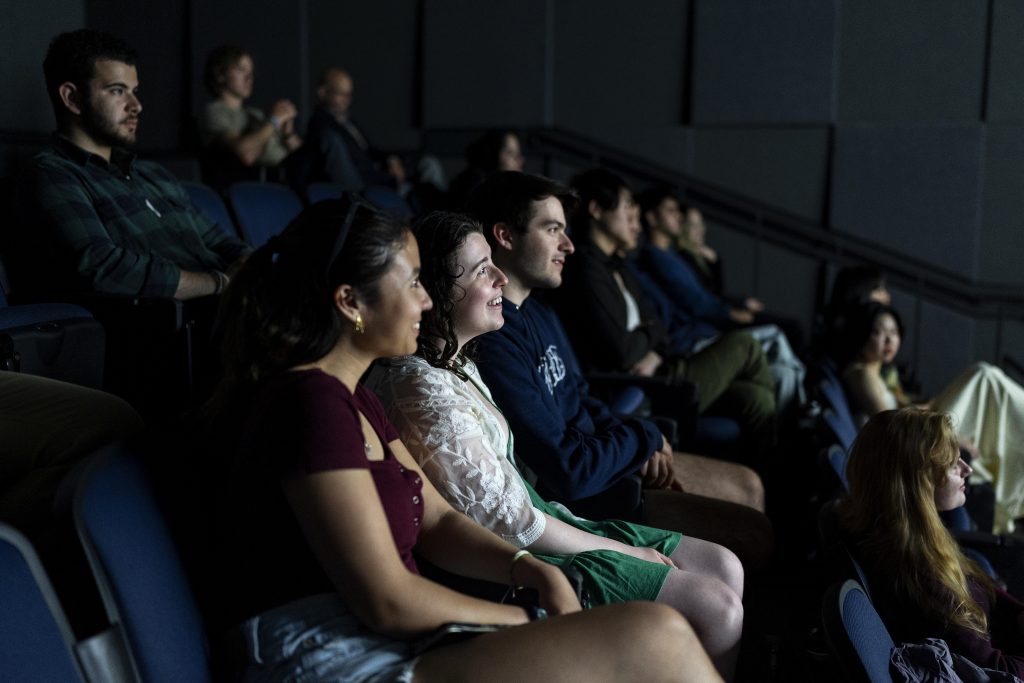
Slingluff expressed gratitude to Sloan and Phillips for making Colby’s CLAS a world-class event. “I can’t emphasize enough that CLAS wouldn’t be what it is without Jim and Jenn—I’m just honored to get to learn from them,” she said.
Historically, the library’s involvement has been led by Data Services Librarian Kara Kugelmeyer, who manages the poster portion of the event, with support from Natalie Hill, scholarly communications librarian, and Bonnie Paige, user experience librarian.
To further support the Office of the Provost, this year the library staff will have a full team on hand during the poster sessions to help students navigate the room and manage transitions between sessions. Librarians are also debuting a new type of programming, with self-guided poster sessions in the Coburn Smith Library.
Running concurrently with the traditional sessions in the Parker-Reed Room, these will feature digital content from across the Colby community, including audio storytelling with podcasts from Writing Department Postdoctural Fellow Rebecca Taylor’s Jan Plan course, the newly launched Lunder Institute for American Art Audio Archive, digital highlights of curated selections from Special Collections and Archives, and Historical Colby, a new library initiative featuring an interactive map of the original campus with archival photos and notes.
A focus on student success
Jackson Lake ’26 has participated in CLAS each year at Colby. A physics major, he will present his honors thesis on a technique called electromagnetically induced transparency to detect Rubidium Rydberg states, highly excited atomic states with properties important to quantum computing and simulation. “These Rydberg atoms have an electron in large, loosely bound orbits, giving them several interesting properties,” Lake explained. “To excite atoms in these states, we use three different infrared lasers.”
Lake will also present, along with classmates in Professor of Physics Duncan Tate’s course Experimental Atomic Physics, their project to build two external-cavity diode lasers, which are essential for applications that require specific, stable wavelengths, such as atomic physics. “We’ll be presenting on the construction process of the lasers, the various parts, some of which we machined ourselves, how they were aligned, and how we used them in an experiment,” he said.
CLAS is important, he said, because it’s a chance to hear about interesting work being done by friends and peers, especially in the Physics and Math departments. “I’ve also learned some cool things just by wandering into random poster sessions during CLAS. It has been motivating to see my classmates present work that ranges from the accessible to the highly technical, even graduate-level,” Lake said.
As a younger student, he benefited from attending senior thesis presentations in the Physics Department. One of the talks he attended as a first-year student was his initial exposure to atomic physics research, which became the focus of his senior thesis. “It opened my eyes to the type of experimental physics research students can do at Colby.”
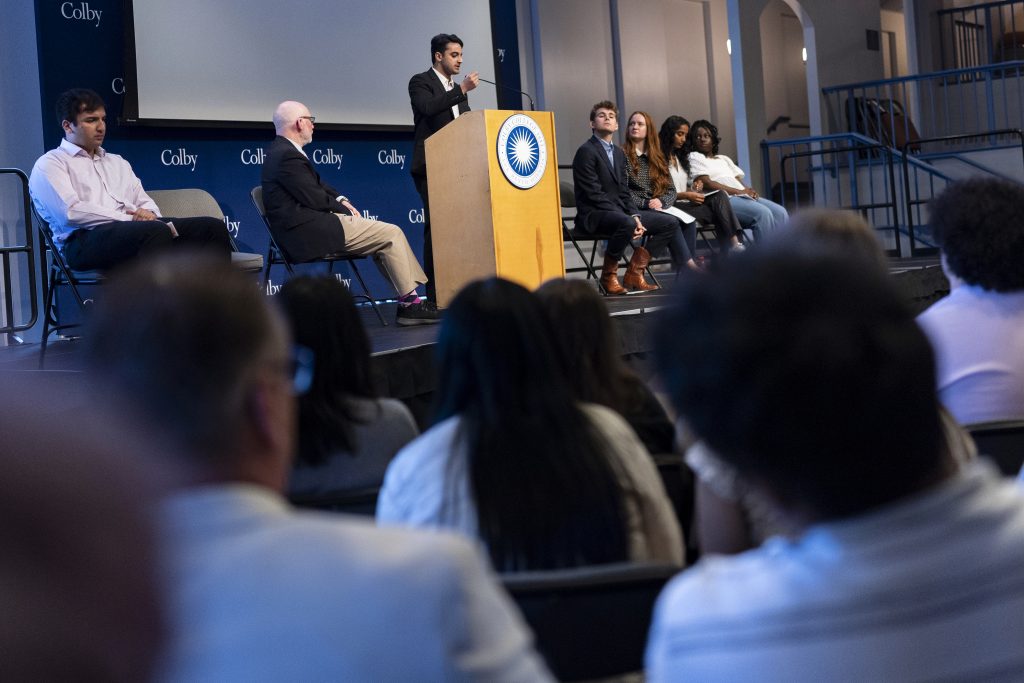
Ashley Kwon ’26 had a similar experience. She remembers the positive impression CLAS made on her as a first-year student, when she attended as an observer. Each year since, she has participated as a presenter.
“Honestly, I wasn’t expecting Colby to have a day that was dedicated specifically to student research. And the fact that it did emphasized just how much the school cares about it,” said Kwon, a psychology and economics double major with a minor in music. “It was interesting for me to see the niche topics that students wanted to pursue, whether they were required to by their classes. I liked that Colby provided space for it.”
Kwon will present this year about her research in Professor of Psychology Jen Coane’s Memory and Language Lab on the impact of articulatory suppression on false memory. Articulatory suppression impairs memory and memory processes by requiring someone to repeat an irrelevant sound while performing a task, such as memorizing words or learning. “In other words, if we distract you while you are trying to memorize something, how well can you recall what you have and have not studied?”
Enthusiastic faculty support
Jen Meredith, assistant professor of economics, said CLAS embodies the Colby ethos that promises incoming students will engage in research and the scientific academic process, including creating and testing original hypotheses.
Most students in her 200-level Environmental and Natural Resource Economics course participate in CLAS. As social scientists, her students are collecting, analyzing, and presenting data related to the Coast to Cow to Consumer project, a collaboration among Colby, Bigelow Laboratory for Ocean Sciences, and multiple other institutions. Researchers are using seaweed to develop a sustainable cattle feed additive that would reduce methane emissions from dairy cows while potentially enhancing milk production, creating a locally sourced, sustainable product.
Using either existing data or data they collect themselves, Meredith’s economics students are exploring how willing Mainers are to pay higher prices for methane-free dairy products. For different CLAS presentations, other groups of students are analyzing data on coastal residents’ perceptions of the seaweed aquaculture sector and its potential to diversify Maine’s economy.
The presentations will be livestreamed so external project collaborators can watch.
“It’s amazing how much confidence presenting research can infuse in a student, and it makes me proud how they rise to the occasion. They tackle it with everything they’ve got,” Meredith said, adding that CLAS is also important because it requires students to articulate their work in a way that experts and non-experts can understand.
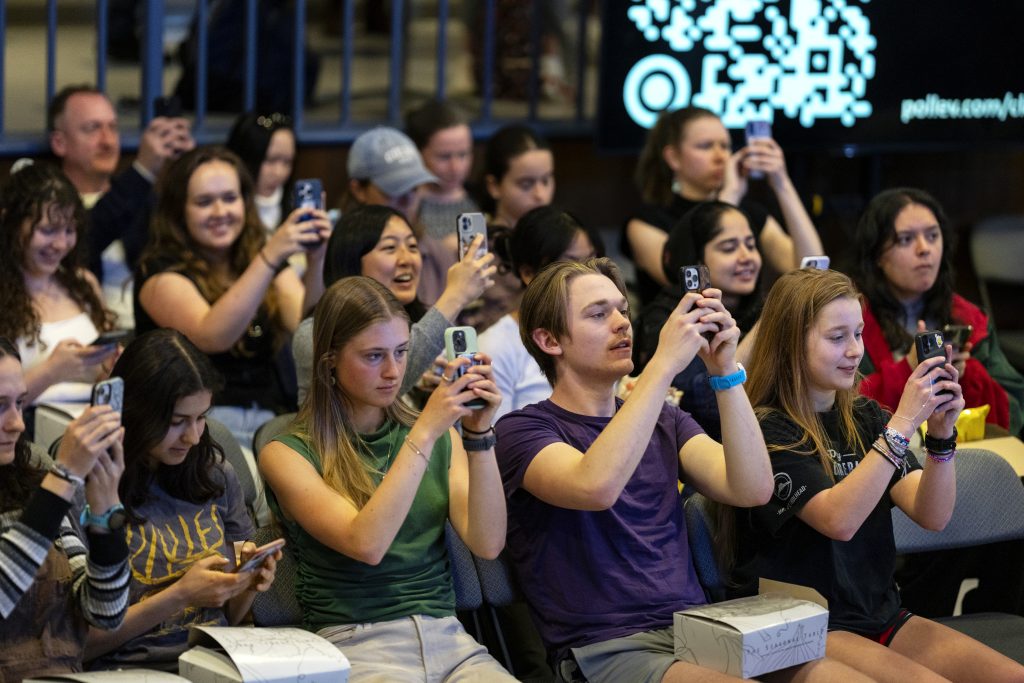
To add a dramatic element to her literature course, Assistant Professor of English Dyani Taff assigned students in Greenworlds and Changeable Bodies in Early Modern Drama to choose a short scene from one of the plays they read in the course to perform for CLAS26.
They all chose scenes from William Shakespeare’s Twelfth Night. Each student, some in pairs or trios, some solo, will perform 10 lines from memory. The idea is to encourage students to immerse themselves deeply into the material, Taff said.
“What drew me to this idea was the moment when the students have a still-friendly but real audience beyond me, the professor. I ask them, what do you want to convey to people beyond our course about the material you have learned?” Taff said. “To present for actual people, they must invest a little more, they need to know their stuff a little more.”
Oak Professor of Biology Cathy Bevier requires students in her 300-level Animal Behavior course to present, and she encourages all of her students to attend. She appreciates the day-long energy and excitement of CLAS among students, their professors, and the wider community.
“I am really proud of students under my own mentorship, but when I happen to see that students I know from current courses or past courses are presenting in a discipline other than biology, I like to support them,” said Bevier, who has participated in CLAS since its beginning. “I am also impressed when other students come to support their peers. I have seen whole athletic teams show up to support one of their teammates giving a presentation. It’s nice to see that level of camaraderie. It fills the room with energy.”


