Fostering Excellence in Teaching
With three new books, Colby's Center for Teaching and Learning leads national conversation
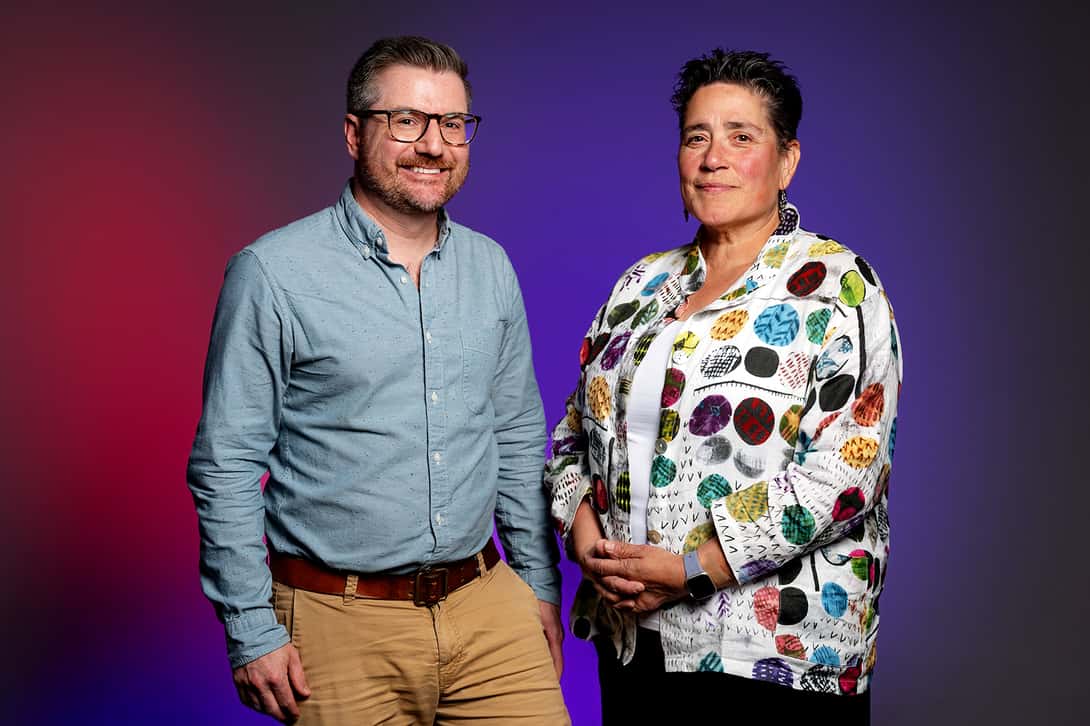
What does it mean to be an excellent teacher at Colby? What kind of environment allows faculty to do their best work?
Nearly 10 years ago, Carol Hurney came to Colby seeking answers to these questions. Today, she is a leading voice in the national conversation on both the questions and the answers.
“I came to a small place to do a big thing,” said Hurney of establishing Colby’s Center for Teaching and Learning in 2016. The center is now a critical resource that supports faculty through programs and dialogue about pedagogy, effective practices, and academic inequities.
In the ensuing years, Hurney has learned a great deal about what does and doesn’t work, who the faculty are, and what motivates them, as well as how to elevate the field of teaching and learning. As a result, she has published three books highlighting the work she has undertaken at Colby, including midcourse correction programs, design course institutes, and a data-driven assessment of the field.
She sees the books as a way of giving back to the field and its body of scholarship.
“These are topics that I really dug into here,” said Hurney, now associate provost for teaching and learning. “It’s a way of sharing some of the experiences I’ve had at Colby.” Moreover, the books have spawned frequent invitations to give conference presentations, pre-conference workshops, and keynote addresses nationwide.
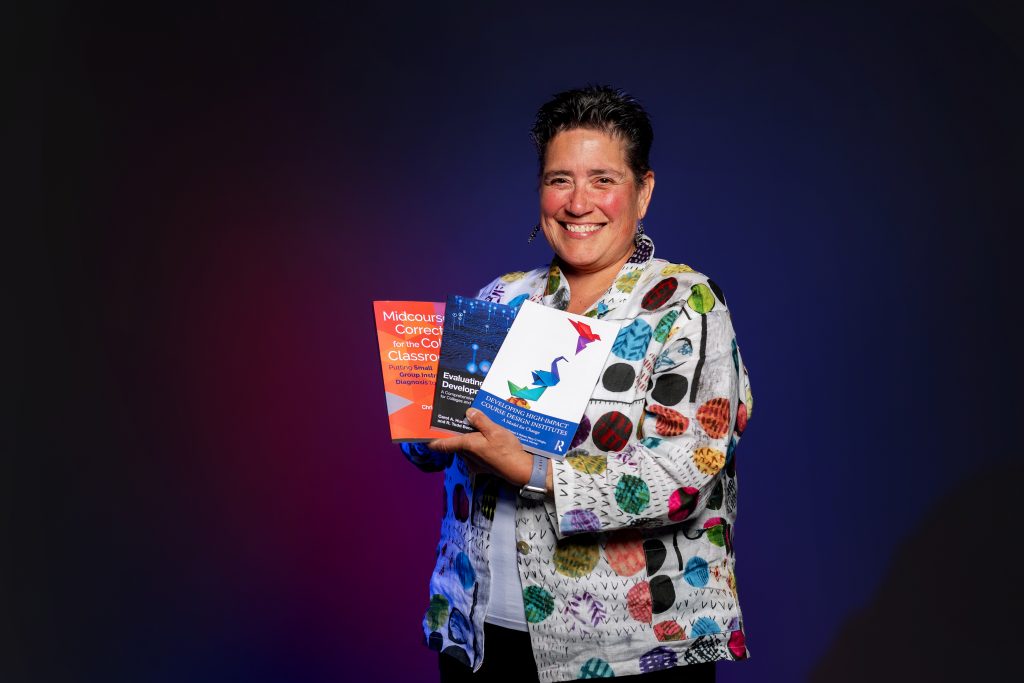
Writing one book, let alone three, was something Hurney never thought she would do. “It got under my skin that I wanted to make sure we were part of the national conversation,” she said, looking at the books on the table in front of her.
“These books,” Hurney said definitively, “will change the way other centers do their work.”
Experience, and a long leash
Hurney attributes her success at Colby to two things: the experience she brought with her and the freedom she was given once here.
A biologist and passionate educator, Hurney was enjoying a teaching career at James Madison University in Virginia when a colleague asked her to join the university’s newly formed Center for Faculty Innovation. Hurney had previously worked at a teaching center at the University of Virginia, where she earned her doctorate, and conducted education-based research at JMU. The offer was an exciting new direction for her career.
Years later, she became the center’s executive director.
“We developed a holistic center that wasn’t just about teaching,” said Hurney. The center at JMU worked to ensure faculty could thrive in their respective areas with programs that supported their teaching and scholarship, helped them reach career milestones, and more.
That 12-year experience running a center at a large university gave Hurney a clear vision of how and where to start at Colby.
“Coming here was great. They gave me a really long leash—like no leash,” she said.
“Those first couple of years, I dug into the literature, and I thought really hard about what the most important things I should start with are. And I knew that one of those things was for me to make the center into a model for small liberal arts colleges and to be part of the national conversation.”
A labor of love
The first program Hurney implemented at Colby was a Mid-Semester Course Analysis program. Five years later, it became the topic of her first book, Midcourse Correction for the College Classroom: Putting Small Group Instructional Diagnosis to Work (Routledge, 2021).
In a mid-semester feedback session, a consultant from the CTL enters a classroom where the professor has left, and they conduct a structured discussion with the students about their learning environment. The consultant then meets with the professor to share what is typically formative, qualitative feedback. The sessions provide insight into teaching that Hurney believes is essential for both faculty and professionals like herself.
“It’s what got me into the career—that kind of intimate experience where I was working directly with the students and then bringing the feedback back to the faculty,” she said.
Hurney called the book a “labor of love” because she felt so strongly about the program.
‘I knew that one of those things was for me to make the center into a model for small liberal arts colleges and to be part of the national conversation.’
Associate Provost for Teaching and Learning Carol Hurney
There was another reason for the book. “The literature was a wreck,” she noted. “Everyone called it something different, and it was hard to find data.” So Hurney joined forces with Jordan Troisi, director of Colby’s Center for Teaching and Learning, and Christine M. Rener, president of the POD Network in Higher Education, to write the book.
Informed by research and enriched by the authors’ experiences, the book is a comprehensive guide that “keeps the needs and interests of instructors and educational developers front and center,” said Mary Dean Sorcinelli, founding director of the Center for Teaching and Learning at UMass Amherst.
Measuring success
Hurney’s second book, Evaluating Educational Development: A Comprehensive and Data-Driven Approach for Colleges and Universities (Routledge, 2024), emerged as a way to evaluate the work in the field of teaching and learning. It stemmed from a larger discussion amongst her colleagues about how to prove to senior administrators that their centers for teaching and learning (CTLs) were worth keeping.
Was there impact data? Were CTLs changing institutions? Administrators wanted to know.
Initially, Hurney said the basic assumption was that if faculty development impacts faculty, then they should teach better and students should learn more. The challenge for centers was how to measure student success since they interact primarily with faculty, not students.
The answer, Hurney realized, was for CTLs to identify what specifically they want faculty to learn.
In CTLs, faculty are the students, so Hurney thought about using learning outcomes, which are specific, measurable items identified as something students should know at the end of a course or program. Hurney’s idea was to establish learning outcomes for faculty who participate in their programs, mirroring how faculty are taught to identify learning outcomes in their classrooms. Understanding what faculty were learning was the first step in changing their behavior in the classroom, she said.
From there, Hurney worked in collaboration with POD Network colleagues Bonnie B. Mullinix and R. Todd Benson to develop a faculty learning outcome framework and write the book.
At the same time, Hurney was working with other POD scholars to create a rubric to assess centers for teaching and learning in general. Evaluating Educational Development brings together the two ideas, measuring what faculty learn about teaching, but also measuring all the other things that make a CTL “awesome,” she said.
Finding the special sauce
Hurney’s recent, and top-selling, book is Developing High-Impact Course Design Institutes: A Model for Change (Routledge, 2025).
Offered at many colleges and universities, course design institutes are multi-day experiences where faculty learn how to design or redesign a course using learning-focused and equity-minded teaching and learning principles. Hurney and her coauthors knew anecdotally that course design institutes, or CDIs, were transformational, but they wanted to determine their impact using pre- and post-surveys.
To design a study, Hurney brought in Troisi, who has experience in educational research, Lori Hostettler and Michael Palmer from the University of Virginia, and Mary Wright from the University of Sydney.

Once the team got started, it soon became sidetracked with conversations about differences among course design institutes. Each had its strengths, but what did it take to run impactful CDIs? They decided to set the initial study aside and conduct an entire study to find what Hurney called the “special sauce” of successful CDIs.
Together, the team decided that Troisi was best situated to be the lead author, and the resulting book has been so well received that both Hurney and Troisi have been invited to run course design institutes at colleges across the country—further proof of the value of their voices.
“It’s all relational work,” Hurney said of engaging with faculty. “Trying to figure out the impact you’re having on them and creating places where they can do amazing things.”


