Poet Richard Blanco Begins Duties as Presidential Fellow in Arts and Community Life
In this role, the renowned poet will explore creativity with students and members of the community
Renowned poet Richard Blanco, Litt.D. ’14, has begun working in his role as presidential fellow in arts and community life. In this new position, Blanco will work across departments and disciplines to engage widely with Colby students and the Waterville community in a series of planned and pop-up events around such themes as creativity, connection, and the non-linear path of life.
Blanco will serve in the position through January 2026.
Born to a family of Cuban exiles, Blanco writes about collective, sociopolitical issues and advocates for the role poetry plays in the public realm. Most famously, he wrote and read his poem “One Today” at the second inauguration of President Barack Obama in 2013.
Blanco received an honorary degree from Colby in 2014, he was the first artist in residence at the Lunder Institute for American Art in 2018, and he delivered the commencement address in 2021. During his time as a Lunder Institute fellow, Blanco created a poetry-in-the-schools program with the Waterville students.

A civil engineer who has followed a dual career path in engineering and poetry most of his adult life, Blanco will use his skills across disciplines to engage with students and others about the importance of an interdisciplinary approach to careers and life in general.
“It’s an honor to serve in this role, and I look forward to interacting with Colby students and the broader community,” said Blanco, a member of the Colby Museum Board of Governors. “One of the unique qualities I bring as a poet-engineer is understanding that all knowledge is in some way interconnected, and broad knowledge is essential in any career or in life. I will be working with different departments and different labs and institutes to explore a range of possibilities, interests, and subjects. I hope to touch every student, and others, in some way.”

Examples of his upcoming events illustrate the range of his activities as Colby’s inaugural presidential fellow in arts and community life:
- At 6:30 p.m. Sept. 29 in Bixler 219, the Center for the Arts and Humanities will host Blanco to speak about the center’s “Islands” theme. Blanco, whose family is from the island of Cuba, will speak about “Our Proverbial Search for Home, Place & Belonging.”
- At 8:30 a.m. Sept. 30 at the Schair-Swenson-Watson Alumni Center, the Goldfarb Center for Public Affairs will present a breakfast talk, “Poetry, Protest, and Power.” During this discussion, Blanco will challenge the traditional view of activism by exploring how creative expression is a powerful force for political and social change.
- At 4 p.m. Sept. 30 at Greene Block + Studios in Waterville, Blanco will be featured in a kickoff event for the monthly teacher professional development sessions hosted by the Central Maine Education Consortium, ColbyArts, and the College’s Education Department. In his program, “Teaching Poetry through Wonder, Noticing, and Discovery,” Blanco will work with educators around the development of a poetry-based curriculum.
- At 7 p.m. Sept. 30 at Diamond 122, DavisConnects will feature Blanco as a guest speaker in its new speaker series, Detours and Destinations: Embracing the Non-Linear Path. Blanco will share the story of merging his career as a civil engineer and his passions as a poet. “I’m a better engineer because I’m a poet, and a better poet because I am an engineer,” he said.
- At 8:30 a.m. Nov. 13 at the Gordon Center for Creative and Performing Arts, Blanco will present a reading and speak on themes of home, place, belonging, and cross-generational engagement in a “meet-the-poet event” for Waterville students and teachers.
As a gay man growing up in a household of immigrants, Blanco brings a unique and valuable perspective to cultural dialogue, said Dean of the College Gustavo Burkett.
“At a time when a lot of identities are being questioned and challenged more than ever, bringing Richard into the fold is an incredible opportunity for students and the community,” Burkett said. “Just hearing his journey and the rewards and challenges of developing his persona as writer and poet when that was not his original career path is incredibly valuable for students.”
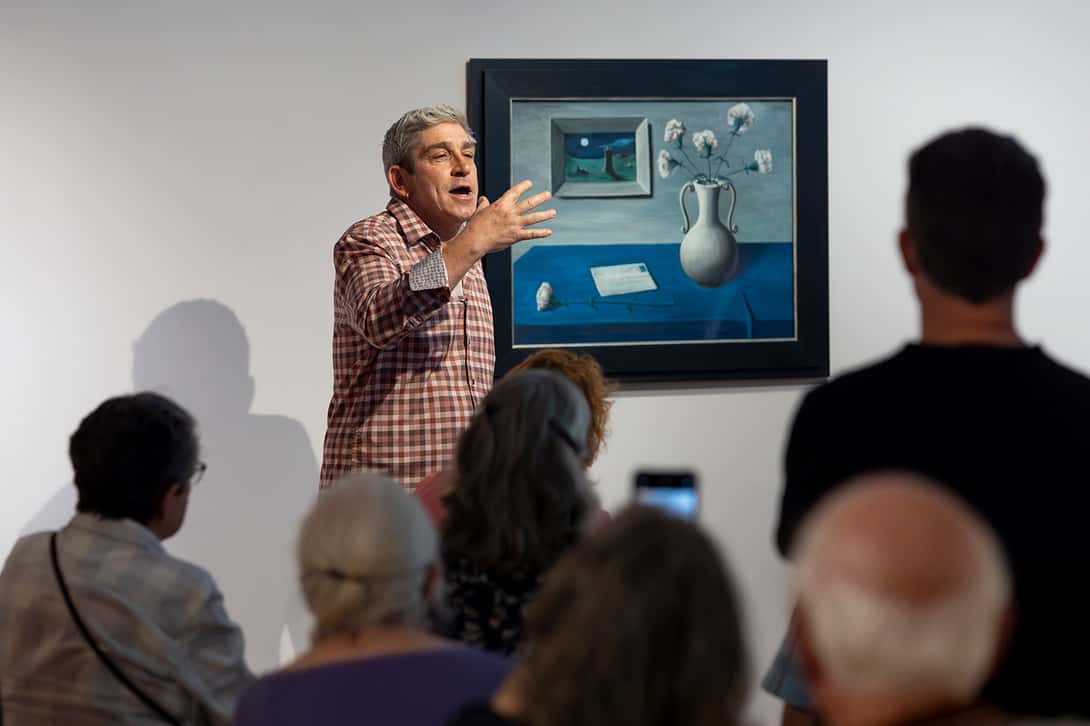
To begin his fellowship, Blanco hosted an Art Break discussion at the Colby Museum and a day-long Makers Challenge with the Lyons Arts Lab at the Gordon Center for Creative and Performing Arts. During the Makers Challenge, Blanco worked with multi-disciplinary teams of students, who were given prompts, resources, and materials to create something—anything, including visual arts, recordings, and performances—to share at Waterville’s First Friday event in September.

During the Art Break event at the museum, he led a gallery discussion about the painting Letter from Karl that is part of the current exhibition Gertrude Abercrombie: The Whole World Is a Mystery. The oil painting features a table with a rumpled blue tablecloth set against a wall, on which hangs a painting of a solitary, decayed tree illuminated by a bright full moon. On the table are a vase of flowers, a single flower that has been laid on the tablecloth, and a letter.
The painting, Blanco told those assembled in the gallery, is full of mystery. But he cautioned against trying to solve the mystery. From the name of the painting, we know the letter is from Karl. But who is Karl? Has the letter been opened? What news did it bring?
Looking at Letter from Karl through a poet’s eyes prompted him to think about how poetry is often taught.
“We approach poetry like a sleuth. You read a poem and the teacher asks, ‘What does it mean?’ I was thinking how we sometimes approach visual art that way, too. ‘What’s the answer?’ ‘What’s the secret?’ ‘What does it mean?’”

Good art answers questions, he said. But great art keeps on asking questions.
“It’s really all about questions, it’s about noticing and wondering, and exploring,” he said, describing the painting as he would his fellowship. “It’s about potentialities and the possibilities.”