Student-Scholars Shine at International Art Conference
Art history course and Colby Museum prepare students to dialogue with experts on Edvard Munch
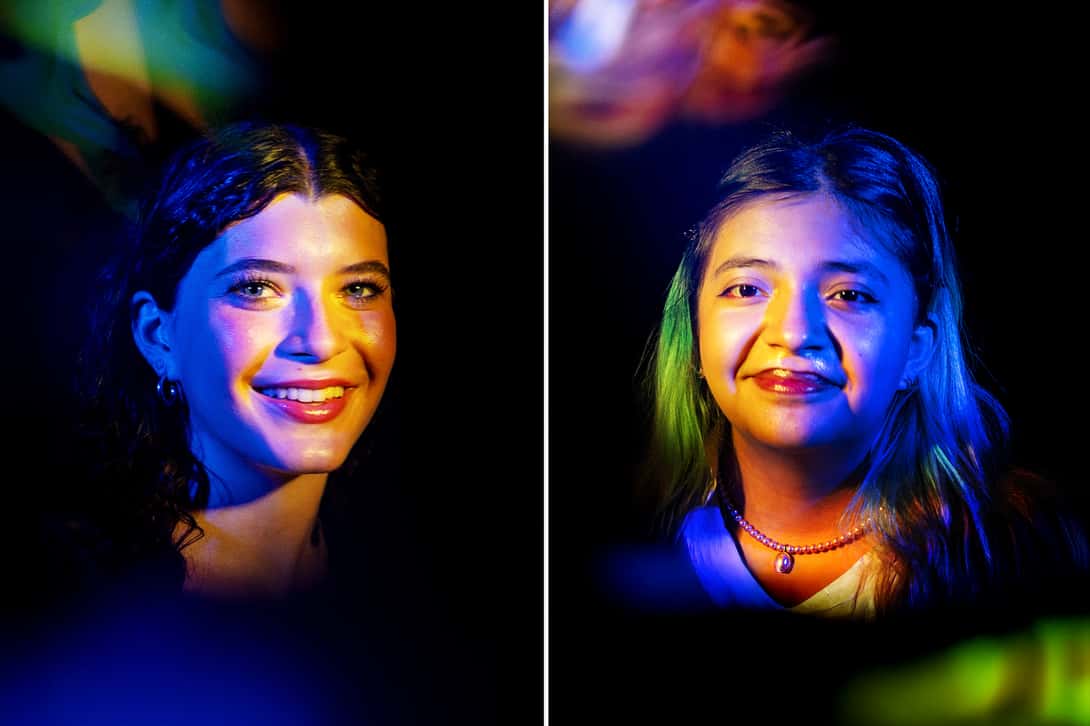
At dusk on a September night in Norway, two American undergraduates dash from the warmth of a Scandinavian sauna and plunge into the bracing waters of the Oslo Fjord. Goose-bumped and exhilarated, they shriek with delight.
Across the water, they gaze up at the hulk of Oslo’s MUNCH, a museum and dynamic hub dedicated to the Norwegian artist Edvard Munch, where they had just presented their research at a major international conference, proving themselves capable young scholars.
The audacity of their cold plunge speaks to their exuberance of having jumped into a challenging scholarly environment and emerging with full-throated confidence.
Nora Demak ’28 and Carla Servin ’27 traveled to Oslo last month to participate in the conference Curating Modernism and Medicine, held in conjunction with the museum’s exhibition Lifeblood—Edvard Munch. Although best known for his painting The Scream, Munch had a lifelong engagement with illness, health, and the medical environment, which was the focus of the exhibition.
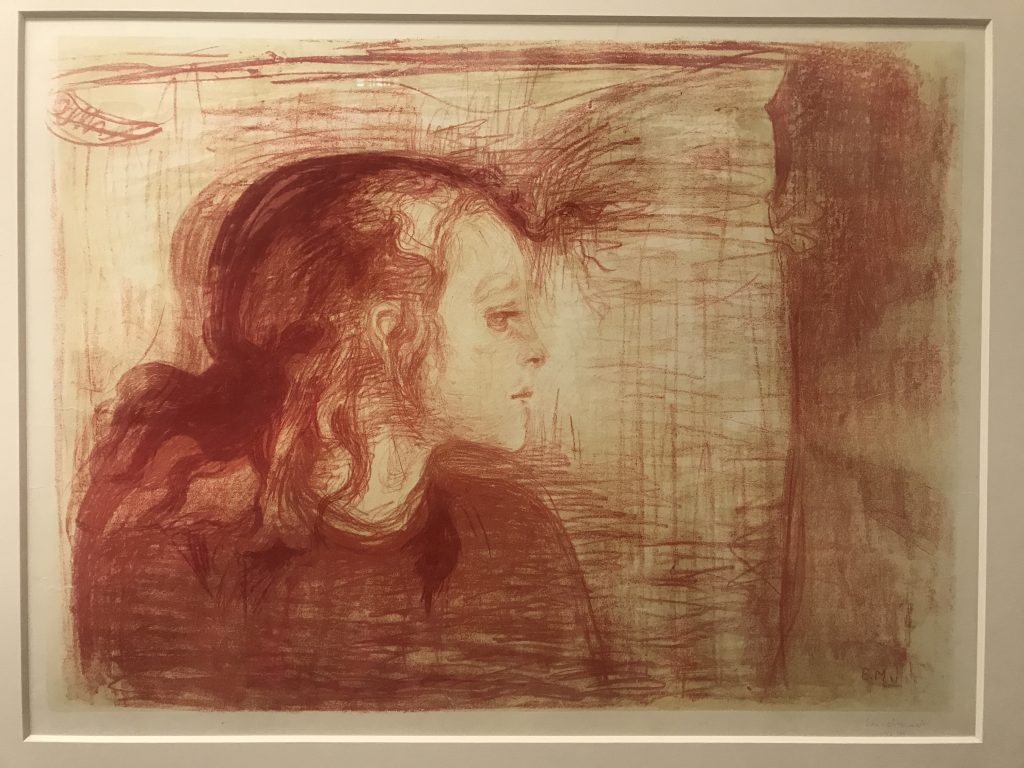
A highlight of the exhibition was an oil painting and eight prints of Munch’s The Sick Child, a theme he returned to more than any other in his body of work. Using a lithograph of The Sick Child in the Colby College Museum of Art’s Lunder Collection, Demak and Servin studied the motif last summer, developed their interpretation of it, and led four 30-minute sessions at the conference’s study day.
Poised and prepared, the students captivated an international audience of academics, curators, and artists.
“Nora and Carla brought new perspectives and enthusiasm to our conference. I was very impressed with their presentation and their ability to engage people in conversation about art,” said Allison Morehead, professor of art history at Queen’s University in Canada and curator of the Lifeblood exhibition. “They were extremely well prepared and obviously deeply engaged in thinking about Munch’s The Sick Child. It was very inspiring for me and my colleagues to witness such passion among undergraduate students.”
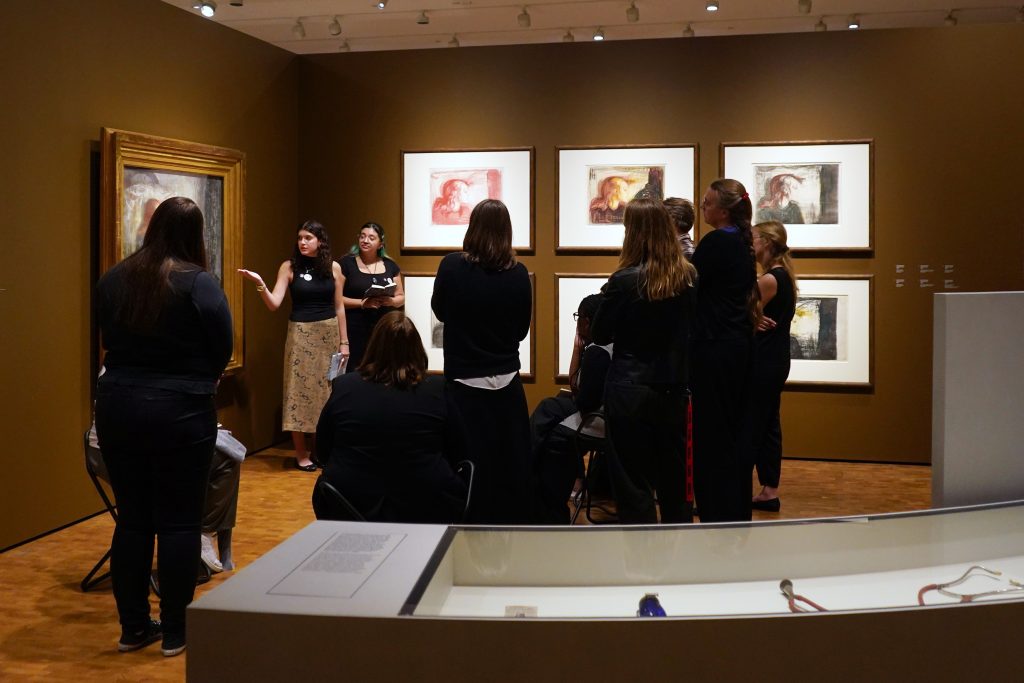
Also watching was their mentor, Tanya Sheehan, Colby’s Ellerton M. and Edith K. Jetté Professor of Art, a scholar working at the intersection of American art history and critical medical humanities, who co-organized the conference in Oslo.
“I knew they would do well,” she said. “I didn’t know they were going to shine as much as they did.”
Students as teachers
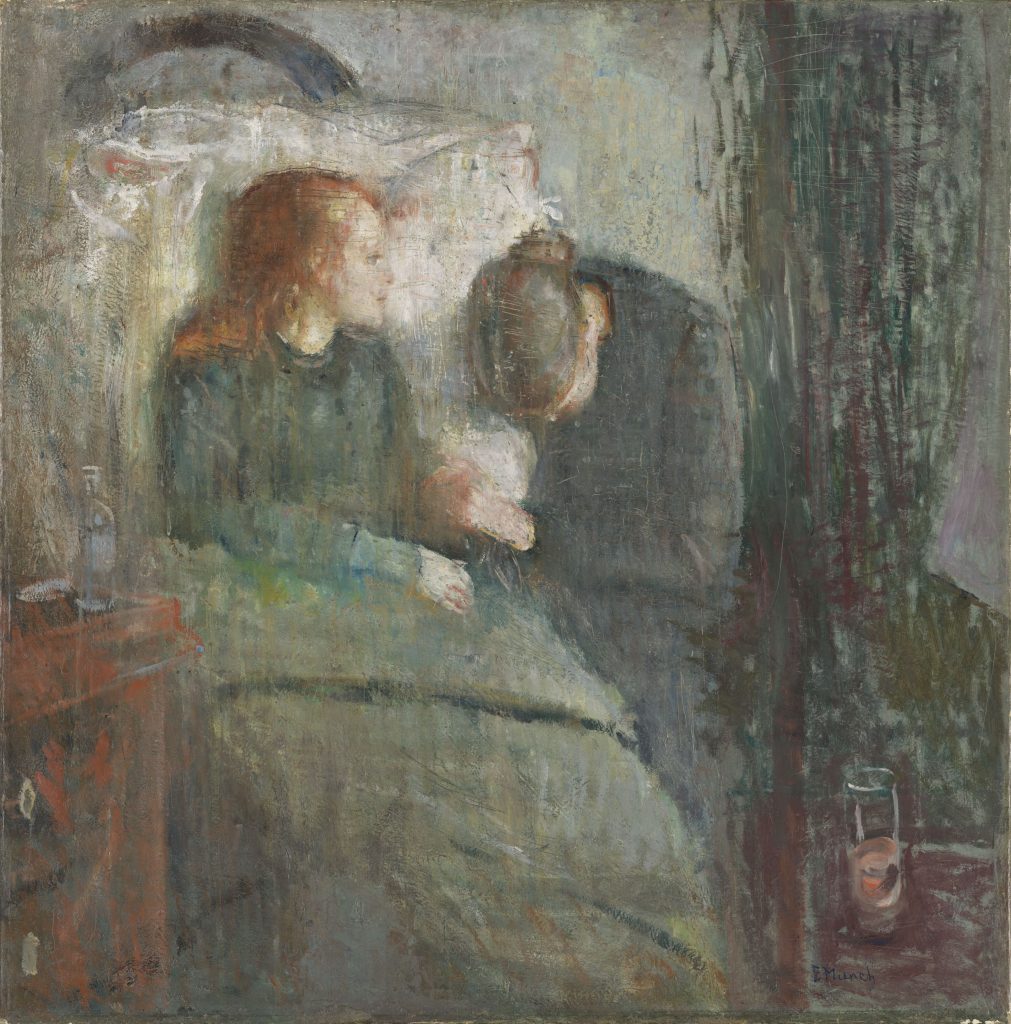
Edvard Munch painted his earliest version of The Sick Child in 1885-86, nine years after the death from tuberculosis of his sister Sophie, then 15. He would paint five more versions and create etchings, drypoints, and lithographs of the motif, attempting to capture his impression of his dying sister. In the original painting, a sick adolescent girl lies in bed, her skin pale, eyes heavy, and red hair splayed across the white pillow. At her side sits a caretaker, her head lowered as she holds the girl’s hand.
When Munch began making prints in 1896 in Paris, he returned to the motif and made his first color lithograph—but only of the girl’s head silhouetted against the pillow.
Demak and Servin focused primarily on the lithographs for their research, comparing and contrasting versions with the print in the Lunder Collection. Did the yellows represent mucous? The reds, blood? How did the viewers’ emotions change seeing the girl in isolation versus with a caretaker?


When they arrived at the museum in Oslo, they took their place in a gallery exhibiting Munch’s oil painting and lithographic prints. Nerves overwhelmed them. They were doubtful that they could teach new or different ways of understanding his work.
“We wanted it to mean something,” said Servin, a first-generation student and QuestBridge Scholar from Little Rock, Ark. “You can say a bunch of stuff, but is anyone actually going to take anything from this? Are they going to think about this past 30 minutes from now?”
Once they got started, their doubts began to vanish.
“We focused on making it interactive and honing in on that conversational aspect. That was where we found we were all learning the most,” said Demak, a Presidential Scholar from New York, N.Y. She called the discussions they led in the gallery the best kind of liberal arts seminar. “We bounced ideas back and forth, gave each other feedback, and together uncovered new ways of seeing the work.”
For the undergraduates, witnessing people’s excitement while holding their ground and staying on topic proved most thrilling.
“It felt like we were really professors,” Servin said.
Selecting the right students
The ability to engage in discussion, pose questions, and respond to others’ thoughts were skills Demak and Servin learned in Sheehan’s art history course, Medicine and Visual Culture, which they took last spring. Sheehan chose them from a large pool of interested students for the summer research and conference opportunity.
As a key conference collaborator—along with Morehead, Gustav Jørgen Pedersen from MUNCH, and Øystein Sjåstad at the University of Oslo—Sheehan saw an opportunity early on to engage students in the event.
“Given that what we do at Colby is teach students to look closely at objects and talk about them in our galleries at the Colby Museum,” said Sheehan, “I thought it would be a great idea to have the students talk in the galleries about a group of works on the same theme as the print they could study in depth.”
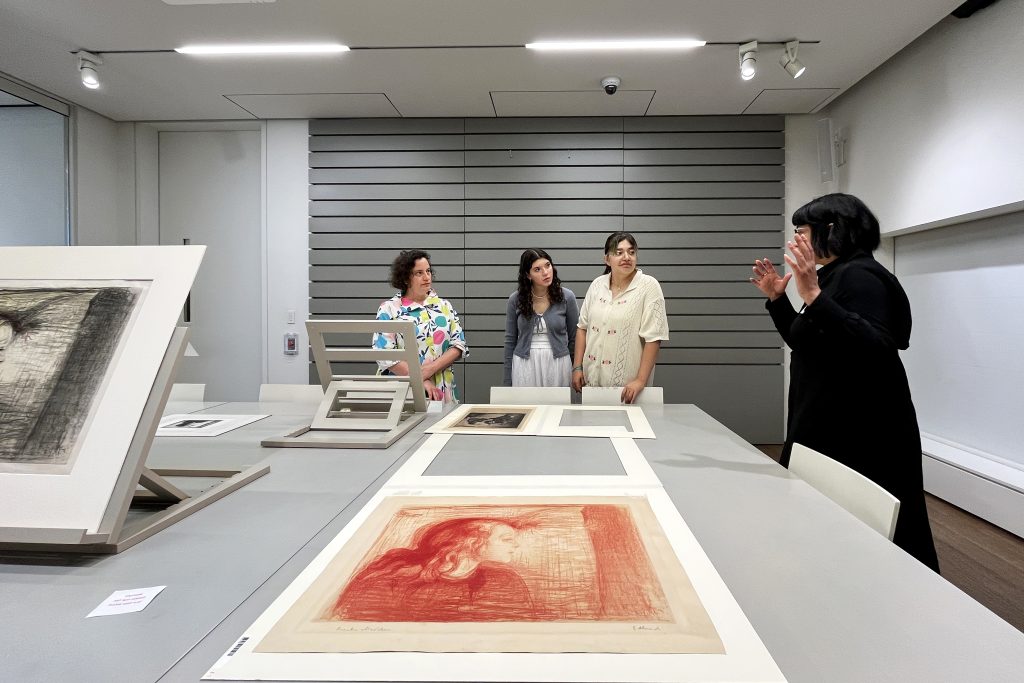
It was important to Sheehan that the students represent different disciplines at the College. In Demak, a double major in biology and religious studies, she saw a student “capable of thinking very deeply and critically across fields.” Demak took courses on medical practice at Brown University and Johns Hopkins University before coming to Colby, where she is on a pre-med track with a minor in science, technology, and society. She is interested in how we think about medicine and society, and she thought Sheehan’s course would be a way to connect medicine and the humanities while finding “other ways to think about medicine.”
Servin is a studio art major and painter who won six awards from the Arkansas Young Artists Association before coming to Colby. They thought Sheehan’s course would relate to their major and “personal relationship with illness and seeing loved ones suffer through it,” they said. Servin’s “beautiful letter of application” touched Sheehan, as did the fact that Servin had never traveled outside of the United States. “I knew the opportunity would be transformative for Carla, and that was also something I took very seriously,” said Sheehan, who was a first-gen-to-college student herself.
With travel expenses to Oslo funded by Colby’s Office of the President, Center for the Arts and Humanities, and Department of Science, Technology, and Society, their summer work began.
Boston bound
In late May, Sheehan and the students traveled to Boston to see Colby’s lithograph of The Sick Child at the home of its benefactors, Peter Lunder ’56 and Life Trustee Paula Lunder, who display pieces of the Lunder Collection in their apartment. The Lunders kindly welcomed the students for their first in-person encounter with the artwork and were thrilled to have the students talking about art in their home.
Later that day, Sheehan and the students visited the exhibition Edvard Munch: Technically Speaking on view at the Harvard Art Museums (March 7–July 27, 2025), where they received a private tour from Elizabeth Rudy, the museum’s Carl A. Weyerhaeuser Curator of Prints. Rudy also joined Demak and Servin in the museum’s study room, where they viewed other impressions of Sick Child by Munch in the museum’s collection. This behind-the-scenes opportunity was made possible by Elisa Germán, the Lunder Curator of Works on Paper and Whistler Studies at the Colby Museum, who previously worked at the Harvard Art Museums.
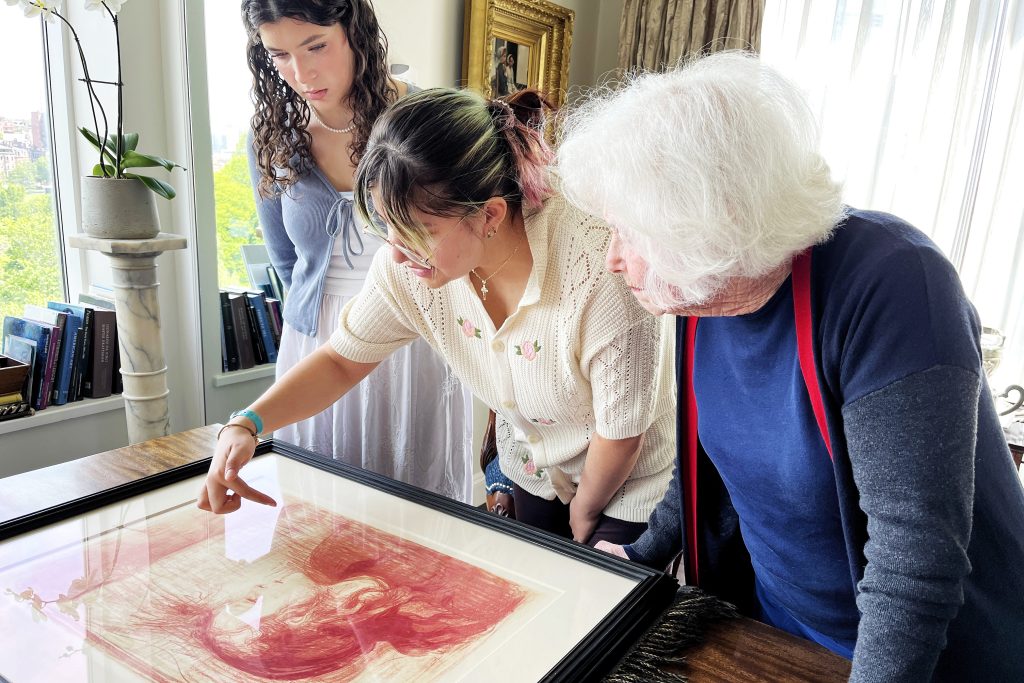
When they returned from the conference, Demak and Servin wrote to the Lunders, recapping their experience and expressing their gratitude.
“Studying The Sick Child up close was transformative,” Demak wrote. “No image on a screen, no matter how high quality, could capture what struck me standing just a few inches away from the lithograph—its rough textures, the subtle contrasts, and the way even the smallest brush marks carried weight.”
Servin noted that “visiting your lithograph in person and being able to discuss it in a less formal setting in your home opened my mind. I came to see how important it is to notice how the artwork makes me feel through its visual elements.”
Discourse on Munch
Following the Boston trip, Demak and Servin initially worked independently to begin developing their interpretation of the work. Using a process Sheehan outlined in her course, they identified the formal elements of the work and considered the cultural discourses in which they could situate the motif. They conducted library research to support their conclusions.
As they began to grasp what was happening with both medicine and society in the late 1800s, they applied it to their visual observations of the lithograph and came to very similar claims about the work. At this point, they decided to collaborate on their conference presentation.
Of The Sick Child motif, they concluded that “Munch is reframing illness to be a timeless human experience in a way that is unique to the human condition,” said Servin. Specific to this motif, the artist is focusing on care rather than cure, they argued.
By isolating the girl, Munch makes her even more vulnerable, conveying the emotional weight of her illness with his use of heavy lines and his intentionality, said Demak. “Critics talked about how it looked unfinished, because it looked kind of like a sketch. But that was how Munch intended it because he thought that was the best way to have the viewer experience this level of grief.”
Most of the lithographs are void of nurses, doctors, or medicine, Demak pointed out. She and Servin believe that Munch is asking us not to think of illness as something that needs to be treated, but rather to be witnessed. “Because when medicine and science fall short, we tend not to know what to do as a society,” Demak continued. “So, we think he’s getting at that idea of having us feel that emotion when we realize science is limited.”
The takeaway
The Oslo trip has spurred conversations at the College about supporting similar experiences for students. In addition to students’ scholarly contributions to specific topics, such experiences can significantly impact students’ academic and personal lives.
For Demak, the experience “turned everything upside down,” she said a week after returning from Oslo. “It left me with a stronger sense of my own voice—and also with even more questions about what I want to do next. In the best possible way, the experience complicated my plans and opened doors I hadn’t imagined before.”
The experience also left Servin with questions, certainly, in relation to how they think about medicine, but also about their career. “I know that I love making things and being an artist, but I’m also really interested in learning about other artists and their motivations for making art,” Servin said.
Demak and Servin expressed deep gratitude to Sheehan for introducing them to the field of art history and for her mentorship throughout the experience. “We respect her as a person, and look up to her so much,” said Servin, who found personal growth in the experience as well.
“With Norway being my first international experience, I feel like my mindset has forever changed,” they said.
“Everyone always says you can do whatever you put your mind to, and this trip has made me truly embrace that idea.”