Art as a Form of Inquiry
Filmmaker Taka Suzuki invites us to look beyond what we see and consider new possibilities
A calligraphy brush hangs from a small tree branch. When the wind traverses the landscape, the branch sways, and the brush’s inky tip marks the sheet of paper beneath it.
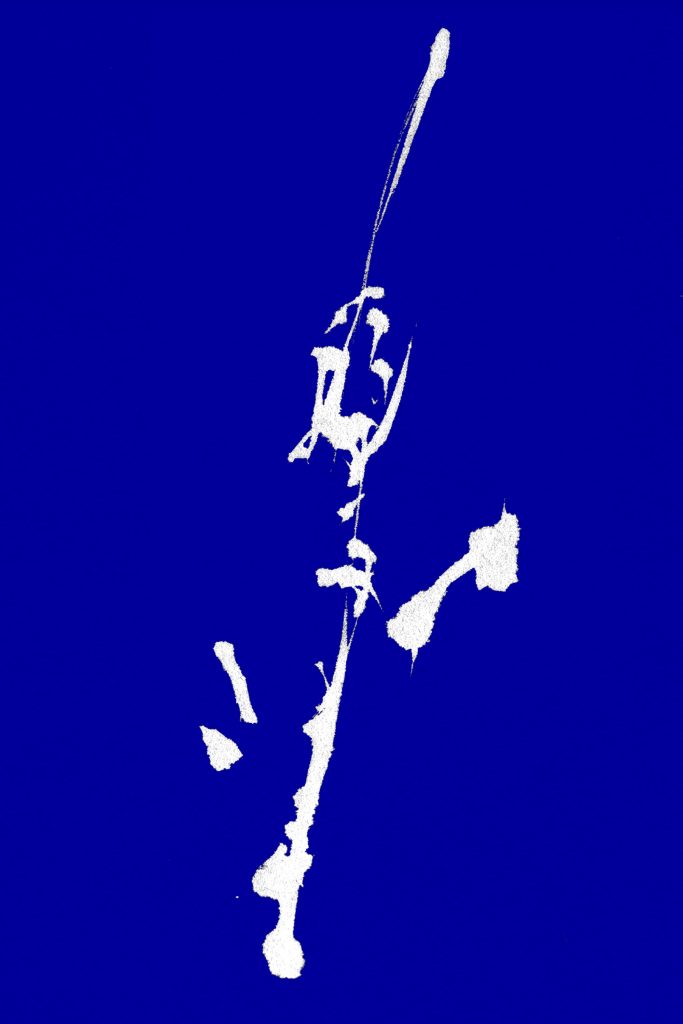
Could the mark be from a script or alphabet? Maybe it’s “a written language trees are trying to author to humans through the wind,” suggests Takahiro “Taka” Suzuki, Colby’s newest assistant professor of art.
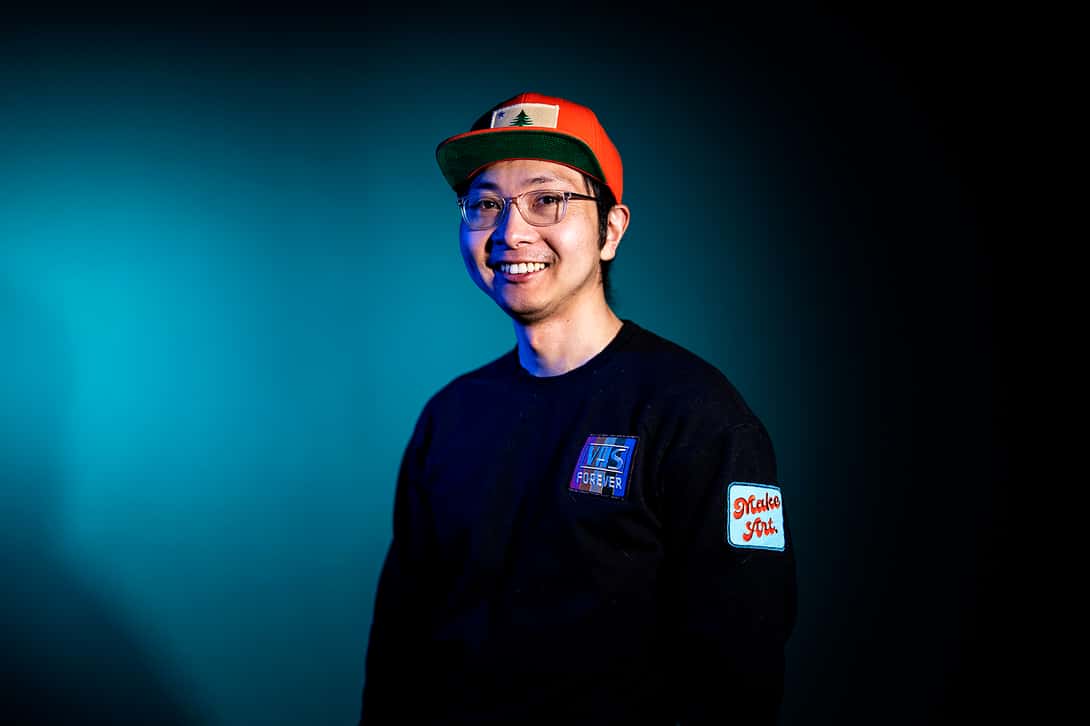
As an educator and a filmmaker, Suzuki explores the hidden knowledge and communicative properties of plants and trees. Through innovative projects involving film, artificial intelligence, digital media, and performative art, he has brought a fresh and distinctive voice to Colby’s art scene and curriculum.
Suzuki joined Colby’s Department of Art in 2023 and established a new concentration track in digital media. Borrowing from a model he designed at Brevard College, the concentration has a modular structure that allows students to take courses in graphic design, 2D animation, sound, or filmmaking in any sequence or individually.
“I like the idea of keeping art accessible,” said Suzuki, “of keeping creativity accessible.”
Born in Japan and raised in the United States, Suzuki incorporates elements of Japanese identity and culture into his work, elevating its intrigue and mystery. The tree marks, for example, are the focus of his project kaze no e (or why the wind whispers among the leaves), which includes a forthcoming short film as well as paintings, currently on view through Oct. 1 at the 2025 Faculty Biennial at the Colby College Museum of Art. Suzuki translated the marks into paintings to “learn empathetically through them,” mixing Japanese indigo into acrylic paint to create the rich, deep blue that dominates the large-scale wood panels.
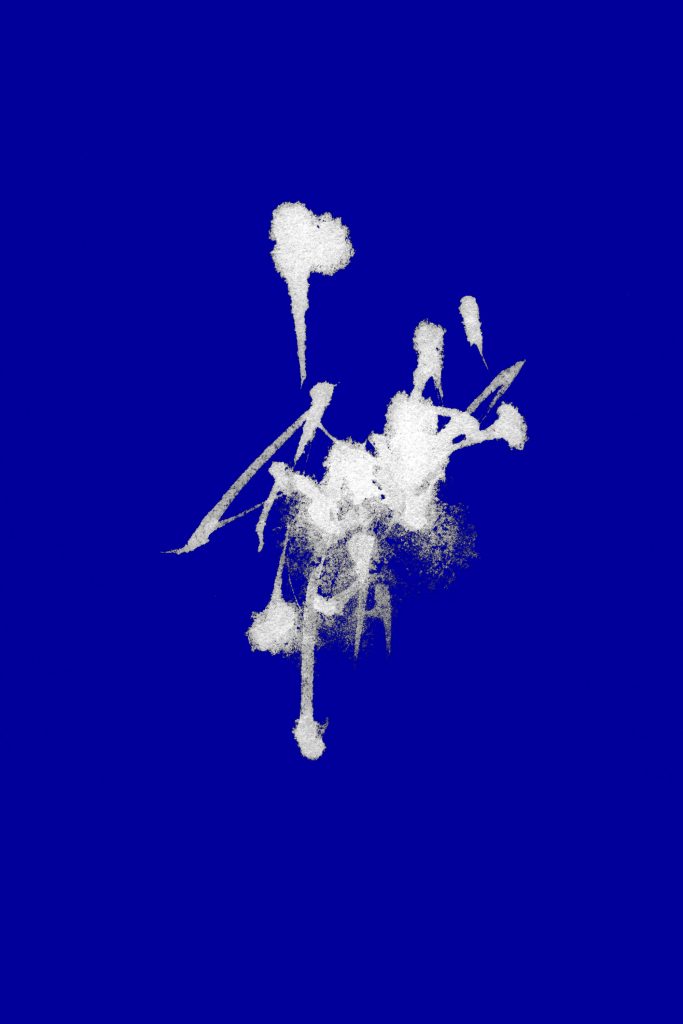
With wide-ranging interests and seemingly endless curiosity, Suzuki creates art that is a form of inquiry. It beckons us to look closely, consider new hypotheses, and discover synergy between disparate ideas.
Because really, he said, “art can be anything.”
Making and watching films
A career as an educator and filmmaker was not what Suzuki envisioned as an undergrad at the University of Virginia. His initial plan was to be a biomedical engineer, which he quickly discovered was not the right fit. In search of a new path, he gravitated toward courses offering the freedom to experiment. An acting course opened the door to a cinematography course and eventually a bachelor’s in studio art with a concentration in photography and cinematography.
Suzuki remained at UVA for a post-baccalaureate fellowship that allowed him to develop his filmmaking technique and style. Two years later, he enrolled in graduate school with the intention of becoming a teacher, largely due to the faculty and mentors at UVA, who modeled a lifestyle that balanced teaching with a creative practice. He earned his M.F.A. in film, video, animation, and new genres from the University of Wisconsin-Milwaukee in 2016, before his first teaching stint at Brevard College.
Today, much of Suzuki’s work has been screened and exhibited nationally and internationally. At the 2025 West Virginia Mountaineer Short Film Festival, his film The Hungry Ghost & The Earthshaker was named Best Experimental Film.
Making films is one thing. Equally interesting is people’s reaction to them.
“I’m always the weird person who likes to sit in the back of the theater,” said the filmmaker, who relocated from Portland to Waterville to be close to the Maine Film Center. If he watches cinema in a theater, it’s because he wants the social element of “seeing how other people are interacting with the screen, how people are responding to certain narrative plot points,” he said.
People also interact with film differently depending on how and where it’s projected. Battery power allows “rogue projections” on unconventional surfaces, such as on the façade of Greene Block + Studios downtown, where Suzuki screened student films at the end of the school year. Or the floor of the Colby Museum, where he projected a film for the 2023 Faculty Biennial. In an exhibition setting, he said, floor projections invite visitors and their shadows to interact with the film and the space around it in uncommon ways.
Nature as narrative
Suzuki’s most recent work is centered on the changing climate. It’s an emerging trend among artists working in a new era he calls the Ecocene, where ecological processes drive the narrative. It challenges the Anthropocene, where humans dominate it.
Part of Suzuki’s interest in trees’ and plants’ communicative properties stems, in part, from recent research by Suzanne Simard on trees’ ability to communicate through their mycorrhizal network, or root systems. Also, thework of forester Peter Wohlleben, who proved that trees can communicate through chemical signals akin to pheromones.
“If we’re just now discovering these sorts of ways in which plants and trees have ‘intelligence’ or ways to communicate,” Suzuki posited, “what other ways could they possibly communicate information to us that could be helpful?”
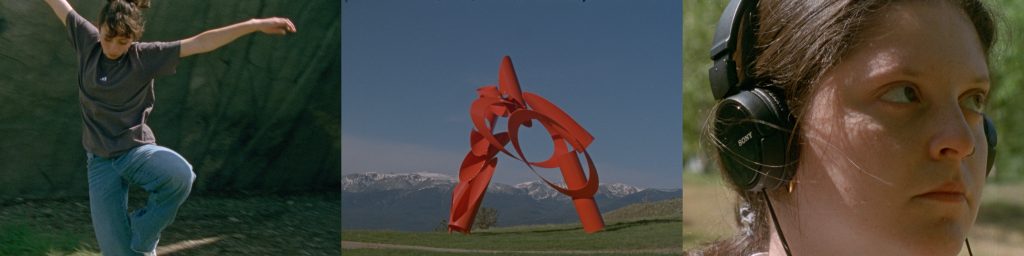
That question guides his work. His ongoing kaze no e project with the tree marks is one example. Another is his short film electric moonlight & the language within the leaves. The film is a modern retelling of the Japanese folktale “The Bamboo Cutter and the Moon Princess,” in which an Earth-bound princess longs to find her way home to the moon. To tell that story in the Ecocene, Suzuki imagined that the trees, reaching ever upward and skyward, would hold that knowledge.
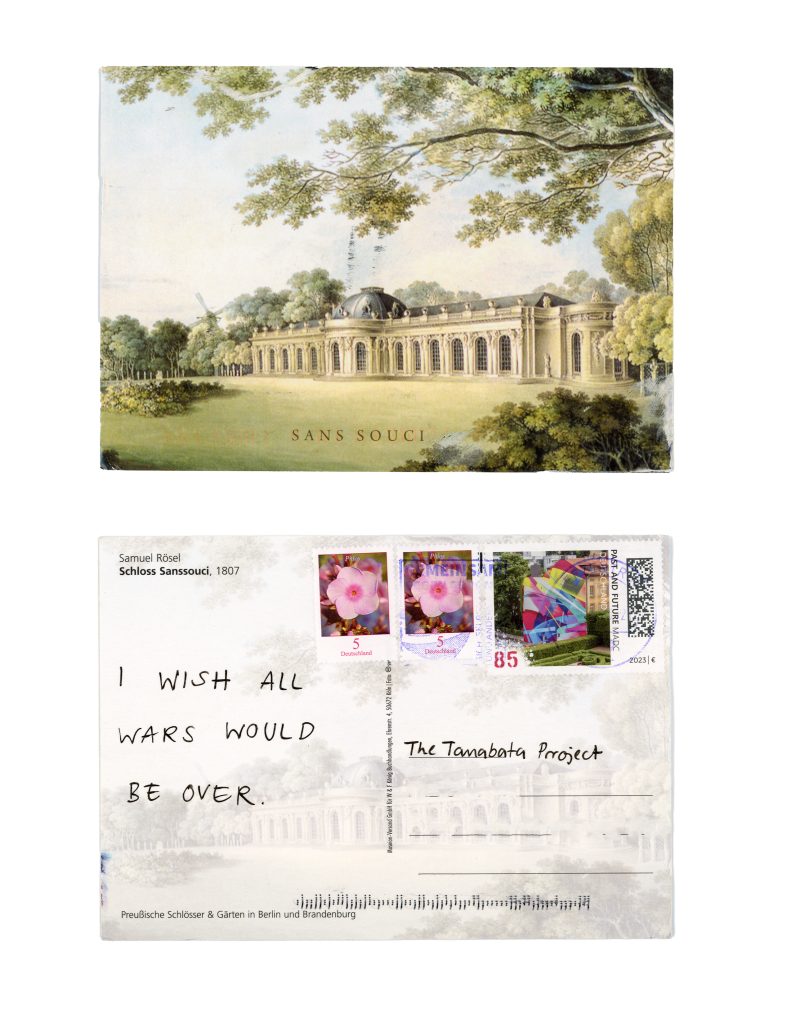
His Tanabata project borrows from the Japanese festival of the same name, when people write down one wish and hang it from a tree. The idea is that the wind carries the wishes to the deities to be read and granted. Suzuki is asking people to mail him a postcard with one wish that will become prompts for artwork or a form of wish fulfillment, he said.
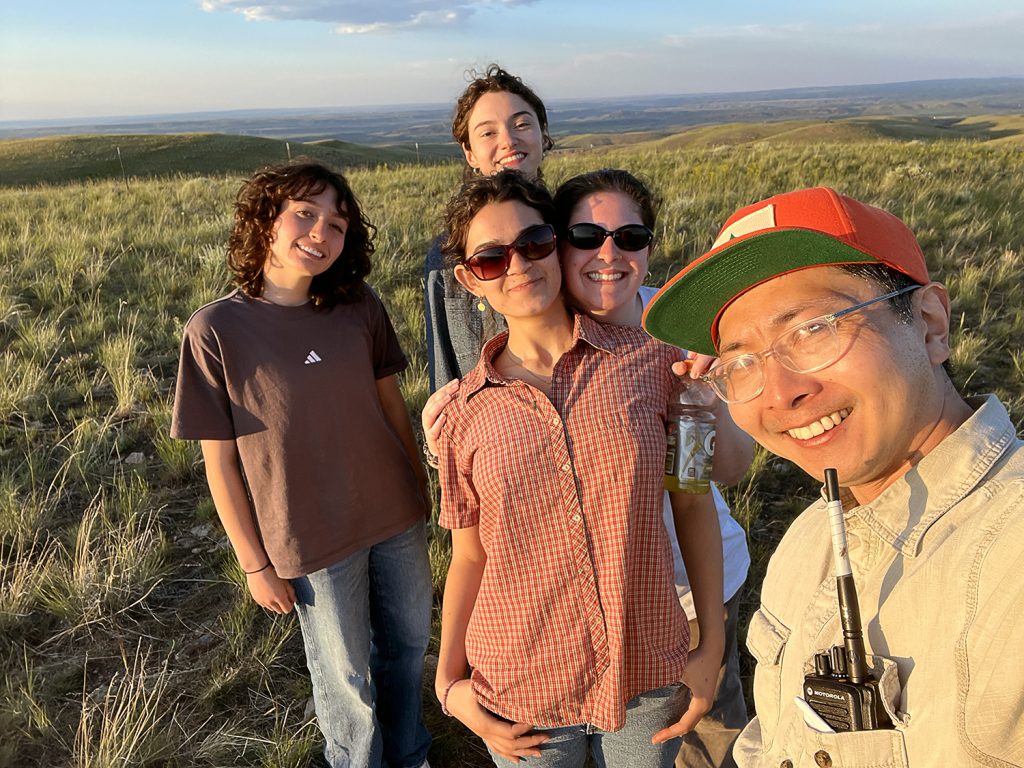
Suzuki’s well of ideas never seems to run dry. “I think that’s the one wonderful thing about the creative arts—you’re not really bound to any particular field,” he said. That couldn’t be truer for this filmmaker. “What I’m interested in,” he laughed, “is everything.”
When simply living is art
Suzuki is also curious about how artificial intelligence views the climate crisis. As a current fellow at Colby’s Davis Institute for Artificial Intelligence, he’s undertaking a yearlong project to capture what AI thinks of the Earth’s future by exploring how large language models that power AI are understanding what is happening in relation to the climate.
Every day since Jan. 1, 2025, Suzuki has used ChatGPT to prompt AI to predict how long the Earth will be habitable. And every day, AI gives the year when the Earth will reach a tipping point. As he tracks how that date changes, Suzuki also asks AI to generate short fiction tales of the planet’s future features. Those stories provide inspiration or guidelines for artworks he creates that reflect AI’s vision of the future.
Suzuki is also considering the environmental impact of his AI usage during this project.
Each day, he also asks AI what the carbon footprint of running each prompt is and how long he will need to stay offline to offset it. At the end of the project, on Dec. 31, he will tally up that time, go offline, and not use electronic devices for that length of time. He estimates two or three months.
This is performative artwork, where the act of living is the art.
“It’s this idea of asking, what does it mean not to be visible, or engaged, or just offline for three months as an art practice,” he said. Especially for him, a digital media artist, the project considers an actual lived experience as a “digital practice” or as an extension of a digital practice.
Suzuki won’t communicate or document this part of his project. “I think that’s the intrigue or charm of it,” he said. “Only I would know, or maybe people who run into me during that time would know.”
In our modern culture, the act of eschewing electronic devices may seem radical. But while Suzuki is offline, his circle will be smaller, and, like the trees, interconnected, human to human.