The Art of an Art Exhibition
What’s unseen in the Senior Art Exhibition is the technical work students accomplished to bring it to life
Art exhibitions are works of art in and of themselves. The selection and arrangement of artworks in any gallery result from the creative collaboration of artists, curators, and preparators.
“Art exhibitions don’t happen magically,” said Jacqueline Terrassa, the Carolyn Muzzy Director of the Colby College Museum of Art, at a recent exhibition opening. “They come together in space through a process.”
Seventeen Colby seniors now have a firsthand understanding of that process. As studio art majors, they have learned the art of an art exhibition through the Art Department’s yearlong capstone course. The result is the Senior Art Exhibition 2025, on view at the Joan Dignam Schmaltz Gallery of Art in downtown Waterville through May 24.
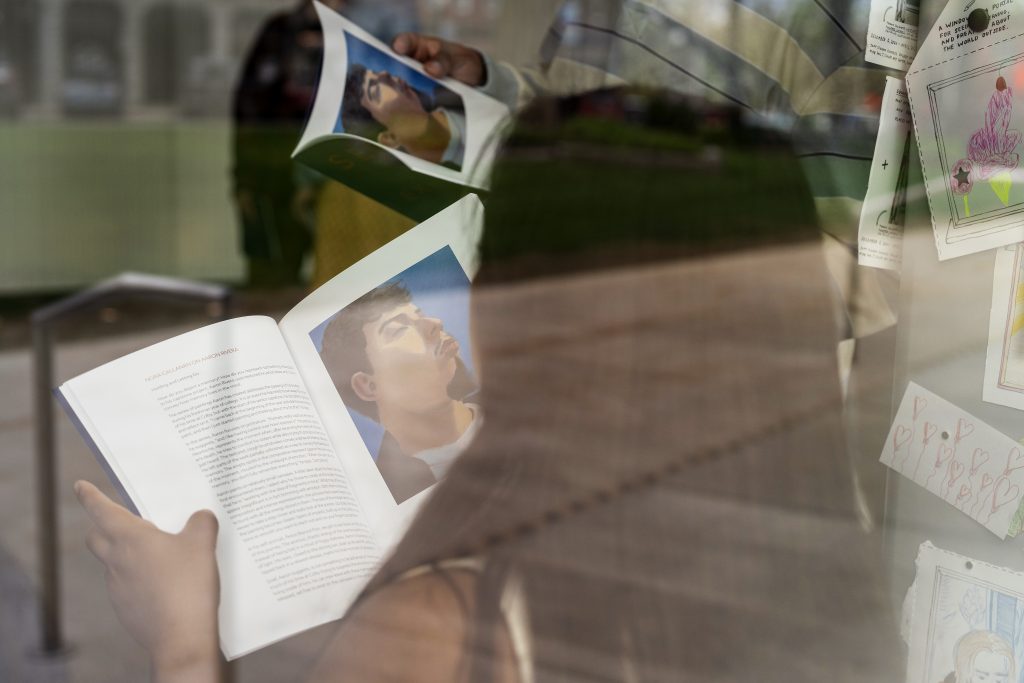
The exhibition showcases the work of the 17 students—four sculptors, two photographers, three painters, five printmakers, and, for the first time, three digital media artists. A catalog accompanies the exhibition, containing artist statements, photographs of the artworks, and critical essays written by students enrolled in this year’s Contemporary Art Criticism course.
“Participating in our studio capstone, accompanied by two upper-level studio courses, is a formidable challenge on the part of our students,” said Professor of Art Gary Green, this year’s capstone coordinator. “It shows great commitment to each one’s art and craft.”
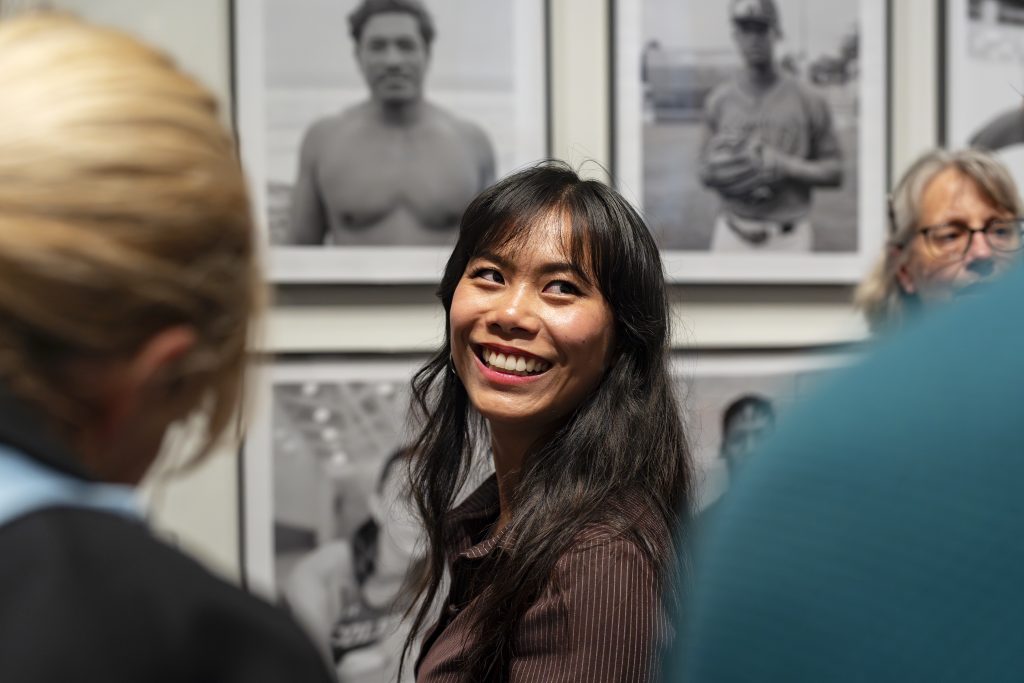
The exhibition is held in the Colby Museum’s satellite gallery for the second year. The downtown location broadens the audience and lends a contemporary, urban vibe, “almost like any New York or contemporary gallery,” said Green, who is retiring at the end of this academic year.
On May 8, the exhibition opened to a large, eager crowd.
“It’s a beautiful show,” said the professor, feeling pride and relief. “It’s exciting to see their work finished and properly mounted.” In other words, “done right,” he said.
The capstone experience
This year’s exhibiting artists are seniors Emily Alford, Michelle Bechtel, Drew Bennett, Jana Berry, Jamie Fiedorek, Isabel Grimes, Seung Yeon Hong, Zoey LaTour, Ellie Mackle, Fiona Mejico, Aaron Rivera, Eric Seaman, Keon Smart, Hannah Soria, Anna Staton, Grace Yang, and Jenifer Zanabriga.
These students worked in their respective studios through much of the fall semester. Green kept them focused on developing an artistic practice to produce work for the exhibition and the catalog. They had one mid-term critique and weekly group meetings where they talked about assigned readings, watched art-focused videos, and discussed what it means to be an artist.
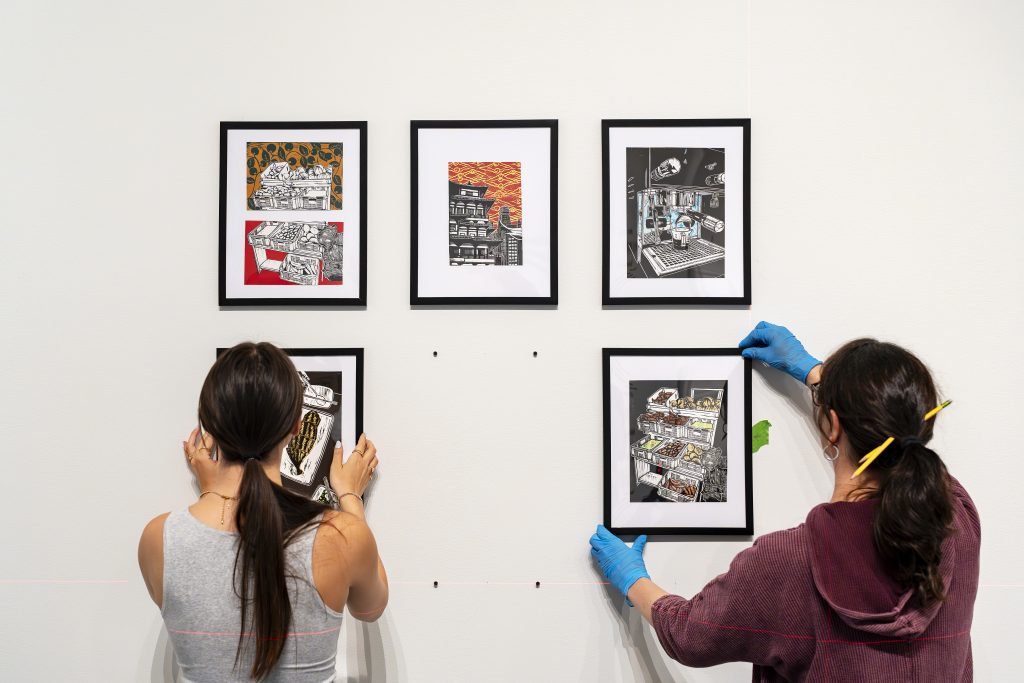
Students worked closely with museum staff throughout the year and more intensely in the spring semester. They did walkthroughs of the gallery, communicated expectations, reinforced rules, and determined the best way to hang each student’s work. Students developed an installation plan, had their artwork photographed for the catalog, prepared it to be moved downtown, and much more.
Green said the process was the most organized and hands-on it has ever been.
Museum staff members Gussie Weiss, Juliette Walker, Chris Patch, Danae Lagoy, and Ryan Ridky “were on top of it,” said Green. “They were great and helped enormously,” which was especially useful with so many students enrolled in the capstone course.
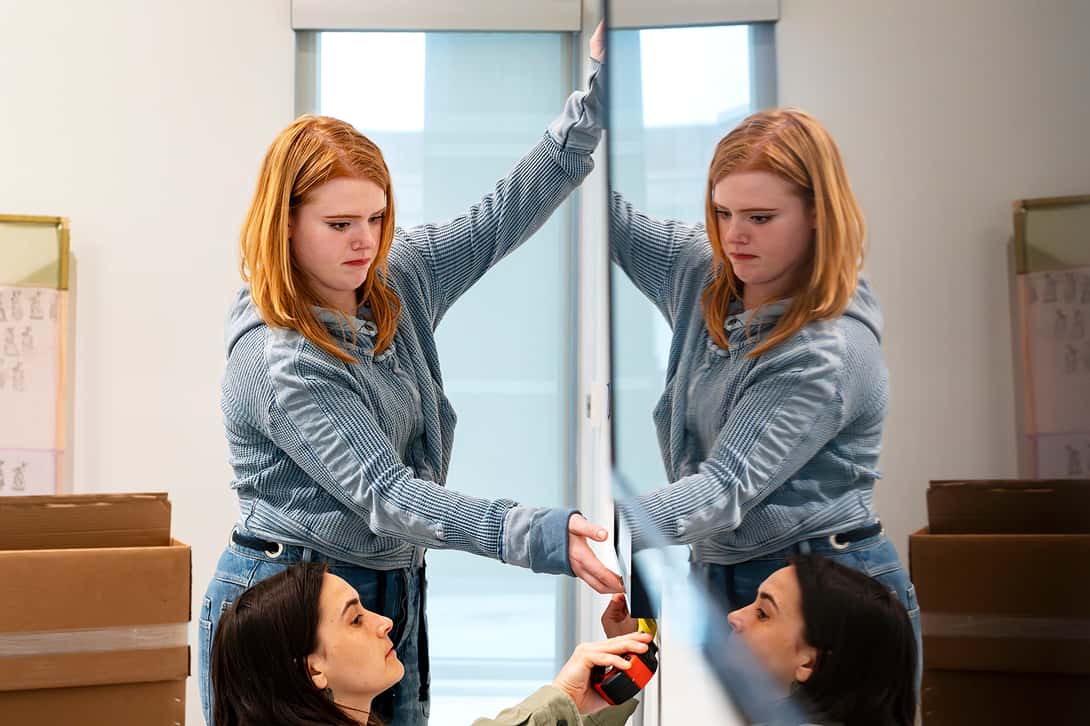
When it was time to install the exhibition, students signed up for slots to work directly with museum preparators in the gallery. Here, they learned about laser leveling, double-sided tape to hang labels, and other best practices.
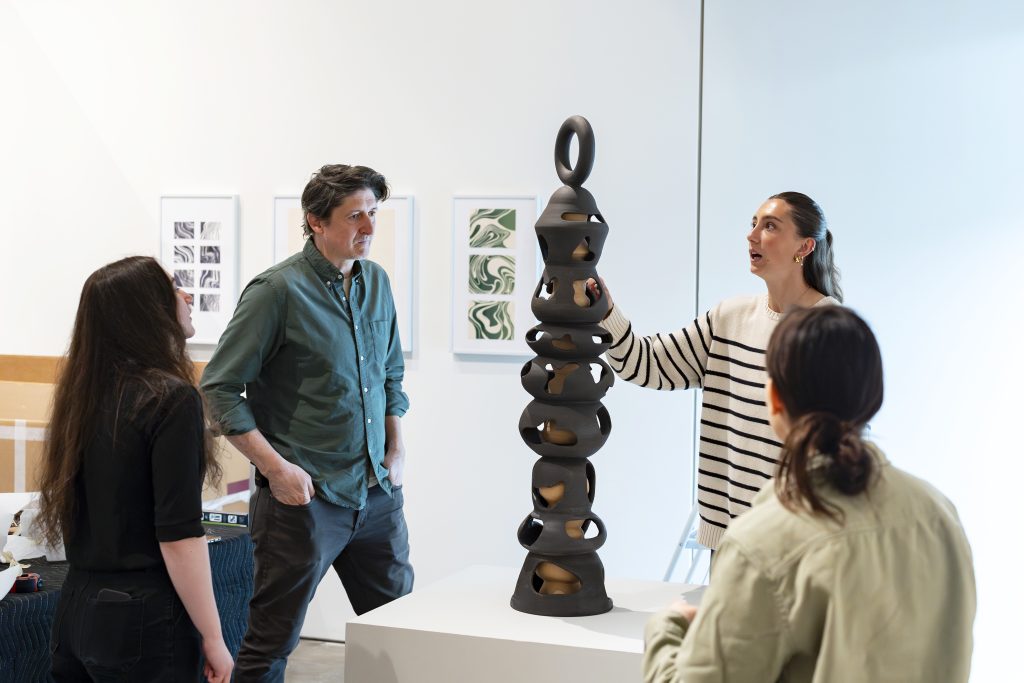
When the installation was complete, students stood back and savored the results.
“It felt rewarding to share my work alongside other senior artists,” said painter Jen Zanabriga ’25, “because the space was something we came together to build over the course of our senior year.”
“It was really gratifying to see my work, and that of my peers, so professionally displayed,” printmaker Hannah Soria ’25 said after the exhibition’s opening. “I was so excited to have so many people and friends there to see it.”
The Pepper Prize
In the heart of the gallery, Soria’s freestanding piece Worn Paths sits gently on a podium. It invites visitors to orbit its folded-paper form, warm reds and oranges on the inside, a deep blue on the outside. Her Remembering I’m Forgetting work hangs nearby, with rows of progressively obscured prints speaking to the passage of time.
“These works specifically are in response to memories and nostalgia,” said the senior, double majoring in studio art and computer science. “And art is really the only way I feel I can express how I relate to these feelings.”
Soria used disposable, polyester lithographic plates to make her prints. “After a number of prints, the plate degrades, and ink accumulates in unintended locations, overrunning the images,” she wrote in her artist statement. “This effect, though typically unwanted, embodies my ideas and intentions. As I repeatedly print imagery, the ink unpredictably clouds the plate like how my memories seem to sporadically dissolve.”
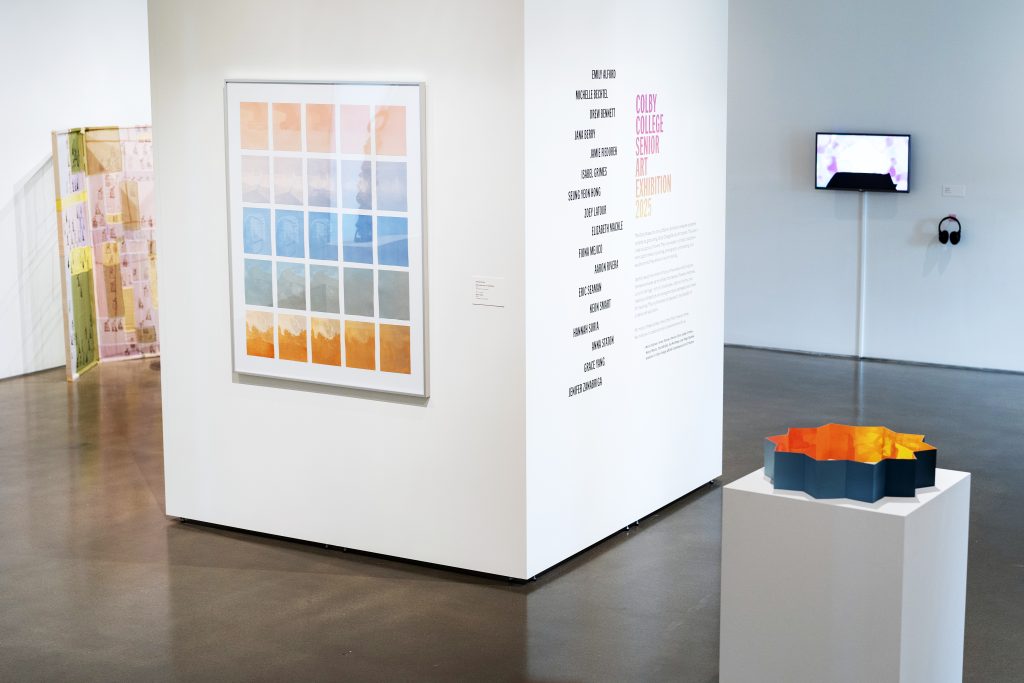
The process required patience and a willingness to work through roadblocks. “I just kept continuing to create, write, and sketch, and the ideas and work started to become clearer.”
Her efforts were recognized at the exhibition opening when she was awarded the Art Department’s Charles M. Hovey Pepper Prize for meritorious creative work.
“I was totally shocked when I won the Pepper Prize,” said Soria. “I worked really hard this year and throughout college on my printmaking and creative practice. My work is very personal, and it was validating to be recognized for work that is so dear to me.”
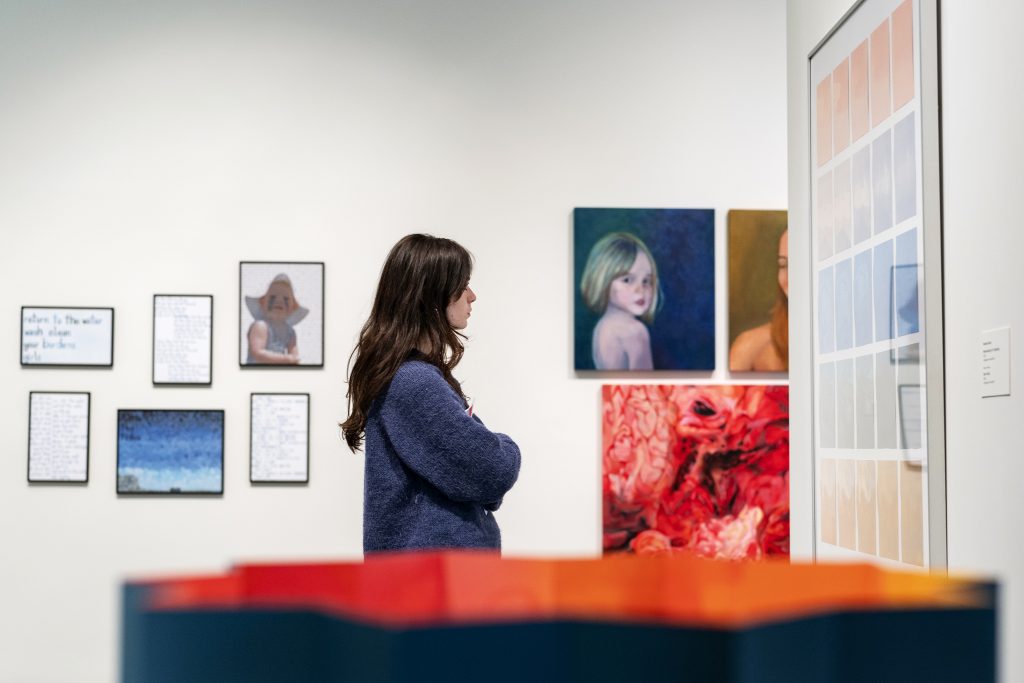
This year’s judges were artist and curator Ann Bartges, painter Alan Bray, and Andy Versoza, executive director and curator of the Stanley-Whitman House.
Soria finds art-making valuable as a way of communicating with herself and the world as she experiences it. She also co-curated the LC Bates Museum 2025 summer show, Gardens. As she prepares to attend the University of Colorado Boulder’s engineering school to earn a master’s in creative technology design, she is grateful for her Colby experiences.
“I just want to thank all of the Colby Arts people, Professor Amanda Lilleston, the rest of the Colby art professors, and my printmaking peers for their involvement in making me the artist I am now.”
The President’s Prize
The series of six oil paintings Zanabriga prepared for the exhibition combines real-world objects with elements from her imagination. The surrealist subjects embody her Oaxacan-Mexican heritage and draw on inspiration from the artist Frida Kahlo.
In her largest work, Conceded Acknowledgement, Zanabriga has painted herself as a bright-faced child holding up a human heart, a flower sprouting from its aorta. As blood drips down the child’s arm, a brain with a probing eye descends to observe.
In her smallest, Cerebral Bloom, human fingers hold a small blossom. At first glance, it looks like the blossom of a common clover. A closer look reveals the blossom is a human brain with nerve filaments reaching outward.
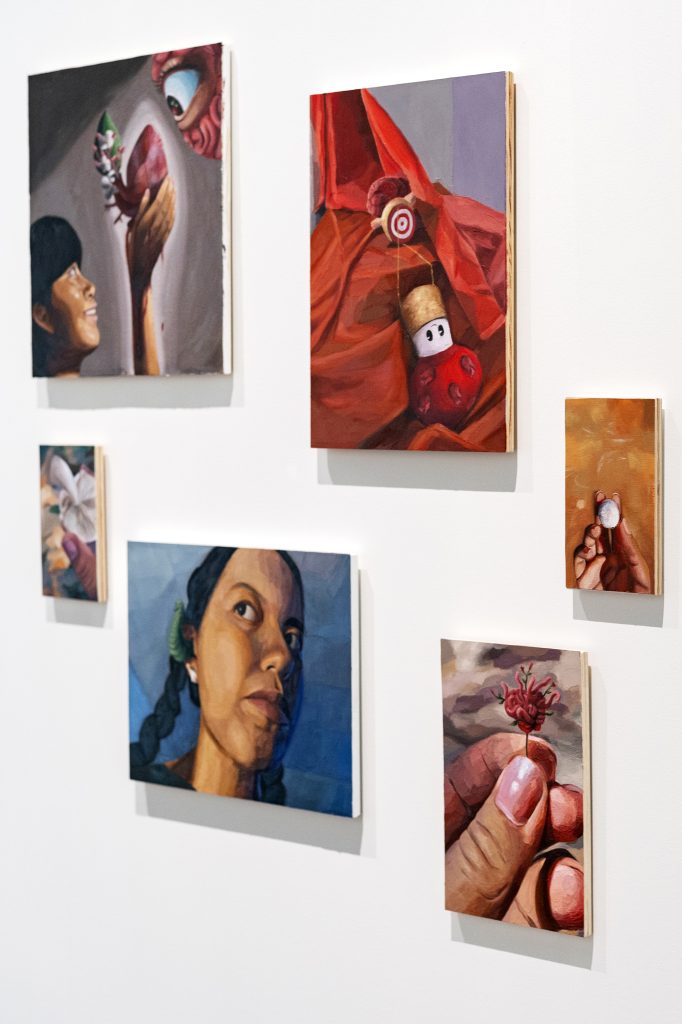
As Zanabriga worked on the series this year, she had to learn to trust the process and stand in her truth. In discussions with her teacher, Professor of Art Bevin Engman, she “often found myself doubting the direction of my work and regaining inspiration at the same time. It was a challenge to balance the technical aspects of my art-making process, knowing what I wanted to paint and express while trying to gauge if it was within my abilities to do so.”
The judges certainly found her capable. They awarded her the President’s Purchase Prize, which honors exemplary efforts within the studio practice and is given to a student who shows promise and potential as an artist.
Zanabriga was astonished that she won.
“The series I created was an intimate and vulnerable endeavor, based on experiences that I had reflected on since my sophomore year and just recently had begun sharing with others,” said the senior, double majoring in studio art and anthropology.
“I feel validated as an artist.”
Jenifer Zanabriga ’25
“Having spent many hours on my work and taken seven semesters of painting, it was special to receive this recognition. A recognition that inspires me to continue nurturing my passion for art.”
The role of art-making in her life has changed, from developing a skill to “a space for personal self-exploration and expression,” she said. While she doesn’t have immediate plans after graduation, she hopes to find a career to apply her dual passions for anthropology and art.
“There’s much to be explored beyond an expression of myself,” she said. “Art to me is an expression of my voice that I hope resonates beyond an individual self and with a larger collective.”