‘Write Your Own Story’
Colby Welcomes Class of 2030 to Mayflower Hill with 209th Convocation
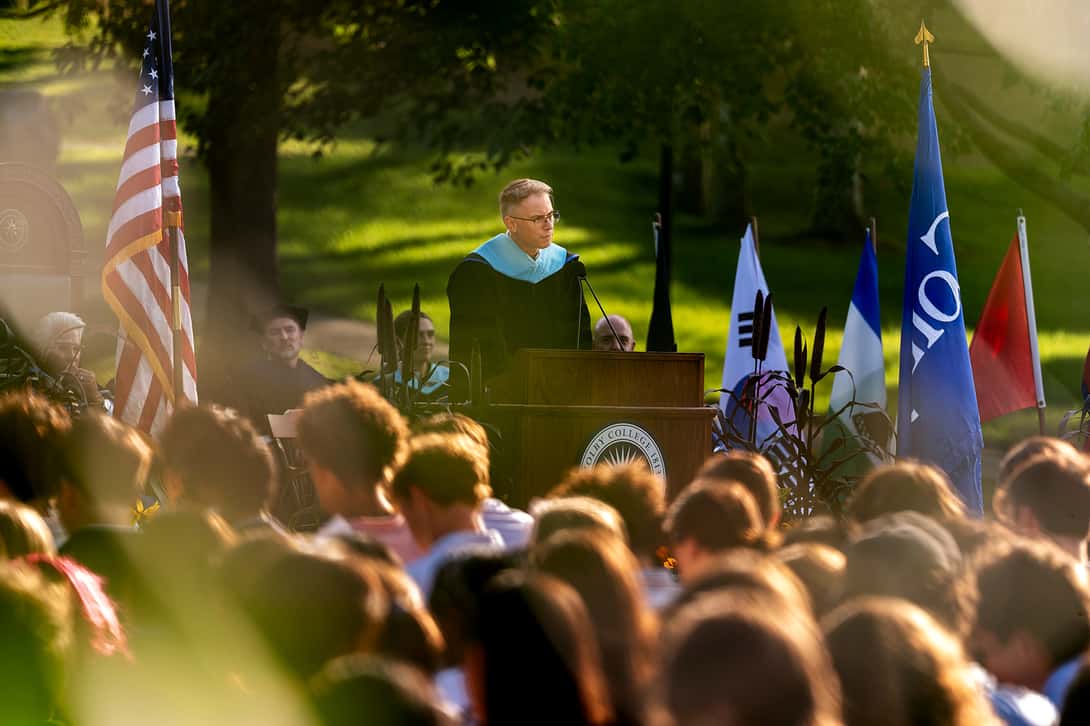
President David A. Greene welcomed the Class of 2030 to campus and encouraged Colby’s newest cohort of students to take intellectual risks, spend time with challenging ideas, and seek support when needed.
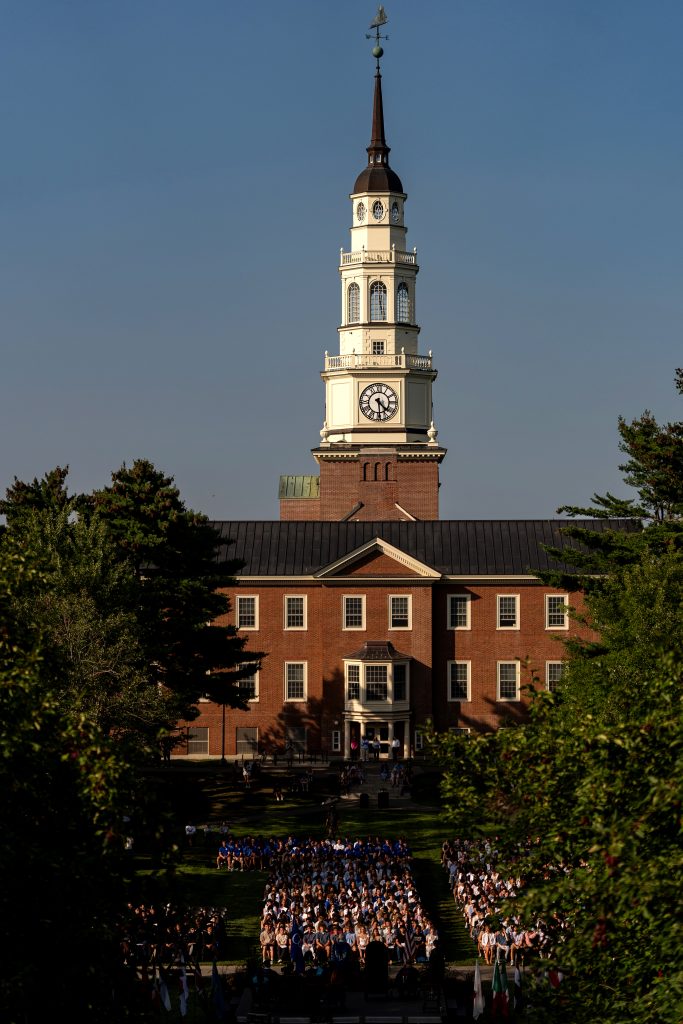
Addressing students at the 209th Convocation on the Lorimer Chapel lawn Sept. 8, Greene also urged them to author their own stories throughout their college years and beyond. Doing that, he said, is one of the gifts of a great education.
“Don’t let anybody write your story for you,” the president said. “Find a story that’s authentic to who you are, that’s true to your values, and use that as a way of going into this next story of your life at Colby and into the rest of your life to do things that really matter.”
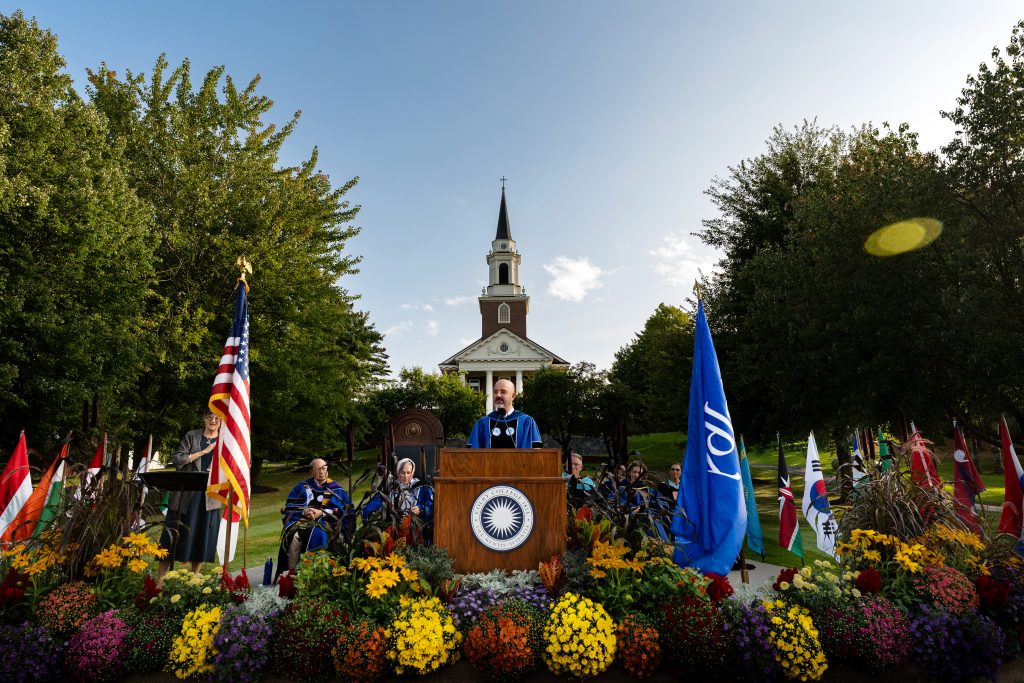
At just over 680 students, the incoming class is the largest in Colby’s history. For many of its members, it’s likely that they don’t yet know what they will major in or what they want to do after graduation. That’s a good thing, Greene said.
“Let that come to you. Use this as a time of exploration. Use this as a time for deep thinking and hard work. Do not feel like you have to have all the answers now,” he said. “It’s about those unexpected turns where suddenly you find something that is absolutely revelatory in your life that you never expected. You will miss those if you try to chart that clear path, when so much of the beauty is in the twists and the turns.”

‘A world of possibilities’
Arnout van der Meer, associate professor of history, gave the welcoming address, in which he described the array of choices that lay before the students. It wasn’t like that when he was a new student at a university in the Netherlands, he said. Before he began his studies, he chose the academic path he wanted to take, a path that turned out to be very narrow. He chose to study history, and in four years he took only two electives.
“That is a lot of history. But here you are with a world of possibilities in front of you. Unlike me, you can try a geology class, physics course, writing class, or a history course and see what you are passionate about,” van der Meer said, adding that they have 48 majors and 38 minors to choose from. “This freedom might feel scary to some of you, but I’d encourage you to think of it as an opportunity. An opportunity to explore who you are, what you find interesting, and who you want to become. It is also an opportunity to see and understand the world from different perspectives and academic disciplines.”
Van der Meer recently spent four months doing fieldwork in Southeast Asia, studying everyday resistance to colonial rule. When he got to Indonesia, he found a new resistance movement underway, this one against the whitewashing of the legacy of former President General Suharto, an authoritarian strongman who ruled the country for 32 years.
Many Indonesian students are pushing back on the current government’s declaration of Suharto as a national hero, the professor said.
“For me, this experience underscored the importance of a college education. It is worrying to observe the extent to which history is weaponized as a tool of political manipulation, deliberately misconstrued, willfully ignored, and whitewashed, rather than seen as something to critically understand, explore, and discover,” he said. “These Indonesian students showed me the value of critical thought. This, too, is an opportunity Colby provides. Regardless of discipline, critical thinking is at the heart of every liberal arts education.”
Just like the students he met in Indonesia, Colby students will learn to think critically, challenge assumptions, ask difficult questions, ponder complex answers, wrestle with ethical dilemmas, and do the hard work of inquiry.
The value of critical thinking
This is important because the major challenges of our time, such as climate change, political instability, artificial intelligence, and war and peace, are complex, and people will need an interdisciplinary mindset to understand and help solve them.
A liberal arts education will help with that, van der Meer said. Artificial intelligence, on the other hand, may not.
“Where strongmen distort facts for power, AI tempts us to replace deep thinking with convenient shortcuts,” he said, before sharing a story from his own life that demonstrates the fallibility of AI

In Indonesia, van der Meer contracted dengue, a mosquito-borne fever that can be severe and even life-threatening. At first, though, he didn’t know what was causing his fever, weakness, and painful eye movements. So he asked ChatGPT for help.
The chatbot was initially reassuring, telling him that his symptoms were likely caused by dehydration, heat stress, and muscle recovery strain. As he grew sicker, ChatGPT came up with many other explanations, including hepatitis and liver failure. Finally, van der Meer realized that the right answer was simply to go to a doctor. The tropical medicine specialist he visited determined that van der Meer was in the most dangerous phase of a dengue infection, then prescribed medicine that allowed him to start recovering.
“AI absolutely has its uses, but it is no substitute for human skills and experience,” van der Meer said. “It is hard work to acquire true expertise. There are no shortcuts. This is a lesson for all of us. The true value of our education, a Colby liberal arts education, lies in the things we learn and carry with us that help build our own expertise.”
Building community through coffee dates and care
He finished his speech by encouraging the new students to find ways to be part of their new campus community, and challenged them to invite a friend, classmate, or professor to join them at the Mary Low Coffeehouse during their first month on Mayflower Hill.
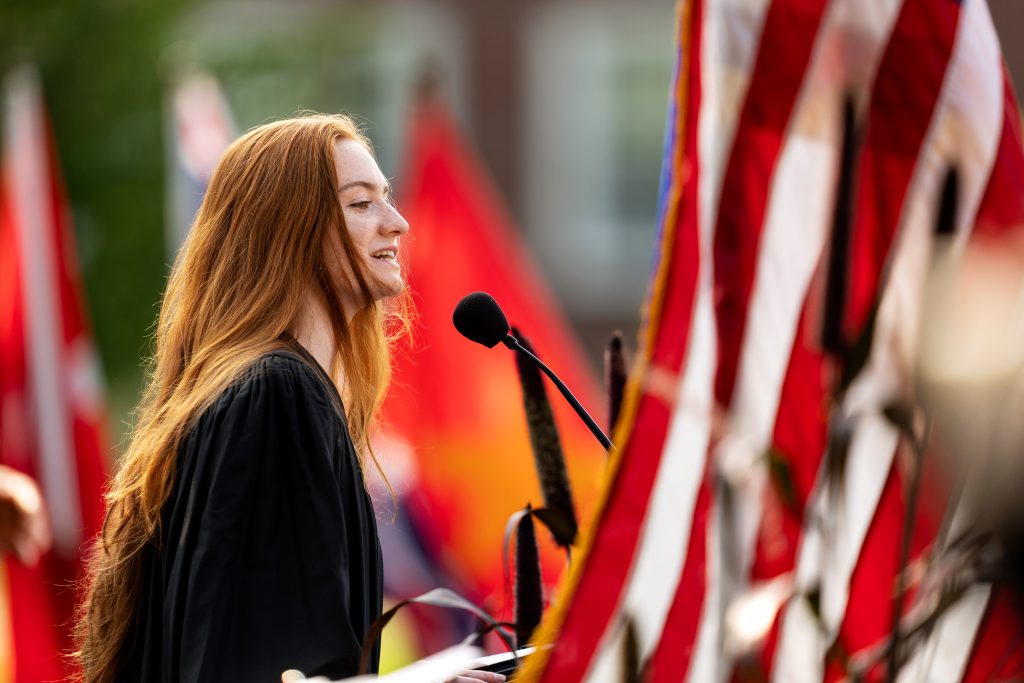
“Do the work of getting to know each other, build your community, and welcome to Colby,” he said.
The Class of 2030 also heard from Aubrey Costello ’27, president of the Student Government Association, and Jed Swan ’28, vice president, who shared practical advice for settling into college life: call home once a week; go out responsibly on weekends; go to the doctor when you’re sick; and remember to say thank you.
“Call your parents, go out, take care of yourself, and most importantly, take care of each other,” Costello said. “I promise that you all have so much to look forward to here. As you look ahead, I’m confident that you will find the very same sense of friendship, love, and joy that I have found here on Mayflower Hill. Welcome home, Class of 2030. I’m so glad you’re here.”


