‘You Are the Author of Your Own Life Story’
Bassett Teaching Award winner Dan Cohen tells graduates that becoming who you are is a lifelong project
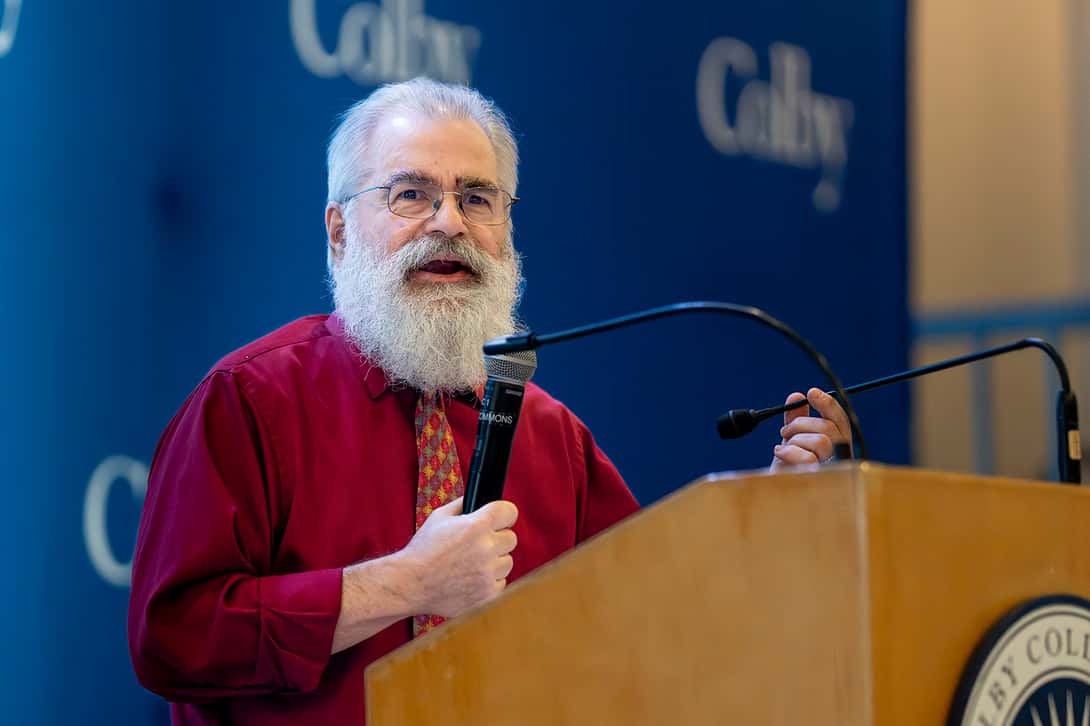
Dan Cohen presented graduating seniors of the Class of 2026 with a freewheeling tour de force during the annual Last Lecture, making his audience laugh out loud as he meditated on some of life’s biggest questions.
Those included one that has dogged philosophers for millennia: how does a person answer the query, “Who am I?”
Cohen, a professor of philosophy and winner of the 2026 Charles Bassett Teaching Award, told the students who packed the Page Commons Room on May 19 that there is no single answer and no shortcut to figuring it out.
“My training as an analytic philosopher won’t let me offer up, ‘be yourself.’ That kind of platitude is too trite for a last lecture,” he told students. “I think we should upgrade the advice to be yourself to become yourself. And that’s a lifelong project. You are the author of your own life story, and it doesn’t get finished in your lifetime.”
Coming full circle
For Cohen, who graduated from Colby in 1975, delivering the Last Lecture was particularly meaningful given his own story. As a student, he took classes from Bassett, the late Lee Family Professor of American Studies and English. As a professor, he taught alongside Bassett. And as the recipient of the Bassett Award, chosen by a vote of the senior class, he centered the lecture on Bassett, who retired in 2000 and died 10 years later.
Because of Bassett, Cohen learned a lot about how to be a good teacher—though the lessons weren’t simple ones that could be copied and pasted into his own classroom. In fact, they raised more questions about how to be and who to become.

“There was something really puzzling going on about Bassett as a teacher, because while everyone agreed that he really was this terrific, inspiring, effective teacher, no one was quite sure how or why he managed to be so good at it,” Cohen said.
Bassett was deeply knowledgeable, enthusiastic, and passionate about his subject. He was also engaged with his students and didn’t see learning and teaching as two separate activities but rather as a single, shared, collaborative endeavor. He also helped Cohen find his voice as a young writer.
But he was also a deeply idiosyncratic professor known for having no sense of personal space and for yelling at and creatively insulting students who had not done the readings. This inspired campus-wide imitations that Cohen was delighted to share with the graduating seniors.
“He couldn’t contain himself. He turned bright, splotchy red, and he would explode. ‘You! You! You toads! You haven’t done the reading!’ And we would cower, and be ashamed of ourselves, and eat it up,” Cohen recalled, his normally soft-spoken voice rising to an enthusiastic roar on the word ‘toads.’ “We could barely wait to get back to the dorms and share with each other. ‘Guess what Bassett called us today!’”

A loving homage
The lecture was a loving homage to a man who left campus years before the students in the room were born. But it was more than that, too. As Cohen deftly wove philosophical insights in with his memories, he described a way of being that Sofía Escobar Amaya ’26, an art history and philosophy double major, recognized as a road map to an authentic life.
“Graduation is a moment when it is nice to be reminded that life doesn’t stop being interesting at age 22,” she said after the lecture. “And Professor Cohen reminded us, with ample philosophical substance, that ‘who you are’ is a trick question, because there is no one, fixed answer to it … instead of telling us to be ourselves, he told us to become ourselves.”
Amaya, who took several classes from Cohen, said that while his logic, analytic philosophy, and other courses are not easy, they are worthwhile. She’s learned a lot from the professor, who she said is very kind, makes witty puns, and brings a gavel to class because he is so quiet that he sometimes needs it to get the students’ attention.
“He carries the wisdom of four decades of teaching the love of wisdom, and I am delighted that his contribution to the Colby community was recognized,” she said. “I thought the Last Lecture was incredibly sweet. It was very full circle, because Professor Cohen was taught by Charlie Bassett at Colby, later on taught with Charlie at Colby, and now is the recipient of the Charlie Bassett Teaching Award. … I might be biased, but I can’t think of one other person to whom this would’ve meant more than it does to Professor Cohen.”
Becoming who you are
Cohen drew on his own life to explore his questions about becoming who you are. What connects him now—distinguished, gray-bearded—to his younger selves, including the starry-eyed Colby freshman of 1971?
“What makes me the same me that I’ve been in the past? And I also am connected somehow, in ways I’m still figuring out, to my future selves that are yet to be,” he said. “What is important about me? Not just wanting to be the same me, but why should I care about the me’s in the future? How can I become the best version of me that I can?”

Part of the answer to that lay in another story about Bassett, this one set at a faculty meeting when Cohen was a junior, untenured faculty member. The topic at hand concerned the College instituting a policy of merit raises for faculty and the administration’s decision not to release any data on the distribution of raises. The meeting got heated, and the dean of faculty stood to defend the policy.
“In a long, drawn-out, soothing, and even soporific monotone, he droned on, and on, and on about the reasons why releasing the data would generate little gain but have significant negative consequences. It would be unnecessarily divisive. It would generate a lot of anxiety. There would be a lot of resentments and the like. And on, and on,” Cohen recalled. “And the faculty was lulled into a kind of silent torpor when he sat down. Until from one corner of the room came a thunderous, ‘BALDERDASH!’ And just like that, the spell was broken.”
It was Bassett, and no one but he could have pulled that off. Who even uses the word “‘balderdash?” Nobody says that word out loud. But Bassett did.
“It was spectacularly perfect,” Cohen said. “It was just the right word, at just the right time, with just the right person. It was Charlie being Charlie, just cutting through this huge pile of BS that the dean had shoveled in our direction. But Charlie being Charlie wasn’t just some happenstance. Who he was was something that he made himself to be.”
Writing your own life
Bassett had created the identity of “Mr. Colby,” Cohen said, and became so comfortable with it that it was hard for him to become anything else. For years, Bassett wrote a column for the Colby Echo titled “I’m Never Going to Retire,” and it wasn’t ironic. When the time came for Bassett to write the next chapter in his life story, it wasn’t easy for him to do so.
In short, Bassett needed someone to yell at him, “You toad!” Cohen said, adding that he brings it up not just because his own transition into retirement is not too far off, but because the seniors’ transition into the next stage of their lives is even more imminent.
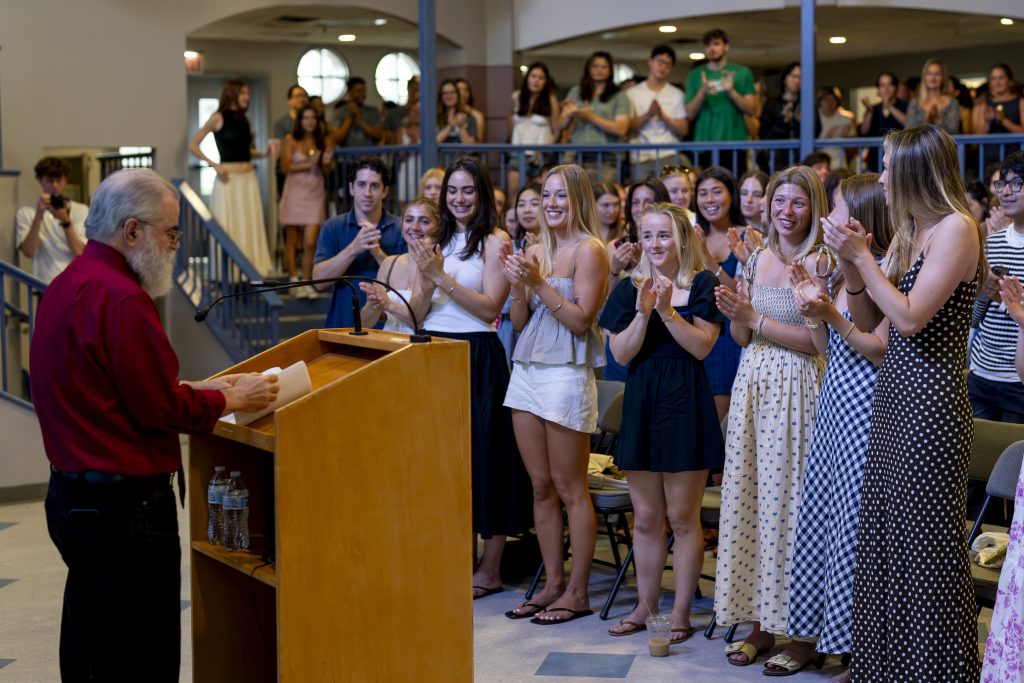
“You don’t get to passively read the next chapter of your life. You have to actively write it,” Cohen said. “What I wish for you is that first you have the great good fortune to have someone, or at least a voice in your head, calling you a toad when you need it. And second, that you have the gumption to shout back, ‘balderdash!’ when that’s what you need.”
Because in the end, he said, when it comes down to writing your own life, the pen is in your hand.


