‘You Get to Be an Explorer’ at Colby
During convocation, the Class of 2029 is urged to take advantage of all the College offers
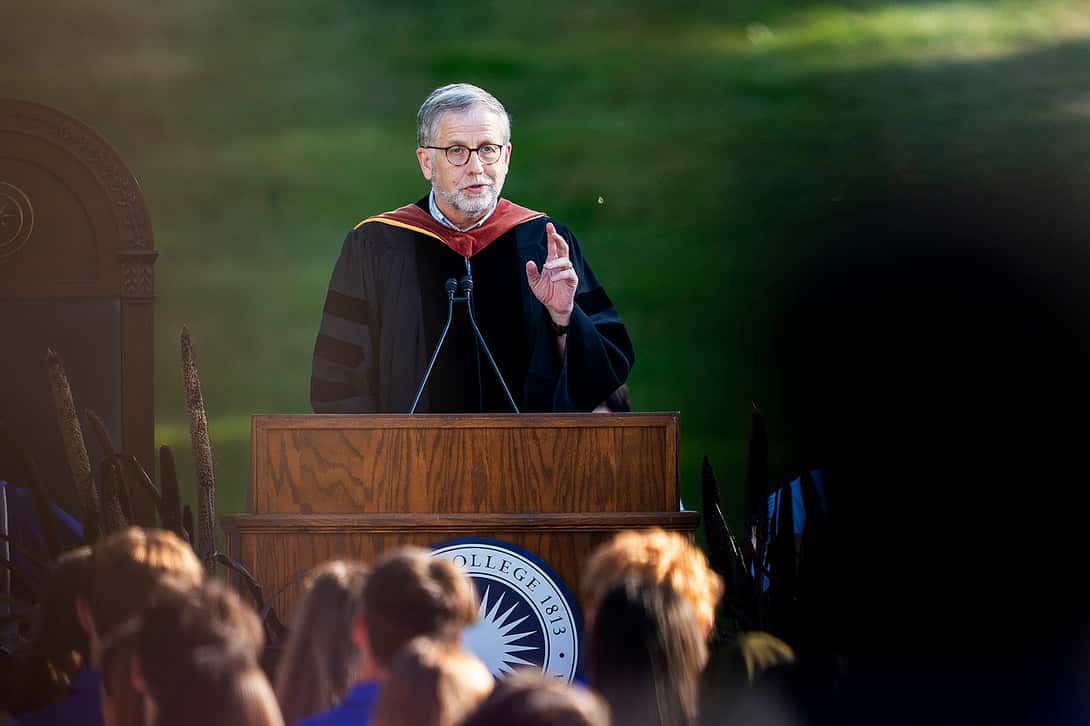
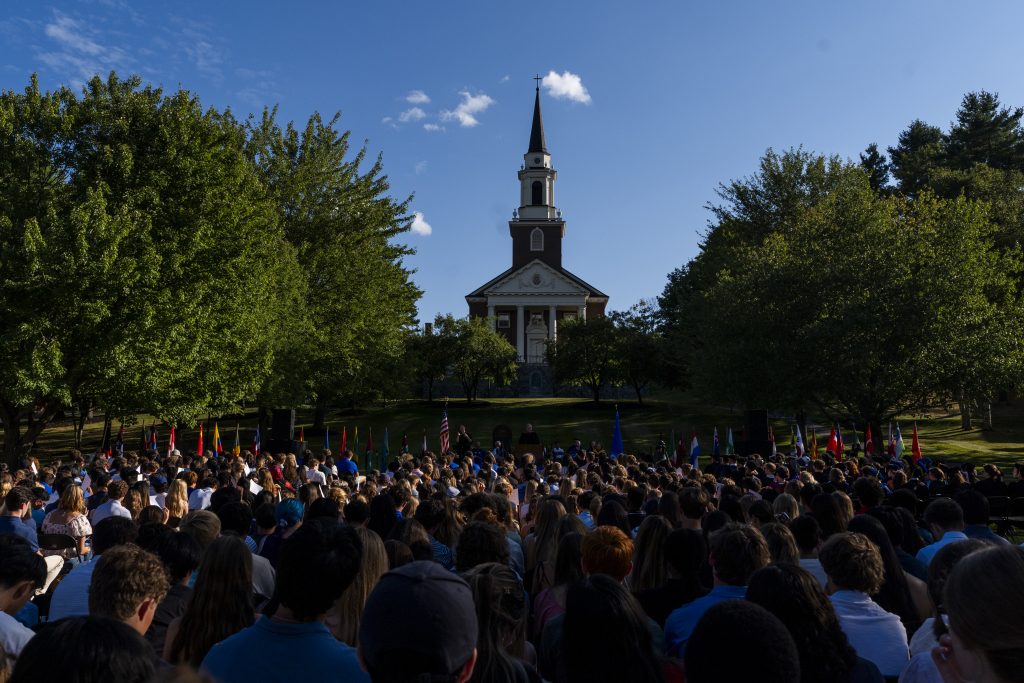
The sun shone brightly as Colby officially welcomed the members of the Class of 2029 to campus with a call to spend the next four years exploring new paths and possibilities so that they can better find their own way forward.
During the 208th Convocation on the Lorimer Chapel lawn Sept. 2, President David A. Greene encouraged the students in the incoming class to get out and experience their new home by going to a sporting event, a music performance, a research presentation, or a faculty member’s book talk. Such activities will give them a sense of belonging and help them feel more at home here, he said.
“The more that you explore this place and you start taking advantage of all the different things that are happening on this campus, the more you’ll start to become embedded in this place to feel like you own it—that this is your place,” Greene said. “The beauty about being at a college like Colby is that you get to be an explorer. If you take it as your mission to keep exploring, you’re going to keep uncovering new things. You’re going to grow in ways that you never had imagined before.”

At nearly 640 students, this year’s class represents 41 states, two U.S. territories, and 56 countries. The students were selected from 20,144 candidates, the largest and most competitive applicant pool in Colby’s history.
Although it is likely hard to imagine right now, their four years at the College will go fast, the president said.
“There’s something that’s really powerful about this place and its staying power in the hearts and the minds of people who have been here,” Greene said. “And I hope you have a chance to experience that and find that out for yourself.”
A polymathic approach to learning
Michael Donihue ’79, the Herbert E. Wadsworth 1892 Professor of Economics, gave the welcoming address, assuring the students that there is a place for them at Colby.
They are part of Generation Alpha, he said, which is the first generation to have lived their whole lives in the 21st century. It’s also a post-Covid-19 generation characterized by a deep immersion in technology and a coming-of-age during the rise of artificial intelligence. During a time when there is no dearth of podcasters and essayists wondering about the role of colleges today and whether Generation Alpha students are ready for higher education, Donihue used his talk to discuss the promises and possibilities of a college education in general—and a Colby education specifically.
For Donihue, who served until recently as interim director of the Davis Institute for Artificial Intelligence, what sets Colby apart from other institutions is the College’s polymathic approach to learning.
“Throughout history, a rare few individuals, with a burning curiosity about humans and their relationship to the natural world, acquired knowledge and expertise that transcended disciplinary boundaries,” he said. “In doing so, they made lasting contributions to the natural and physical sciences, philosophy, the arts, and society. These people became known as polymaths.”
They include famous names like Galileo, Leonardo da Vinci, and Benjamin Franklin, as well as less-recognized scholars such as Ibn al-Haytham, a medieval mathematician and astronomer of the Islamic Golden Age who developed an understanding of the way humans perceive light, and Hildegard von Bingen, a 12th-century German nun who was a visionary, composer, author, philosopher, healer, and mystic.
“These transdisciplinary thinkers left an enduring mark on culture and our understanding of the natural world,” Donihue said. “Their legacies remind us that our most profound insights often emerge when ideas collide across disciplines.”
‘No shortcuts’
At Colby, this kind of thinking is embraced, including through distribution requirements that ensure that students will engage in the sciences, ethics, the creative arts, history, and more, regardless of their major. They are encouraged to ask hard questions, the kind that take a lifetime to answer.
“There are no shortcuts in pursuit of those answers,” Donihue said. “But it turns out that here at Colby, we’re really skilled at helping you learn how to ask good questions. And when you get an answer, we’ll show you how to deconstruct it into what you can understand and what needs further investigation and study. We call that critical thinking. Asking good questions and thinking critically—that’s who we are. That’s what we do.”
Being curious—and knowing how to think critically—is all the more important in a time when there are an unprecedented number of answer-generating tools such as Wikipedia, Google search engines, and generative AI prompts.
“It’s true that ChatGPT, Claude, and Gemini will give you answers, but none of them will teach you how to write, or to articulate the intuition gained from a carefully crafted calculus application,” Donihue said. “Or dance with confidence and joy, or share your emotions with that newfound friend through a poem, a painting, or a song you wrote yourself.”
‘How to be comfortable being uncomfortable’
The students also heard from Leela DaSilva ’26 and Elian Joseph ’26, president and vice president of the Student Government Association, who enthusiastically welcomed the first-year students to campus and shared a little about their own journeys.
“This College has allowed me to be so many different versions of myself,” DaSilva said. “I’ve been around five different majors, from chemistry to painting to biology and classics. I’ve been a water polo player, a student government member, a researcher, a student, and a friend. I’ve taken a class called Bollywood and Beyond, and gone to Bermuda for a Jan Plan. Through this vast assortment, the main thing that Colby has taught me is how to be comfortable being uncomfortable.”
Discomfort is what fuels personal growth, fosters resilience, and cultivates confidence, she said.
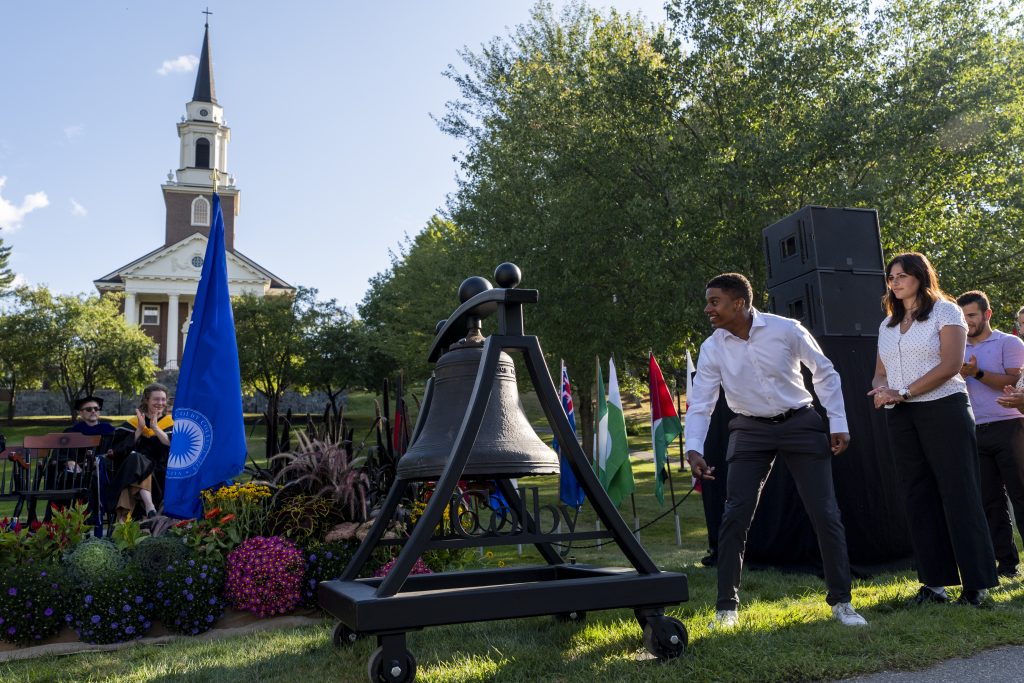
“So join that new club, say hi to that person you’ve talked to once before, and take that class that sounds challenging or interesting to you,” DaSilva said. “Colby has genuinely changed my life by giving me the courage to step into the unfamiliar. … So as strange as this might sound, I genuinely hope you all allow yourself to be uncomfortable. In doing so, you’ll open yourself to the endless opportunities Colby has to offer.”
Joseph spoke about one of the most meaningful aspects of his time at Colby, which is the warmth he has felt from all parts of the community.
“The kindness I’ve received from peers, faculty, administrators, teammates, coaches, support staff, and Waterville locals has been the pillar of this place that has become my home,” he told the new students. “I mean it sincerely when I say that my time at Colby has been an incredibly remarkable experience, and my hope is that each of you will have as positive an experience as I am having right now.”
He advised members of the class to participate in acts of service to others. Not monumental acts of selflessness, Joseph said, unless it is their particular calling, but rather small gestures such as striking up a conversation with a stranger, holding the door for someone, sharing notes with classmates, and showing up for people when they are going through a hard time.
“Make Colby a place where the question of ‘how are you’ becomes an earnest inquiry, and not just a formality of greeting,” he said. “The spirit of joy is infectious, and the best way to spread it is through micro acts of service. When received, these acts can heal the mind, and when given, they can fill the soul.”


