A Full-Circle Fulbright
As a Fulbright Scholar in Germany, philosopher Lydia Moland returns to the formative country for research and insight
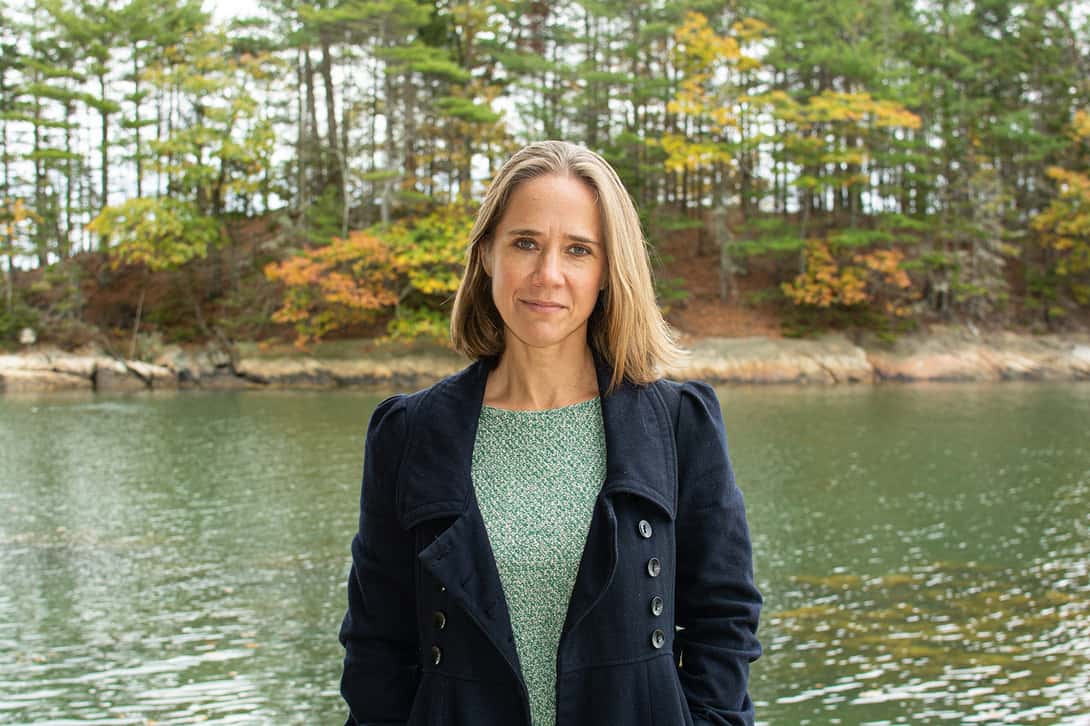
When Lydia Moland arrived in Germany in 1990, the Berlin Wall had just fallen. She was a 17-year-old exchange student “riveted by being near this world historical occurrence,” she reflected. “The defeat of communism in East Germany, the wall coming down, Germany reuniting—I was absolutely bitten by the politics bug.”
She began college with the intention of studying political science, but soon veered toward philosophy, drawn to the large, theoretical questions behind politics. She returned to Germany to study at the University of Tübingen and subsequently pursued a Ph.D. in philosophy. Today, Moland is Colby’s John D. and Catherine T. MacArthur Professor of Philosophy and a respected scholar who has devoted her career to studying political and moral philosophy.
This fall, during her sabbatical year, she has returned to Germany as a Fulbright Scholar sponsored by the German government. Through the fellowship, she is affiliated with Freie Universität Berlin, where she will lead seminars and collaborate with colleagues on the faculty. Moland is among the few scholars this year to receive the prestigious fellowship to conduct research in Germany. Her subject is the philosopher, feminist, and pacifist Helene Stöcker, a thinker she finds both morally praiseworthy and morally complicated.
“It’s a huge honor to get to be here and try to give back some,” Moland said from her flat in Kreuzberg, one of Berlin’s most storied neighborhoods. As a Fulbright Scholar, Moland will be an ambassador for the United States in a country especially important to her. “To me, it feels like a kind of confirmation of the ongoing relationship that I’ve had with Germany since my teenage years.”
The professor and author spends many days conducting research in the State Library of Berlin and smaller archives. “There’s nothing like actually having your hands and your eyes on primary sources,” said Moland, who finds the work even more special in an increasingly digital age.
The research energizes her, especially in the place so formative to her becoming a philosopher.
Said Moland, “I get up in the morning raring to go.”
A thorny puzzle
Moland learned of Helene Stöcker while writing a book chapter on 19th- and 20th-century women who used philosophy in the feminist movement. Stöcker caught Moland’s eye because of her paradoxical inspiration: Friedrich Nietzsche.
“When I came across her, it was one of those moments where I just thought, wait, what?” Moland said. “She was a Nietzsche convert, and she was a feminist? How did that even work?”
A 19th-century German philosopher, Nietzsche became infamous for envisioning an Übermensch, a “superman” unburdened by outdated moralities and freed from their limitations. Among those burdens were persons deemed weak, especially women. Nietzsche’s reputation as a misogynist was well known, said Moland, and debated throughout his lifetime.
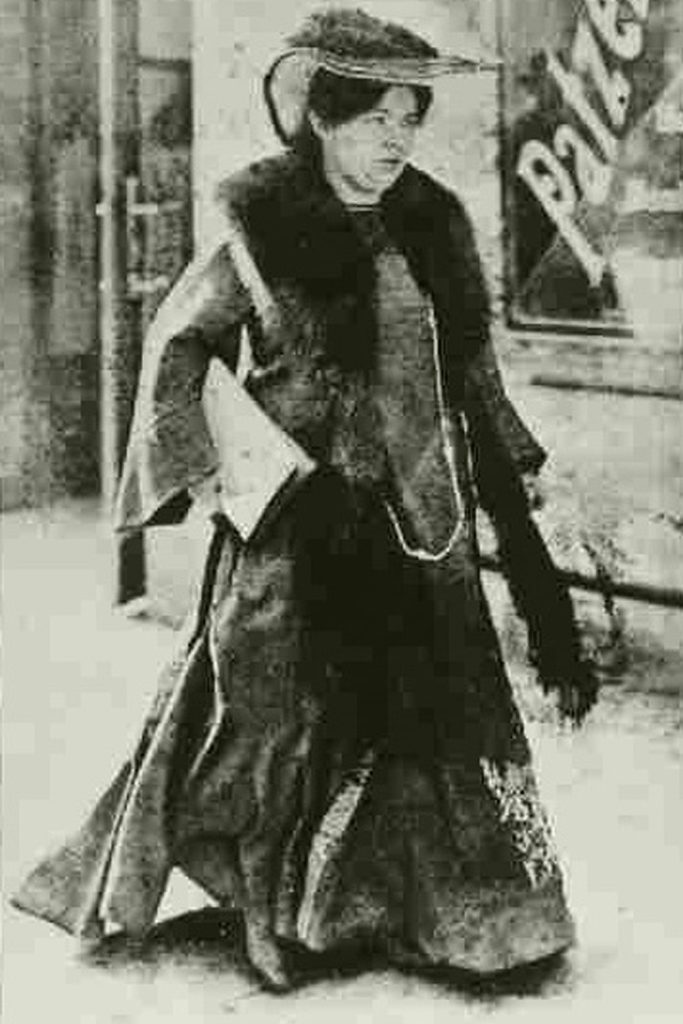
Stöcker was born in Germany in 1869 into a traditional, Calvinist family and educated in a girls’ school that emphasized rationality and morality. Restless and rebellious, she continued her education first in Berlin and then in Switzerland at the University of Bern, where she was one of the first German women to receive a doctorate.
Stöcker discovered Nietzsche at age 21 and “became convinced that thinking philosophically alongside Nietzsche was the way to really transform society,” said Moland. Stöcker’s embrace of Nietzsche is a “thorny puzzle” Moland has set out to solve. How could Stöcker use Nietzsche’s thought to fight for women’s rights and for peace in both world wars?
Stöcker’s New Ethic
In her 2024 article “How the feminist philosopher Helene Stöcker canonised Nietzsche,” Moland helps us understand why Stöcker embraced Nietzschean thought and how she used it to uplift women. “In Nietzsche,” Moland wrote of Stöcker, “she found caustic contempt for outdated norms, a vision for a humanity emancipated from tradition, and an exhortation to be oneself, whatever the cost.”
A pioneer in feminism, Stöcker drew inspiration from Nietzsche’s vision of unlocking human capacity. She argued that if women could be free of material limitations, they could embrace their “Nietzschean potential to be strong and creative and to love freely,” Moland said.
As a teacher of moral philosophy, Lydia Moland seeks real-life examples to talk through moral theories in the classroom.
In her quest to liberate women using her “New Ethic” philosophy, Stöcker put thought into action. She cofounded the League for the Protection of Mothers and Sexual Reform in 1905, and she famously championed rights for illegitimate children, the legalization of abortion, and sexual education.
With the onset of World War II and the rise of Nazi power in 1933, Stöcker knew her arrest was imminent. She fled Germany, eventually riding the Trans-Siberian Railway across Russia to Japan and taking a steamer to San Francisco. She died 10 years later in New York.
Practical philosophy
Stöcker left behind decades worth of the journal Die Neue Generation, which she published for nearly 30 years. She had to publish her writings herself because, as a woman, she was not permitted to publish academically or hold an academic post. These journals, and her personal writings, are what Moland is currently delving into to develop a fuller picture of Stöcker. The research is still in progress, so Moland isn’t certain if her final product will be a biography or take another form.
Moland did not begin her career as a biographer, but she enjoyed writing her last book, a 2022 biography of the American abolitionist Lydia Maria Child. That leaves the door open to the possibility of another biography.
Child and Stöcker both used thought and philosophy in practically applied ways, which fascinates Moland. As a teacher of moral philosophy, Moland seeks real-life examples to talk through moral theories in the classroom. Instead of making up thought experiments, she wants her students to look at actual people’s lives.
“So, in what ways did Lydia Maria Child use moral philosophical thinking to oppose slavery?” Moland asked as an example. “And in what ways did Helene Stöcker use philosophy to think through resistance to patriarchy and to war?”
This approach reflects Moland’s ability to connect philosophy with contemporary issues. It harkens to her early experience in Berlin as a high schooler. “I really came to philosophy through watching the way philosophy works in the world. So, I think I’ve always had that as a framework for my own thinking.”
A better teacher
If there’s another thing Moland hopes to bring back to her teaching next fall on Mayflower Hill, it’s a reminder of how students feel when confronted with new material.
“I’m always up for trying to do something on sabbatical that’s really challenging,” Moland said, recounting how she learned the trapeze during her previous sabbatical. During one lesson, she said she was so terrified she couldn’t follow the instructor’s directions.
Learning something totally new is essential for teachers, she said. “I think it’s important for teachers to know that students in our classrooms can feel similarly terrified and similarly at sea.”
Moland hasn’t yet identified what that activity will be during this current sabbatical, but she aims to. “I would like to try something totally new and terrifying that makes me a better teacher.”