A Tariff Expert on Speed Dial
For economics professor Andreas Waldkirch, a 'boring' academic specialty is suddenly the most talked-about topic in America
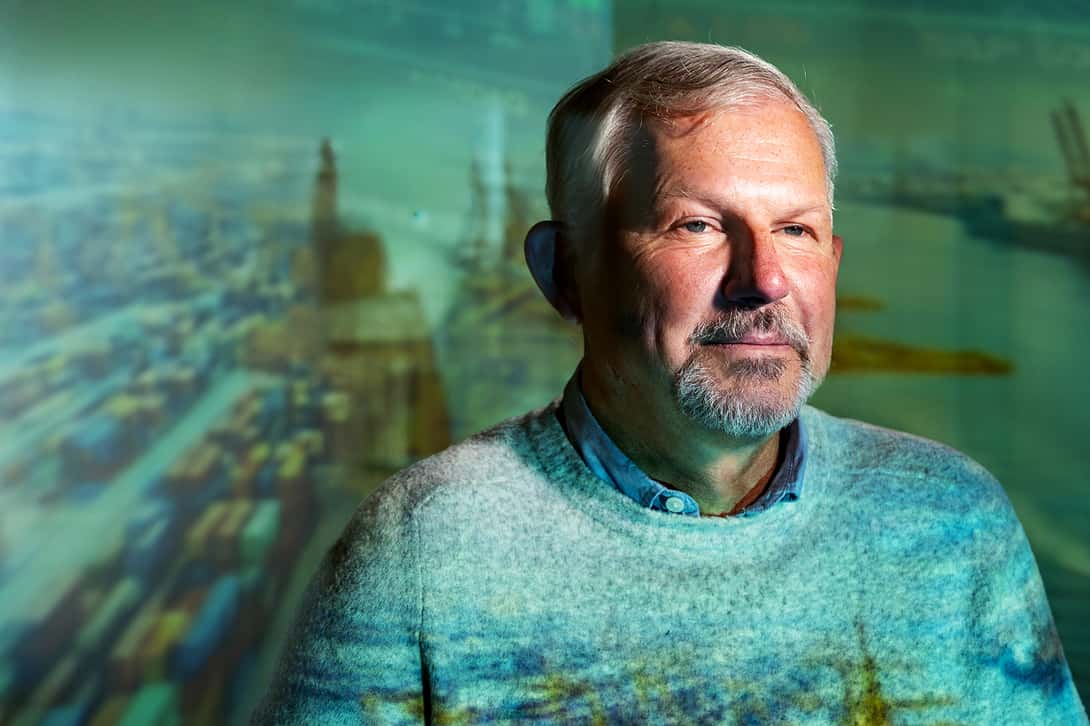
International trade economist Andreas Waldkirch is an expert on tariffs, something that, for a long time, most non-economists associated mostly with dusty history books—if they thought of them at all.
But oh, how times have changed.
Tariffs have become a central tool of U.S. economic and foreign policy. They’re in the news but are often not well understood by regular folks. Enter Waldkirch, the Mitchell Family Professor of Economics, who has helped to lead a national crash course about tariffs.
Over the last year, the professor has been interviewed by a slew of media outlets, including theWall Street Journal, USA Today, and the Today show. He was a guest on Maine Public’s deep-dive call-in show Maine Calling, and a reporter for the Associated Press seems to have him on speed dial. It may be a little bewildering to be near the center of this particular economic storm, but Waldkirch, a jovial fellow with a ready smile, is taking it in stride.
“Before, students had to care a little bit about tariffs because they were in my class, but nobody else really cared,” he said. “Now there’s this interest in tariffs because it’s affecting really everybody, all consumers, pretty much every business in the United States. And I think that’s really what’s gotten people’s attention. And of course, the constant barrage. You can’t turn around without hearing about tariffs.”
Tariffs have been in the news again recently, when the Supreme Court weighed in on the legality of President Trump’s second-term tariffs.
Beyond the politics
In simple terms, a tariff is a tax imposed by a government on imported goods and services, with the intention of generating revenue and protecting domestic products by making foreign imports more expensive. In recent decades, treaties such as the North American Free Trade Agreement and groups such as the European Union and the World Trade Organization have reduced tariffs and other barriers to trade.
“At some point, it was almost boring to talk about tariffs because they seemed to be on their way out. They seemed to become irrelevant,” Waldkirch said.
In his classes, he touched on tariffs, but other topics such as trade, income inequality, and environmental concerns were more prominent. Then the first wave of tariff increases took effect in 2018 and 2019, initially on specific goods such as solar panels and then more broadly with the implementation of tariffs on China.
“That was the first wave—and that got people’s attention,” Waldkirch said, adding that it made for a new relevance to his courses on trade. “Economic policy is really front and center to a lot of what we do, but I’m not a political scientist, so I do try and stay away from politics.”
Instead, he tries to keep the focus on the policies at play, discussing what the consequences of specific policies are and imagining what other policies might look like. It is hard, he acknowledged, to always draw a clear line between politics and policy.
“Politicians make policy. So it’s not always possible to separate the two entirely,” he said.
Translating the jargon
The situation with the tariffs has been fluid, fast-developing, and with far-reaching implications for people both in this country and all around the world. It didn’t take long for journalists trying to make sense of it all to seek out Waldkirch’s expertise. They started to reach out to him in December 2024, anticipating that tariffs would be important in the months to come.
“People were very interested in asking, ‘Hey, what do you think is going to happen? How bad, or how much, is it going to be?’” Waldkirch recalled. “There was a lot of speculation.”
Journalists also needed a basic primer on tariffs that they’d be able to explain to their audience. What did tariffs mean? How would people’s lives actually be affected? What goods would be most affected? What should people think about buying sooner rather than later?
Fielding media queries while traveling in Europe, Waldkirch pondered an essential question: “How do I talk effectively with an audience that’s not made up of economics majors?” He soon learned that daily reporters don’t have time for free-flowing conversation. They need the bottom line.
“You really want to try and make it understandable for people who just want to know the basics,” he said.
Still, the longer conversations he prefers allow for more background, context, and relevance.
“More than once I come away from those 10-, 15-minute conversations thinking, ‘Well, these are not the questions I would have asked,’” Waldkirch said. “What I have found in the context of my classes is that if you don’t know what to ask, you’re not going to get the right answers.”
In contrast, when he was a guest on the radio program Maine Calling, he enjoyed the much more in-depth conversation. He’s also looking forward to an upcoming talk on tariffs he will give early next month to the World Affairs Council of Maine.
Regardless of the outlet, it has felt important to Waldkirch to explain economics to regular folks. In his classes, he emphasizes to students that a major part of their education is to be able to translate the jargon so the greater public can understand.
“That has always been a mission. I’ve always been driven by trying to really get the broader public engaged,” he said. “That’s always been a motivation, but getting this opportunity now has been really satisfying and very rewarding.”