Levine’s Discovery Headquarters Will Foster Enterprise and Creativity
Named in honor of the Levine family of Waterville, the community hub will be housed in a renovated Runnals Building
With a generous lead gift from the Bill and Joan Alfond family, Colby will transform an iconic campus building into a modern, technology-rich innovation headquarters that will serve as an axis for enterprise and creation and honor one of the great entrepreneurial families that helped to build Waterville.
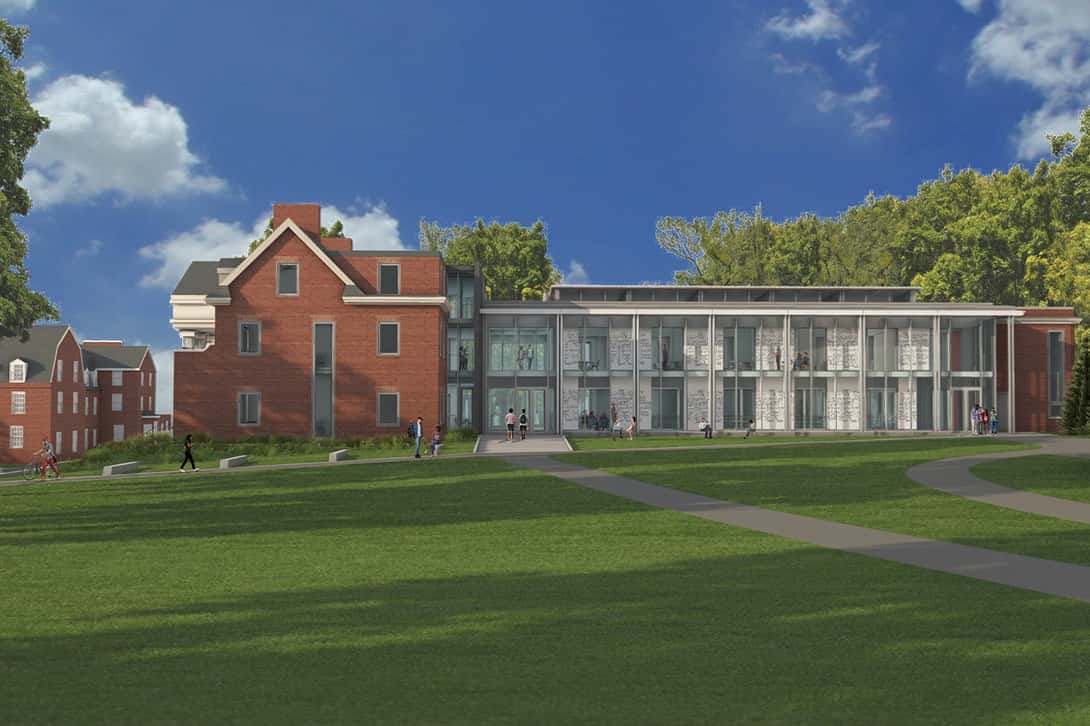
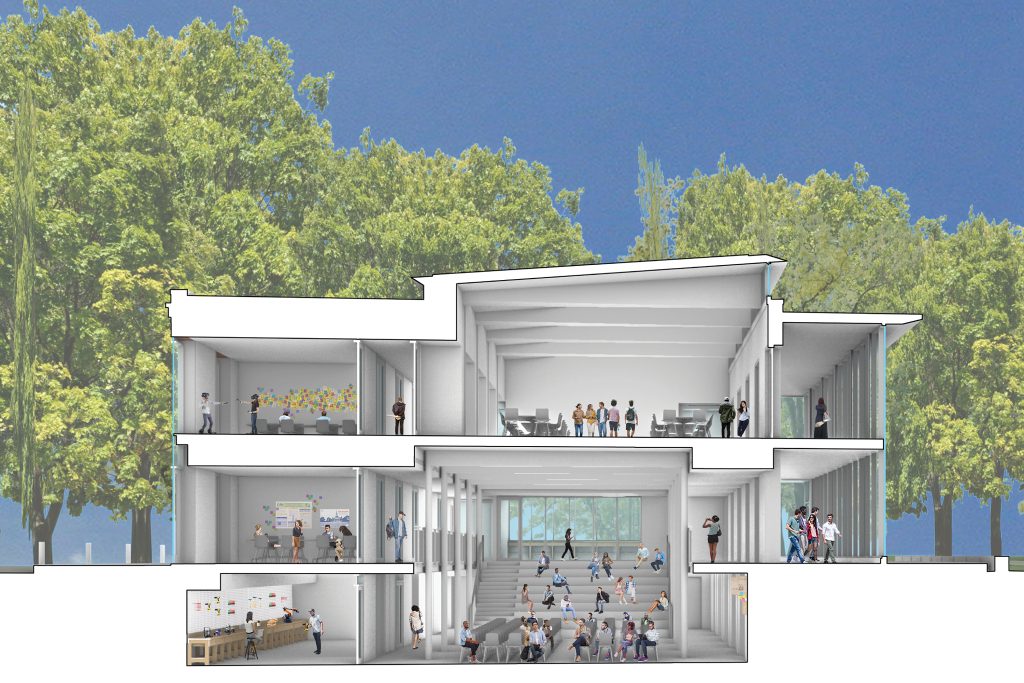
The new Levine’s Discovery Headquarters will be housed in the renovated Runnals Building, which will reopen in fall 2027 as a modern, 40,000-square-foot community and discovery space with flexible project rooms, maker spaces, offices, and an adaptable open multipurpose central creative core. It will become a hub where students will explore new ideas and engage in projects supported by the Davis Institute for Artificial Intelligence and Colby’s various academic labs that encourage creativity, research, and innovation.
The name celebrates the Levine family of Waterville, which founded the beloved, longtime Waterville clothing store Levine’s and is known for its deep commitment to all aspects of civic life, including in social, business, and religious circles. William Levine arrived in the United States from Lithuania as an 18-year-old, made his way to Waterville, and began what became Levine’s in 1891. Levine’s sons, Lewis “Ludy” Levine, Class of 1921, and Percy “Pacy” Levine, Class of 1927, took over the store. William Levine’s daughter Dorothy “Bibby” Levine Alfond ’38 named her son William “Bill” Lee Alfond ’72 after his grandfather.
In the spirit of collaboration, students who are active in the discovery headquarters will also have the opportunity to collaborate with community partners such as Dirigo Labs, a Waterville-based startup accelerator that will have dedicated space in Levine’s Discovery Headquarters, as well as peers from other regional institutions of higher learning.
The project is part of Colby’s historic $1-billion Dare Northward campaign to transform and position the College as a leader in higher education and a key component of the College’s planned $500-million investment in innovation, science, and technology.
“We are grateful to the Bill and Joan Alfond family, who have created this incredible opportunity for our students and community members to come together around entrepreneurial and innovative activities, where they will have the kind of space to foster, develop, and showcase their ideas and work,” said Colby President David A. Greene. “This project is about working in partnership with the community to find solutions that are creative and enterprising.”

Levine’s Discovery Headquarters will also serve as a visible symbol for the multidisciplinary and forward-thinking nature of a Colby education. Runnals originally opened in 1939 as the women’s union and gymnasium and later became home to Colby’s theater and dance community. It was named after Ninetta Runnals, Class of 1908, and the first dean of women. The opening of the Gordon Center for Creative and Performing Arts in 2023 presented the opportunity to reimagine Runnals and give it a third life.
The spacious hub will be used for community gatherings, large presentations, and as a workspace for large-scale projects and prototypes for Colby and the broader community. It will include adaptable, flexible spaces for meetings, discussions, lectures, and presentations. The north side of the building, facing Dana Lawn, will be rebuilt with a glass exterior wall, a nod to transparency and as a way to invite the outside world in. The rest of Runnals’ exterior will remain clad in red brick with architectural interventions to bring more light into the building.
Colby labs and Davis AI provide the foundation for new center
Colby has already invested more than $50 million in a variety of related initiatives that will form the programmatic foundation of Levine’s Discovery Headquarters. Those investments include:
- The Davis Institute for Artificial Intelligence, the first institute for AI at a liberal arts college, which facilitates interdisciplinary human-centered scholarship.
- The Halloran Lab for Entrepreneurship, providing education, training programs, and mentoring for students to launch commercial and social enterprises.
- The Buck Lab for Climate and Environment, a nexus for collaborations among Colby students, faculty, staff, and community partners to investigate and help solve environmental challenges.
- The Linde Packman Lab for Biosciences Innovation, which connects students with leading Maine-based research institutions and industry partners, strengthening Maine’s scientific workforce and bioscience economy.
- The Lyons Arts Lab, a creative think tank for students to test, focus, refine, and bring to life creative projects.
- The Bram Public Policy Lab, where students work closely with faculty, community partners, visiting practitioners, and governmental and nongovernmental organizations to engage in policy research, analysis, and implementation.
In addition, Dirigo Labs will use the building to continue its ongoing work to help entrepreneurs launch and scale their ventures. A program of the Central Maine Growth Council, Dirigo Labs is dedicated to supporting innovative startups and small businesses through mentorship, access to capital, and strategic partnerships. Over three cohort classes of startups, Dirigo Labs created more than 80 jobs in the Waterville area and direct and induced economic impacts of 192 jobs, $15.3 million in earnings, and $41.8 million in sales in such industries as biotechnology, clean technology, information technology, and precision manufacturing.
“Colby College and the Central Maine Growth Council have been strong partners, particularly over the past decade,” said Garvan Donegan, president and CEO of Central Maine Growth Council. “We are inextricably linked in our shared objective to grow jobs, grow our regional GDP (gross domestic product), and grow business in the greater Waterville region. We’re excited about extending our partnership with this new initiative.”
About half of Dirigo Labs’ seven-person team will work day-to-day in the new space. The building will also accommodate students, staff, and faculty from Thomas College and Kennebec Valley Community College to engage in entrepreneurial activities. These entities from Colby and the broader community will operate under one roof with a goal of nurturing, inviting, and encouraging community partners to create a dynamic learning, entrepreneurial environment.
Community connections
Those connections within and beyond Colby are critical to the success of its individual labs, the Davis Institute for AI, and the long-term vision of Levine’s Discovery Headquarters, Greene said. Given the range of issues that Colby scholars address through their work, it’s important to ensure students and faculty are aware of the projects and issues their peers are undertaking so they can collaborate across disciplines and fields. Those connections, while often not obvious, are where the most lasting and valuable collaborations happen, he added.
“The connections between biosciences innovation and public policy are critical at this moment, as are the connections between artificial intelligence, entrepreneurship, the arts, and the sciences,” Greene said. “Levine’s Discovery Headquarters will facilitate multidisciplinary collaborations, both those we can imagine now and those that will emerge in the future.”

In addition to partnering with Dirigo Labs, Colby envisions working closely with other startup accelerators and entities dedicated to next-generation solutions. Much of the enterprise work that Colby students undertake involves early-stage ideation, including creating business plans, testing ideas, and small-scale prototyping.
“But there are many people and other entities in Waterville and elsewhere who are further along than that, who already have funding, and who are working on the next-stage development of their business plans,” Greene said. “We’re working very closely with the burgeoning innovation assets in central Maine, including in Waterville, to see how this building can also support their work, because we think it will be much stronger if this becomes not simply a Colby center, but the headquarters for the broader community. The goal of this project is to bring all of that together.”
Greene compared what Colby is creating to similar efforts in other geographic centers for innovation across the United States, on a smaller scale. Silicon Valley in California, the Research Triangle in North Carolina, and the bioscience hub in Boston and Cambridge all began with one or more leading academic institutions committing to innovation as a core principle and guiding ethos, Greene noted.
A ‘statement building’
The heart and soul of the renovated Runnals Building will be the faculty, students, staff, and local entrepreneurs who come together to activate the core open space, which will span three floors and be equipped with modern maker-space tools and technology.
Designed by Susan T. Rodriquez | Architecture and Design and Mitchell Giurgola Architects LLP, the new Runnals will be flexible, dynamic, and inspirational to meet the needs of a society that is evolving quickly and in unexpected ways, while maintaining a sense of history and its original purpose as a physical space to support the dreams and ambitions of pioneers.
“We see this as a statement building,” Greene said. “It’s an 85-year-old building that will have its third life as a headquarters for innovation and new practices. We will maintain the iconic architecture of the building, but create something entirely new and forward-looking so that this building will work for the next 100 years.”