Meet Colby’s New Dean of Faculty
Proactive and solutions-oriented, historian John Turner supports the faculty as teachers, scholars, and community-builders
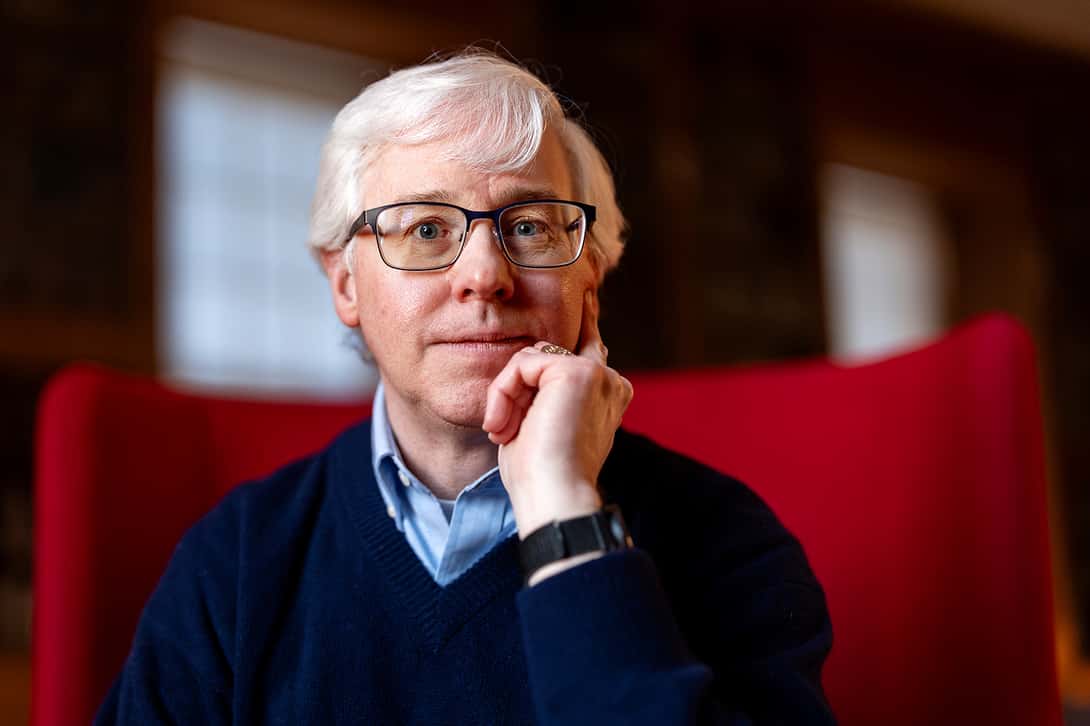
Advisor. Mentor. Advocate. Colleague. As Colby’s new dean of faculty, John Turner embodies all of these roles. It’s a job that requires equal parts wisdom, experience, and tact—and an eagerness to help professors perform at their highest level.
Seven months into his new position, Turner has found his happy place.
“I feel like I’m helping people, like I’m able to do things that are making people’s lives better,” said Turner, an associate professor of history and a scholar of Middle Eastern history. “And that feels really good.”
By his own definition, the dean of the faculty facilitates the conditions for the faculty to do their best work by supporting them in their roles as teachers, scholars, and community-builders.
Colby employs nearly 300 professors, including visiting, continuing, pre-tenure, and tenured professors. While Turner is available to help every faculty member, he also works closely with department chairs and directors of interdisciplinary programs.
Whether he’s advising pre-tenured faculty on their dossier, discussing how to get a research project across the finish line, or ensuring professors have what they need for grants, sabbatical, or travel, Turner is proactive and solutions-oriented.
“It’s asking, ‘What do you need? What can we do? What’s the best path forward?’” he said of his work, which takes place primarily behind the scenes.
“I’m very much geared toward collaboration,” said Turner, admitting he had to adjust to this new role supervising his former peers. “The only way that we ever get anywhere effectively is by working together.”
A historian turned dean
Turner is the first person in recent history to hold the position of dean of faculty exclusively; previously, it was paired with the provost’s responsibilities. But as Colby has grown in size and complexity, the need to split the roles became apparent.
While Turner manages the day-to-day needs of the faculty, Provost Denise Bruesewitz, the Clara C. Piper Professor of Environmental Studies, focuses on the academic mission of the College. Both Turner and Bruesewitz work closely with members of the provost’s team and many others across campus.
Turner joined Colby’s History Department in 2006, having earned his doctorate in Near Eastern studies from the University of Michigan, Ann Arbor. He defended his dissertation 10 days after the 9/11 attacks in 2001, then taught at both Swarthmore College and Kennesaw State University in Georgia before moving to Maine. An expert on Iran, Islam, premodern Islamic history, and modern Middle East history, he also oversees Colby’s Arabic Program, which prepares students for an effective study-abroad experience by offering Arabic language courses.
In graduate school, Turner studied Persian in Tehran and Arabic in Damascus and maintains fluency in both languages. At the College’s annual Martin Luther King Jr. Day Breakfast last month, he read “Banu Adam (Humanity)” by the Sufi poet Saadi. Persian poems of that era weren’t titled, Turner noted, but are referred to by their few first words. At the breakfast, he read the poem twice, once in Persian and again in English, using his own translation.
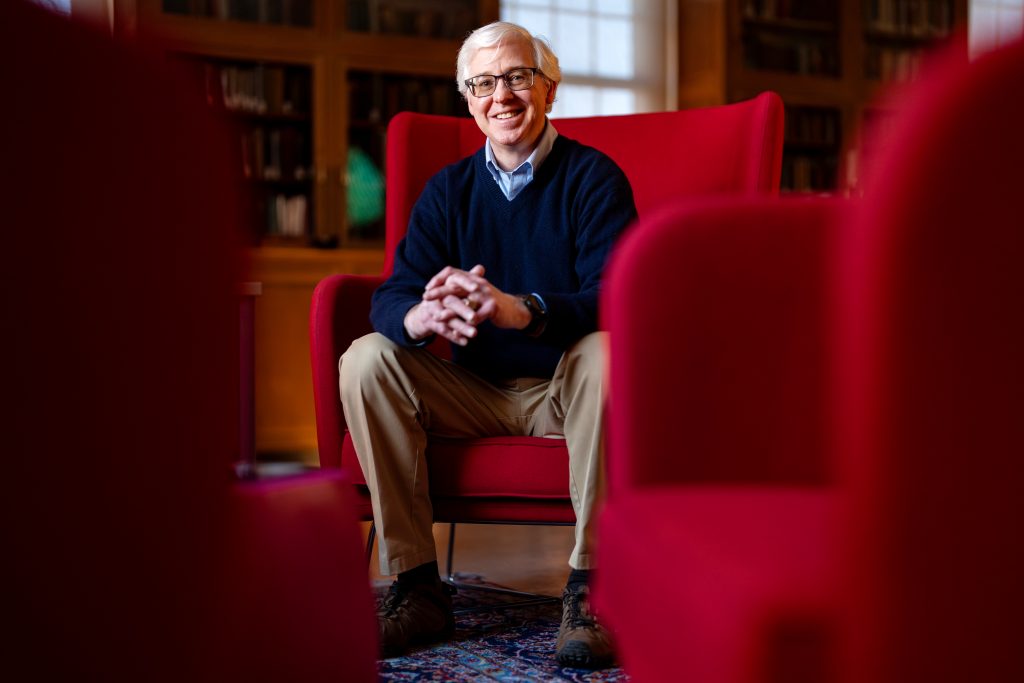
During his 20 years at Colby, Turner began to experience the administrative side of academia as chair of the History Department (2014-22), associate director of the Goldfarb Center for Public Affairs (2010-14), and a member of numerous College committees.
His service on the Promotion and Tenure Committee was especially impactful.
“It is one of those special spaces where you have to think beyond your department. You have to think beyond your division,” he said. “You have to be thinking in terms of the College as a whole, and you gain a lot of perspective.”
Colby operates with a model of shared governance among staff, faculty, and administrators. Committee work, he emphasized, “is a really important part of Colby and how we get things done.” It also gives professors invaluable experience and insight.
When the dean of faculty position became available, many of Turner’s friends encouraged him to apply. The winner of the Charles Bassett Teaching Award in 2015, he loved teaching and thus needed “something pretty compelling” to leave the classroom behind.
“And it was that I felt like there is a lot of good that I can do in this role … that I can help [faculty] to do their job better,” he said.
Turner went through a rigorous application and interview process before starting as dean of faculty on July 1, 2025.
An evenly balanced faculty
Among Turner’s broad goals is to establish a mentoring system that supports faculty members from the day they arrive until their retirement. He’s thinking about the long arc of a person’s career, which includes ensuring pre-tenured faculty receive tenure.
“Our goal, our mindset—and this is true for the whole institution—is we want people to get tenure,” he said. “We want to set them up for success. We want to give them the space and the tools that they need to be successful.”
Arnout van der Meer received mentorship and support from Turner when he joined Colby’s faculty in 2014. He recalls their first mentoring conversation, when Turner impressed upon van der Meer that he and the department wanted him to receive tenure.
“It is this culture of collegiality, support, and community that defined John’s tenure as chair of the History Department,” said van der Meer, now an associate professor of history. “John’s sincere desire to build a supportive faculty community means we can expect even more emphasis on mentoring and supporting faculty throughout their careers at Colby.”
‘We have kept our focus keenly on the undergraduate experience and making sure that we are teaching at the highest level we can. That we are preparing students for a world of ambiguity and uncertainty.’
Dean of Faculty John Turner
Turner will have plenty of opportunities to mentor faculty across campus in the years ahead.
Because of Colby’s robust hiring in the last 10 years, the faculty has grown at a faster rate than the student body, Turner said. This means that the faculty is young, with nearly one-third of the professors in the pre-tenure category.
Currently, the composition of the faculty is distributed fairly evenly across three of the College’s four divisions—Humanities, Social Sciences, and Natural Sciences—with a lower percentage in the smaller Interdisciplinary Studies. Colby remains committed to maintaining that balance, Turner said.
The liberal arts, Turner explained, is an integrated way of thinking about the world, of seeing from different perspectives when one encounters different fields. Investing and building fairly evenly in the sciences and humanities alike is part of what makes Colby’s graduates successful.
“We’ve taken the attitude that that’s the value added that makes the liberal arts degree more impactful over the course of a person’s life. That’s going to be the thing that really sets people up for overall life success.”
Faculty and Colby’s future
An evenly balanced faculty also makes good sense as the College invests a half-billion dollars in a new model for the sciences, engineering, and technology in the liberal arts. It’s an indicator of how the College is thinking about these fields as being interdisciplinary, Turner said.
“All engineering problems sit within a social context. All scientific problems sit within a social context,” he continued. “And all social contexts encounter technology and science, right? And so, these things are so inextricably intertwined that to try to think of them in a very narrow way is actually extraordinarily limiting.”
Colby’s new state-of-the-art science complex, expected to open in 2030, will reflect this mindset. The facility’s design will foster connections by integrating several disciplines within a single physical space and encouraging the breakdown of silos.
Already, cutting-edge scientists and researchers are paying attention and applying to join Colby’s faculty. But Turner is clear that applicants must value teaching, which is the College’s highest priority.
“We have kept our focus keenly on the undergraduate experience and making sure that we are teaching at the highest level we can. That we are preparing students for a world of ambiguity and uncertainty,” he said.
“That’s what liberal arts is really good at. And we’re particularly good—actually, great—at that.”


