Rachel Nicholas ’26 Named Colby Global Fellow
She will spend the summer in Argentina and Australia exploring her project Cofio Cymru, or Remembering Wales
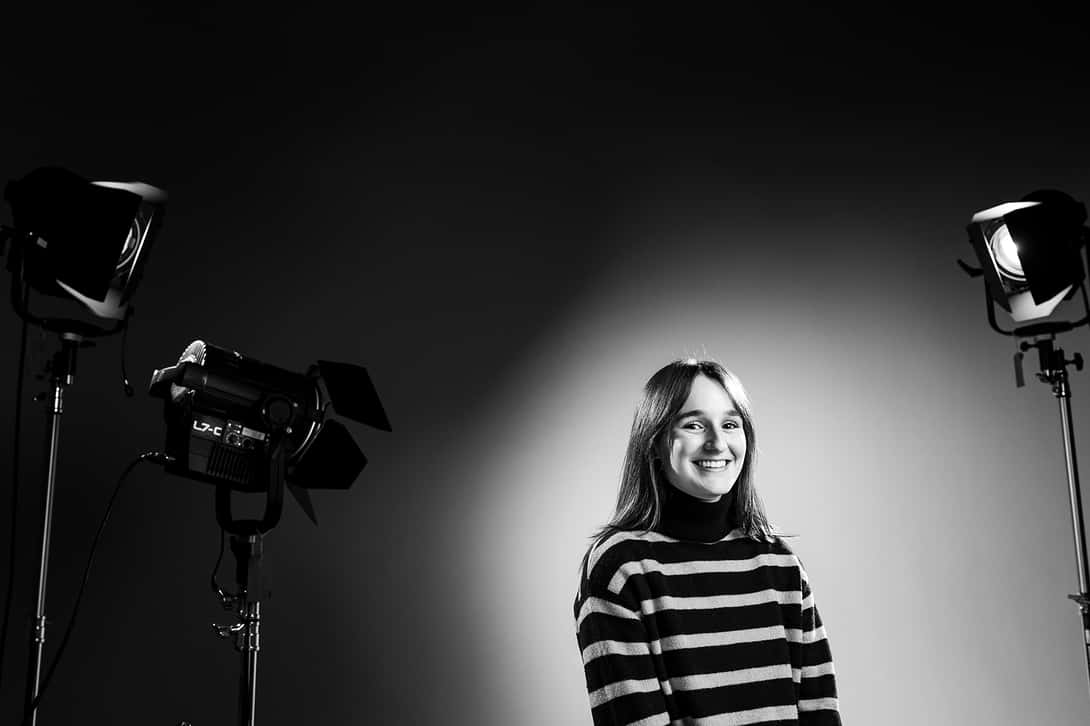
Rachel Nicholas ’26 knows the courage it takes to build a life for oneself in a new country. Having left her homeland of Wales to study at Colby four years ago, she appreciates the challenges of integrating into a new culture while upholding her heritage.
Her personal journey fueled a curiosity about how others forge their own paths, balancing legacy with new lived experiences. Of particular interest is how those in the Welsh diaspora have built new lives.
Nicholas is about to find answers to many of her questions when she embarks on a three-month journey as the 2026 Colby Global Fellow. The fellowship includes a $12,000 grant, allowing for immersion in two countries with established Welsh communities: the Patagonia region of Argentina and the cities of Melbourne and Sydney in Australia.
“This is such an honor,” said Nicholas, expressing deep gratitude for this opportunity. “It still doesn’t feel real. For so long, it has felt like this intangible dream project that I would get to do. Now, the fact that I’m actually planning it is surreal.”
Nicholas is proud to be an ambassador of sorts for the Welsh, whom she feels are often the underdog.
“In many ways, this project is a celebration of the resilience of Welsh people and the lives that they’ve gone on to build abroad—the bravery, the open-mindedness, and the tension it can take to integrate with communities,” she said. “I think it’s definitely going to be special.”
After graduating on May 24, the history major with a minor in French studies will embark from Boston on June 1.
Unanimously selected
Nicknamed the “mini-Watson,” the Colby Global Fellowship is given to the highest-ranked Colby nominee for a Watson Fellowship who did not win a national award. Nicholas was one of Colby’s finalists for a 2026 Watson Fellowship. Her Watson project was titled Cofio Cymru: Memory Preservation in the Welsh Diaspora.
Nicholas is the fifth Colby Global Fellow. Colby’s Watson Selection Committee unanimously selected her for the fellowship, which was established in 2022 by former Watson Fellow Joe Meyer ’79. The fellowship is now supported by both Meyer and Claudia Rouhana ’71. It is designed to allow the winner to pursue a condensed version of their Watson project after graduation.
“Rachel approached the Global Fellowship with her trademark thoughtfulness, strategically narrowing her original four-country exploration to focus on the Welsh experience in Patagonia and Australia, tackling complex questions of cultural identity, resilience, and assimilation,” said Véronique Plesch, James M. Gillespie Professor of Art and chair of Colby’s Watson Selection Committee. “While deeply personal, this project possesses a rigorous methodological framework. Inspired by historian Pierre Nora’s lieux de mémoire, Rachel will seek to understand the ways in which the Welsh diaspora preserves and lives memory.”
‘The Colby Global Fellowship is part of the access to opportunity that makes the Colby education unique.’
Rachel Nicholas ’26
Even though Nicholas has traveled internationally while at Colby, the Colby Global Fellowship will be her first solo adventure. She will be on her own this summer, making decisions she’s never had to make before. She anticipates moments of discomfort when something won’t go as planned, knowing such moments will be formative, “especially at a young age,” she said.
“I wouldn’t have the bravery to go to rural Patagonia for two months by myself to pursue this project without this fellowship. It’s like a vessel to push myself, and that’s really exciting.”
First stop, Argentina
Nicholas will begin her fellowship in Argentina’s Patagonia region, where she’ll spend two months in the Welsh community Y Wladfa (The Colony), a “little Wales beyond Wales.” Established in 1865 by Cambrians escaping English suppression of the Welsh language and identity, Y Wladfa is seen by the Welsh as a magical place, the longest-standing and most culturally rich community in the diaspora.
“There’s so much to do there,” said Nicholas, who is quickly learning as much Welsh and Spanish as possible before her arrival. Originally from Cowbridge in southern Wales, Nicholas has only an elementary command of the language because Welsh is less prevalent in the south than in northern Wales.
“I want to be able to interact meaningfully with these people, such as having conversations around identity,” she said. “So, it’s going to take some thinking.” Nicholas is working with a contact in Patagonia to determine the best way to use her time and contribute meaningfully to the community.
Y Wladfa is nestled in the Dyffryn Camwy (Chubut Valley), and Nicholas is curious to explore landscape as a form of memory in Patagonia. Among the places she’ll visit is the town of Gaiman and its Welsh Regional Historical Museum, housing more than 3,000 items and a Welsh newspaper library. She also plans to see the first house in Gaiman, built in 1874, to better understand early settler life in the Lower Chubut Valley.
On to Australia
After Argentina, Nicholas will travel to Australia, where she’ll aim to understand modern Welsh practices and identity, as well as what happens when Welsh communities vanish or fade.
She will spend time at Australia’s National Library and engage with a variety of Welsh societies, choirs, and a Welsh-language summer school in Sydney. Welsh communities in Australia are English-speaking, so assimilation happened at a faster pace, said Nicholas. She’s curious if Welsh descendants there today feel much of a connection to their ancestors.
Most exciting for Nicholas is the opportunity to travel to Llanelly, an abandoned Welsh mining town northwest of Melbourne. Established in the 1850s, it was once a thriving community with a population of nearly 20,000 during the gold rush. When the gold ran out, almost everyone left. Today, fewer than 100 people live there.
“I’m really excited to see what happens when a diaspora disappears. Where did they go for work?” she asked, knowing that mining is a driving force behind Welsh migration and the success of communities in the diaspora. Nicholas hopes to locate a local historian who has documented the Llanelly settlement for clues about what to look for when she visits.
In Australia and in Patagonia, Nicholas hopes to stay with a local family to enhance her overall experience.
“I had host families in Paris, and it completely transformed my experience. It really alters the way that you interact with a place,” she said. “My whole project is about human connection, and the nature of a homestay encourages that.”
A perfect alignment
Nicholas is pleased to have been awarded the Colby Global Fellowship and said that it worked out for the best, allowing her to have “the most incredible summer” before beginning a job at FTI Consulting in London, where she interned last summer.
“It aligns perfectly with my plans,” said Nicholas, who begins her job September 7.
As she prepares to leave Colby, she expressed gratitude to her professors, notably Jesse Meredith, visiting assistant professor of history; Flavien Falantin, assistant professor of French studies; and Plesch. She also thanked the College for its support of the opportunities she’s had.
“The Colby Global Fellowship is part of the access to opportunity that makes the Colby education unique. During my time here, I have had the privilege of receiving funding for an otherwise unpaid summer internship in Washington, D.C., a Jan Plan course in Prague examining dissident literature under Nazi and Soviet occupation, and archival research in the UK for my history thesis,” said Nicholas. “Each of these experiences has shaped me during my time at Colby, broadening my perspective and allowing me to make connections between my schoolwork and the real world. This fellowship feels like the most exciting yet.”
Nicholas also noted that coming from the UK, opportunities such as the Colby Global Fellowship are practically unheard of.
“Everybody back home is just as wowed as I am.”


