The Stories of Maine’s Rural Workers
With prestigious grant, Colby anthropologists will create oral histories of workers and community building in rural Maine
To understand how rural people find meaning in and through work over the past 25 years, two Colby anthropologists have embarked on an ambitious research project to collect and make available stories of workers in two Maine counties.
Professor of Anthropology Winifred Tate and Lecturer of Anthropology Suzanne Menair have received a grant of more than $180,000 to support a two-year ethnographic and oral history research project in Aroostook and Washington counties.
“Our primary interest is exploring how people think about the future of work and how people build community in the context of the kinds of economic challenges that rural Maine is facing,” said Tate, a political anthropologist.
For people in rural Maine, the 21st century has brought profound changes to their work. Transformations in the global economy, informal labor practices, and immigration policies, as well as the ongoing opioid crisis and pandemic disruptions, have altered the shape and scope of jobs.
The project will employ ethnographic methods to trace these transformations, as well as the hopes of rural Mainers for future productivity. Among the researchers’ goals is to “make visible the often-hidden practices of community care, and how work contributes to community resilience.”
The grant comes from the Future of Work Program at the Russell Sage Foundation. The New York-based foundation supports innovative social science research that explores cutting-edge methods, questions, and policies to improve social and living conditions in the United States.
Tate stated that while research exists on rural workers in other parts of the country, such as Appalachia and Louisiana, this will be one of the few contributions to this growing literature focused on Maine.
“To do this kind of intellectual work, I think, is really a privilege,” said Tate. “It’s so important to analyze the ways in which rural communities are grappling with the changes that are happening in their communities right now in all kinds of ways.”
Project genesis
The project, titled “Rural Work, Precarity, and Resilience,” aims to collect and produce 60 oral histories. The histories will be housed in Colby’s Special Collections & Archives and serve as a valuable resource for the public, students, researchers, and local communities.
The project grew out of Tate’s work as director of the Maine Drug Policy Lab at Colby and her ongoing research with women who use drugs, incarcerated women, and women in recovery. Her work has taken her several times to Washington County, where the opioid crisis became visible in Maine, she said. Through conversations with stakeholders, she began thinking about the ways substance use has been used to explain how the lack of work and so-called “deaths of despair” emerge from areas of post-industrial decline, such as Washington County, she said.
‘It’s so important to analyze the ways in which rural communities are grappling with the changes that are happening in their communities right now in all kinds of ways.’
Professor of Anthropology Winifred Tate
Tate is also interested in how jobs supporting recovery and substance use can contribute to and build resilient communities. She views jobs such as peer coaches and recovery specialists as part of a rapidly growing industry.
All of those threads came together as Menair and Tate were developing their project.
“I think about [the project] as something that both comes out of and builds on the work that I’ve been doing with the Maine Drug Policy Lab,” said Tate. She and Menair were thrilled to receive the grant, often given to political scientists instead of anthropologists.
Anthropological methods
Research for the project began in earnest this last summer, with Menair, a linguistic anthropologist, focusing on Aroostook County and Tate turning her attention to Washington County. While Colby student researchers built an archive of information on various Maine industries—such as timber, healthcare, lobstering, and tourism—the professors conducted research trips to their regions for initial interviews, with Menair in Presque Isle and Tate in the border city of Calais.
“I just love talking to people and hearing how they think about their lives and their work,” Tate said, reflecting on her time in Calais. “It was a time of building a lot of connections and reaching out to a lot of people.”
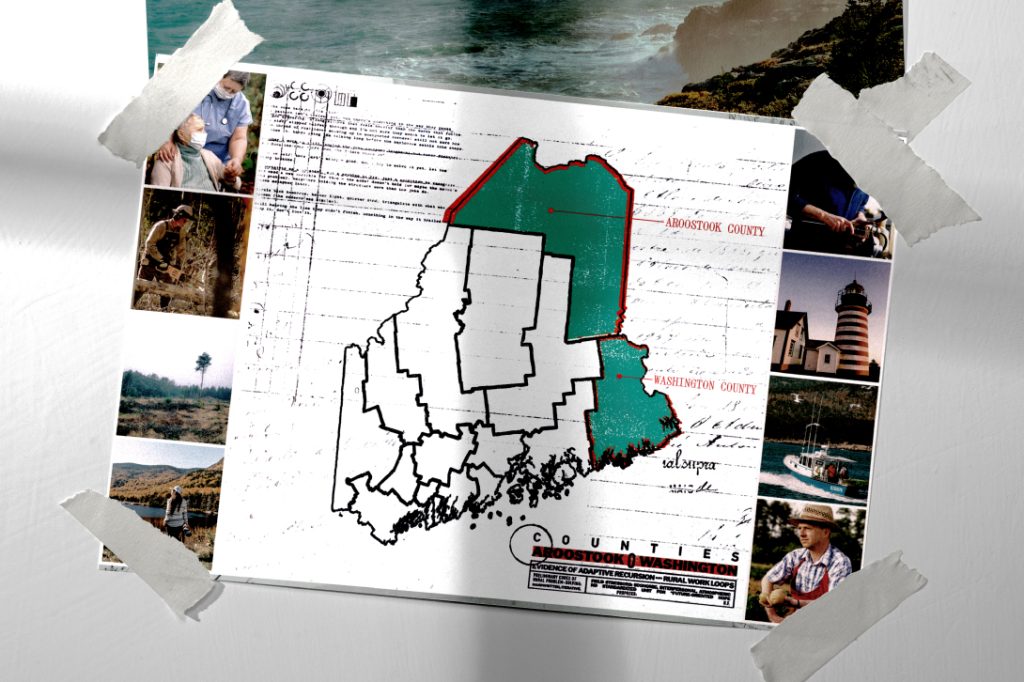
Tate and Menair’s project will unfold in three stages. The first stage includes a small survey with a cohort of the graduating class of 2015 from Calais and Presque Isle high schools. The second stage involves semi-structured interviews with a broad group of workers. The third stage, still under development, involves the collection and production of oral histories.
For each stage, the researchers will use sets of questions focused on work histories, the kinds of work people would like to see in the community, barriers to work, and how substance use has impacted the workforce. They plan to talk with general and seasonal workers, business leaders, elected officials, heads of nonprofit and government agencies, and others.
“Our hope is to have as broad a representation as we can,” said Tate. “But I also want to be humble in knowing that we can’t capture everyone.”
Throughout, they’ll use an anthropological method called an iterative research process.
“It’s where you go into the field, and you see what new questions emerge, how you can refine your questions, how you can narrow your focus,” said Tate, whose interviews last summer moved her work in a different direction through conversations with religious leaders, who originally were not on her radar.
An abundance of questions
Six months into the research project, Tate and Menair are just getting started. Right now, they have more questions than answers.
Among their interests are individuals who relocate for work and those who work where they are, and how both groups approach community building. This interest is tied to Maine communities’ placemaking and community practices, which value “kinship networks, place-based identities, specific kinds of gendered labor, and local independence entangled with reciprocal obligations,” they said.
Both anthropologists also have a strong interest in community work and care work, such as direct care for individuals and indirect work, such as cooking and cleaning. It’s work that is not counted in economic forecasts and assessments, said Tate, but is foundational to communities’ survival. The researchers are eager to bring those stories into the archives as well.
Throughout their careers, Menair and Tate have developed a methodology that analyzes themes that emerge from the stories people tell about their experiences. Through this, they hope to “illuminate the production and experience of economic inequality and precarity, alongside rural vitality, resilience, and productivity,” they said.
Tate is energized by this project, partly because it forces her to engage a beginner’s mind and being open to new understandings. “Starting a big, new project like this puts you in that place,” she said. “It’s very humbling and very exciting.”
She also brings her research into her classroom, where she gives students examples of what she’s experiencing as a researcher—and “how complicated and hard it is to do this kind of work,” she said.
“I can offer them my understanding of what I’m asking of them. It’s really hard. It’s hard to talk to people and to ask difficult questions. It’s hard to go out in the world and try to figure out what’s going on and what other people think about it and why,” she said empathetically.
“But I think it’s the most important work we can do.”