A Swallow in Decline
An ambitious community-based science project aims to help purple martins
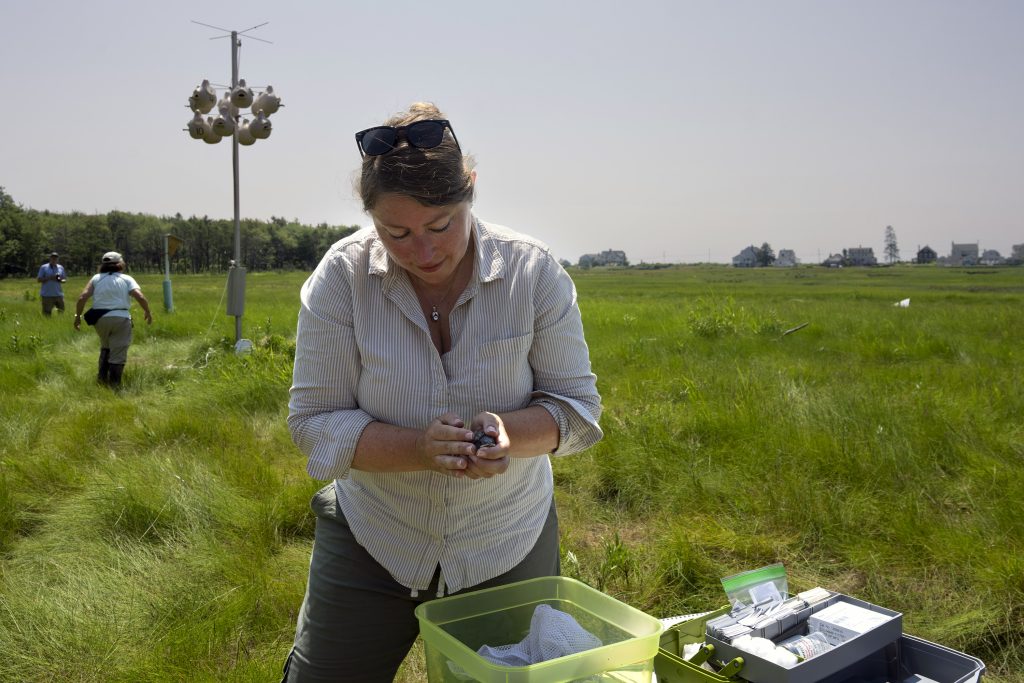
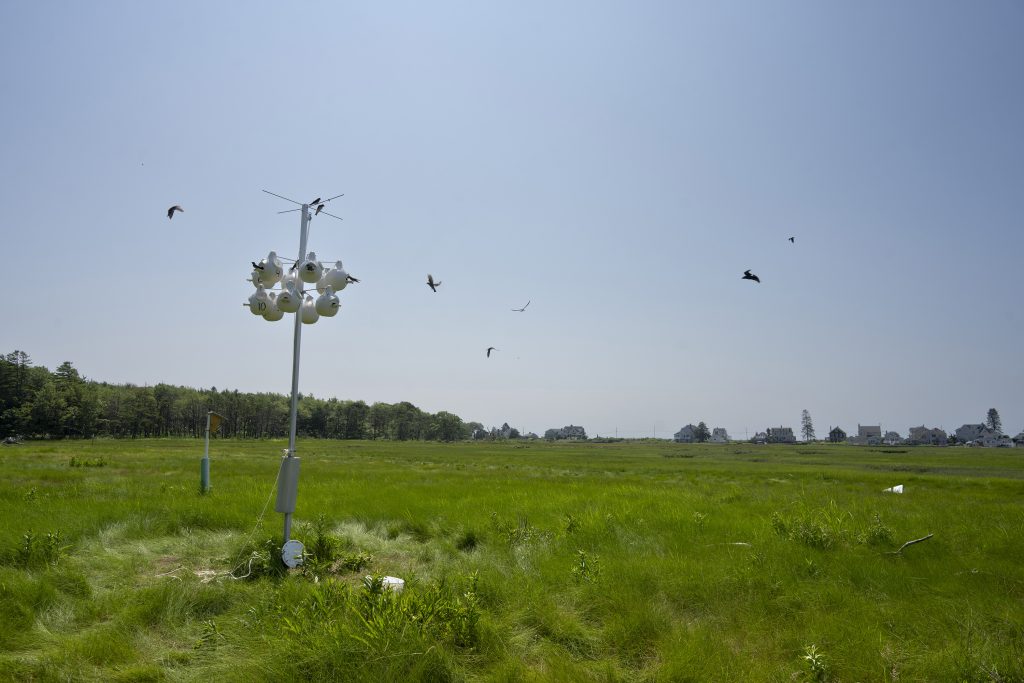
Whirling and gliding, swooping and diving, dozens of purple martins circled high in the air as Anna Forsman approached their nest complex on the Mousam River Estuary in Kennebunk.
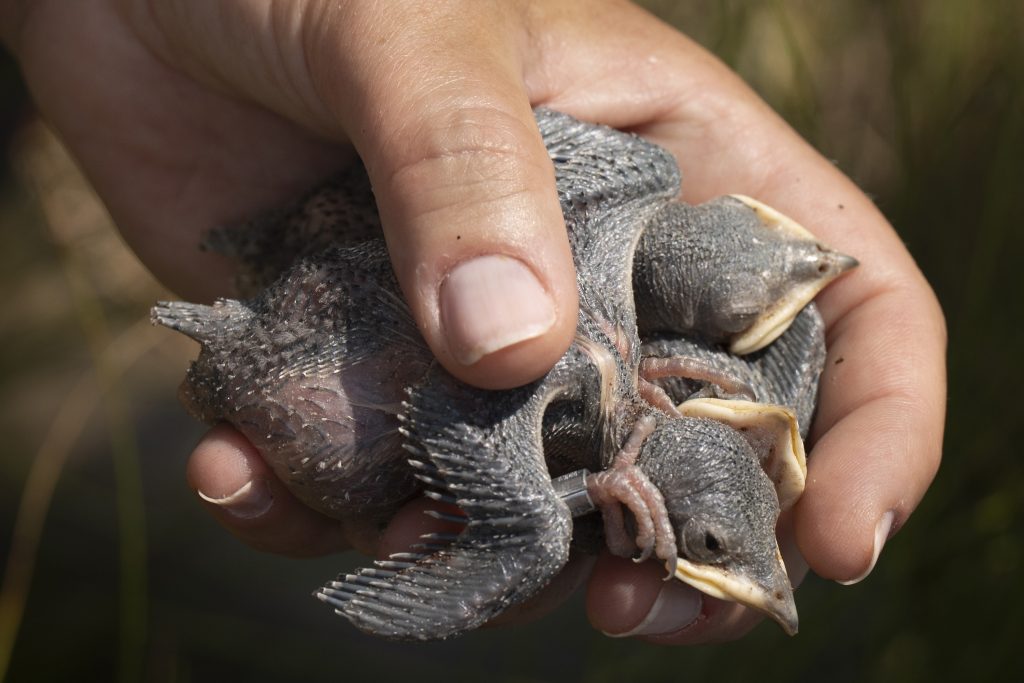
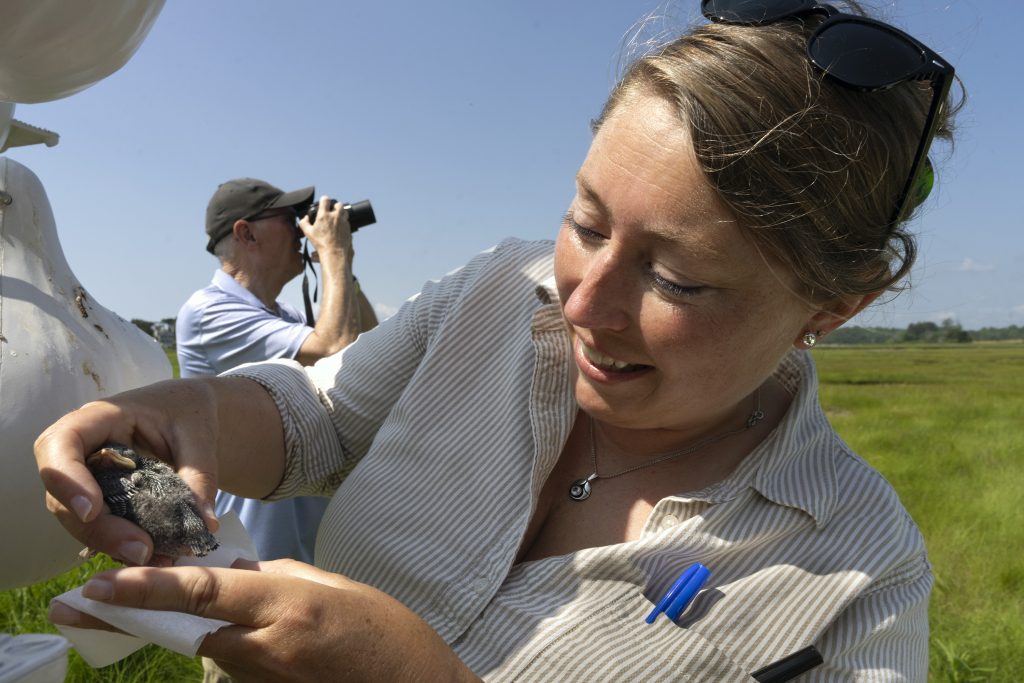
The assistant professor of biology was happy to spend a beautiful summer day at a salt marsh doing something she loves: checking in on purple martins in order to get a snapshot of what they are eating and how they’re doing. The friendly chatter of the birds made her smile as she delicately reached into a nest to pull out a baby bird.
“It’s so wonderful to hear that sound here in Maine,” Forsman said.
Purple martins, a favorite of birders and the largest swallows in North America, are special. They are gregarious, chatty, and acrobatic, and the adult males are an eye-catching iridescent blue-black.
They’re also in trouble.
Purple martins were once a common sight during the summer all over the East Coast of the United States, but their populations have significantly declined over the past half-century. In Maine, where they used to be found all over the state, they have experienced a precipitous 95 percent decline. There are now just a handful of active colonies in a few towns.
Forsman wants to better understand why that is the case, and so with the help of her students, she launched in January 2025 a community-based science detective project, Pooper Snoopers, to learn more about the diet composition and the gut microbiome of purple martins.
Through the initiative, volunteer purple martin “landlords,” who have active purple martin nests on their property, will collect fecal samples that they will send to Forsman’s lab at Colby. The landlords are not allowed to handle the birds themselves, but will just passively take the poop samples out of the nests.
At the lab, Forsman and her students will extract and sequence DNA from the samples, which will show them what insects the birds consume and what types of bacteria live in their bellies. A little over 200 landlords from the U.S. are participating.
Forsman and her students are working closely with the Purple Martin Conservation Association, a nonprofit organization committed to ensuring the future of the species.
“Honestly, the scope of this project is unprecedented,” Forsman said. “I’m kind of blown away by the excitement and willingness to participate that has been shown by the purple martin landlord community.”
The sweet sound of a morning song
For many years, humans have been closely intertwined with the lives of purple martins. Western and desert purple martins tend to nest in old woodpecker holes in trees and, sometimes, cacti. But Eastern purple martins have contended with the loss of suitable habitat and the rise of invasive competitors such as English house sparrows and European starlings. As a result, Eastern martins are dependent on housing provided by people.
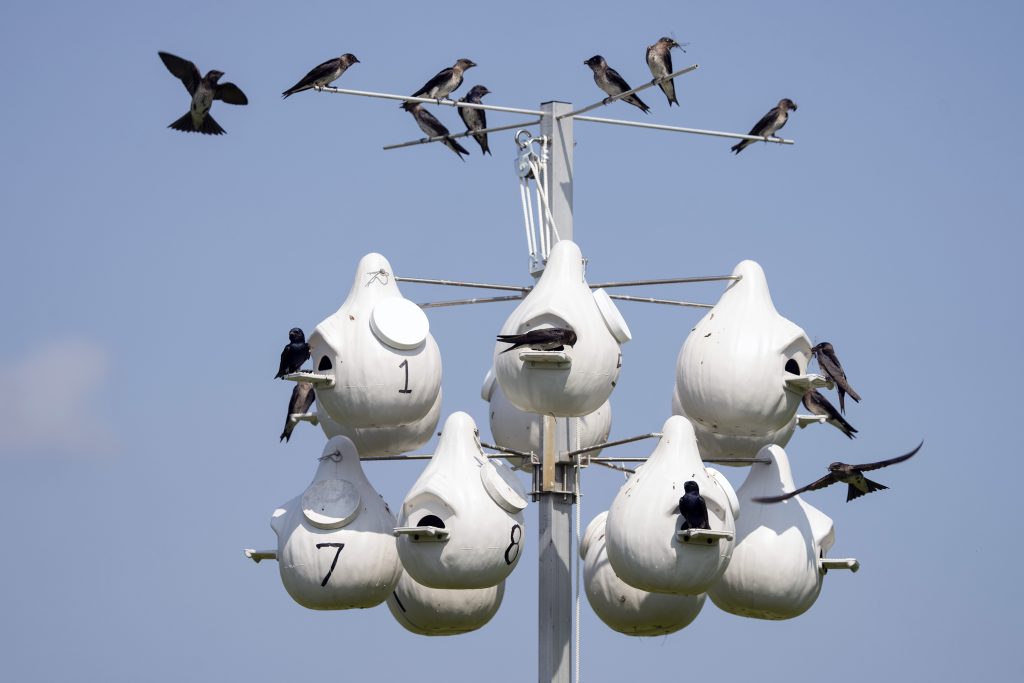
The housing could be gourds or miniature condominiums, with one family in each cavity, and should be sited in an open area, a safe distance from trees, and not too far from human housing. The housing should be able to be raised and lowered, and the cavities should be easily accessible for nest checks and cleanouts.
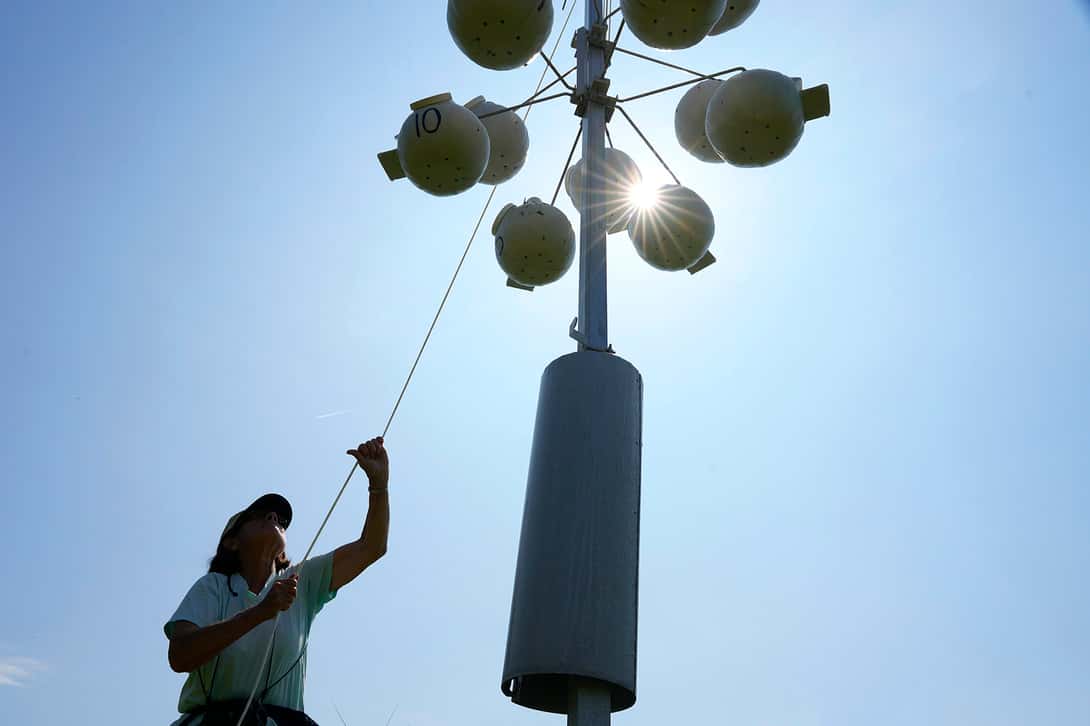
In Kennebunk, the purple martin housing complex is of the gourd variety. A dozen or so white, plastic gourds dangle from a metal pole situated in the tall marsh grass of the Madelyn Marx Preserve, not far from another martin house that a family has maintained on their property since the 1990s.
Members of York County Audubon installed the martin housing in 2017, and for seven years had occasional purple martin visitors check out the gourds, but none moved in.
Kathy Donahue, the group’s treasurer, never gave up hope. She knew that the adult male purple martin sings a special song in the morning, the Dawnsong, to attract other birds to the nest site, and so she went to the marsh in the early mornings to play it on her phone. Finally, in May 2024, she got a call from another member of the Audubon chapter telling her that the martins had arrived. It was an overwhelming moment.
“I couldn’t believe it,” Donahue said. “The next morning, I got up early. I came out, and there were martins all over. So I had to call everybody. I was out in the marsh calling the president and saying, ‘Guess what? The martins are here!’”
The Audubon members are planning to put up another martin house in preparation for next season, and they have invited Colby students to come help set it up, Forsman said.
A close look at a bird’s diet
This year, there are even more martins on the marsh, all of whom had active nests and hungry chicks. It’s a good sign, but it doesn’t mean that the birds are definitely making a comeback in Maine and elsewhere, Forsman said. In addition to habitat loss and increased competition, purple martins are facing a decline in insects, which are their source of food, and ongoing challenges from climate change.
“We don’t know for sure why the population is in decline. But we certainly know from published studies that insect populations are also declining globally. Purple martins and tree swallows are aerial insectivores, and so not only do they eat exclusively insects, but they will only eat them when they’re flying,” she said. “So any cold snaps in the spring, where the insects stop flying, or several days of rain where the insects are not flying, is very difficult for the birds.”
Her research will look closely at the birds’ diet—very, very closely.
“You can even see all the insect parts in there. You can see little pieces of wings and legs,” she said as she inspected a fresh fecal sample she had just collected from a nestling martin.
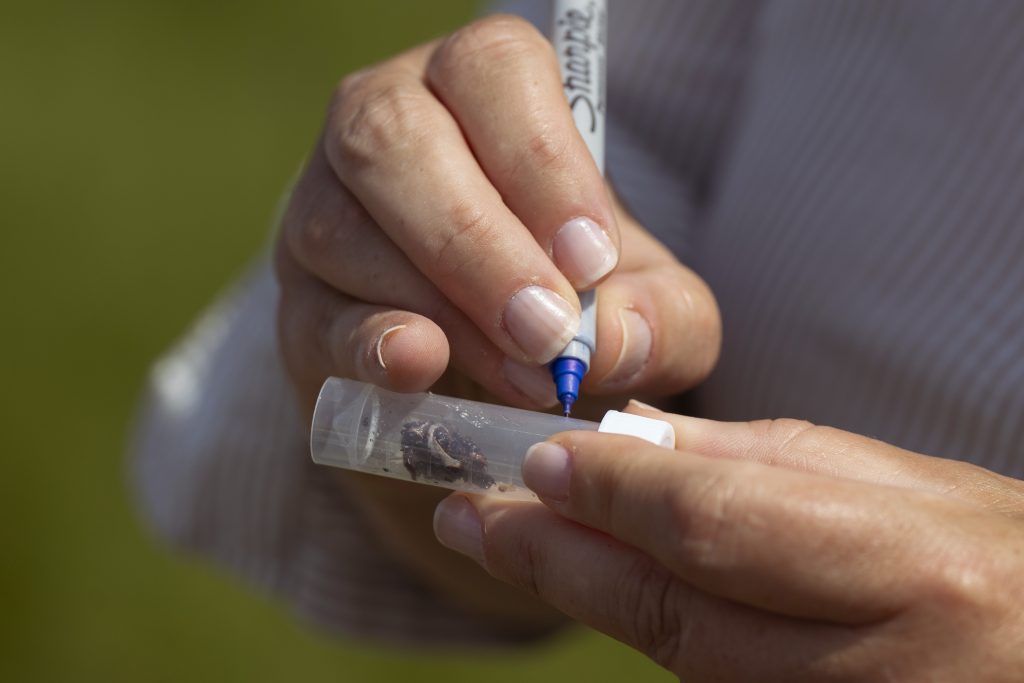
Forsman, who is licensed through the U.S. Geological Survey’s Bird Banding Laboratory and the Maine Department of Inland Fisheries and Wildlife to handle and band the martins, reached gently into the nests to pull out a baby bird. Some of them snoozed in her hands as she banded them and collected fecal samples to bring back to Colby.
“From fecal DNA, we can look at diet composition. We can look at the gut microbiome. We can look at internal parasites,” she said. “We are sampling birds from across their breeding range, and I cannot think of another study that has taken such a comprehensive look at diet across such a large geographic area.”
In the lab, she and her students will use a relatively new technology called DNA metabarcoding, which allows for the simultaneous identification of many different taxonomic groups within the same sample. Forsman explains this to her students with a grocery store analogy. If they were to grab a bunch of boxes of different brands of macaroni and cheese and line them up, the cashier might not identify at first glance which is Kraft, and which is Annie’s, and so on.
“But as soon as they scan the barcode, they know what it is. It’s a unique number that corresponds to that brand,” she said. “What we’re doing is the same thing, but instead of scanning, we’re using DNA sequencing, and we’re focusing on a very small portion of the genome. … And then we can tell what those insects are that have been consumed by comparing DNA sequences to a reference library. It’s really cool.”
‘So passionate about birds’
Dorothy Liu ’28, a computational biology major, is closely involved with the Pooper Snoopers project and presented a poster about her work earlier this summer at the Colby Undergraduate Research Retreat.
She takes the samples that purple martin landlords send to Colby—in purple envelopes, of course—and organizes them on a spreadsheet that includes information about when the birds hatched and the date that the fecal material was collected from the nests. She jots down any notes that the landlords share, and she makes sure the samples are correctly stored in a lab freezer until they can be worked on.
“I take these samples that are in the tubes, and I have to mush them using a swab, and then I put them in this DNA buffer to stabilize the DNA,” Liu said. “And that’s when the extraction comes in.”
There are more than 1,000 samples, and extracting DNA from all those samples takes time. In the fall, other students will assist Liu and Forsman in doing the work.
For her part, Liu is enjoying the project a lot.
“I think it’s super cool,” she said. “Seeing a lot of people outside Colby, really all around North America, just being so excited about birds and science makes me excited, too. They’re so passionate about birds.”
Another of Liu’s tasks is to write thank-you notes to the purple martin landlords. It makes a difference, Forsman said, for the landlords to know that there’s a real person on the other side of the collection envelope and that their efforts are appreciated.
“I really love the idea of community-based science because I feel like we can get some really cool data over a really big geographic range,” Forsman said. “But I also like the idea of inspiring people to be thinking about science and the natural world. You’re fostering a conservation mentality, with people getting really involved and feeling like they have some sort of ownership over the science.”


