Ingrid Sant ’21 on the Future of Urban Ecology
How an interdisciplinary journey through art and policy brought this Colby alumna to the forefront of environmental humanities
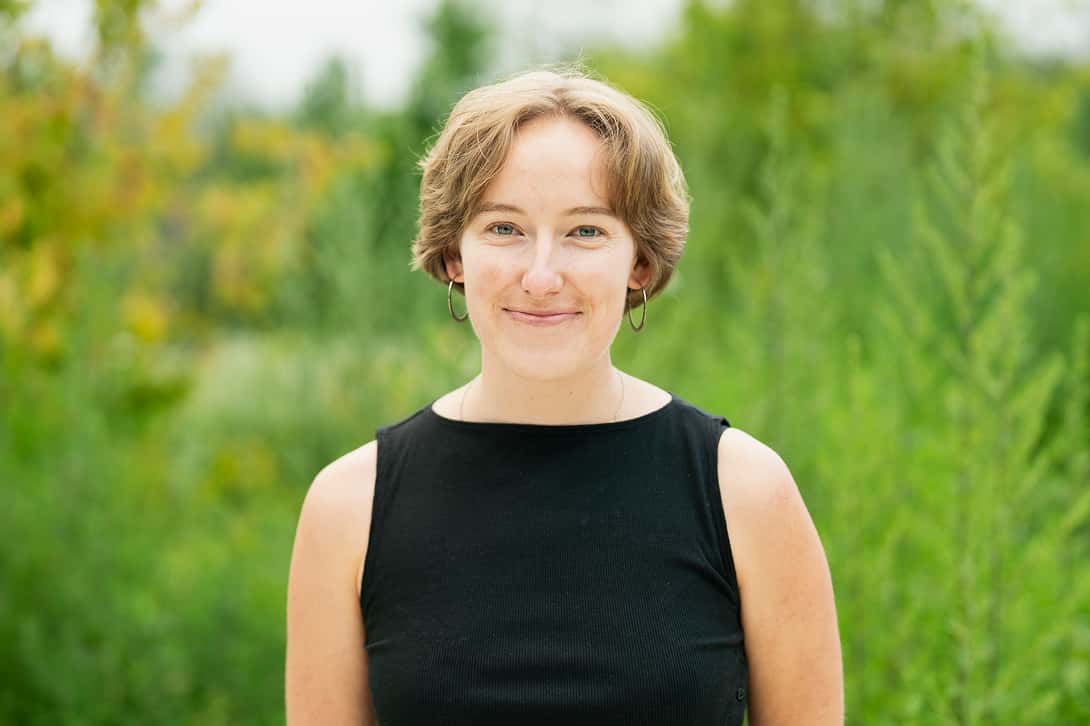
Los Angeles and Maine. Art and science. Cities and nature.
From a young age, Ingrid Sant ’21 has woven between these different worlds, exploring the questions, tensions, and ultimately, the interplay between them.
With a background in research and communications across the climate sector, her work explores contemporary human–place relationships to advance more resilient urban systems for the future.
Now a recent graduate of the M.S. program in environment, culture, and society at the University of Edinburgh, Sant is embarking on the next step in her interdisciplinary journey: Colby’s seventh annual Summer Institute in Environmental Humanities (SIEH).
The institute, which began July 27, is a weeklong gathering of scholars who, through seminars, workshops, and excursions from Waterville to Allen Island and Colby’s Island Campus, aim to explore relationships between humans and the natural world.
“It’s not very often that you get a bunch of environmental humanities people in a room together,” Sant said. “I’m really excited to meet folks from all over the world and from so many different disciplines.”
Her goal for the institute is to continue her work on urban ecology, a topic that combines natural science, cultural history, and personal connection to place. While she began her current project—a nonfiction essay about the diverse ecosystems of California’s Venice Beach—as a master’s student, its roots reach all the way back to her childhood.
Though she grew up in California, Sant spent her childhood summers swimming in the brisk waters and hiking in the dappled woods of mid-coast Maine with her family. This not only instilled in her a deep and lasting relationship to the state and its wilderness but also revealed to her from a young age the preciousness of having access to nature, especially coming from an urban environment.
Sant also attended a Waldorf school, known for its emphasis on holistic learning, creativity, and nurturing the childhood imagination, from ages 5 to 12. “It was a very unique early childhood education,” she reflected, “especially for a kid in Los Angeles. That experience really informed my interest in connection to nature within an urban context, and finding ways to express myself through creative media.”
Those two threads—art and the environment—as well as her existing ties to Maine and its natural beauty, are what drew Sant to Colby. “It was the only school I looked at that had really strong resources in both fields,” she said, “and I could tell that getting outdoors was an important part of the campus culture; that was another piece I was looking for.”
Art and environment
At Colby, Sant pursued a visual arts minor and environmental policy major. Throughout her four years, a multitude of courses, experiences, and professors had an impact.
Within the art minor, Sant cites Assistant Professor of Art Amanda Lilleston’s printmaking class as memorably hands-on and experimental, while Professor of Art, Emeritus Gary Mitchell’s courses empowered her to explore new media and develop what would ultimately become the visual side of her senior thesis. That project, titled “Loss, Hope, and Speculation: Imagining Environmental Futures through Climate Fiction Art and Literature,” included both mixed media illustrations and short stories about how humans experience environmental change at a local scale.
On the environmental side, Sant credited Gail Carlson, associate professor of environmental studies, for helping her discover a passion for the intersection between human physical and mental health and the environment. This discovery, together with Associate Professor of Environmental Studies Alison Bates’s environmental policy capstone course, led her to prioritize a justice lens in her work.
‘I was really interested in this idea of place writing and personal connections to places as a lens for reaching people emotionally in times of environmental change.’
Ingrid Sant ’21
Sant also cites two Jan Plan experiences studying coral reefs in Bermuda and Belize as solidifying the importance of experiential learning as both a social and academic priority in her life.
Chris Walker, assistant professor of English, also made a great impression. “I’d been searching for the language to describe the lens that I had on environmental work,” she said. “I wanted to incorporate art and storytelling and literature and poetry and philosophy. When I took Chris’s environmental humanities class, I realized, okay, this is my thing.”
A senior year elective with Michael Burke, professor of creative writing and English, emeritus, also helped her discover a passion for creative nonfiction, specifically “place writing”—or writing about human connection to a particular location, region, or physical space. “All these things that seemed like disparate threads continued to weave together all the way through my Colby education,” she said, “and later through my career and my master’s education.”
A move to Scotland
After graduating from Colby, Sant spent three years in Washington, D.C., on the climate team of the strategic communications firm FGS Global. In this role, she worked with climate NGOs, companies, researchers, and activists to amplify stories of local action and global transformation.
With this experience in the climate sector and a growing desire to return to a more humanistic lens on the climate crisis, Sant embarked to Edinburgh, Scotland, in August 2024. There, amongst the grand limestone buildings and grey-green cityscape, she began her master’s in environment, culture, and society. “The program challenged every convention I had about the structures and systems I’d taken for granted as being immovable in terms of environmental policy and change,” she said.
The master’s program offered a lot of flexibility, allowing her to study topics ranging from marine environmental policy and planning to political ecology and theoretical frameworks around how humans value and relate to nature.
‘Take note of what excites you and what makes you tick—because you never know how the things you’re passionate about can lead to a career.’
Ingrid Sant ’21
Her master’s culminated in a creative nonfiction writing dissertation exploring the ecosystems, both natural and synthetic, that define her home city. Drawing on childhood experiences in Venice Beach, as well as research on how the landscape has informed the city’s culture and evolution, Sant wrote four essays combining emotional affect, memory, and urban history research to explore various forms and scales of change.
“I was really interested in this idea of place writing and personal connections to places as a lens for reaching people in times of environmental change. Not just climate change, but also urban transitions, like gentrification,” she said. “My research also revealed who gets left behind in those transitions—it pulled together a lot of things that I’d been thinking about for years, and I enjoyed having the opportunity to think about my childhood through an academic lens.”
Coming back to Colby
Her goal for the Summer Institute for Environmental Humanities is to workshop components of her dissertation into a single long-form essay for publication. She also hopes to gain inspiration and direction for her broader research interest in urban ecologies, particularly human-centered urban design and storytelling at the nature-culture nexus. “I’m working on a few projects right now focused on reclaiming public spaces in cities for people over cars,” she explained, “exploring the potential to create more thriving urban ecosystems for both the environment and human well-being.”
When asked what advice she has for current Colby students, Sant emphasized the importance of nurturing strong relationships with faculty and maintaining them throughout their Colby experience and beyond. She also said, “Take note of what excites you and what makes you tick—because you never know how the things you’re passionate about can lead to a career.”


