When Sights are Smells, and Words Have Tastes
Sophia Hausladen ’27 is using a grant from Halloran Lab for Entrepreneurship to build an app to identify and understand synesthesia
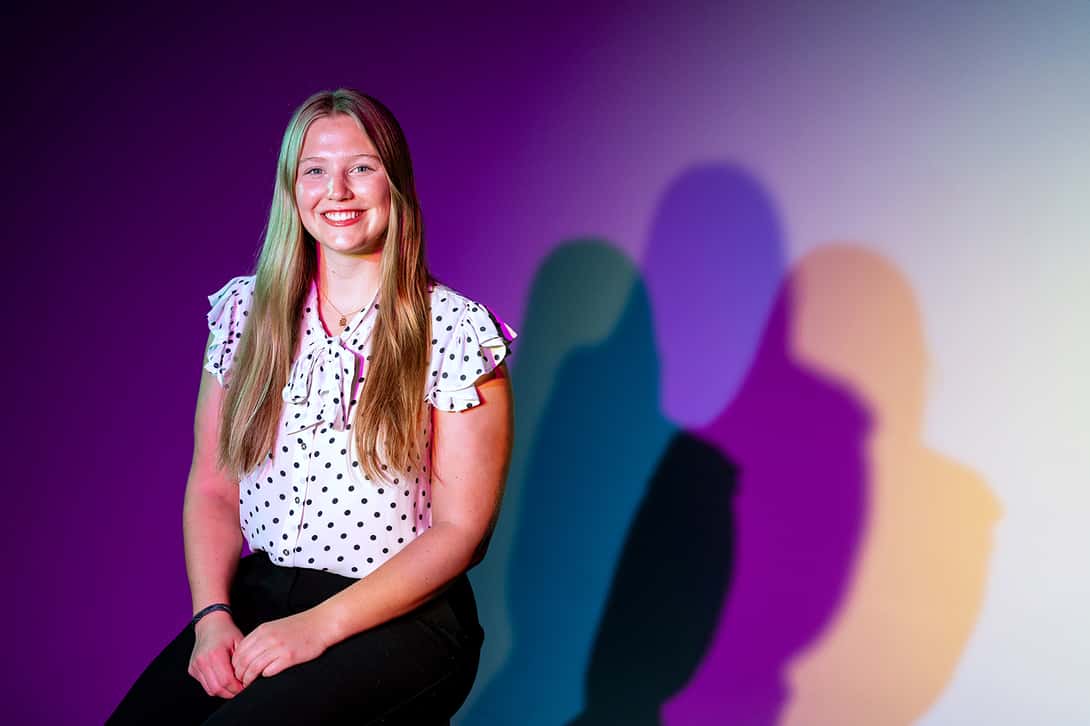
We all know the five senses: sight, sound, smell, taste, and touch. But for about 4 percent of the global population with synesthesia, these senses get mixed up—for example, words may have a specific taste, or a color may smell a certain way.
“It’s a combined sensory experience,” explained Sophia Hausladen ’27. “The most common we see is when people report hearing a color or tasting music. There are two different kinds of synesthesia, so-called projectors, which actually physically experience the sense changes, and associators, who mainly experience this phenomenon in the mind’s eye.”
Hausladen, a pre-med chemistry and Spanish double major, first encountered synesthesia after her Global Entry Semester in Salamanca, Spain. “My host family was so wonderful,” she said, thanking Dominika Wojcik, a psychology professor at the Universidad de Salamanca, for the family’s hospitality. “We stayed in touch, and she offered me a research internship during my sophomore Jan Plan, to return to Spain to research episodic memory and embodied cognition as it relates to synesthesia.”
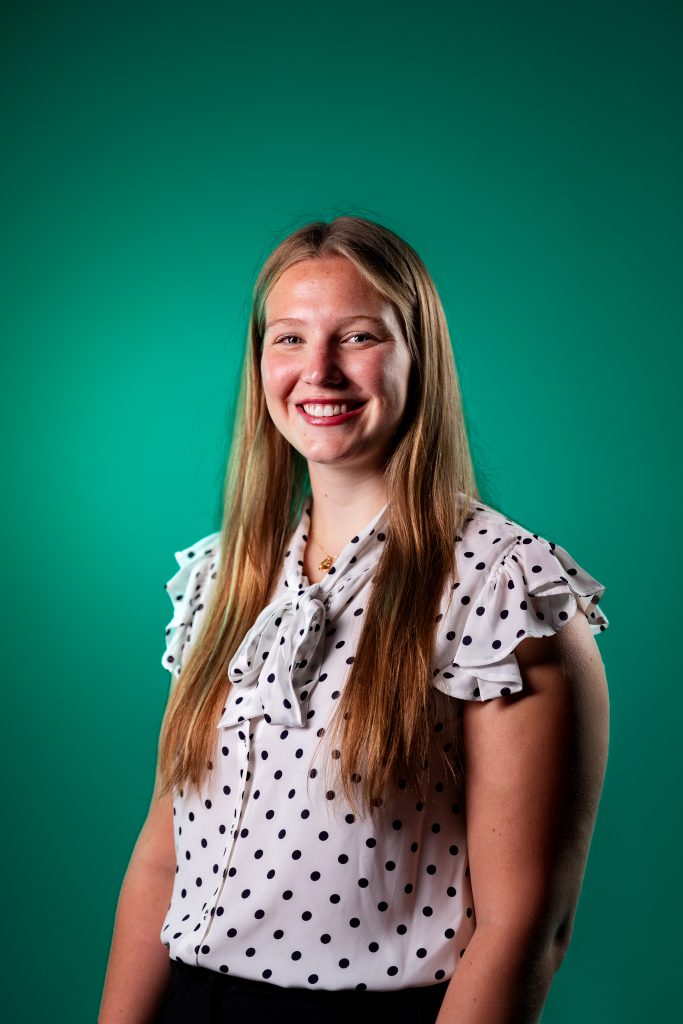
But Hausladen ran into a major roadblock: There’s no unified test that accurately identifies it.
That Jan Plan became the start of a multi-year project to understand how synesthesia relates to memory-making. “I wanted to build something that could capture the 19 different types of synesthesia consistently, in multiple languages, because right now, researchers like Dominika don’t have a great way to do this,” Hausladen said. “My ultimate goal is to make this test accessible to everyone, freely available for research and the general public. The more data is available, the more progress we can make in this memory research.”
Halloran Lab for Entrepreneurship grant
Hausladen submitted the project to Associate Professor of Computer Science Nasar Al-Madi’s Entrepreneurial Software Engineering course in fall 2025. That process helped her put together a preliminary grant proposal for Colby’s Halloran Lab for Entrepreneurship.
“It’s our job at the lab to think more broadly about entrepreneurship and innovation, so we can provide a pathway for any student with an idea just like this one,” said Jon Godbout ’08, the lab’s deputy director.
“I’m not an economics major, and I’ve never had an experience like this. It was so outside my comfort zone,” Hausladen laughed. “But it was an amazing process, and I felt so supported. Coming to the business world from more of a STEM background, there was so much I didn’t know about bringing my vision to life.”
Her first proposal won the $500 Carr Ideate and Explore Grant during her junior year, giving her enough funds to hire Tín Nguyen ’28, a student from the computer science course, to start the technical buildout. “After the class ended, there were still a lot of ideas and energy left in me for this project,” he said. “Making science more accessible to the public is where my interest is at, so the idea of building a place where this dataset can be of use is so rewarding.”
Then, Hausladen took the Halloran Lab’s one-credit entrepreneurship course, Start or Scale: Ideas to Impact in 11 Weeks, to continue to hone her idea. This culminated in winning the $5,000 Compagna-Sennett Iterate and Expand Grant to finish the project.
“Once you’ve gotten an idea that’s taking form, and you know what you want to do, this course helps you build a minimal viable product and get ready to pitch,” explained Godbout. “We offer several grants to financially support students starting a business, but we also serve as a connector, helping students find mentors in their field, offering programming and workshops on different topics in addition to our one-credit courses, and one-on-one advising.”
Interdisciplinary collaboration
Now, Nguyen, a computer science and environmental policy double major, is using that grant money to finish building the app’s technical side. For Nguyen, this project has been a great way to explore new coding techniques outside of class. “I’m learning so much as I go,” he said. “There’s this sweet feeling of understanding and achievement of going from ‘knowing about’ to ‘understanding’ these software development concepts.”
‘My ability to do this was so completely unique to Colby, and I’m so grateful. I found this opportunity through the connections I made in my Global Entry Semester, and Colby has helped me every step of the way. It’s been an incredible experience.’
Sophia Hauslanden ’27
An interdisciplinary project such as this is where Colby’s liberal arts model shines. Said Godbout, “The number one skill Colby will teach students is how to learn new skills and how to think critically. A true innovator and entrepreneur needs curiosity, and they need to get up to speed fast and improvise. Sophia excels at this.”
This project has only solidified Hausladen’s desire to go to medical school. “My ability to do this was so completely unique to Colby, and I’m so grateful,” she said. “I found this opportunity through the connections I made in my Global Entry Semester, and Colby has helped me every step of the way, from receiving funding to return to Spain to do additional research, to learning how to take a multidisciplinary approach to bringing this app to life. It’s been an incredible experience.”
Said Hausladen, “Everyone at Colby has been so helpful, from my mentors at the Halloran Lab to working with the Psychology Department to answer my questions or the Computer Science Department to help build it. I’ve learned so much, and it’s made me excited to build a team and make this project happen.”
Added Godbout, “We’re super proud of Sophia and can’t wait to see the project progress and evolve.”