Meeting the Asian Century
Restructured East Asian curriculum prepares students for an international future
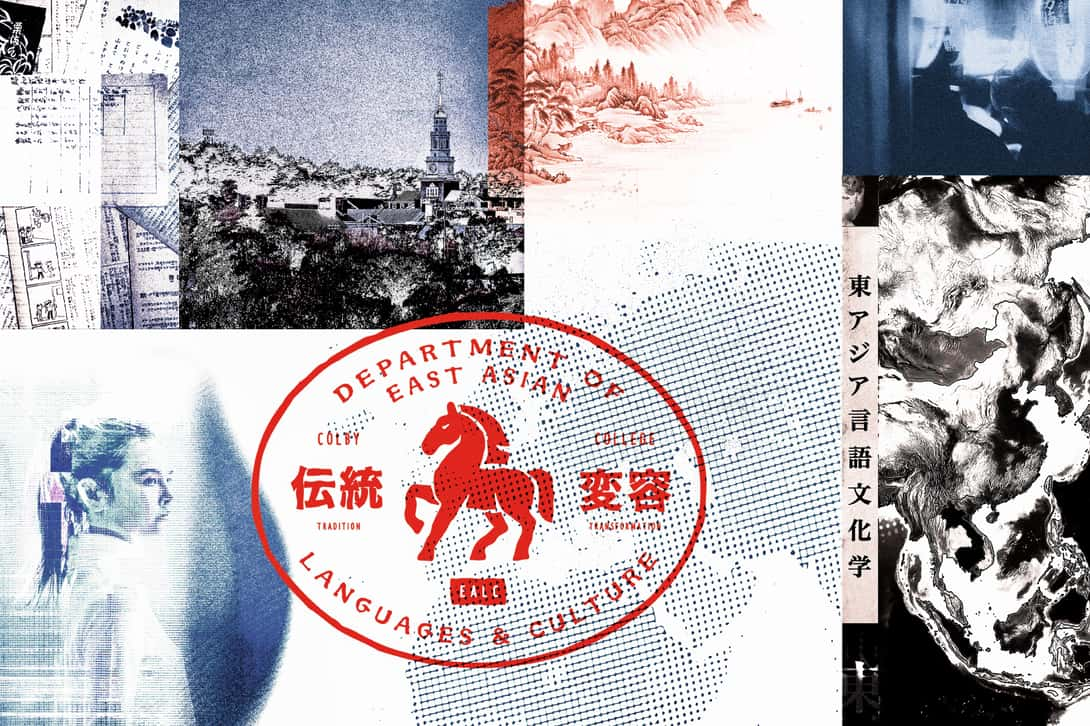
As the nations of China, Japan, and South Korea increasingly dominate the global technical, economic, and cultural landscape, many call this the Asian Century.
Sixty years after becoming the first liberal arts college to offer a major in East Asian studies, Colby has restructured its curriculum to prepare students for this moment.
Beginning this academic year, students can now major in Chinese or Japanese, previously offered as minors, and in East Asian languages and cultures, a cultural studies major with a light language requirement. The majors provide students with the intellectual and linguistic skills required to understand and engage with this region.
Requirements for the majors have also been streamlined, making it easier to double major—an increasingly popular choice at Colby—or declare two majors within the department.
“We are now in a better position to meet the needs of students in a way that recognizes that different students have different goals when they want to study East Asia or an East Asian language,” said Laura Nüffer, an assistant professor in the newly renamed Department of East Asian Languages and Culture.
“We see the department as essential to making Colby a global institution that prepares students for an international future,” said Nüffer.
“Whatever the future holds, certainly Asia is going to play a massive and outsized part in shaping the course of the decades to come.” Creating pathways for students to understand, encounter, and engage with the region is a critical part of a liberal arts education, she emphasized.
A department rethinks its future
The restructuring aims to attract more students to East Asian studies and provide more opportunities to master Chinese and Japanese, both difficult languages to learn.
The yearlong planning process included conversations with current and former students, comparisons with other Colby academic departments and peer institutions, a Board of Visitors review, and a shared vision among the six department faculty members.
It brought the small team together in a new way.
“I think we feel united in promoting the study of East Asia,” said Ankeney Weitz, the Ziskind Professor of East Asian Languages and Cultures, who led the process last year as department chair.
‘Whatever the future holds, certainly Asia is going to play a massive and outsized part in shaping the course of the decades to come.’
Laura Nüffer, Assistant Professor of East Asian Languages and Culture
The department also sponsors a wide array of activities outside the classroom and promotes study abroad to expose students to East Asian culture. Learning about another culture goes beyond specifics about East Asia. “It’s about learning about difference, learning that your values and approach to life aren’t the only way it can be,” said Weitz. “It opens people’s minds.”
The department’s vision couldn’t be clearer.
“It’s really important,” said Weitz, “that we train our students to be more knowledgeable about other regions of the world.”
The power of language
Strong demand for the department’s language programs also prompted the shift.
“The minors in Japanese and Chinese were very popular,” said Weitz, noting that many students exceeded minor requirements. The new major allows students to deepen their language proficiency while building intercultural competency through language, she said.
Language study is also increasingly important as AI language apps and chatbots proliferate. “There’s an idea that you can communicate through a digital app, but in real human-to-human contact, it doesn’t work,” said Weitz. Artificial intelligence cannot replicate direct, effective communication.
“In learning language, you learn not just grammar. You learn a lot of cultural material. Language also has a physical aspect. There are things that we do when we’re speaking a language that a computer can’t do, and that convey certain ideas, feelings, and human competencies that a machine can’t have,” said Weitz.
“We feel very strongly about the power of language learning to equip our students with something that will be valuable as more and more tasks are taken over by artificial intelligence.”
One student’s story
After the department announced the option of a major in Chinese and Japanese, several students immediately switched from a minor to a major, including Alyson Mina ’27.
“I was all for it,” said Mina, who initially minored in Chinese to focus on the language and didn’t have room in her schedule to major in East Asian studies alongside her biology-neuroscience major. However, a Chinese major was doable since she was only a few classes away from the requirements.
Having the word “major” next to “Chinese” on her diploma will give her immense satisfaction and pride.
“It exemplifies all the time and effort I’ve put into this,” said Mina, a Chinese adoptee from Portland, Maine, who came to Colby in part because it offered Chinese. Without any prior exposure to the language, Mina had a rocky start in her 100-level courses, but now she is taking 400-level courses and is mostly conversationally fluent in Chinese. A Jan Plan in Beijing and a semester abroad in Taiwan also boosted her skills and confidence.
”It’s crazy to look back and be like, ‘Wow, I never thought I’d make it,’ but here I am,” said Mina, who now mentors younger students and is on the department’s Student Advisory Board.
Importantly, the opportunities have helped her to embrace her heritage.
‘Since coming to Colby and majoring in Chinese, I have felt more comfortable saying, “I’m Asian. I am part of this community.” It has really been a huge shift in my identity.’
Alyson Mina ’27
Implementing the vision
While the department’s vision may not come to fruition for a few years, early signs are promising, Nüffer said, as more students declare majors and take courses in the department.
High demand for some courses led to long waitlists, prompting both professors to raise enrollment caps on popular survey courses: Weitz’s Zen and the Arts and Nüffer’s Gods, Ghosts, and Goblins: Japanese Mythology and Folklore. The tradeoff of larger class sizes was worth it to expose more students to the region.
Ideally, every student who graduates from Colby would have some exposure to East Asia in their coursework, Weitz said. But not necessarily through her department. “We want to see Asia permeate the curriculum more broadly,” whether through research agendas, case studies, or new faculty hires.
“Imagine somebody in the Environmental Studies Department who looks at environmental issues in East Asia. That would be great,” said Nüffer optimistically. Other departments that could incorporate East Asia studies include economics, art history, statistics, and government.
To make that happen, Nüffer and her colleagues will need to proactively and informally educate others across campus about their vision.
“We want to reach out and encourage them to include it in their curriculum or to think about how a search could be done to bring East Asia into that department,” Nüffer said. “The vastness of East Asia is such that there is meaningful crossover in so many ways.”


