Introducing The Colby Review
Writer-in-Residence Zach Peckham and 23 student editors band together to create a brand-new, student-led literary journal
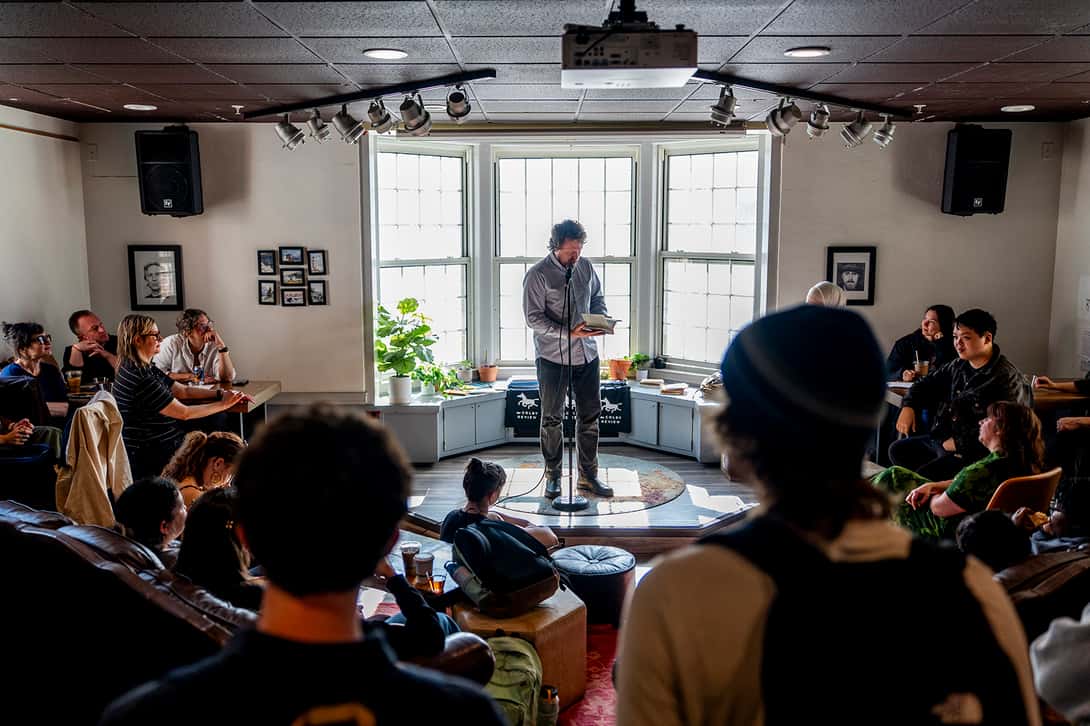
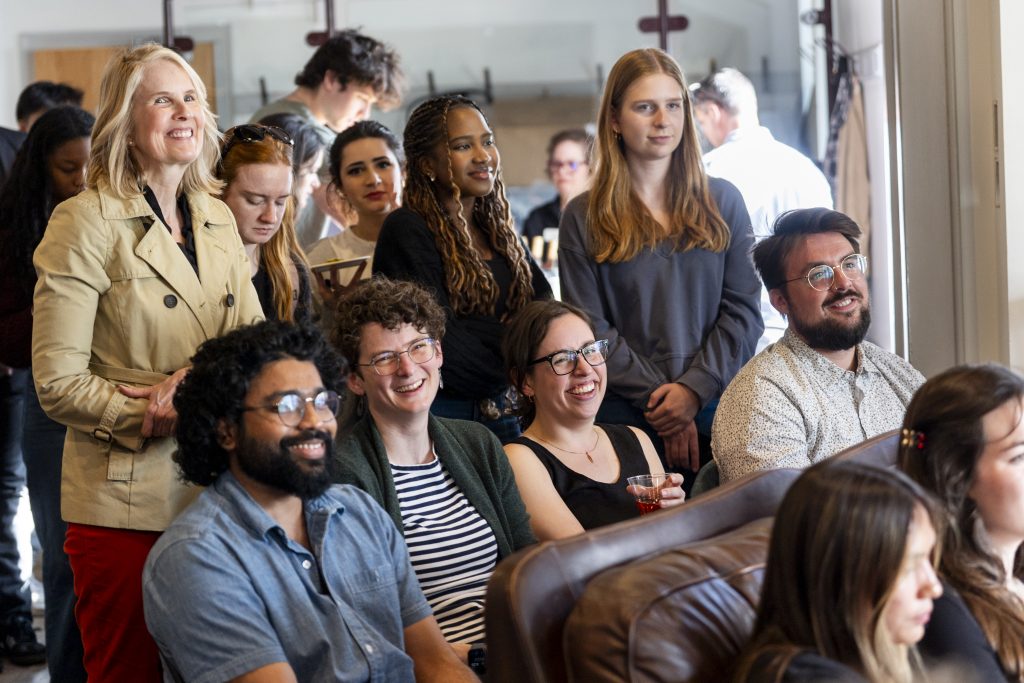
Zach Peckham earned this launch party. The standing-room-only crowd in the Mary Low Coffeehouse. His colleagues peppering the room. Students jockeying for space, juggling iced matcha and chilled cold brews. Even the sunlight streaming through the bay window felt deserved.
Everyone was fired up, and the buzz wasn’t from the caffeine.
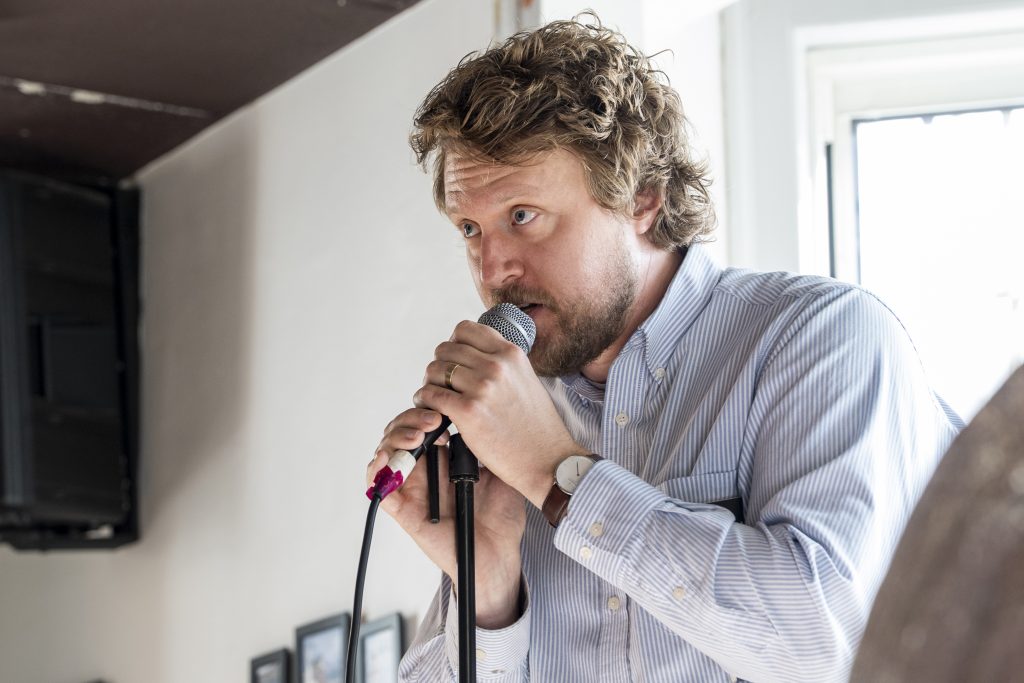
Peckham approached the mic, his sandy hair slightly ruffled from the heat and energy. “I came here this year to teach editing and publishing courses and to make this object,” he declared jubilantly, holding up The Colby Review, a brand-new, student-led literary journal published by the Creative Writing Program. “I guess we were successful—we have an object!”
As faculty editor of The Colby Review, he had been anticipating this moment for months.
“I’ve had the time of my life getting to be here with you all,” said Peckham, his yearlong residency nearing its end. “And what we put together here is messy, and cool, and confusing, and fun as hell.”
The inaugural issue of The Colby Review is available in hard copy and has an online presence.
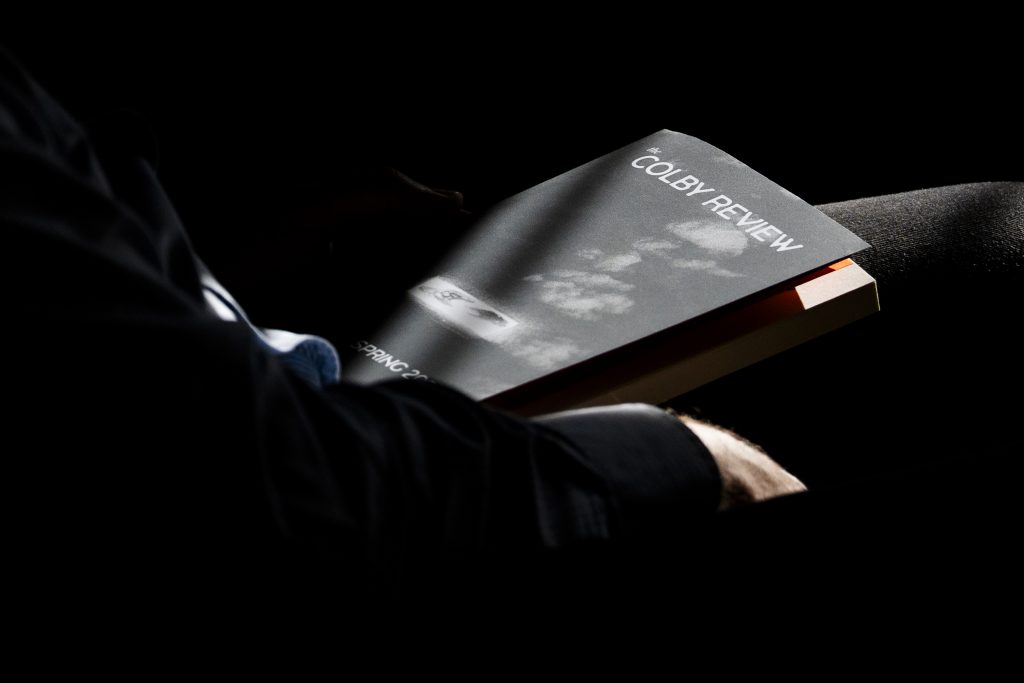
When Peckham arrived at Colby last fall as the Jennifer Jahrling Forese Writer-in-Residence, he envisioned creating a literary journal, but he wasn’t sure if or how it would work. But, together with 23 students he empowered as editors, he found a way. The 200-page journal was proof.
So was this launch party, an event celebrating writers, readers, and editors, and what Peckham hopes is an annual publication. He recently received a one-year appointment as a visiting assistant professor and will offer the course next year.
“There’s an appetite and, I think, a need for this,” he said, reflecting on what he discovered about student interest in this project. “What we found out with this magazine is that you really can just put undergraduate editors in the driver’s seat, start from zero, and get somewhere cool.”
Laying the groundwork
Literary magazines have been outlets for showcasing poetry, fiction, and creative nonfiction in the United States since the 18th century. Still relevant in the 21st century, they reflect social trends, institutions, or specific communities, creating a space for new ideas and emerging writers to reach broad audiences.
Peckham is well-versed in literary magazines as a poet and essayist. He previously taught literary editing and publishing as well as creative writing, literature, and composition courses to undergrad and graduate students at Cleveland State University and the Cleveland Institute of Art, and he runs the journal Coma and the small press Community Mausoleum. He has also previously served as editor-in-chief of the Cleveland Review of Books and managing editor of the Cleveland State University Poetry Center. During the fall 2025 semester, he drew on these experiences and taught a course at Colby titled Literary Editing and Publishing, where students learned “about the structural dynamics and social histories of literary publishing and cultural production,” he said.

In the spring semester, he taught a companion course, Literary Magazine and Publishing Lab, with the goal of creating The Colby Review and giving students an active role in its tone, content, and cultural relevance.
“With this project, it was really about putting students in a position of responsibility. Of saying, ‘You’re all editors,’” said Peckham, who structured the course as a practicum. “And then really just figuring out, how do we build something that serves a learning lab function for editing and publishing, while also representing the program or representing the College, but not in a direct way.”
Ambitious, serious, and global
Students agreed that as editors, they would honor creative risk-taking, said Sama Fattah ’29, an emerging poet, writer, and Scholastic Arts and Writing American Voices Medal nominee who hungered for the type of experience Peckham’s course offered.
“I know Colby as an innovative liberal arts college, and we are always taking intentional and bold risks,” said Fattah, a Pulver Science Scholar and a double-major in sociology and biology: neuroscience from Tampa, Fla. That meant making room for marginalized voices, she said. From Peckham, Fattah learned that literary magazines often “foster creative voices in a world that doesn’t necessarily accept them all the time.”
The students also decided that, to be a serious literary journal, The Colby Review would not include student work. Not their friends’ nor their own. Peckham said he was struck by the students’ instincts about editorial ethics, and that they “innately understood” the reasons behind this decision.
“The approach that we’ve taken,” said Fattah, “is we want creative risk-taking, and we want intellectual craft to emerge, while appreciating the student editors’ very divergent perspectives.”
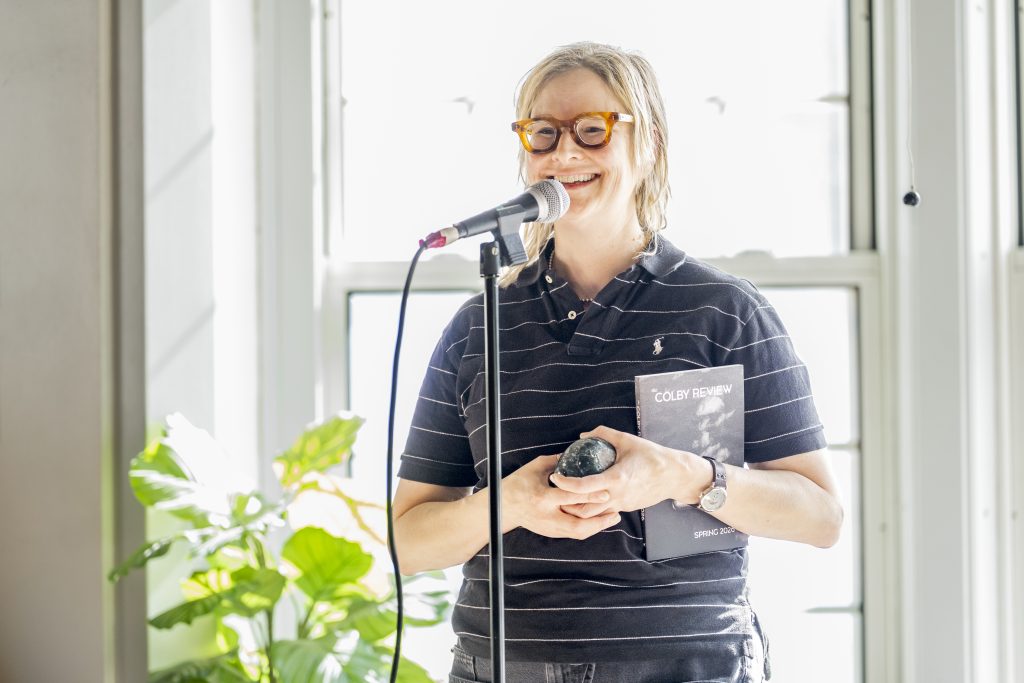
The goal of the project was to be ambitious and push beyond the local community, said Peckham. Along with his Colby colleagues, he solicited submissions from writers they knew. He also advertised on Duotrope, an online service connecting writers and artists with publishers.
About 150 submissions from around the world came in, a number Peckham found respectable for a first-time journal. The class did an initial round of blind readings. Their simple “yes,” “no,” or “maybe” votes sorted submissions into finalist, semifinalist, or rejected categories.
Peckham then split his students into three teams—fiction, poetry, and creative nonfiction—and let them determine which submissions would make it into the journal. As faculty editor, Peckham read each submission and pointed out things he thought may have been overlooked, in service of the editorial conversation, he said.
The clock was ticking. It was March 1, and they needed to get files to the printer within a month. The class met only once a week, and in addition to reviewing submissions, students needed to sequence the magazine, create a table of contents, typeset submissions using desktop publishing software, design a cover, and perform other associated tasks.
A good kind of chaos
“Having to do an unwieldy amount of work in an unrealistically short time period was something I wanted to lean into,” said Peckham, hoping to underscore to students the reality of deadlines.
While Peckham provided guidance and structure, it was up to the students to find consensus, collaborate, and agree to disagree, tasks not always easy with multiple editors. They decided, however, to embrace the situation and “let the chaos coalesce into a process that they made together,” said Peckham, noting that differences of opinion are valuable and instructive.
The students found the process delightfully challenging and time-consuming, especially since it was their first time as editors, and they embraced a non‑hierarchical structure that pushed them to collaborate genuinely.
“We were trying to figure out how to organize a lit mag that’s so deeply entrenched in the idea that everyone’s perspective is equally valued,” said Fattah, who was on the poetry team, which had the most submissions. “We were very open, and no submission maintained consensus from all the editors,” she recalled. “But that’s kind of the point of a literary magazine. We’re supposed to showcase that divergence.”
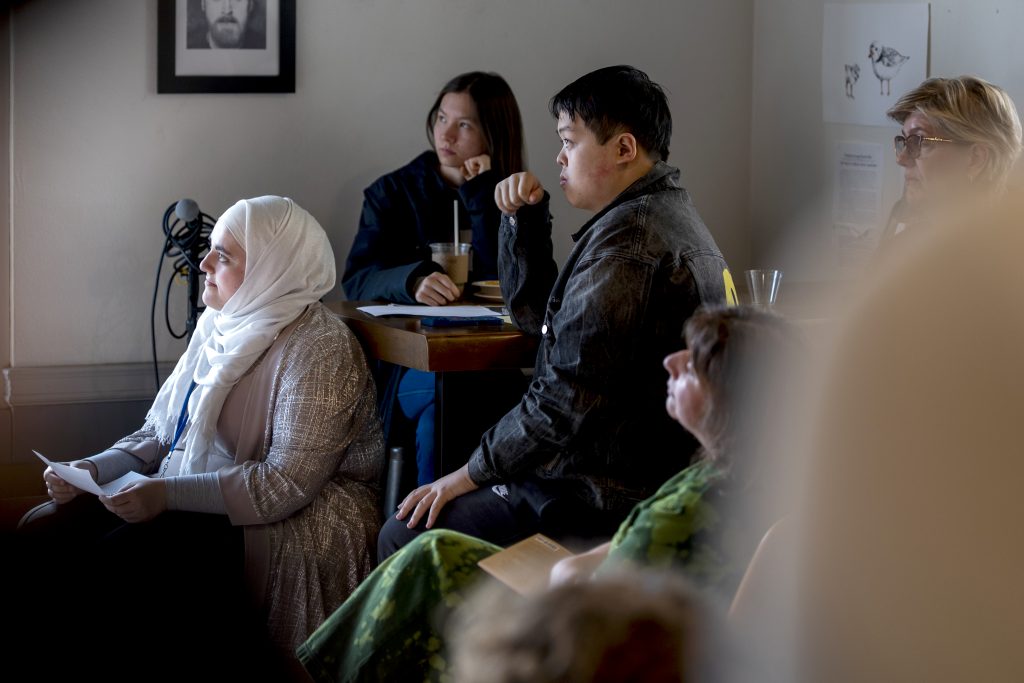
Brooke McCraley ’28 was also on the poetry team. She said the team found poems that were “unique and strange, rather than just conventionally nice to read.” In other words, pieces that pushed the edge. “That’s quite defining of the small literary magazine. So, I think that was successful.”
Editors’ notes
McCraley and Fattah were two of four students who volunteered to write an editor’s note, which Peckham compiled onto one double-sided sheet and inserted into the journal.
In her editor’s note, McCraley likened the magazine to the birth of a child. “This very first issue of The Colby Review has been through a tumultuous adventure. She is hot off the press, and as her new parents, it is our pleasure to announce her to the world,” wrote McCraley, a government major from Bellevue, Wash., with a creative writing minor.
McCraley wanted to have fun with her editor’s note. “I was jonesing to do something a little abstract and weird,” she said. McCraley is a serious writer who, as a high schooler, participated in programs for young writers through Kenyon College and the University of Iowa, both of which publish prominent literary journals.
Her editor’s note is crisp and snappy, occupying a long, thin column on the insert.
“She is hurried and dusted by wind, but like all works of poetry and fiction and literature of each sort, she is meant to be heard,” McCraley wrote of the journal.
The goal of the editors’ notes was, in part, to explain the process. For McCraley, “part of the experience was just how rushed it was and how we were really experimental and trying things for the first time. I wanted to convey that.”
Looking forward
The Colby Review is self-distributed, with students filling orders, addressing envelopes, and processing payments. It’s all part of small-press publishing, said Peckham.
To publish a magazine, Peckham said students have to do—or at least know about—everything else that goes with it: events, marketing, social media, and introducing a writer at a launch party in a compelling way. While these tasks typically aren’t available until graduate school and M.F.A. programs, Peckham is eager to give Colby undergraduates the opportunity to learn them.
“There’s no formal professional path to becoming an editor or working in publishing,” he said. “It’s almost like an apprenticeship or mentorship, a vocational kind of path.”
For at least one more year, Peckham will introduce the art form to another batch of students.
“As long as I’m here, and as long as the College supports this, we’ll keep putting them out,” said Peckham, who is thinking strategically about how to fund the project with an established budget. This year’s journal was funded by Trustee Emeritus Jamie Forese and Jennifer Forese, who supported the establishment of a website, printing costs, the creation of ephemera such as stickers and cloth bags, and the launch party, in addition to Peckham’s fellowship.
Staying involved and showing up
Fattah and McCraley are eager to be involved in next year’s journal, even though their schedules won’t allow them to join the class.
“As a creative writer, it’s something I want to continue,” said McCraley, who will be studying abroad next spring. “I really liked being part of the process, and I wish I were there for more of it. I just want more.”
Fattah feels the same and believes that student participation in a literary journal’s cultural production process is invaluable. Her experience was awakening and transformative.
“Every poem I read, it was like a conversation I was having with the writer,” she said. “I think it’s just really important to show up and care.”
At the launch party, people did just that. Showed up.
“It meant a lot for our emerging publication,” said Fattah. “I could finally see what we’ve been working for this entire semester materialize. It finally came into being.”


