Starting Careers on a High Note
How the Music Department prepares students to succeed in a world where music is often relegated to extracurriculars

There’s a special moment right before a piece of music begins. The upbeat, the breath—and then the magic happens.
Those few seconds represent the culmination of thousands of hours of practice. Running scales up and down, over and over. Picking through tricky lines. Jamming until you find the right riff. Scratching out one note for another. At Colby, students can combine a conservatory-style rigor in making music with an expansive, interdisciplinary approach to its academic study.
“We see the major as a holistic engagement with music,” said Associate Professor of Music and Music Department cochair Natalie Zelensky. “It’s not a conservatory, it’s not purely academic, but a synthesis of the two.”
When you think of music study, you’re likely imagining drilling Bach’s suites or analyzing Haydn’s Surprise Symphony. While the Western Classical canon is an important part of the curriculum, Colby emphasizes a broader approach. Students can choose between two types of music courses: applied musical practice, such as Jazz Improvisation, or academic study, such as A History of Rock ’n’ Roll.
“We’ve built a lot of flexibility into the program so it includes exposure to a variety of musical traditions, genres, and regions of the world,” said Zelensky. “Our hope through the curriculum is not just that students become a more proficient musician, but that they become a better listener. We want students to be able to talk about music and make the profound leap between a sound and meaning, and articulate that.”
A curriculum that addresses the ‘why’
All students start with an introduction to music and music theory, which focuses on training the ear and on learning how music is put together at the structural level. From there, they can explore a variety of genres and traditions and their impact on society, the environment, or the body. Zelensky’s ethnomusicology seminar, for example, invites students to apply anthropological methods to music around campus.

“The fundamental question of that course is, ‘How is music shaping Colby’s campus?’ So we’re thinking about the important work that music is doing in our everyday lives,” she said.
That includes everything from digital composition to AI-generated music and gender and sexuality in the classical canon. Students also have the freedom to create their own research projects based on their interests.
Often, students examine a topic they’ve learned about in other classes, but in an entirely new way. “It’s these kinds of projects that are beautiful examples of liberal arts at its best,” said Zelensky. “For me, what’s most exciting is building interdisciplinary connections for students, which makes these topics so much more vibrant. For example, in my rock history class, we talk about music’s essential role in the civil rights movement and countercultural protests of the ’60s. It’s rewarding as a professor to see students make those connections between classes and disciplines.”
Community building with performance
What makes the Music Department special is that even though there are 27 majors and 20 minors, more than 365 students participate in lessons and ensembles throughout the year.
“Music plays such a powerful role in students’ lives,” said Zelensky. “A large percentage of the student body comes through the Music Department, even if they never major or minor, because it’s so important to who they are as people.”
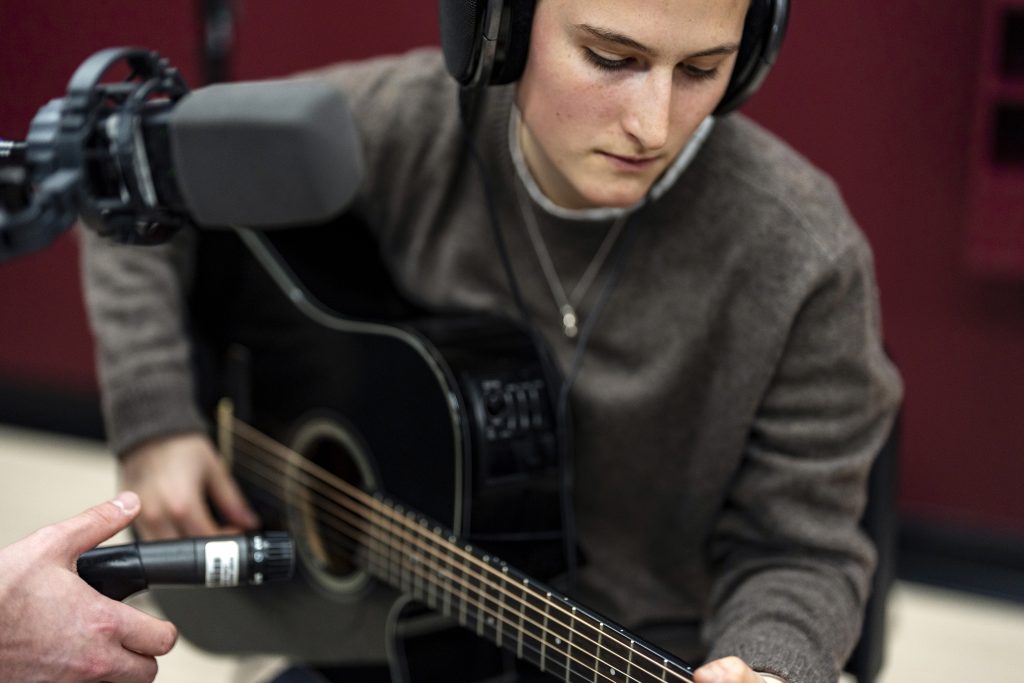
Some ensembles, such as the Colby Collegium or the Colby Symphony Orchestra, are audition-based. Students can also study on their own, with weekly music lessons in their chosen instrument, or hang out in student-run jam bands that practice at the Gordon Center for Creative and Performing Arts.
Said Zelensky, “We have some amazing music directors here, and our concerts are frequently filled to capacity. Our students are also performing at a high level. It’s a really important service that we do in terms of community-building, offering free concerts at a world-class arts center with strong performances.”
Both the ensembles and the academic study give students a foundation to pursue whatever they’re interested in after Colby, whether or not music is a major part of their careers. “Musicians have a solid work ethic. They can perform under pressure, and they have an incredible sense of focus. All of these skills are byproducts of studying music, so whether students are going to law school or med school or business, they’re applying the skills they’ve learned in a musical context.”
A career in musicology
As a double major in music and classical civilizations at Colby, Kendall Hatch Winter ’13 has always been interested in history. But it wasn’t until taking Zelensky’s course about women in music that she realized musicology was her calling.
“It was such a light-bulb moment for me my senior year, where I realized that’s how I wanted to spend the rest of my life,” said Winter, who is now an assistant professor of musicology at the University of Kentucky. “As a music major, I had taken music theory classes, composition classes, songwriting, and participated in ensembles, but it was the history and analysis that interested me the most.”
At Colby, Winter was always in some kind of rehearsal as a member of Broadway Musical Revue, Powder and Wig, and Colby Chorale. She also took independent voice and conducting lessons in addition to her academic coursework. “It was such a great bonding experience, putting on all kinds of performances,” she laughed. “I sort of had my fingers in every musical pie, so to speak, conducting, performing, composing, and singing.”
What she loved the most was just getting to try it all. “Colby never told me no,” said Winter. “Everything I wanted to do in music, my professors found a way to help me do it.”


