A Master Class in Wonder
Lynn Brunelle ’85 reflects on a career built by following her curiosity
When a gray whale washed up and died on a beach on Bainbridge Island, Wash., a few years ago, it was a sad event—and one that awakened a deep curiosity for Lynn Brunelle ’85.
The island resident found herself pondering a big question: what happens when the world’s largest animal dies? Because she is a writer with a gift for bringing scientific stories to life through meticulous research and clear, lyrical language, she was uniquely placed to find out.
In Brunelle’s quest for answers, she dove into academic papers and interviewed a range of experts, from pioneering researchers from the 1980s to those breaking new ground today. The result of her work was Life After Whale: The Amazing Ecosystem of a Whale Fall, a picture book she wrote and Jason Chin, a Caldecott medalist, illustrated.
People can’t dive all the way down to the ocean floor to see for themselves what happens when whales fall. It’s just too deep, with conditions too unsuited for human life. But through research and imagination, it’s possible to illuminate the ocean floor in a different way.
“We can shine a penlight down there,” Brunelle said.
Life After Whale follows a 90-year-old blue whale as it dies of natural causes and slowly sinks to the bottom of the sea. There, the whale’s massive body allows a new ecosystem to flourish, one that provides food and shelter for many other organisms.
Readers and critics appreciated the light Brunelle and Chin shone in the darkness, and last year, the picture book won the American Library Association’s Robert F. Sibert Medal, considered a top honor for children’s nonfiction in the United States. For Brunelle, an English major at Colby, it’s been a gratifying experience. She’s also been happy to offer another view of mortality to readers more accustomed to hearing about death as the end of the story.
“I think we get myopic. We see things as a straight line: we’re born, we live, we die,” Brunelle said. “But it isn’t a straight line. If you step back a little further, it’s a curve. The whale lives this beautiful, gorgeous, 90-year life, and then the materials that make up her body feed the next generations. It’s beautiful.”
A fountain of creativity
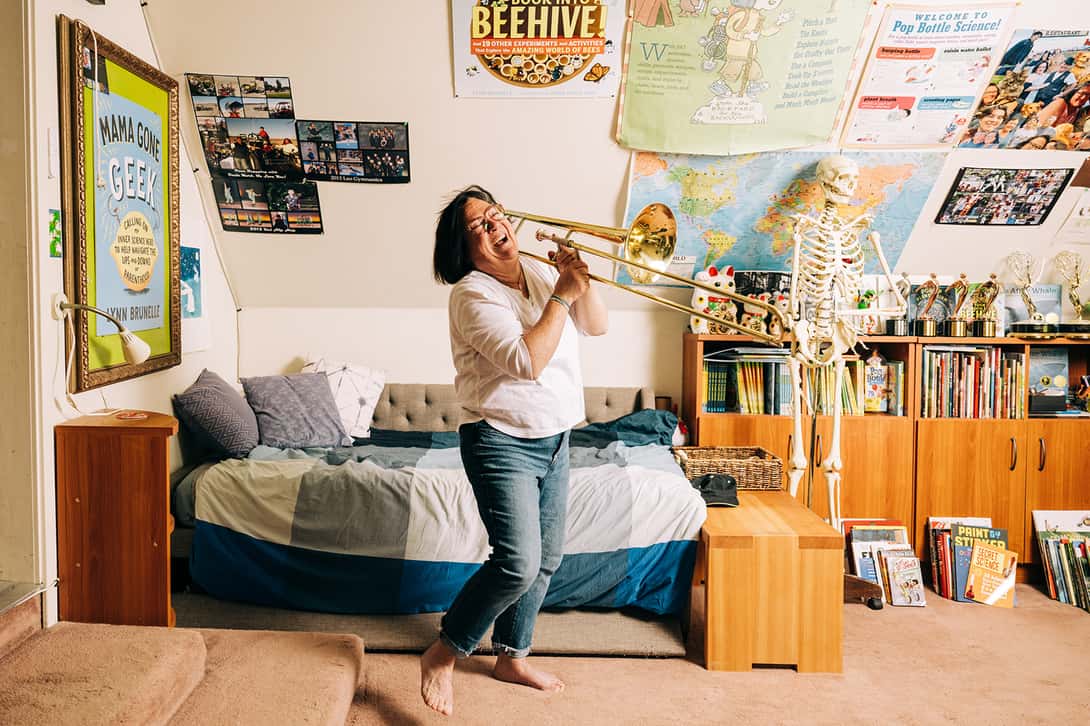
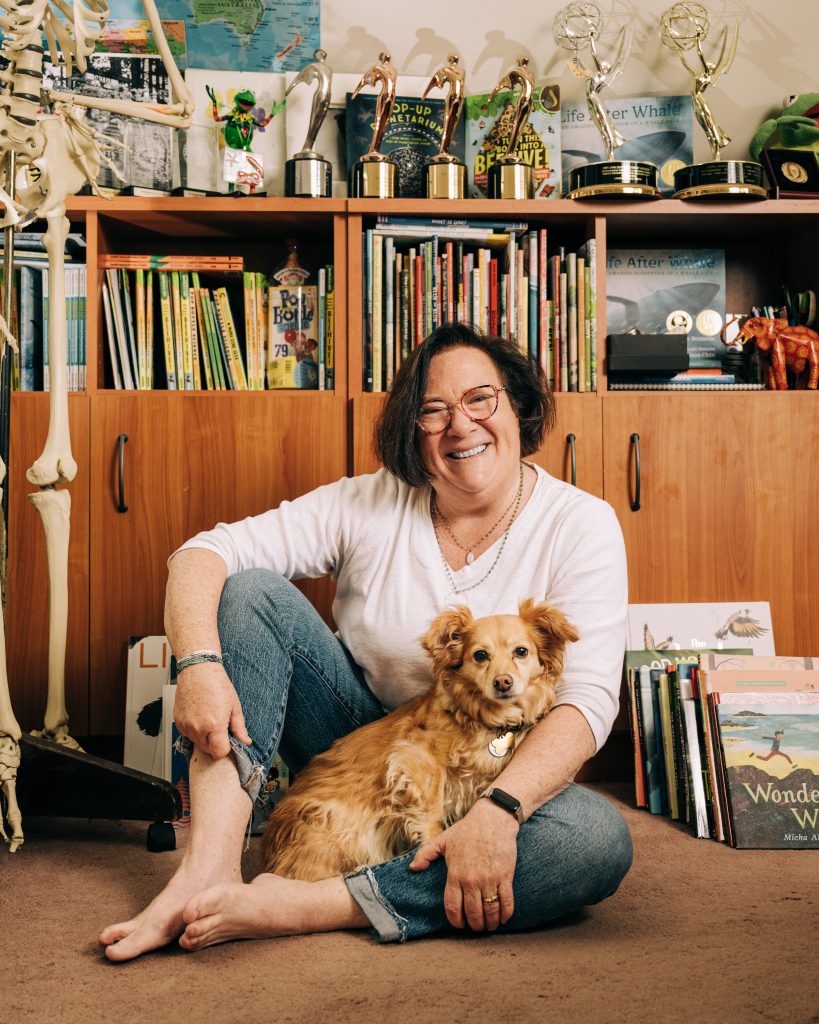
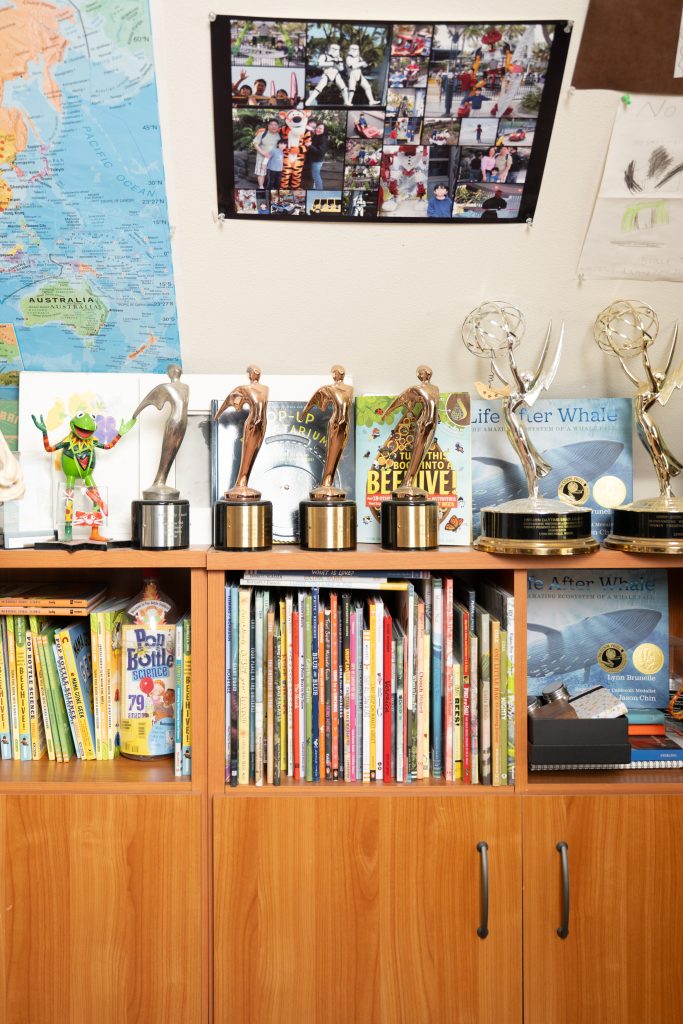
Brunelle has written more than 65 books and is a four-time Emmy Award-winning writer for Bill Nye the Science Guy. She’s created projects for entities that include National Geographic, Disney, Sesame Workshop, the Discovery Channel, NBC, NPR, PBS, and many more, and she has also won eight Telly Awards (which honor excellence in video and television), spoken at the United Nations about girls and STEM education, and been named an Island Treasure of Bainbridge Island. Her memoir, Mama Gone Geek, won the Independent Publisher’s Gold Medal Award.
In other words, Brunelle is a bubbling fountain of creativity—one who’s now working on a picture book about the physics of sound inspired by Yo-Yo Ma’s music, a book about America’s wild horses, and a sequel to her children’s book Haiku, Ew! Celebrating the Disgusting Side of Nature (which, delightfully, will be called Limer-Icks).
“Curiosity—that’s the whole thing. And the best kind of PB&J: passion, beauty, and joy,” she said. “If that’s behind what you want to learn, and want to do as a job, I don’t think it could be any better than that.”
Brunelle’s own story seems like a master class in embodying passion, beauty, and joy, though when she was growing up in Cape Elizabeth, Maine, she didn’t always feel that way.
“I was a nerd. I was not in the popular crowd,” she remembered. At Colby, though, it was different. Brunelle was a swimmer and reveled in academics, taking as many classes as she could in English, biology, and art history. Faculty, including the late Mark Benbow, Roberts Professor of English Literature, Emeritus; the late Charles Bassett, Lee Family Professor of American Studies and English, Emeritus; and Abbott Meader, professor of art, emeritus, expanded and unified her world.
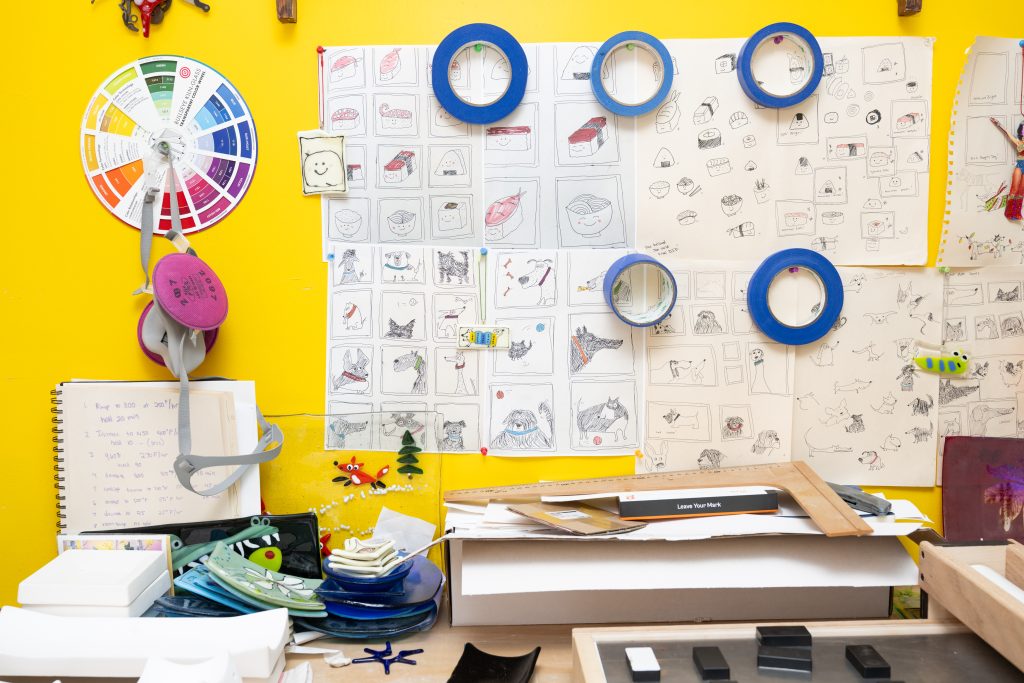
“I loved it because it all connected to me,” she said. “In education, we often separate it and say you’re a science person, or a word person, or an art person. But those are all different ways of looking at the same thing, and why can’t we braid them together?”
Forging a new path
Although she had come to Colby thinking she’d become a veterinarian, that path changed when she fell in love first with Shakespeare, then art. After she graduated, her first professional job gave her a blueprint for how to continue braiding her passions together. She was hired to teach in Cape Elizabeth, leading a classroom of 20 or so fourth- to eighth-grade students, all of whom had behavior problems so severe that they couldn’t remain in mainstream classrooms.
“Most were just acting out because they didn’t want to look stupid and they processed information differently,” Brunelle recalled. “And it was the making of me as a communicator.”
One student had a loathing of biology but a love of music. Brunelle wrote a song about the human excretory system, which helped the student learn the material and ace their test.
“People say they don’t like science. I will always say it’s not that you don’t like science, you don’t like how it’s been presented to you,” she said. “You didn’t have someone make it come alive for you, because if you’re interested in the world, you’re interested in science.”
From Brooklyn to Bill Nye
After a few years of teaching, Brunelle wanted to reach more people than she could in a classroom. So she moved to New York City to work in publishing, finding positions at Scientific American and then Workman Publishing. She edited and ghostwrote STEM books for kids, activity and craft books about the Muppets, and educational books about New York’s Museum of Natural History. For that job, she was given permission to prowl through the back corners of the museum’s massive collection. For a self-described geek, it was a dream come true.
“I went in the back, in storage, in people’s offices, pulling out drawers, opening things, seeing stuff that people hadn’t looked at for decades,” she said.
Brunelle made a career pivot in the 1990s after being inspired by the popular PBS education television show Bill Nye the Science Guy. It was funny, fast-paced, creative, and effective, and she wanted to be part of it. She applied to be a writer on the Seattle-based show, knowing it was a long shot, but producers asked her to send them a “spec,” or sample script, for consideration. They would take all the submitted scripts, remove the authors’ names, and then pick the three they liked the best. The producers would hire those writers for the season.
After calling a friend to find out what, exactly, a spec script was, Brunelle poured her heart into the project. She wrote a serious script, a funny script, a commercial parody, a music video, and more for submission. A long time went by, and she didn’t hear anything. Then she got a phone call from Bill Nye himself.
“I thought it was a joke. I was like, ‘Who is this?’” she recalled. “[Bill Nye] said that they had looked at more than 200 submitted scripts and chosen three. I was the writer for all three of them. He said, ‘So, can you come and move out here and write for me?’”
Doing good in the world
After quickly packing up her Brooklyn apartment, she and her cat moved to the West Coast. At first, Brunelle was intimidated by her new career and being the only woman in the writer’s room, but she soon found her place writing skits and song parodies, such as one about measurement that used The Police’s hit “Every Breath You Take” as a starting point.
“It was such a fun show to work on,” she said. “We sat around, and we just made each other laugh. It was anything-goes, and so much fun, and there were so many brilliant, talented people who worked on it. It still holds up.”
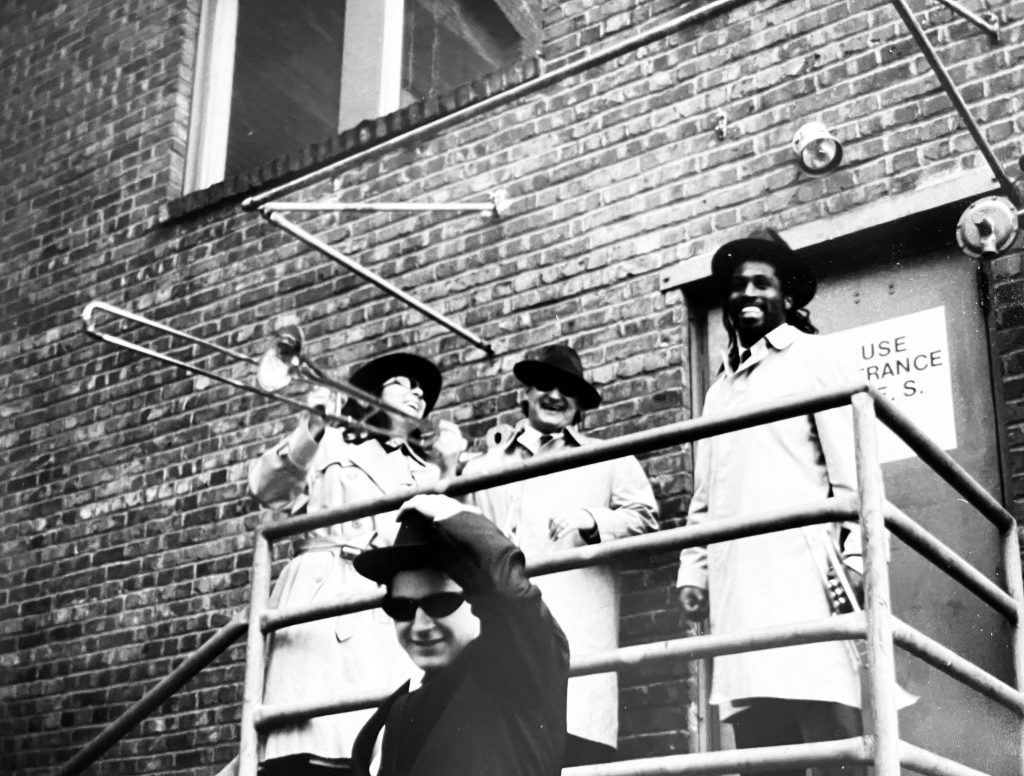
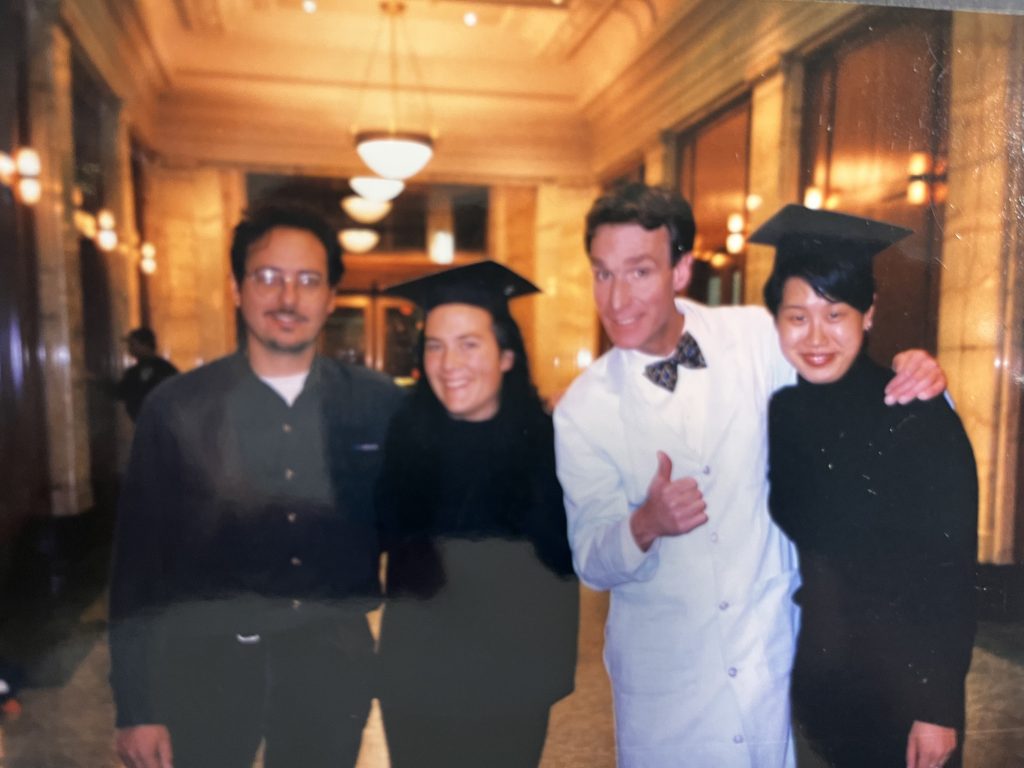
Nye also has good memories of Brunelle.
“Lynn is creative, hardworking, and very funny,” he said recently. “She was a big part of the success of Bill Nye the Science Guy. Her Emmys are well deserved.”
When the show ended in 1999, Brunelle, who had met her husband “in the fast lane” of a swimming pool during a master’s swim practice, stayed in the Seattle area. They raised two children, and she stopped ghostwriting and started writing books under her own name. Her first book, Pop Bottle Science, is still in print after more than 20 years.
For Brunelle, measuring success is not about wealth and fame, but something more important than those things.
“Are you putting good into the world? That, to me, is the question,” she said. “You might make a boatload of money, but so what? Are you happy? Putting good into the world is a better kind of rich.”


