Onnesha Roychoudhuri Wants You to Be Braver On (and Off) the Page
Why the writer and professor brings lessons from improv to her classroom
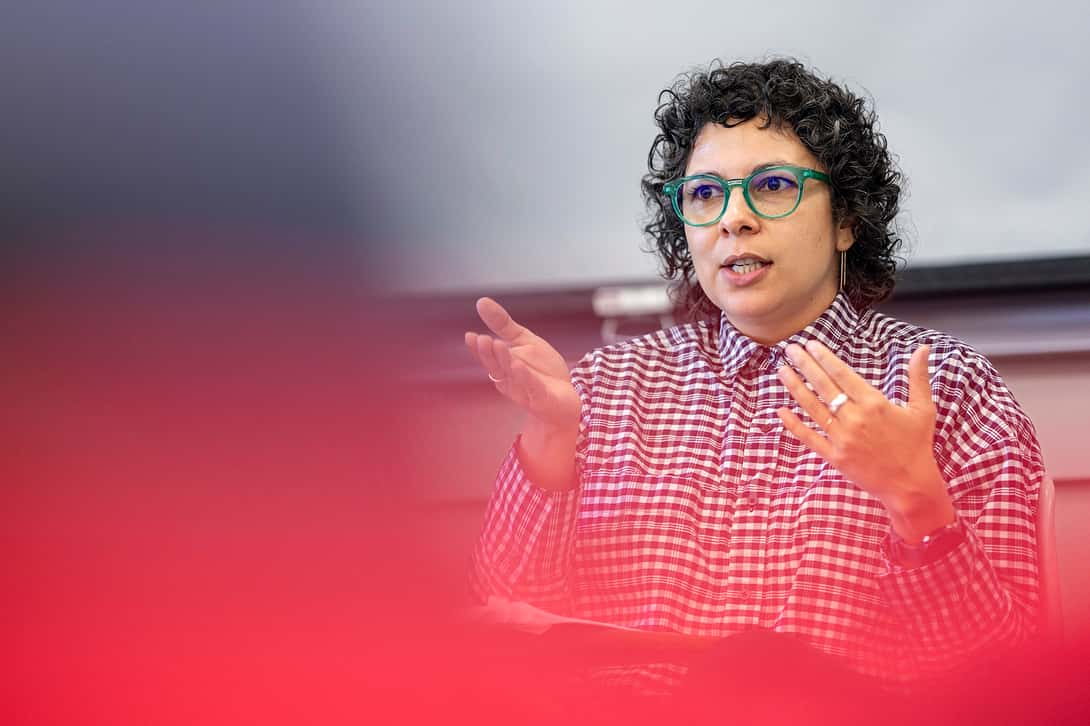
Ever since humans were humans, we’ve been telling stories. Stories teach, entertain, connect, and inspire us to do more and be more.
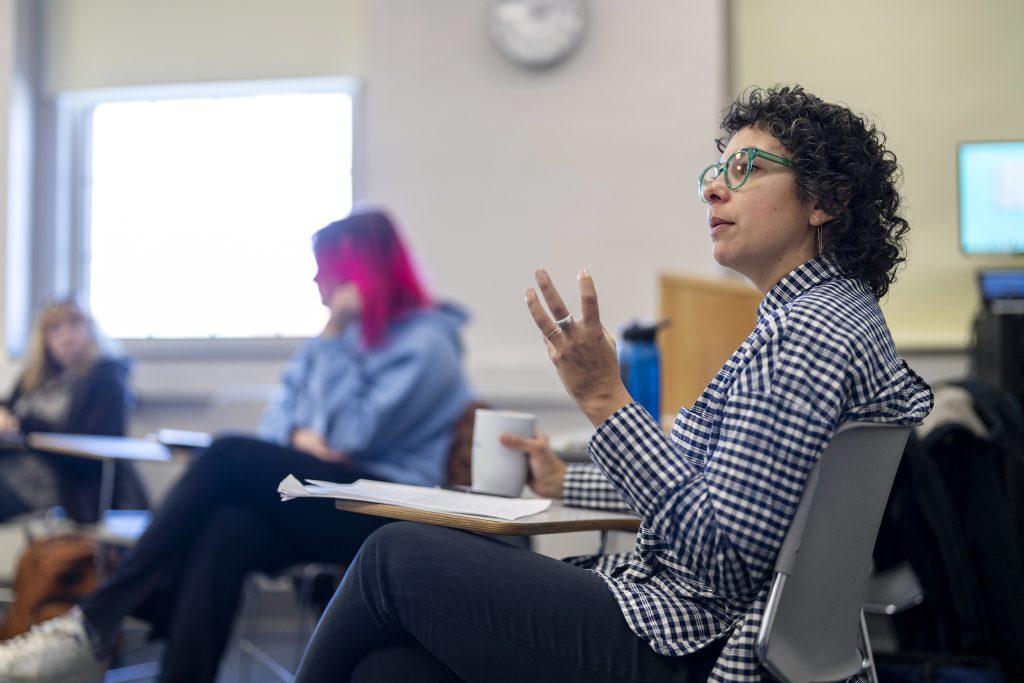
For Assistant Professor of English Onnesha Roychoudhuri, stories also serve as a critical means of understanding the world. She encourages her creative writing students to use nonfiction stories to explore both inner and outer landscapes, something that often leads them to unexpected places.
Roychoudhuri is a journalist, essayist, improvisational comedian, and teacher. Storytelling, and why we tell stories, is a throughline that knits all of these together.
“The ways in which we try to make sense of things, and the stories we tell about our lives, and the realities we’re living through, very much shape who we are,” she said. “I have a background in storytelling, so to me I’m just obsessed with the notion of how story shapes us even as we shape story.”
Roychoudhuri’s dedication to her craft and witty, thoughtful prose has garnered attention and acclaim. Her book, The Marginalized Majority: Claiming Our Power in a Post-Truth America, was a Best Book of the Year by Kirkus, which called it “one of the most significant, fiery books of the year.” It also garnered praise from the San Francisco Book Review, The Rumpus, and Book Riot, among others.
Her work has also appeared in publications such as Rolling Stone, Harper’s Bazaar, Kenyon Review, McSweeney’s, The Nation, The American Prospect, Salon, and Mother Jones. She has read and performed on stages for The Moth, TEDx, Lincoln Center, and more.
This weekend, Roychoudhuri will moderate a special In The News conversation about movements, power, and political possibility with author and activist adrienne maree brown. The conversation, called “You Can’t Build What You Can’t Imagine,” is part of the third annual Maine Lit Fest, a statewide celebration of books, stories, and communities. Roychoudhuri and brown will speak from 6 to 8 p.m. Saturday, Oct. 3, at the Gordon Center for Creative and Performing Arts.
Over the weekend, Colby will host several Maine Lit Fest events, featuring a lineup of readings, workshops, and panel discussions led by authors, artists, and scholars. Supported by numerous campus departments and funds, the festival highlights Colby’s literary community through faculty involvement and public events that celebrate contemporary writing, social justice, and the arts.
Overcoming the blank page
This year, Roychoudhuri is using her pre-tenure sabbatical to work on her next book, a collection of essays that blend memoir, personal narrative, cultural critique, and political analysis. “I get to have the time to really figure out how I feel like this narrative should come together, and that feels like such a remarkable gift,” Roychoudhuri said.
Some of the important lessons about storytelling Roychoudhuri has learned, and now teaches her students, came from the world of improv comedy. These include ways to overcome the mental paralysis that can hit a writer facing a blank page. That feeling is familiar to just about every writer, who can be so overwhelmed by ideas of how to start and what to write that they can’t get anything down on paper.
When living in New York City, one of Roychoudhuri’s friends did improv. She was curious and asked him questions about it, and he gave her a birthday present of a class at a local improv theater. She was terrified at first, but kept going back.
“There were so many people who were taking this because they wanted to be a little braver, and I felt like that was such lovely energy to be in,” she said.
Roychoudhuri ultimately did improv for several years and performed with a house team at the Peoples Improv Theater in New York City. There, she learned firsthand about how to create a world week after week.
“I think what kept me doing it really was that sense of learning in my body that the only way you really fail is if you don’t start somewhere. You step out on stage with your scene partner, and you say something, even if it’s weird, or not what you thought you were going to say,” she said. “I think that somatic experience of failure means staying silent; failure means just not starting, was a really compelling thing for me and kind of reset my brain when it came to my relationship to creativity.”
Cultivating curiosity
From there, teaching storytelling was a natural next step. She worked for The Moth, a global storytelling nonprofit, where she led storytelling workshops at high schools and colleges across New York City. She also worked for the organization’s community program, leading storytelling workshops for formerly incarcerated women, veterans, and other groups.
Roychoudhuri also regularly performed for The Moth’s Mainstage events, and one of her stories aired on The Moth Radio Hour last February.
“Watching the transformation as [people] crafted their stories, going from not knowing that they had anything to talk about to really owning their voices and leaning into it was such a remarkable thing,” Roychoudhuri said. “I think that’s what got me hooked on storytelling.”
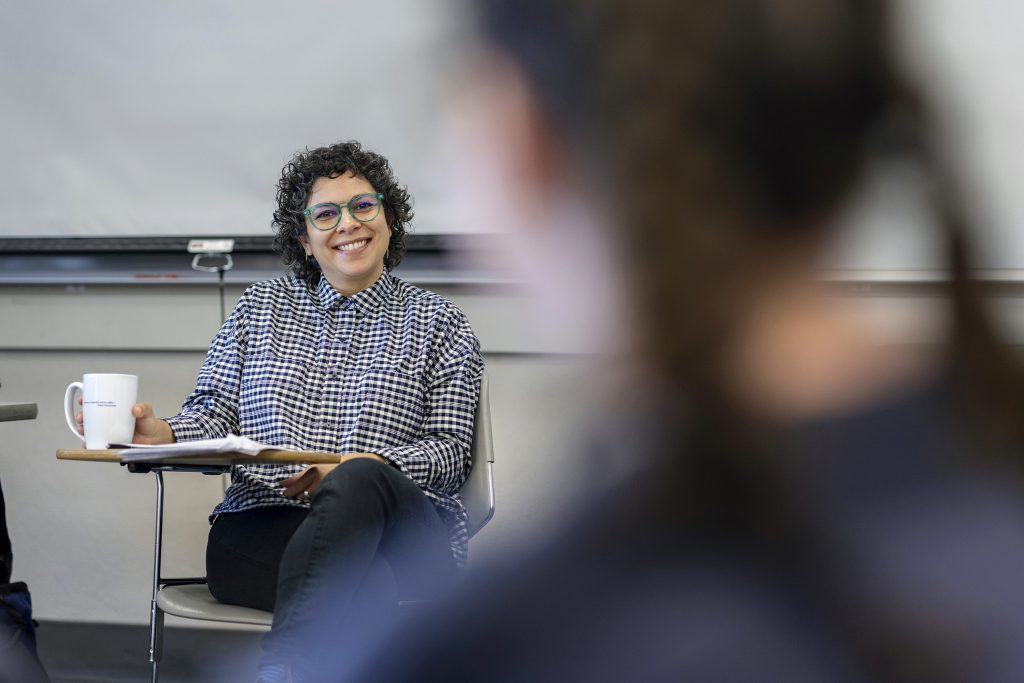
She sees the same transformation in Colby students who might initially be shy about sharing their own stories but come to discover more about themselves and the world around them.
“Curiosity is the core thing that I lean into and try to cultivate in the classroom,” she said. “If you’re being ambitious and exploring the edge of what you know, you’re going to end up with more questions. That’s an amazing and rich way to live.”


