The Middle Ages and This Moment
Megan Cook receives NEH grant to support research on a prolific medieval English poet
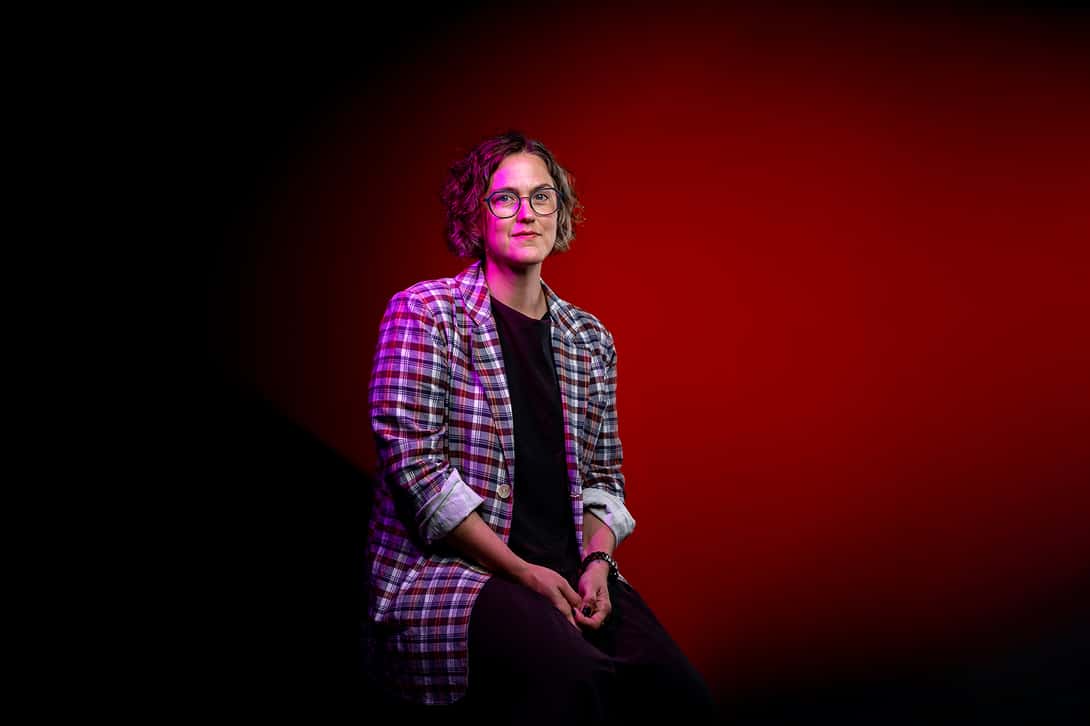
In an era when artificial intelligence can draft an essay in seconds, technology falters when faced with 15th-century handwriting.
That’s why Megan Cook spends her summers in British libraries manually transcribing medieval poems letter by letter. Her goal? To replace a century-old edition of medieval poems and prove that some puzzles still require human intuition and expertise to solve.
Cook, a book historian and scholar of medieval literature, is part of a team that recently received a $300,000 grant from the National Endowment for the Humanities to support research on the short poems of John Lydgate, a Benedictine monk often regarded as the most significant and prolific medieval English poet of the 15th century.
Collaborating with scholars from the University of Tennessee, Knoxville, and the University of North Carolina, Cook is deep into a 10-year project to identify, translate, and collate Lydgate’s short poems using original sources scattered across the Western Hemisphere, many not yet available digitally. Their goal is to produce a multi-volume, critical edition of his short poems.
“Lydgate is interesting precisely because he writes so prolifically and with such variety,” explained Cook, the Arthur Jeremiah Roberts Professor of Literature. “Our hope is that this edition will be able to use his work to explore the richness and complexity of late medieval life and literature.”
Part of the NEH’s Scholarly Editions and Translations program, the three-year grant will fund graduate students at UT and UNC to assist with the painstaking work of transcribing Lydgate’s short, or minor, poems and train the next generation of medieval scholars. As the project progresses, Cook plans to include Colby students in the process.
“Even though most of these poems were edited a century ago, we’re making new discoveries that will help people understand why Lydgate’s work matters, and how looking at the past with fresh eyes can offer a new perspective,” she said.
A poet of the middle class
Cook developed an interest in Lydgate alongside her scholarship on Geoffrey Chaucer, whom she began studying as a graduate student at the University of Pennsylvania. “John Lydgate is the number-one Chaucer fanboy,” she said playfully, noting that Lydgate figured out how to turn his idol’s literary innovations into commercially popular poems.
Lydgate wrote poetry that depicted people from different parts of society, from royal commissions to a popular self-help poem, The Dietary, one of his long poems. His devotional texts were not meant only for monks and nuns living in cloisters, but for the masses wanting to prove their piety, wealth, and middle-class status, Cook said.
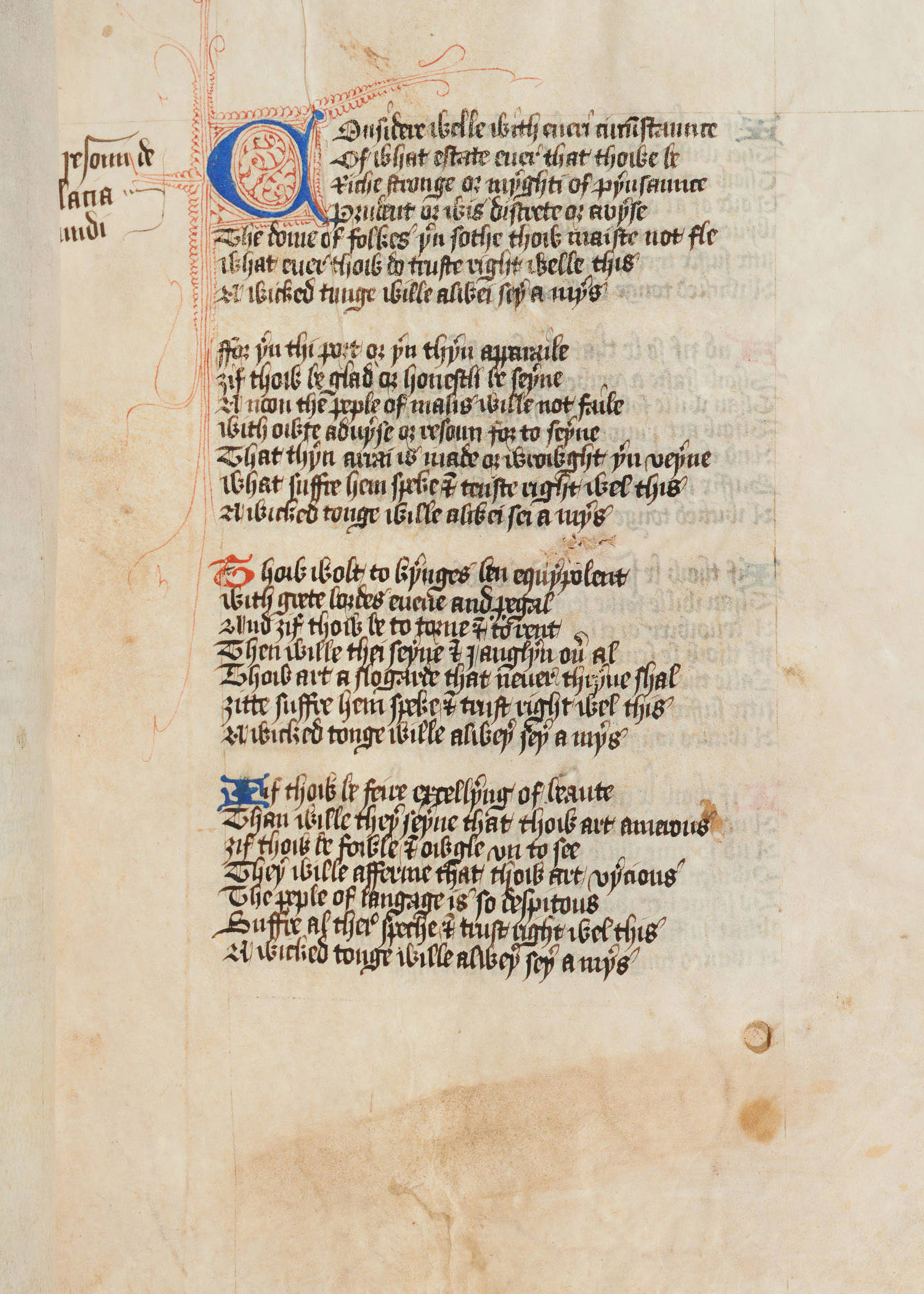
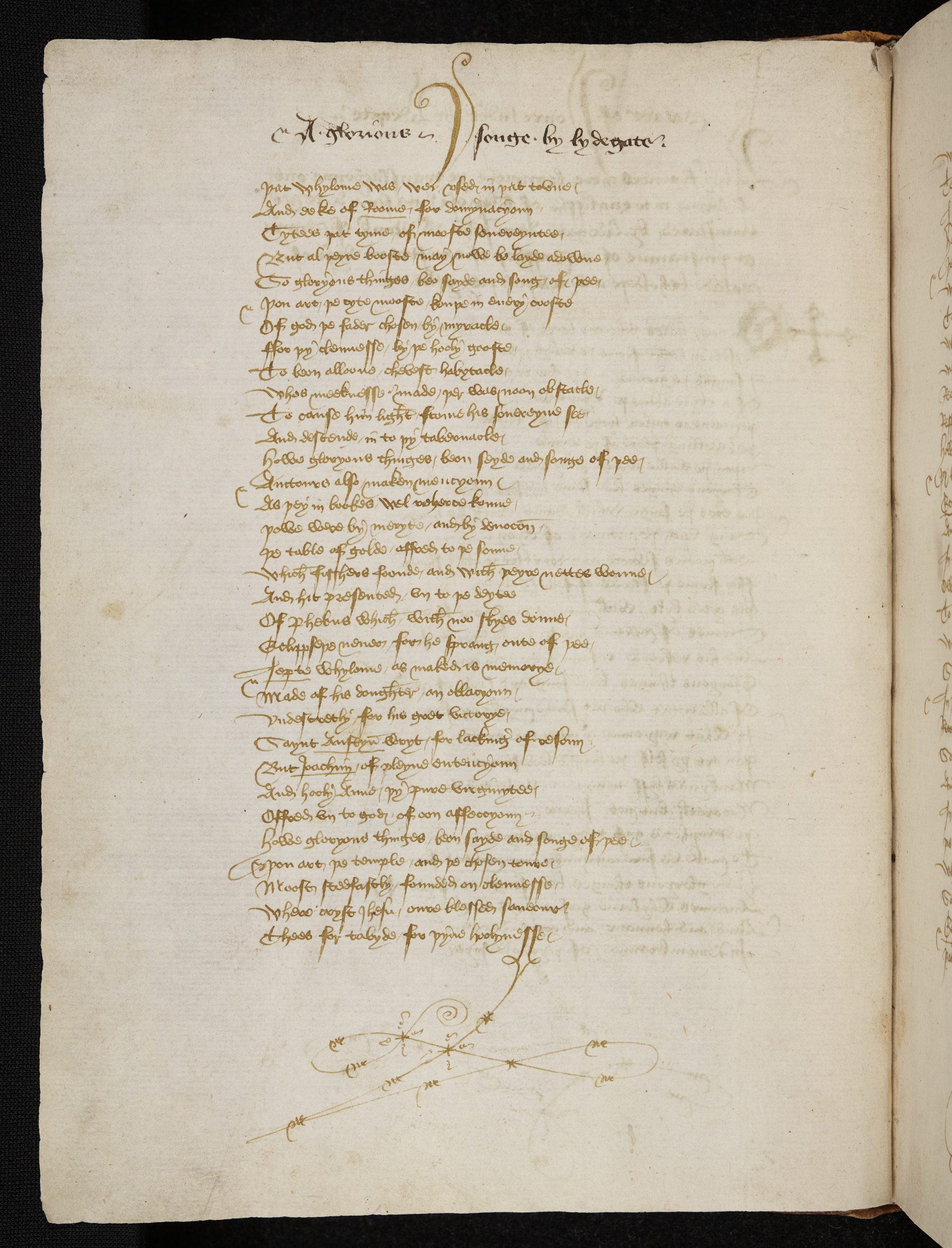
Before his death in 1449, Lydgate wrote as many as 150 poems. Approximately 120 of these meet the 1,000-line cutoff for Cook’s edition. Now scattered across roughly 150 bound medieval manuscripts, they comprise more than 100,000 lines of verse. While many are spread across major libraries such as the British Library and Oxford’s Bodleian, others appear in unexpected places, such as the Venerable English College in Rome.
Medieval detective work
Because Lydgate, like other medieval writers, likely composed his works using wax tablets or other inexpensive materials, authorial copies of his words do not survive.
What has survived are copies made by professional scribes Lydgate hired to transcribe and distribute his work. Scribes, however, often made errors, adapted spelling to local dialects, skipped or rearranged sections, or altered words they didn’t recognize. As Cook and her team identify and transcribe these copies, they will compare variations to better understand the relationships among manuscripts.
“It’s like a logic game that you can figure out through shared mistakes or changes, what belongs to what generation and how many steps removed they are from the original,” she said.
Cook hopes the team’s finished work will offer “the best possible text, but also note where there are differences between manuscripts,” she said. “This is useful because the more coherent the text is, the closer it probably is to the original. The more data points we have, the fuller family tree of these manuscripts that we can sketch out.”
As she spoke, she opened a folder on her laptop and scrolled through files.
“We have 716 items to transcribe, and that’s actually an undercount,” she said. “This is each instance of each poem.”
Opening a few random files, she pointed out differences among handwritings, some with narrow letters close together, others airy and adorned with flourishes. She zoomed in, highlighting two letters with a bar over them to indicate an abbreviation that needs expanding. Depending on the context, it could be “him” or “his,” for example.
Cook’s expertise in pattern recognition, built over years of reading thousands of manuscripts, is essential for understanding context, abbreviations, variations, and other nuances. Advances in AI and Optical Character Recognition (OCR) cannot replace human editors in translating these poems, she said.
“I’ve not seen anything that can do it, or outperform a knowledgeable person spending time looking at them.”
Medieval studies at this moment
Cook’s research on Lydgate’s short poems mirrors a project she completed on his long poem Dance of Death, resulting in the 2019 edition John Lydgate’s Dance of Death and Related Works, which she co-edited with Elizaveta Strakhov of Marquette University.
She believes that creating updated editions of medieval literature is a service—to scholars as well as to undergraduates. Students in one of her courses read the Dance of Death just last week, she said.
“I’m not teaching that because I edited it,” she quickly pointed out. “I edited it because I was teaching it and couldn’t find a good version that I wanted to share with students. Editions are at the foundation of what we do in literary studies.”
People are drawn to medieval studies as a way to think about issues that feel close to home, but in a more mediated way, she said. In her courses, she’s seeing a resurgence of interest among undergraduates—even computer science majors—driven partially by pop culture and gaming.
“The Middle Ages,” she said, “are having a moment.”