Revolutionizing the Technology Behind Drug Development
Felix Baldauf-Lenschen ’14 launched a company devoted to accelerating development of new and effective cancer drugs
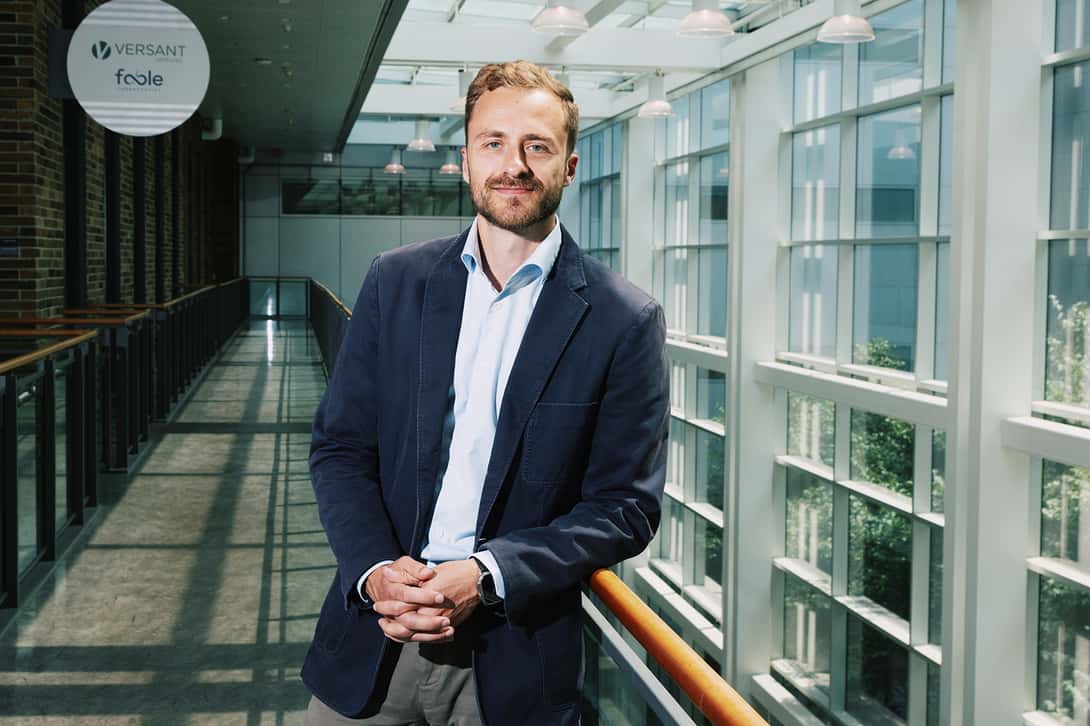
The next time you talk to someone who becomes an excitable student of life when a favorite passion is brought up, look in their eyes. The eyes say it all.
In a conversation with Felix Baldauf-Lenschen ’14, his eyes light up when he discusses AI-enabled medical imaging, which has become the cornerstone innovation for his startup, Altis Labs, a biotechnology company based in Toronto, Ontario.
“The earlier you can find out how well a drug is working, the quicker you can get to the next stage of its development,” Baldauf-Lenschen said in an interview at his office in the heart of Toronto’s MaRS Centre innovation hub. Altis creates software for images taken during a drug’s clinical trial so it can optimize them to speed up what researchers need to know: Is the drug helping, or not, to, say, help patients live longer?
His eyes dance again when he talks about why he’s neck-deep in a sector the economics major never thought he’d dive into. The earlier you know that a drug actually can work, the faster you can get to that phase-three step it needs. “And that means more time on patent, more revenue, more lives saved, more lives prolonged,” he said.
The work of the lab
Known for having one of the world’s largest cancer-imaging databases, Altis Labs developed an AI model that analyzes CT scans by quantifying tumors, muscle, fat, and the cardiovascular health of the patient. The system forecasts a score, which ultimately becomes survival-prediction for that patient based on that scan. As clinical trial patients undergo multiple scans during treatment, their score might increase, suggesting treatment response, or decrease, suggesting deterioration. The company primarily focuses on drugs treating lung, breast, prostate, and colorectal cancers.
During drug trials on cancer patients, radiologists follow criteria established 25 years ago to make measurements that attempt to anticipate whether the drugs will work, but they can often disagree about the data. With AI technology, there is less opinion and more hard data to predict, for example, if a drug is affecting tumors in some way.
“An X-ray is only a 2D image of many vital organs of the chest, so there can be very nuanced findings that on one day a radiologist might see or suspect something, and on another day they might not,” Baldauf-Lenschen said.

The startup’s client list is a who’s who of Big Pharma: Johnson & Johnson, AstraZeneca, Bayer, and Debiopharm. In June 2023, four years after it launched, Altis Labs secured $6 million in seed funding.
“What really gets me excited about Altis Labs is understanding how to bring down the cost for a company to introduce a new drug to market, which should help everyone,” Baldauf-Lenschen said. “And we can even help drug companies fail faster, because the quicker they know their drug isn’t working, the faster they can start trials with another drug. That could bring down drug prices, too.”
He’s got a point: Up to 90 percent of all drug trials fail, according to a 2022 paper.
From ski slopes to specializing in scans
Meeting clients in Toronto and on Zoom to talk about medical imaging is a far cry from the life Baldauf-Lenschen, who was born in Germany and raised in Zurich, led years ago, when he dreamed of skiing for a living. Soccer and skiing had long been family pastimes, and Colby caught his eye thanks to its success in skiing, and he thought he could also walk onto the soccer team.
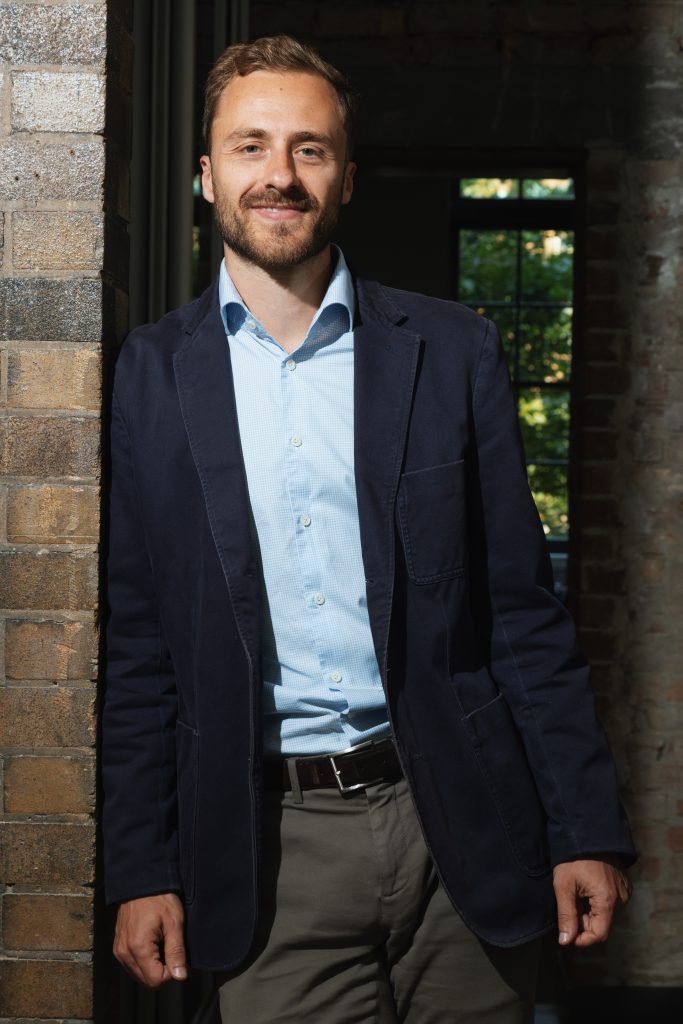
“To be part of a small community where athletics was central, that was appealing to me,” he recalled.
When he arrived on Mayflower Hill, he soon realized skiing was out of the question. “These skiers were very serious, and I couldn’t commit in that way,” he said, adding that a few injuries also set back his midfielder ambitions.
He majored in economics, and Colby’s interdisciplinary approach meshed well with his wide-ranging interests. “What I loved about Colby is the opportunity to take classes across so many disciplines,” Baldauf-Lenschen said, “from philosophy to music to dance. And back then, no, I never thought I’d start my own company in the medical field.”
Soon after graduating, he moved to Boston to work as a financial analyst for a company advising commercial banks, delving into predicting the default rate companies might see in their portfolios. The investment firm Cambridge Associates pulled him away from Boston to San Francisco, and he recalled attending many fascinating conferences with healthcare companies focused on digital innovation.
A high school classmate from his Zurich days had a neighbor on the board of a medical imaging company that used AI technology to help radiologists be more efficient in diagnosing patients and reviewing scans. When that board member, Sally Daub, stepped in as CEO of Enlitic, she brought on Baldauf-Lenschen as vice president of business development.
“That was really exciting to me, to be part of that cutting edge of AI research,” he said, eyes aglow again. “We were working on AI models that were detecting lung cancer a year or two prior to a radiologist being able to do the same.”
The birth of his idea
Being immersed in radiology gave him an idea. Radiology yields the most comprehensive data in healthcare, but that data was poorly used to predict survival differences, he said.
He wondered: Is there a better way to understand how well new drugs are working?
In 2019, he cofounded Altis with Daub and moved to Toronto, a city known for its startup community and for nurturing AI talent while also boasting a single-payer healthcare system that centralizes historical imaging data—something that is widely fragmented in the United States. Canadians’ easy access to healthcare created a pipeline to fuel Altis Lab’s value proposition.
When the company analyzes CT scans during drug trials, it outputs IPRO (Imaging-Based Prognostication) scores, which predict if a certain treatment is effective. These scores can inform drug companies whether to progress or stop development of a new treatment that has yet to reach Federal Drug Administration approval.
A major test of Altis Labs’ promise came when a global pharmaceutical company invited the lab to analyze the efficacy of its new drug approved by the FDA. The company asked back-test Altis’ AI model, meaning it re-analyzed the clinical trial using IPRO scores.
“We got five million images, did the test within a weekend, and later got a call from the company saying how well we performed and asking if we could begin working on additional cancer drugs they were trialling,” Baldauf-Lenschen said.
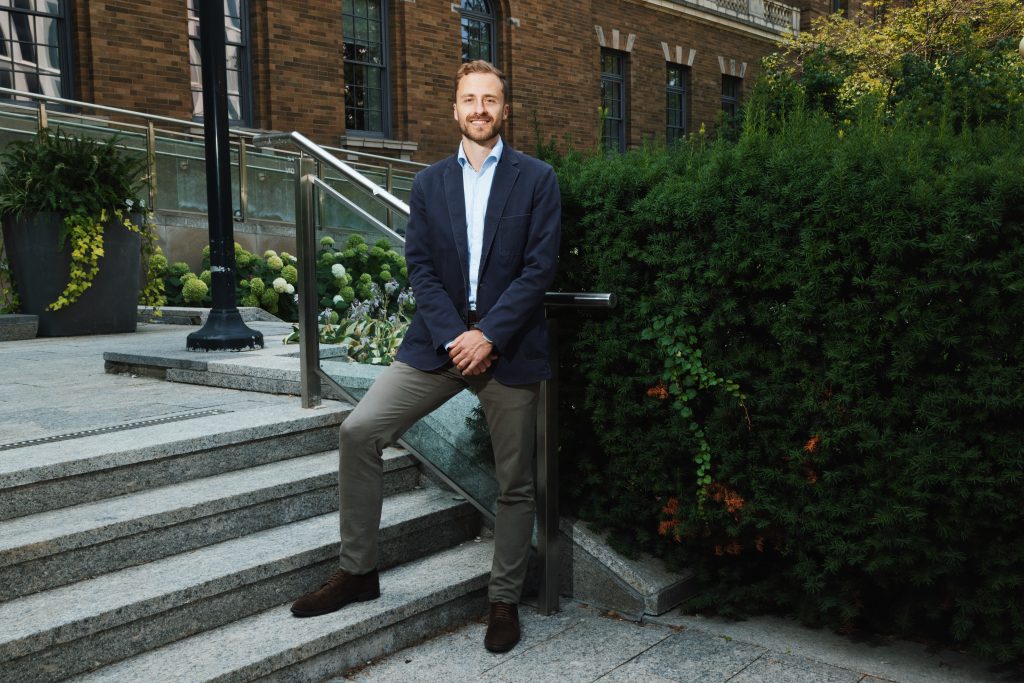
The lab has scanned medical images and found a drug prolonged survival 10 months earlier than traditional radiological interpretation. It’s that kind of rich data, delivered at a fraction of the time of manual analysis, that is so attractive to drug companies, he said. Down the road, if IPRO is accepted by regulators, drug developers would be able to get accelerated drug approval months earlier using the lab’s software.
This space is growing quickly: Cancer medicine spending at list prices surged to $252 billion globally in 2024 and is expected to reach $441 billion by 2029.
It’s appealing to Baldauf-Lenschen that he can be part of a cresting wave of health-tech breakthroughs, while also learning on the job. “I love how I get to work with our engineering and product teams and recognize how much we have to do to have a model trained with so much data, to have these massive historical data sets,” he said.
Even their company name is proof of its direction. “In Latin, altis means high or deep, depending on the context, and since we use deep-learning in our AI systems, well, it just felt right,” he said with a wide smile and beaming eyes. “And I wanted something short and easy to pronounce.”