The Human Element
The Department of Science, Technology, and Society is poised to play a key role in the College’s new science initiative
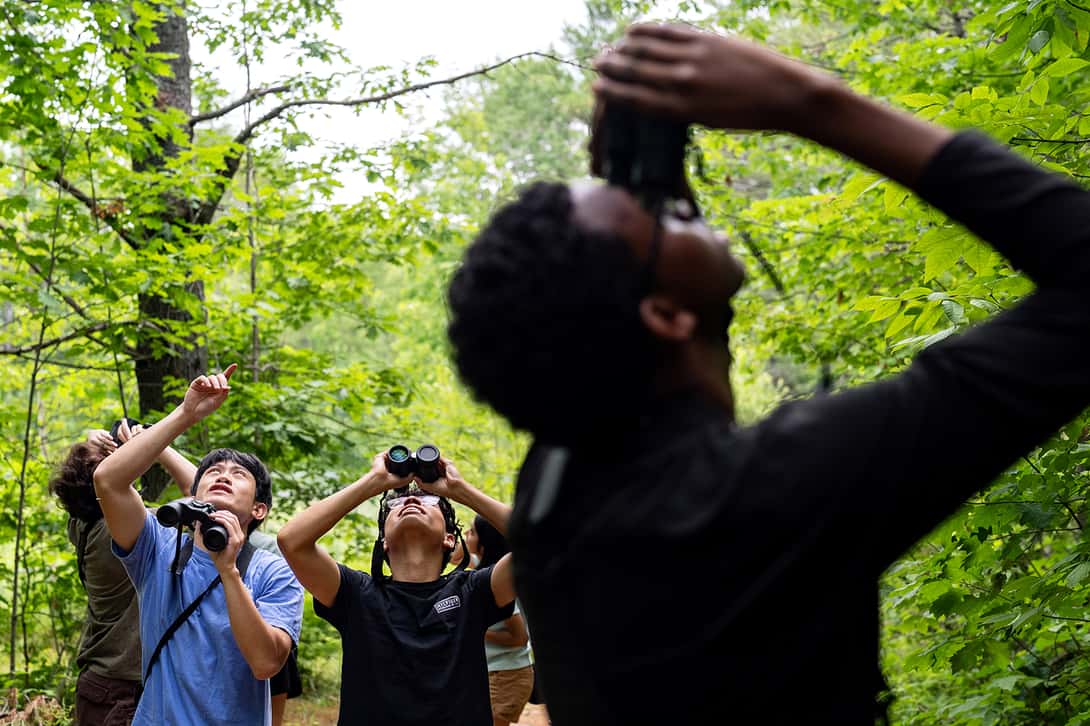
To help students understand how knowledge is produced, Ashton Wesner takes them outdoors.
Binoculars strapped around necks, they trek into Perkins Arboretum, where Wesner, an avid birder, helps them locate and identify Cooper’s hawks, sparrows, cardinals, and more. Sometimes they see the birds, other times they hear them and identify them using an app.
Wesner, assistant professor of science, technology, and society, hopes that the process of walking, observing, and recording data helps students understand that knowledge-building is a practice they can feel in their bodies out in the field.
“Knowledge does not just appear a priori in a vacuum. It doesn’t just exist, and we go pluck it with our minds,” said Wesner. “It’s actually made through work and instruments and mess and decisions about who can come through the door and who can’t come through the door,” referring to who has access and input into scientific discovery.
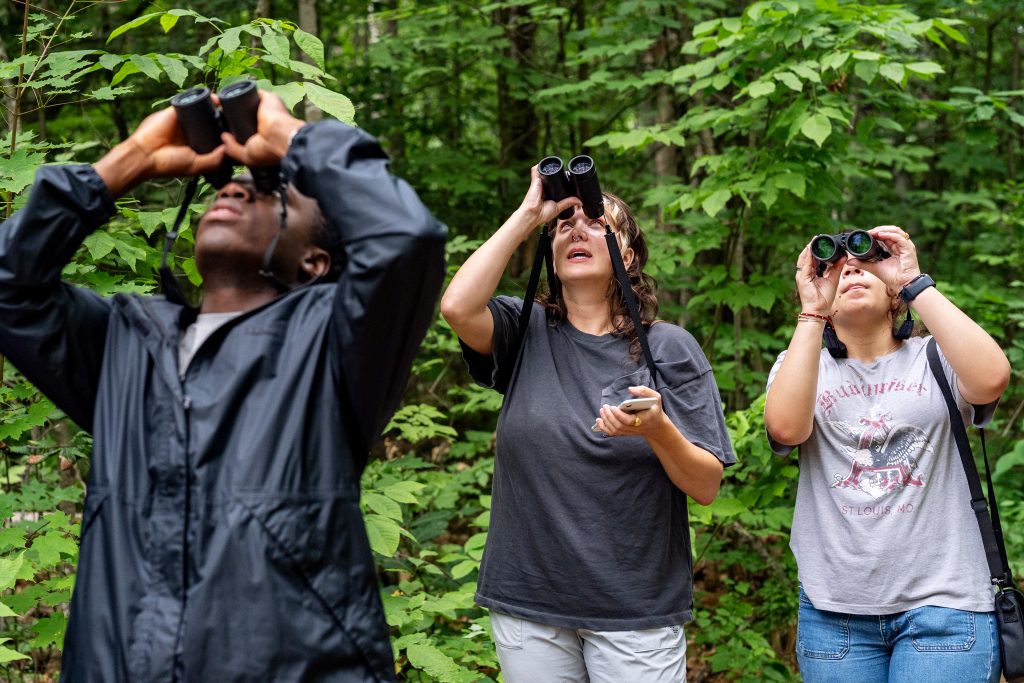
Wesner is a pivotal figure helping the College navigate a boom in student interest in the field of science, technology, and society, or STS. One of the fast-growing programs at Colby, STS is an interdisciplinary field that considers the social, cultural, and historical dimensions of science and technology.
As Colby embarks on its new science initiative, Wesner believes that diverse scholars and diverse scholarship involving society, ethics, and justice are integral to that work.
“STS offers an exceptional toolkit for this, full of literature and academic practitioners whose training moves beyond the critique of science and technology and toward active engagement and innovation.”
National leader in STS
Colby’s nationally recognized STS program prepares students for a variety of professional careers, from policymaking and entrepreneurship to healthcare and engineering, said Tanya Sheehan, chair of the STS Department and Colby’s Ellerton M. and Edith K. Jetté Professor of Art. In these fields and others, “STS scholars keep in mind that technologies are made by people and therefore represent the values, biases, and assumptions of particular social groups.”
A small faculty cohort—Wesner, Sheehan, and Thom Klepach, lecturer of STS—with the support of a Faculty Advisory Board, is steadily building a robust cohort of STS student- and alumni-scholars. Currently, there are 47 students majoring in STS across the Classes of 2026-2028, nearly four times the number from 10 years ago. Members of the Class of 2029 declare their majors next March, and the numbers are on track to increase.
“In a moment of profound technological change and scientific innovation, STS trains emerging leaders who can think critically, creatively, and responsibly in the world,” Sheehan said. “Those are the kinds of leaders we desperately need today.”
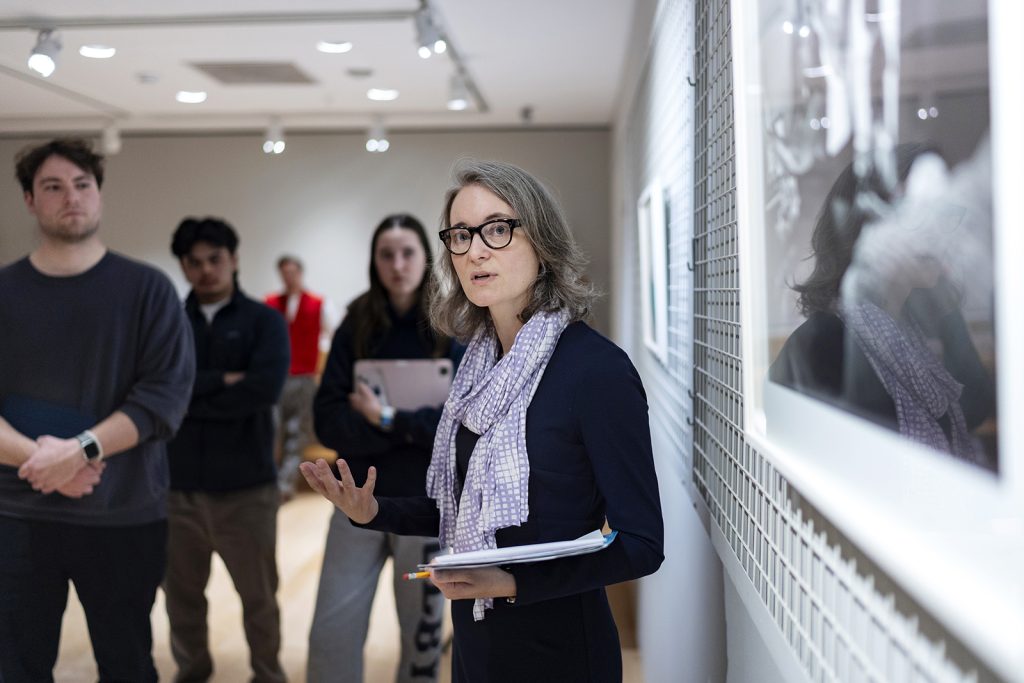
Colby was one of the first small liberal arts colleges to offer courses in science, technology, and society, a field that emerged in the United States as an academic discipline in the 1970s.
In 1988, Colby established a “science and technology” concentration when it hired James R. Fleming, a historian of science and now the Charles A. Dana Professor of Science, Technology, and Society, Emeritus. Fleming served as the program’s inaugural director and, over the next 33 years, pushed to expand it into the thriving department it is today.
Initially, the field focused on the history and philosophy of science and technology. Today, the focus has shifted to matters of justice and ethics, including questions about gender, sexuality, and race. Colby students are investigating a range of issues about biomedical technologies, artificial intelligence, environmental justice, data science, design, and more.
Klepach views STS as a framework that holds together diverse viewpoints, fields, and ideas. “It’s trying to be a glue, a superstructure; a way of thinking about questions that can be applied to any discipline,” he said in a recent Colby Echo article.
Introducing the STS Hub
To complement the College’s science initiative, the College has recently approved an STS Hub, an innovative and flexible pedagogical structure that allows for collaboration between STS and the Natural Sciences Division. Through classroom “encounters,” STS faculty will introduce STS thinking to students and faculty in lab courses by asking them to consider the social and ethical dimensions of the subject matter they’re focused on.
“This idea is kind of unique, in the sense that our context at a small liberal arts college really makes this type of integration and collaboration possible,” said Wesner. Faculty from biology, computer science, statistics, chemistry, mathematics, and more have expressed interest in partnering with STS on this initiative, which launches in 2026-27 with the hire of a new faculty member in STS. Over the last few years, Wesner and her colleagues have built the foundation and piloted the concept of the hub to see that it meets student needs.
‘In a moment of profound technological change and scientific innovation, STS trains emerging leaders who can think critically, creatively, and responsibly in the world. Those are the kinds of leaders we desperately need today.’
Tanya Sheehan, Chair of the Department of STS
Wesner conducts research and coauthors with natural scientists and engineers, and believes that STS faculty teaching in science labs can be incredibly generative.
“This kind of collaboration is nourishing for faculty, too,” Wesner enthusiastically intoned. “We like doing it, and we want to do it. It sharpens our research and our pedagogy. It offers students really wonderful lessons in collaboration, mutual regard, and multiple knowledges. And it actually demonstrates some of the core components of what STS has to teach.”
Students from across the curriculum
The field of science, technology, and society is designed to be in conversation with other areas of study. Many students combine STS with other majors or minors, and the core STS faculty help students integrate their learning across these areas of study, said Sheehan.
Nora Demak ’28, a sophomore from New York, N.Y., finds the STS program a place to explore questions around medicine and society. A premed student double-majoring in biology and religious studies, she took Sheehan’s STS course, Medicine and Visual Culture, her first year on campus as a way to use the humanities to find other ways to think about medicine.
“I’m taking a lot of traditional science classes, but I’m also very interested in how we think about medicine and society, how it’s become this category, and why we think of doctors the way we do,” said Demak. STS helps her question why society sees medicine the way it does and “what that means for us as people,” she said.


Ewemiz “Miz” Insigne ’26 came to Colby with a strong interest in science and technology studies, having attended a science high school in the Philippines that emphasized community research. At a young age, Insigne was conditioned to see science as the “logical and best way to go about the world,” a view they now recognize as held not just at their high school but in the greater world as well.
As a Global South student-scholar and double major in STS and mathematical sciences, Insigne has investigated how economic, material, and labor issues are often overlooked in the production and distribution of science and technology.
“STS taught me not to take science and technology at face value,” said Insigne. “There’s a lot more behind it.” The senior is also co-chair of the department’s Student Advisory Board, which champions the department and encourages students to take its courses.
“In a world that sees technology and science as always worth pursuing,” they said, “there is a lot to learn from being an STS scholar.”
Connecting multiple pieces
To help students become STS scholars, the STS faculty offers students conceptual, analytical, and research tools to investigate their scientific and technological work.
“I want them to feel skilled in asking critical questions, locating and synthesizing credible sources, and articulating their own conception of how they are responsible for, and aspiring to, ethical relationships with science and technology in a really fundamental and practical way,” said Wesner.
Applying those skills daily is Bibatshu Thapa Chhetri ’25, who is working as an analyst with BCE Consulting in Boston.
“This has been a place where I can use the research skills I’ve gathered from Colby and the STS program specifically,” said the native of Kathmandu, Nepal. “I look at things from a multifaceted perspective, but the work also ties directly with policy and understanding the market, economics, and what the intention is at the baseline.”
Thapa Chhetri began questioning technology while playing video games as a high schooler. He wrote software in high school and imagined creating a startup, but during a gap year, he began wondering what it meant for technology to be truthful and what its social impacts were. When he arrived at Colby, he combined his interests into a double major of STS and computer science.
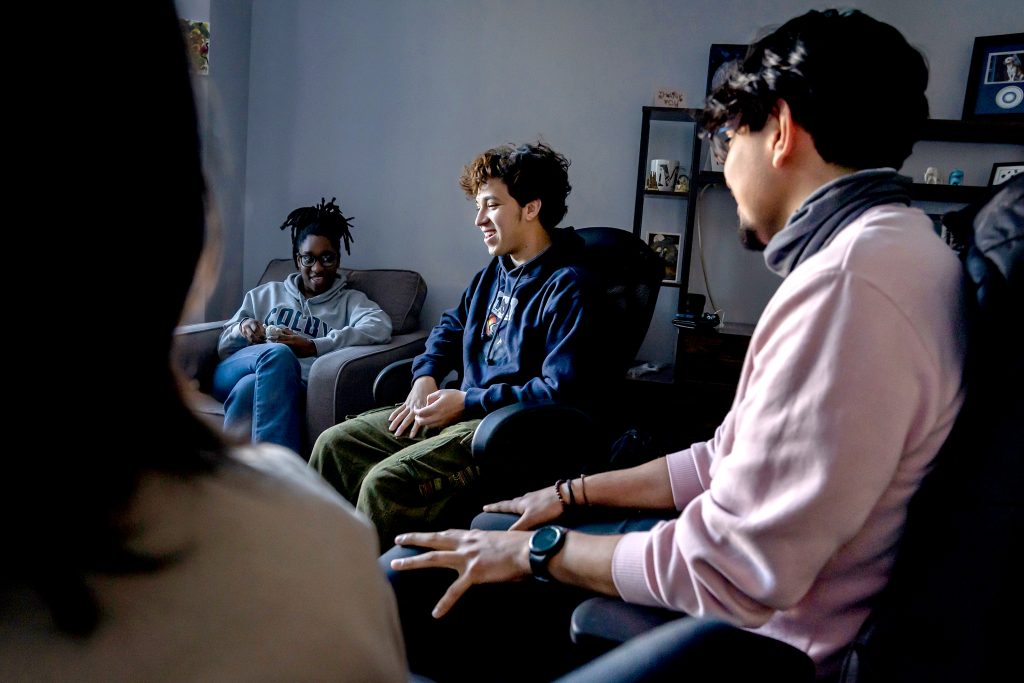
As he took a wide variety of courses, a deep passion for policy work replaced his initial interest in software development. He began augmenting his coursework with internships, summer jobs, and research projects with nonprofits and companies worldwide, relying on the research and critical inquiry skills he learned in STS to refine his career goals.
“It’s definitely easy to connect multiple pieces now,” said Thapa Chhetri, whose ability to think intersectionally is driving his pursuit of a career connecting climate, technology, policy, and finance.
At BCE Consulting, whether his projects lie in the consumer, healthcare, med-tech, or artificial intelligence sectors, ethics informs his research, which relies heavily on data analysis. Fortunately, “STS has helped me ask the right questions to get the right data,” said Thapa Chhetri, ever mindful of the relationship between technology and society.
The human element
Wesner cannot overemphasize the importance of integrating science and technology studies as Colby prepares to implement its new vision for science education.
“We are humans, and it is humans who are doing science. But if we can acknowledge those things and talk about them and contend with them, the argument is that it makes our science more rigorous and more accountable because we’re looking at how it’s produced by us in a social world,” said Wesner.
STS alumna Heather Jahrling ’21 exemplifies this argument as a Ph.D. candidate at Princeton studying 20th-century American technological and urban history. She constantly draws on her STS training to “think beyond conventional boundaries and to question the seemingly ‘objective,’” said Jahrling, who taught an STS Jan Plan course earlier this year.
“STS reveals that science and technology are never neutral. Every experiment, algorithm, and device reflects the values and assumptions of its creators,” said Jahrling, who double majored in STS and history at Colby. “In the current transition from the ‘Age of Information’ to the ‘Age of Intelligence,’ STS is critical to confronting the built-in biases of seemingly ‘apolitical’ and ‘asocial’ technologies, from ChatGPT to [autonomous driving technology company] Waymo.”
“STS has an enormous amount of potential and power,” said Klepach. “All of us need the STS way of thinking and viewing the world.”


