Technical Thinking and Creativity Meld in Architecture Course
In Architectural Imaging, students utilize computer-aided design to create virtual models of an imagined campus building

When student-architect Joshua Iyonsi ’26 set out to design a Colby Welcome Center for his class last fall, he started with a simple question. What does it mean to be welcomed?
For him, the answer came from a single gesture—an embrace.
“That gesture guided everything: the plan, the geometry, and the way the building gathers people inward,” said Iyonsi, a computer science major. He called his building the Harmonize Welcome Center.
“From the start, I imagined a building that does not just sit on the Colby Green, but reaches out, a form whose circular core and outstretched wings act like an embrace as you approach from Miller Library,” he said, referring to his final design.
Iyonsi was one of a dozen students in the fall 2025 course Architectural Imaging, which challenged students to conceptualize and design a 3,500-square-foot welcome center and site it on campus. Of course, their buildings are not actually built; the course is purely an exercise in design.
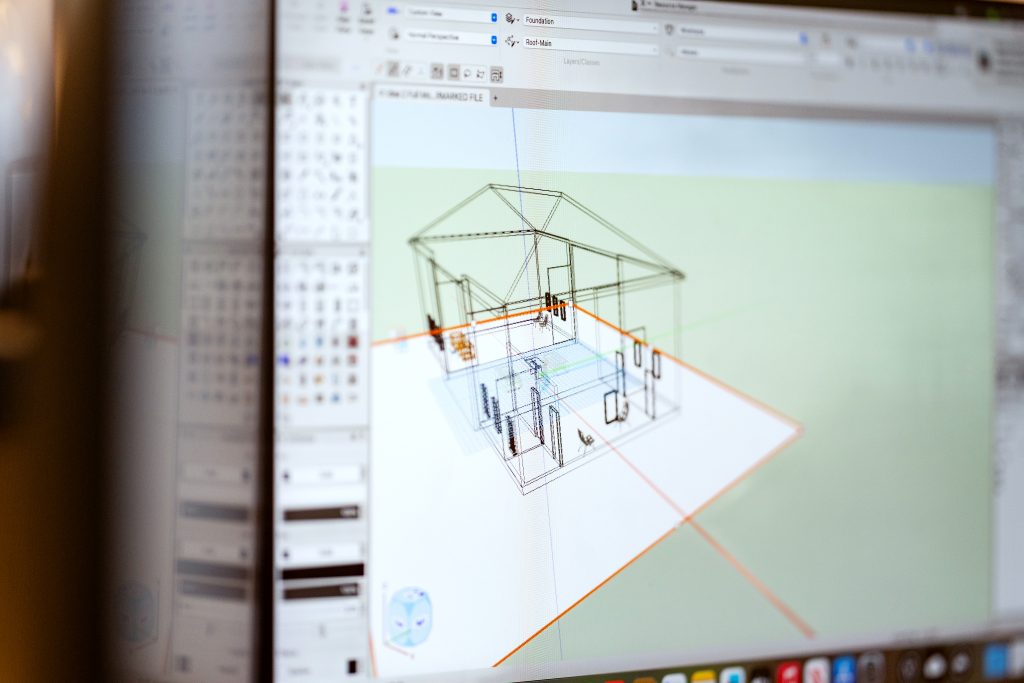
Architectural Imaging is an intensive study of computer-aided design that teaches students how to move through a project from conception to design to presentation. The skills they learn apply to a variety of careers and the creative process in general.
“Taking an idea from a rough concept to a full design has pushed me to think in a new way,” said Iyonsi, who has always been drawn to creative work and visual design. “The course has been a great mix of technical thinking and creativity.”
A design challenge
Offered each fall, the Architectural Imaging course teaches students how to break down a complex design project into a series of processes. The instructor, Jim Thurston, associate professor of performance, theater, and dance, models the course after professional design practices used in architecture and scenography, which involves designing for the stage.
To give students a realistic project that is close to home, he selects a different design challenge each year that relates to Colby or the surrounding area.
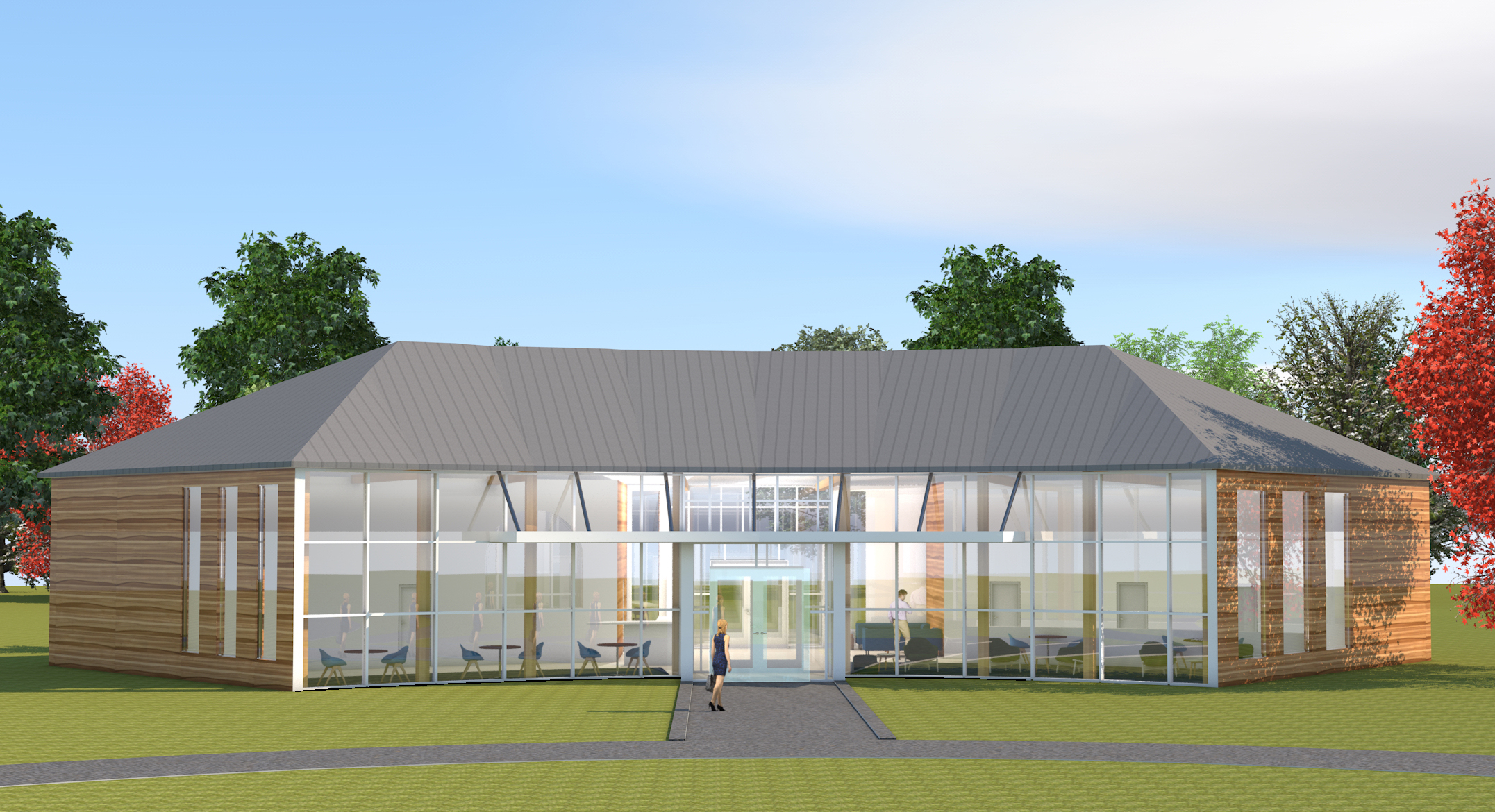
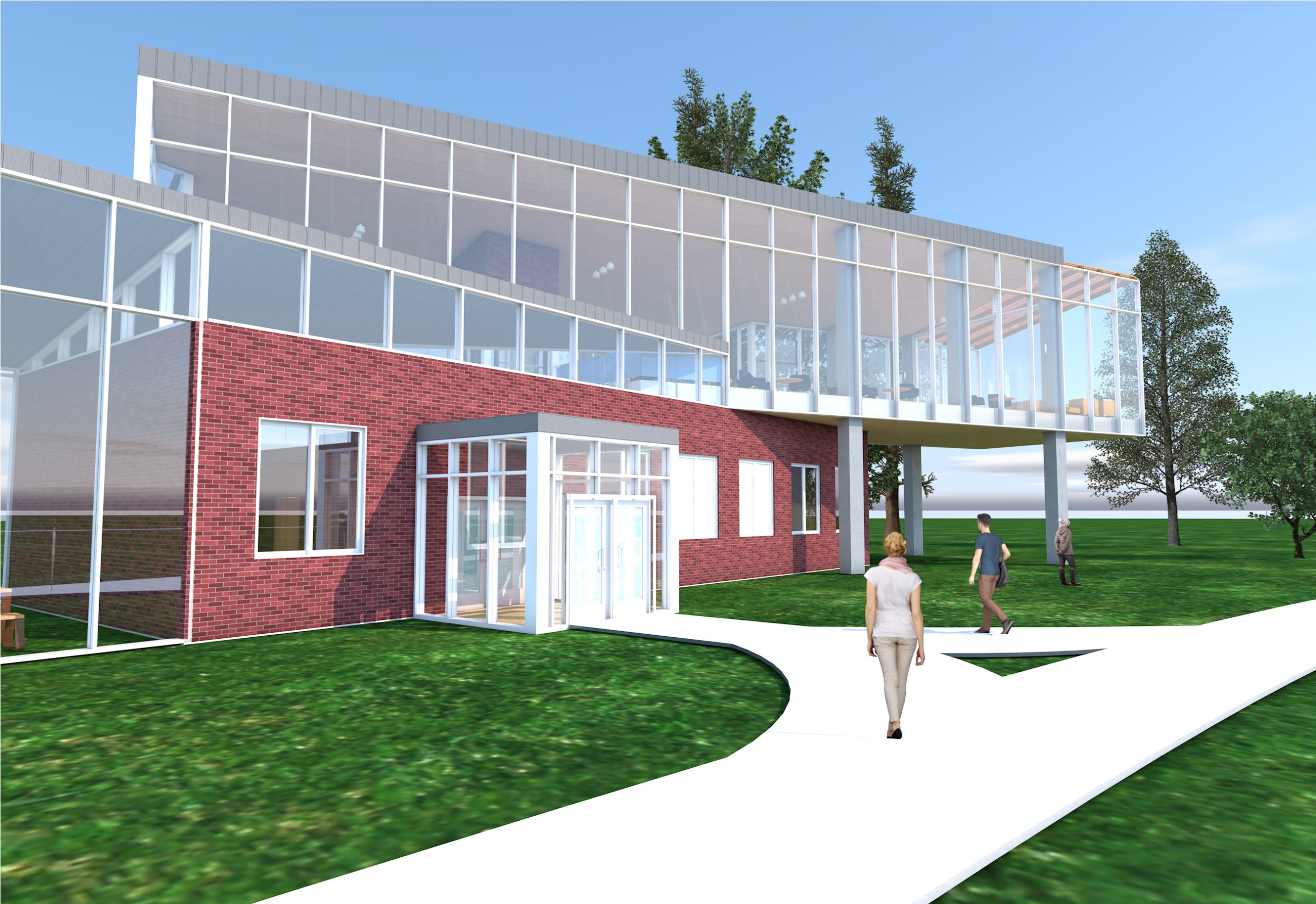

“This particular course has always had architectural projects at the core of it. Something substantial conceptually,” such as this year’s welcome center, said Thurston. “Students take that concept, go through a series of studies and research, employ sketching and drawing, and use the computer to flesh out their ideas.”
Midway through the course, they build a fairly refined 3D model of their final design using Vectorworks, a sophisticated vector-based design and modeling software. During the last week of the course, they present large-scale posters showing their research and design elements along with a fully rendered image of their building, complete with landscaping and atmosphere.
Parameters, then agency
At the beginning of the course, Thurston asked students to consider questions such as how their building would fit into Colby’s landscape, architectural form, and cultural purpose. How might it celebrate learning and create community? How could it highlight Colby’s history while employing a contemporary design?
He also encouraged them to use sustainable design practices and materials and to show respect for the earth when siting their buildings. Locations typically off-limits include those too close to Johnson Pond, on Runnals Hill, or deep in Perkins Arboretum, where land would theoretically need to be cleared.
As a class, students also mutually agreed on design parameters and what their buildings would include, such as a welcome desk, program space, offices, ADA restrooms, or a café. They also determined the square footage for access, egress, and utilities.
Beyond these guidelines, each student-architect was free to realize their own design.

The whole process was eye-opening for Iyonsi, who was surprised by how much problem-solving goes into design. “Every decision affects the structure, the flow, and how people experience the space,” he said. “Working through those layers has made me appreciate architecture a lot more.”
Iyonsi sited his welcome center directly across from Miller Library, a location both practical and symbolic. “It’s anchored at the heart of campus, where sunrise and sunset move across the façade and animate the interior through glass and clerestory light,” he said, referring to light coming from windows above the roofline.
He also used specific materials to bridge Colby’s past and present. Red brick for the center’s wings “grounds the building in the College’s Georgian Revival tradition,” he said. The large transparent windows of the circular core “echo the openness of Colby’s newer contemporary architecture.”
An early fascination with architecture
Thurston began teaching his Architectural Imaging course in 2016, having taught introductory design, stagecraft, and studio art courses. He joined the College in 1988 as an adjunct professor in the still-growing Performing Arts Department, thinking he’d stay for a few years, and then move on to something bigger.
At Colby, “it has been this path of growth all the way through, with new opportunities all along,” said Thurston, who hasn’t gone anywhere, 37 years later. From his office in the Gordon Center for Performing and Creative Arts, a building he helped conceptualize during its design process, he added, “My work here has never been static in any way.”
His fascination with architecture and scenography began in his youth when he accompanied his mother to museums and theater shows in New York City. The bridges, skyscrapers, and structures such as Grand Central Station ignited his imagination. High school courses in engineering drawing, hand drafting, and architecture, coupled with participation in theater productions, propelled him to study theater and art history at Ohio Wesleyan University. After his undergraduate work, he went directly to Northwestern University, where he earned an M.F.A. in scenography.
“I’ve always had a leaning toward architecture, the built environment, and how people organize structures for different purposes,” said Thurston.

Thurston’s background and training made him well-suited to fill a void left when David Simon retired from the Art Department in 2014. For many years, Simon, the Ellerton and Edith Jetté Professor of Art, Emeritus, had been teaching a course on architectural theory. The course included an optional fourth credit through a hands-on project coordinated by Campus Architect Joe Feely. It was also an integral component of the architectural studies program, which Simon is credited with formalizing.
When Feely left the College and Simon retired, Thurston stepped in and began advising students going through the program. Shortly thereafter, Thurston developed his Architectural Imaging course, which has proved pivotal for many students, especially those who are serious about becoming architects or working with architectural firms in some capacity.
Architecture studies at Colby
One of those students is Will Elwood ’26, who, on a whim, took Thurston’s course as a sophomore in 2023. That year’s challenge was to design a physical identity for one of the Colby Labs. Elwood chose the Buck Lab for Climate and Environment.
“My concept was built around a hexagonal beehive structure, given the importance of bees to the environment and their collaborative nature, which the Buck Lab hopes to foster through its programming,” said Elwood. “I ended up naming the building ‘The Hive’ as a nod to this.”
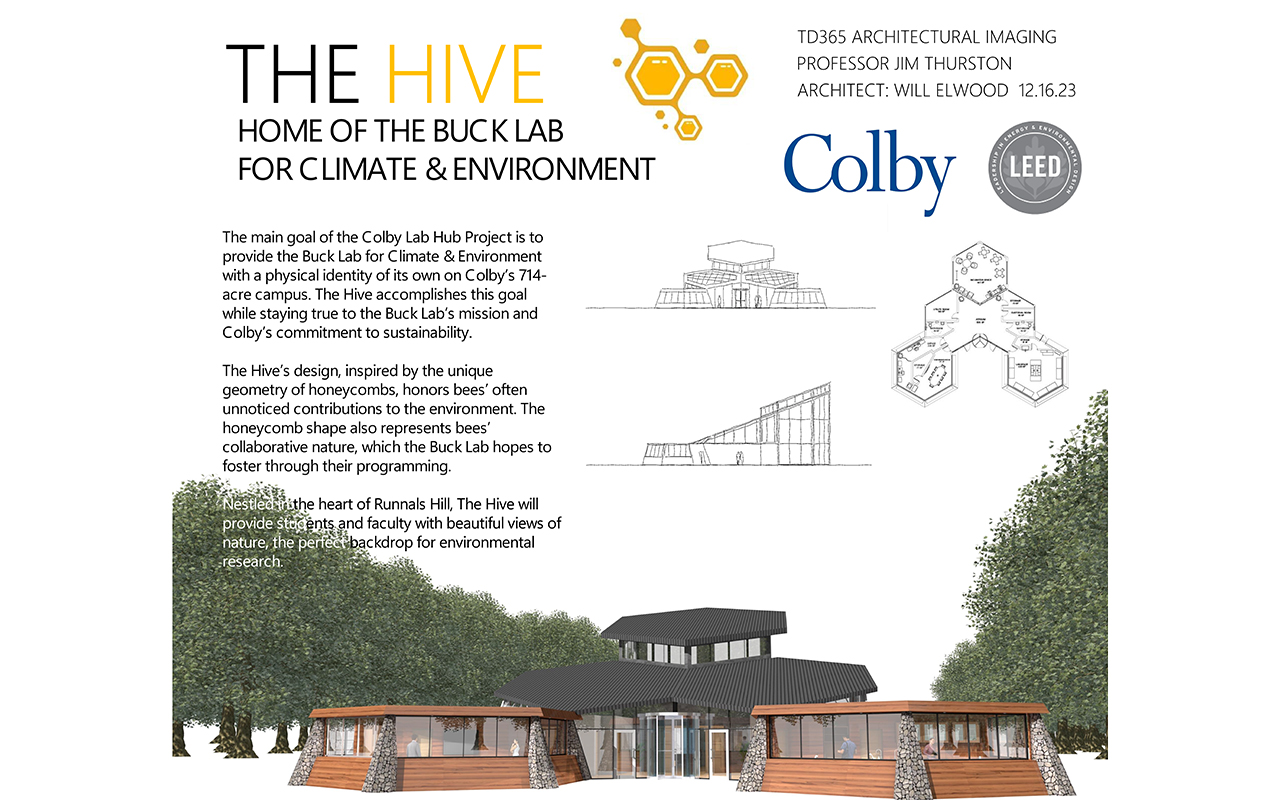
Even though he harbored only a slight interest in architecture when he came to Colby, the course transformed him and solidified what he wanted to do.
This spring, Elwood will join the ranks of Colbians with a degree in architectural studies, an independent major.
While the independent major is one route for students, they can also combine the study of architecture, design, or their relationship to the environment with other majors. The Department of Art oversees the program, and other departments offer relevant courses, including American Studies, Computer Science, English, Environmental Studies, Math, and Performance, Theater, and Dance.
Students rely on an advising guide that identifies course options, pathways for study, and on- and off-campus opportunities to gain foundational skills in the field while exploring the liberal arts.
“What I’ve learned is that design and architecture contain so many other things. You can take inspiration from so many different places,” said Elwood, who found inspiration in an environmental humanities course. As a future architect, he plans to focus on sustainability and design buildings that create a better future.
Architecture in the liberal arts context
When Elwood pursues graduate studies after a gap year, his Colby education will make him competitive, said Thurston. “We have a good track record,” Thurston emphasized. “Students present themselves well and are having success in really good graduate programs.”
Recent graduates are enrolled in programs at Columbia University’s Graduate School of Architecture, Planning, and Preservation; the University of Virginia’s School of Architecture; and Harvard University’s Graduate School of Design, where Ellie Bailey ’24 is in her second year.
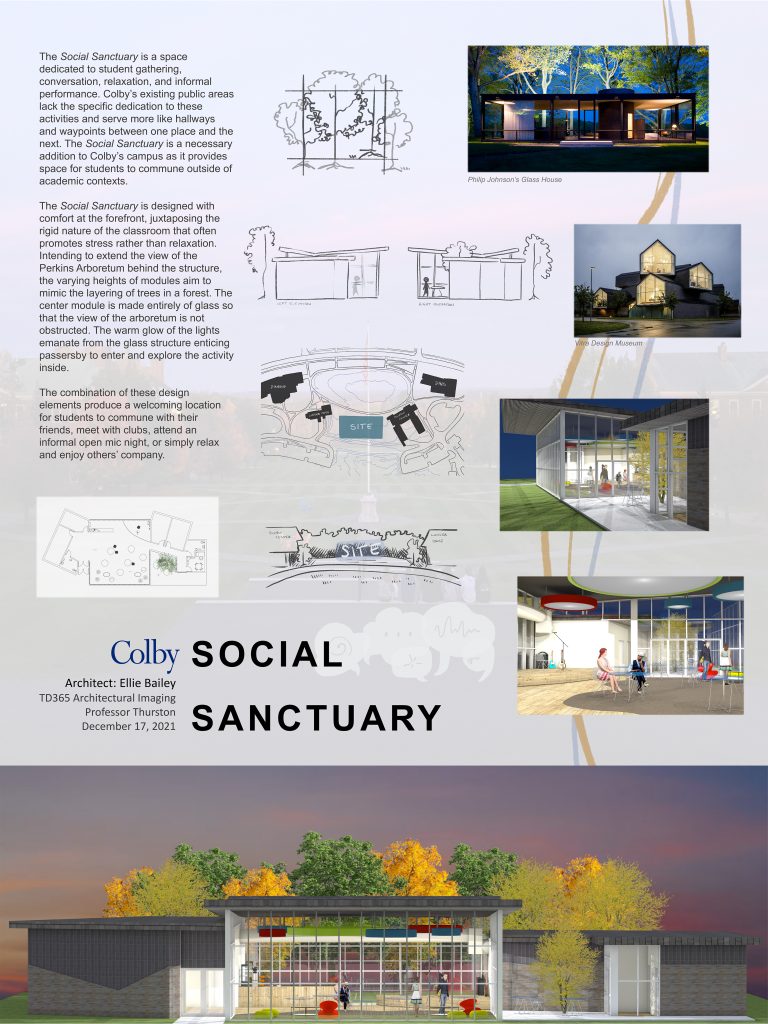
Ellie Bailey’s final poster for the 2021 Architectural Imaging course, showing her Social Sanctuary, “a space dedicated to student gathering, conversation, relaxation, and informal performance,” she wrote. (Courtesy of Jim Thurston)
Bailey came to Colby with interests in math, art, and psychology. She realized during her first Jan Plan in an architectural design course that, in architecture, she could “meaningfully combine my interests in a way that felt both creative and analytical.”
In her sophomore year, she took Thurston’s Architectural Imaging course, which pushed her to pursue architecture seriously, she said. It was also her first introduction to computer-aided design.
“Learning digital tools for drawing and modeling opened up an entirely new side of architectural thinking for me,” said Bailey. “It made the work feel more connected to actual practice and helped me understand how design ideas translate into real, buildable forms.” Bailey hopes to use her skills in the nonprofit sector, where she can “contribute to design work that supports communities and has a meaningful social impact,” she said via email from Harvard.
As a senior, Bailey completed an honors project in architectural studies that integrated her interest in psychology. Thurston served as her mentor on that project, and professors in psychology and American studies were her readers.
Thurston spoke of how he and his colleagues holistically support students like Bailey, who earned her Colby degree in the psychology of architecture.
“We’re always thinking and working within this liberal arts context,” he said. “A student like Ellie just celebrates that.”


